
• 40. Caroline to Luise Gotter in Gotha: Göttingen, 3 April 1784
Göttingen, 3 April [17]84
|77| . . . Your journey to our area would be the easiest thing imaginable [1] . . . and your husband must keep his promise to me to make that journey with you one day. |78| We shall also build him a little hut on the summit of the Brocken with a view of the sunrise [2] . . .
We have a charming house, insofar, that is, as it is externally comfortable and decorated as invitingly as possible, and if I were to put a sign out front, it would doubtless be Temple of Friendship — though I am not really one for posting such things. The double doors will both be opened when you two come. [2a]
And if you get tired of lingering inside, I can also show you lots of pleasant things outside as well. I can not only show you the mines and excavations, but also introduce you in the house of General Superintendent Dahme, whose wife is British and is also my cousin. [3] A family whose English furnishings and English charm have made them the object of everyone’s admiration and the object of curiosity for visitors from elsewhere [4] . . .
You will then also see a great many beautiful areas, as compensation for Switzerland. After all, people call the Harz Mountains “Switzerland in miniature,” and Lichtenberg assures me that at first glance, Clausthal bears the closest resemblance to Bath in England [4a] . . .
Then you will get to know my Böhmer, and I would like so much to hear your approval in person. He is, as I have been told in these exact words, the darling of the Harz Mountains; and what will you think of him if I reveal to you that a certain respectable, corpulent madam, who initially opposed him with the entirety of her corpulence, now finds him irresistible? That certainly opens up for me the opportunity to gain the goodwill of my future fellow citizens, and if heaven so grant, I intend to take advantage of that path as often as possible . . .
I have not yet met Madam Spittler but tomorrow I do intend to thank her and at the same time also take leave of her, for she is about to travel to Swabia for six months, her fatherland, and I will not be seeing her again.
If you already knew this charming woman, you would find it quite natural that at such an idea my eyes |79| well up with tears. For behold! she is the sort of ideal woman I would wish for my brother, and she would certainly fulfill his ideal as well. I have hardly ever seen such a combination of understanding and naiveté, cheerful disposition, inner goodness, and independence, all of which comes to expression in her appearance through the most sublime grace. The most striking elements are her beautiful black eyes and her slender figure.
But now I am merely giving a description, which satisfies neither the narrator nor the listener. Otherwise I also need to tell you a great deal about her husband, who loves her inordinately. He is the most refined, almost overly subtle connoisseur of the human heart, and yet is also philanthropic and full of learning and wit; that should be enough information.
I am so happy that both are quite favorably disposed toward me. She and I understood each other from the very first moment of our acquaintance. She is only two years older than I and was enjoying the same circle of girls which I had just left. [4b] Spittler asked me to come by alone some afternoon before he left so he could read me a lecture on the marital state. But I missed the opportunity and must now enter wholly unprepared into the most tricky of all states. Have I lost much, or is one better served simply with good luck?
He will doubtless come visit me in Clausthal with his wife to get a sense for how things are going. For just between you and me, he is of the same opinion as the wife of Count Lindenhall in Die unversehne Wette, whose role your husband once so cheekily and incautiously let you play. [5] He maintains that every good wife rules her husband in a permissible fashion. I for my part asked that he wholly refrain from speaking about it because wanting to rule in that way makes me feel so small, and he thought that an extremely fine bit of philosophizing.
Several weeks ago I had a déjeuner with Meyer and Fr Böhmer at Therese Heyne’s house, and once we get together, it can admittedly get rather loud. We had a look |80| at Meyer’s portefeuille, a collection of paintings of the best artists he met during his travels. Angelika Kauffmann is also among them.
I recently saw a similar curiosity in the engravings of Lenardo und Blandine by Baron Götz. [6] Is it already available in Gotha? Gotter will find it delightfully refreshing. If only the drawings were not so untrue, occasionally eliciting more a sense of the ridiculous than addressing one’s feelings. But the overall collection is splendid and really is a singular idea.
I have heard a great deal about Baron von Götz from Hofrath Schlözer and Meyer. He is supposedly the greatest genius in both the good and bad sense. A creative imagination radiates from his work of the sort no longer found in all of Europe.
Therese and I, we occasionally have a rendezvous of the spirit, for whenever one of us reads something that is strange or clever or particularly dumb, we immediately send it to the other. She is currently knitting me a pair of socks because I have not been as diligent in such business as Madam Louischen, and an emblem will be added of the camel’s head from Le diable amoureux or Biondetta so that, as I told her, I might recognize her and know what it means when my feet want to dance. We exchanged some extremely witty little billets on this sujet [7] . . .
But do tell me, has a certain trashy book made its way to you yet called Schattenrisse teutscher Frauenzimmer? [8] It is, I must say, utterly beneath criticism, and the author certainly worthy of all conceivable contempt. But for ladies who have exhibited their own, unique merit only in a way quite unknown to others, and who seek to live only within the domestic sphere, it is always extremely aggravating to have such a shallow character expose them to public display in this way, to be praised to the point of satire and then reproached in the crudest possible manner.
A certain Müller, who used to be a family tutor for Captain |81| Schroeder in Lüneburg, is the author, and he did not know any of these ladies any better than one normally knows someone with whom one has dined at a third party’s house. [9] He is now writing for a living in Dresden. It seems to me that even in a larger sense, it is becoming quite fashionable for such people to put private individuals on public display in order to entice our inborn curiosity for everything that is going on around and next door to us in our neighbors’ homes.
Böhmer brought me the book while we were at a social gathering where Madam Meiners was also present; I had to read aloud from it, and we could hardly stop laughing. References to “Apollonian hair” have now become proverbial, and since he did indeed elevate her beauty to the rank of a goddess, you can imagine how things went with the others [10] . . .
Hofrath Heyne, wanting to make a gallant gesture to his wife, put the book on her writing table in his room, and then, eavesdropping, overheard how while leafing through the pages she said very quietly to herself, “le coquin!” [11] . . .
Everyone is afraid for the next installment to appear.
I have [not] spoken to you at all about our Koppe. Although we are losing him, you will be gaining a splendid preacher who also looks like the disciple John. I would not be able to console myself were I staying here. [12] She is a pleasant little woman of impeccable propriety and a most delightfully charming, diminutive countenance. You will be surprised to find that she is just as dainty and petite — take a bow, Madam Louischen — as you.
My dear friend, have you really listened quietly to me the whole time without interrupting? Not a single word of contradiction? Ah, you are sleeping! Well, then, rest peacefully. Let me kiss you quickly one last time and then quietly steal away from you. Adieu; in the door I will yet blow you one more kiss.
Caroline Michaelis
Notes
[1] Though writing from Göttingen, Caroline is here anticipating the Gotters visiting her in Clausthal (Post Karte Durch ganz Deutschland, ed. J. Walch [Augsburg 1795]):

[2] The Brocken, or Blocksberg, the highest peak of the Harz mountain range and also the highest peak in northern Germany, located near Schierke in the German state of Saxony-Anhalt and ca. 20km east of Clausthal, where Caroline would be living (Karte des deutschen Reichs, ed. C. Vogel [Gotha 1907], no. 13):

Goethe used it as the setting for his Walpurgis Night in Faust. Here an illustration of the first inn on the top of the Brocken (ca. 1800) (Hans Hoffmann, Der Harz [Leipzig 1899], 265) and in the nineteenth century (Wilhelm Blumenhagen, Der Harz, Das malerische und romantische Deutschland: In zehn Sektionen 4, 2nd ed. [Leipzig 1847], plate following p. 48):


[2a] Here a young mother nurses an infant, as Caroline later with Auguste, with such double doors in the background (“Kinderstube,” Berlinischer Damen-Kalender auf das Schalt-Jahr 1804):

[3] Georg Christoph Dahme and his wife, a daughter of the influential Wilhelm Philipp Best, the Göttingen library liason in London. Caroline’s future mother-in-law, Henriette Philippine Elisabeth Böhmer, was the daughter of Johann Friedrich Mejer, Geheimer Rath in the German chancery in London and also closely related to the family of Wilhelm Philipp Best, hence Caroline would be related to Madam Dahme by marriage. Concerning the Mejer-Best connection, see Joachim Lampe, Aristokratie, Hofadel und Staatspatriziat in Kurhannover: Die Lebenskreise der höheren Beamten an den kurhannoverschen Zentral- und Hofbehörden (Göttingen 1963), 1:246 and 2:28, 38.
Henry Blackburn remarks in his book The Harz Mountains: A Tour in the Toy Country (London 1873), 133–34, that “in Clausthal we are in a district where the whole business and interest of the population is underground.” Although Caroline spent four years in Clausthal, in her extant letters she refers with startling infrequency to the operations and business of mining and excavations. At the same time, she was around this industry and its representatives daily, lived not far from the mining academy, and was, after all, married to a man whose job description included that of “municipal mining physician.”
In 1781 Erich Christian Heinrich Dannenberg published an in part highly technical descriptive poem in seven cantos with accompanying illustrations on precisely this industry and region, Der Harz: Ein Gedicht in Sieben Gesängen (Göttingen 1781), dedicated coincidentally to
the Right Reverend and Learned Gentleman
Herr Georg Christoph Dahme
General-Superintendent of the Principality Grubenhagen
Special Superintendent and Pastor Primarius in Clausthal
with whom a mere three years later Caroline would regularly socialize and with whom, as mentioned above, she was related through marriage. Even though Caroline nowhere mentions this book in her extant letters, it is difficult to imagine she was not familiar with it.
Click on the image below to open a gallery featuring this book’s and earlier illustrations of various aspects of the mining industry around Clausthal and in the Harz Mountains during this period:

[4] Concerning the “anglicization” in the Dahme household about which Caroline here speaks, see Dahme’s obituary in Friedrich Schlichtegroll, Nekrolog der Teutschen für das neunzehnte Jahrhundert, vol. 2 (Gotha 1803), 222:
In England he had become completely anglicized, and he ever after maintained the appearance and manners of an English bishop. His preference for the good and excellent characteristics of the English nation was limitless, similarly also for the king and queen, and his speech never became more animated than when he spoke about the good royal family and about the noble English nation. English manners reigned in his entire household arrangements as well as in the education of his children [of which he had ten], and his children also had an English governess. Indeed, members of his family almost always spoke English at home. Back.
[4a] Here the Clausthal and the Harz Mountain Range in relation to Göttingen (Rudolf Koch and Fritz Kredel, Deutschland und angrenzende Gebiete [Leipzig 1937]):

Here scenes of the often dramatic Harz Mountains landscape, a landscape, incidentally, which Caroline rarely mentions or describes with any element of romantic enthusiasm (Wilhelm Blumenhagen, Der Harz, Das malerische und romantische Deutschland 4, 2nd ed. [Leipzig 1847], plates following p. 52, 90, 102, 246; Friedrich Jügel, H. Hinze, Der Ilsenstein im Harz [ca. 1776–1833]; Herzog August Bibliothek; Museums./Signatur Top. App. 2:106.1):


It may be noted that Caroline, living in Jena but visiting Dresden, later also visited what is known as Saxon Switzerland.
Otherwise perhaps a reference to Bath’s geographical and topographical setting (Bath, anonymous nineteenth-century engraving; lithography of Clausthal by Eduard Pietzsch [1841]; second illustration of Clausthal from August Ey, Harzbuch: oder, Der geleitsmann durch den Harz, 2nd ed. (Goslar 1855), plate following p. 170):


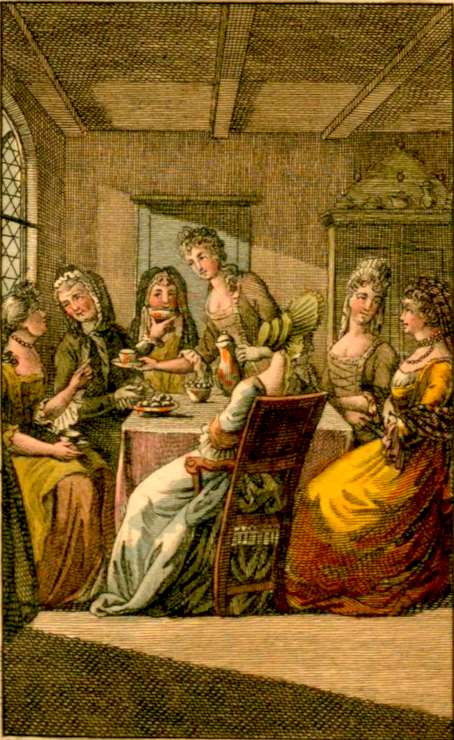
[4b] Illustration: Der Freund des schönen Geschlechts: ein angenehm und nützlicher Taschenkalender für das Jahr 1808:
[5] Die unversehene Wette. Lustspiel (published in volume 6 of Johann Gottfried Dyk’s Komisches Theater der Franzosen: Für die Deutschen [Leipzig 1781]), 229–308, a comedy written by Friedrich Wilhelm Gotter in 1780 for the new amateur theater in Gotha (the court theater having folded), after Michel-Jean Sedaine, La gageure imprévue. Comédie en prose et en un acte (Paris 1768).
The play seems to have premiered in September 1780, with Gotter’s young wife, Luise herself, the recipient of this letter, in the leading role of vivacious Countess Lindenhall, who gets the best of her spouse (Rudolf Schlösser, Friedrich Wilhelm Gotter, 252):
by closing up a harmless visitor in her room and then betting her spouse, who has arrived home, that he cannot name all the parts of a door lock. He manages to name them all except the key, which he calls for only after his wife tells him her lover is sitting behind the locked door. Hence the wife wins the bet, and the play (which, of course, also includes a secondary plot involving a marriage story), concludes to the merriment of all.
Here a photograph of the cast for a performance of the play in 1892 in Paris (publicity illustration of the cast for Michel Jean Sedaine, La gageure imprévue: comédie en 1 acte as performed in Paris at the Comédie-Française on 27 March 1892; Bibliothèque nationale de France, département Arts du spectacle):

[6] Joseph Franz von Götz, Lenardo und Blandine. Ein Melodrama nach Bürger in 160 leidenschaftlichen Entwürfen erfunden und auf Kupfer gezeichnet (Augsburg 1783), a dramatization of Gottfried August Bürger’s poem Lenardo und Blandine, first published in Bürger’s Gedichte (Göttingen 1778), 209–29, also in a monodrama (musical score by P. Winter; see below) providing a framework for discerning the external signs of human emotions; the engravings portray discrete moments in the ballade expressing specific emotions, often over several successive frames after the fashion of comic-book panels:


Here the illustrations on display for perusal by the public; the original size of the illustrations is clear. From Lenardo und Blandine. Ein Melodrama nach Bürger in 160 leidenschaftlichen Entwürfen erfunden und auf Kupfer gezeichnet, published in Versuch Einer Zalreichen Folge Leidenschaftlicher Entwürfe: Für Empfindsame Kunst- Und Schauspiel-Freunde (Augsburg n.d. [1783]), 212:

Concerning the melodrama Götz also composed based on the same poem, see Erich Ebstein, “Bürgers Gedichte in der Musik,” Zeitschrift für Bücherfreunde 7 (1903/1904) no. 5 (August 1903), 177–98, here 197:
Lenardo und Blandine. In 1779, Joseph Franz von Götz composed a melodrama based on Bürger’s poem, for which Peter von Winter [1755–1825] composed the music. The poem was apparently presented in this adaptation in Göttingen in November 1790. A certain Göttingen professor’s [ed. note: unidentified] daughter provides the following account [ed. note: August Nebe, “Aus Bürgers Leben. Nach einem ungedruckten Briefwechsel,” Unterhaltungsbeilage zur Täglichen Rundschau (1902) 27 (1 February 1902), 106–7, here 106]: “Last Thursday, I along with many others as well was quite poorly edified in a concert. The music was mediocre and the declamation of Bürger’s delightful poem Lenardo und Blandine was recited so terribly and indeed ridiculously that the man was almost whistled off stage. The students maintain that it was only out of consideration for the ladies and professors that they did not outright cast him down the stairs . . . ” Back.
[7] Friedrich Ludwig Wilhelm Meyer translated Jacques Cazotte’s novella Le diable amoureux (Naples 1772) into German as Teufel Amor in Heinrich August Ottokar Reichard’s Bibliothek der Romane, 21 vols. (1778–94), Bände III–V (Berlin 1779–80; 2nd ed. Riga, Leipzig 1785), and in a revised book edition as Biondetta (the name of the transformed devil) with the same publisher (Himburg) in Hamburg in 1780. Here the front and back illustrations to that edition:


A later edition of the material appeared as the play (or singspiel) Biondetta: Ein allegorisches Schauspiel mit Gesang in vier Aufzügen, by Karl Christian Engel (Berlin 1792), which Schmidt (1913), 1:680, seems to conflate with Meyer’s book edition of 1780. In any event, illustrations of the camel’s head appear in the French original (after page 138) and as the title vignette in Engel’s 1792 edition, but not in Meyer’s 1780 book edition ([1] frontispiece to Bibliothek der Romane, vol. 3 [Berlin 1779]; [2 and 3] the two appearances from Cazotte’s edition, following pages 14, where it is invoked as Beelzebub, and 138):


Concerning the other illustrations of a camel, invoked as Beelzebub, in the editions of Cazotte and Engel, see Caroline’s letter to Meyer on 16 October 1792 (letter 117) with note 9. In his Spiele des Witzes und der Phantasie (Berlin 1793), 21, Meyer also has a poem “Biondettas Übersezer an seine schöne Leserinn.” Back.
[8] “Silhouettes of German Ladies.” After the model of Christian Heinrich Wolke (according to Therese Huber Briefe, 1:537n459–65 [Christian Gottlob Heyne is effusively praised in vol. 1, 86–100]; by contrast, Erich Schmidt [1913], 1:680, mentions a certain “Lose” as the presumed author, a name mentioned in a later review), Schattenrisse edler Teutscher. Aus dem Tagebuche eines physiognomischen Reisenden, 3 vols. (Halle 1783–84), an anonymous author published the sullied Schattenrisse edler teutscher Frauenzimmer oder offenherzige und unparteyische Nachrichten von jetztlebenden — berühmten — schönen und biedern Damen. Aufgesetzt von einem ihrer Verehrer und Freunde, no. 1 (Halle 1784); 2 (Halle 1785); although the initial slim volume was not really gossipy, it was according to Erich Schmidt nonetheless tasteless, tactless, and replete with repugnant clichés (e.g., “H** on 12 December 1783. Count von A***”).
See the review of later volumes of both titles in the Allgemeine Literatur-Zeitung (1786) 285 (Wednesday, 29 November 1786) 416:
Halle, bey Hendel: Schattenrisse edler Deutschen — Aus dem Tagebuche eines physiognomischen Reisenden. Volume 3, with 11 silhouettes. 1784. 320 pages. 8vo. (20 gr.).
Halle, bey Hendel: Schattenrisse edler deutscher Frauenzimmer; oder unparteyische Nachrichten von schönen und edlen Damen. Volume 2, with 7 engravings. 1785. 340 pages. 8vo. (20 gr.).
What more should one say about these nuggets except that, unfortunately, “Here they are”? Whoever has not yet been scared away by the saccharine, sometimes laudatory, sometimes unseemly, bloodless, impotent twaddle of the earlier volumes and installments may feel free to read what cannot but either embarrass or enrage the majority of the largely quite respectable persons who are affected.
The book to which Caroline is referring (Schattenrisse edler teutscher Frauenzimmer oder offenherzige und unparteyische Nachrichten) includes “Ladies from Lower Saxony”: aristocratic ladies as well as, apart from the poetess-governess Demoiselle Rudolphi, the wife of Edukationsrath Joachim Heinrich Campe, and also Philippine Engelhard-Gatterer, who, to be sure, was not generally considered to be particularly comely, then also wives of Göttingen professors.
Concerning Madam Meiners, wife of the prolific philosopher and historian Christoph Meiners, we read that her beautiful features include “Apollonian hair”; “the way she looks — indeed, it is with precisely these features that I would paint Minerva (the goddess of wisdom)” (see below for the entire excerpt). The praise accorded to Madam Heyne is cast wholly in the superlative: her slender figure, “extremely beautiful facial features . . . fine eyes, attractive hair, and an extremely delicate rose complexion lend her an element of infinite grace.”
The Deutsches Anonymen-Lexikon 1501–1850, ed. M. Holzmann and H. Bohatta, vol. 4 S–Z (Weimar 1907) 28, no. 854 (see also 853) refers along with Hugo Hayn, Bibliotheca Germanorum Erotica. Verzeichnis der gesammten deutschen erotischen Literatur mit Einschluss der Uebersetzungen nebst Angabe der fremden Originale, 2nd ed. (Leipzig 1885) 277, to Adam Friedrich Geisler as the author, a reference that does, however, derive from a mistake, since Geisler similarly commenced his Gallerie edler deutscher Frauenzimmer mit getroffenen Schattenrissen in 1784–86 (Dessau, Leipzig), concerning which see Hayn, Bibliotheca Germanorum Erotica 277 (who dates the book 1785):
See in this regard the following spicy anecdote in the novel [by “Haudart”] Jochen von Bopfingen, oder Leben eines armen Teufels (Frankfurt, Leipzig 1789), 139: “The task of describing the bosom mathematically is best left to a certain Adam Friedrich Geissler [(1757–1800), a historian and writer] in Leipzig, who, thanks to his considerable diligence, has already physiognomically dissected many a bosom of queens and herb sellers and incorporated those complete autopsy reports of such into his Gallerie der edlen deutschen Frauenzimmer in a most dishonorable fashion.”
Here a sampling of Geissler’s admittedly peculiar Gallerie edler Deutscher Frauenzimmer (Dessau, Leipzig 1785–86), no. 1, vol. 1, 99 (Philippine Engelhard, née Gatterer:), no. 2, vol. 1 , 232, 273–74 (Louise Henriette Wilhelmine, Princess of Anhalt-Dessau; Elisabeth Wilhelmine Louise, Princess of Württemberg-Stuttgart); and no. 4, vol. 2, 345–46 (Betty Georgine Sophie Isenbart), with the accompanying silhouettes and in order of — basically — increasingly rhapsodic enthusiasm:
Philippine Engelhard, née Gatterer:

“Her bosom is symmetrically rounded.”
Louise Henriette Wilhelmine, Princess of Anhalt-Dessau:

“Her delicately white bosom is formed with a considerable upward lift toward the front and is handsomely and magnificently vaulted with a maternal swell.”
Elisabeth Wilhelmine Louise, Princess of Württemberg-Stuttgart:

And — her bosom — ah! under which a heart dwells for whose sake Elisabeth is so pervasively loved, honored, indeed worshiped. — One look at this bosom and one beholds how this noble heart lifts it, not such that it distends out with vehement passion, no, but rather such that it swells, gently, flowing forth seeking innocent love, like the unclouded silver spring that causes but quiet, modest waves, silently, across clear pebbles. Beautiful and full — utterly unlike that particular torturous current fashion or pushed up by coercive short-stays — it is instead quite properly rounded, without artifice, charmingly handsome just the way Nature herself fashioned it — delicate and white.
Betty Georgine Sophie Isenbart:

Her bosom — there it stands in perfect fullness like a quiet, peaceful lake, its waves disturbed by no storms or passion, enveloped in the purest veil of innocence that even the greatest rogue would not dare remove unless he be utterly void of conscience. Only the man of pure heart and pure manners is allowed to observe, from a distance and through the consecrated veil of innocence, this feminine sanctum, observe how the stirrings of the excellent heart of its inhabitant develop upon it to their higher calling. Her skin is soft, delicate, and swan white, and every muscle, everything in proper fullness, true elasticity: the entire corporeal system one of true harmony, her countenance mirroring the handsome accord of her good soul and magnificent heart, the entire figure one of pleasing proportion — in a word: he entire being and every part reflects perfect symmetry and harmonious beauty. Back.
[9] Caroline’s “a certain Müller” could perhaps be Johann Georg Heinrich Müller (1759–1819), who later taught in Altdorf and who also published Schattenrisse der jetzt lebenden Altdorfischen Professoren, nebst einer kurzen Nachricht von ihrem Leben und Schriften (Altdorf 1790) (personal communication to Erich Schmidt from Reinhard Buchwald). A “Captain Schröder” with the 7th Electoral-Hannoverian Mounted Dragoon Regiment in Bruchhausen (in lower Saxony, 30km south of Bremen, west of Lüneburg) is mentioned by, of all people, Adam Friedrich Geisler (see previous note) in the non-paginated index of pre-publication subscribers of his Leben und Karakter Leopolds, Herzogs zu Braunschweig-Lüneburg. Ein Beitrag zum vollkommensten Gemälde der Menschheit im 18ten Jahrhundert (Leipzig 1786) (Maximilian Julius Leopold von Braunschweig-Wolfenbüttel, Prince of Braunschweig-Wolfenbüttel and nominally Duke of Braunschweig and Lüneburg [1752–85], who drowned during the flooding of the Oder River in 1785). Back.
[10] See Schattenrisse edler teutscher Frauenzimmer oder offenherzige und unparteyische Nachrichten, 301–3 (silhouette of Friederike Meiners from Erika Wagner and Ulrich Joost, Göttinger Profile zwischen Aufklärung und Romantik [Neustadt: Dosse 2011], 74; by permission):

Madame Meiners is in every respect an extraordinarily beautiful person. — Her figure is proportionately comely and pleasing, though at once also sturdy, healthy, and strong, on the whole quite representative of the body of a handsome German woman whom beauty and strength themselves seem to have fashioned. She is of majestic height and carries herself in a completely noble fashion, such that her seemly and proper demeanor seems not in the least forced or affected, — and is characterized instead by a certain guiding hand of art that nature here and there merely adjusts and ennobles. —
Just as little is any element of affectation to be found in her overall personality, for her comportment is straightforward and good, just as should be that of any pure, irreproachable person. — Her arms and legs are all formed quite proportionately and handsomely, — to a one soft, supple, and full — And her hands delicate, her feet utterly dainty quite according to our concept of beauty. . . .
This lady is similarly quite beautiful with respect to the formation of her face. Her entire facial structure exhibits regularity, refinement, and attests considerable understanding and intelligence. Moderately filled-out, sublime facial muscles, — a comely, refined, white-tinted facial coloring to which nature herself has added a pleasing, pale blush, — pleasing, handsomely slit, expressive blue eyes — and Apollonian hair: all these features in concert are of considerable advantage to this diminutive countenance. The way she looks — indeed, it is with precisely these features that I would paint Minerva (the goddess of wisdom). Back.
[11] Fr., “naughty rascal, rogue.”
It is difficult to determine just which remarks prompted this reaction from Madame Heyne, since the entry is largely one of unmitigated praise from her countless good qualities. An arguably unflattering and presumptuous passage, however, is indeed found almost at the end of the entry (Schattenrisse edler deutscher Frauenzimmer; oder offenherzig und unparteyische Nachrichten von letztlebenden – berhühmten schönen und biedern Damen, no. 1 [Halle 1784], 224–25; silhouette from Erika Wagner and Ulrich Joost, Göttinger Profile zwischen Aufklärung und Romantik [Neustadt: Dosse 2011], 40; by permission):

I must say, however, that this dear lady’s feelings and emotions are quite touchy and excitable, for she has often convulsed her own nerves and rendered them extremely irritable — which by nature are already quite sensitively tuned in any case — by her prodigious reading of novels and other emotional writings by the authors of various nations, through her attendance at plays, and by the excessively sentimentalist tone of conversation that is similarly so very fashionable here in Hannover as well.
Here vignette by Daniel Nikolaus Chodowiecki illustrating the deleterious effects of such reading material on a young woman reading Goethe’s Die Leiden des jungen Werthers (Leipzig 1774) (Herzog Anton Ulrich-Museum; Museums./Signatur DChodowiecki AB 3.814):

The author continues:
And yet she is far removed from such typical honey-sweet sentimental gushing. This grand refinement of feeling and emotion is a valuable possession, for subtle and correct emotion must always extend its hand to the faculty of understanding over the course of a person’s life, allowing that person to proceed in all the more salutary a fashion.
Such subtlety of emotion and feeling, however, in the midst of ubiquitous sentimental excess, can also be dangerous for a woman who is one day to become a mother, and who must thus anticipate being subject to considerable suffering and bouts of cramping and such. For then the woman suffers doubly and under infinitely more pain than if her affective nervous system has not yet been rendered quite so refined, subtle, vulnerable, and sensitive. For such a condition can give rise to illnesses that both accompany and shorten one’s life. Back.
[12] Concerning Koppe’s departure and references to his farewell sermon, see the second paragraph in Caroline’s letter to Lotte Michaelis on 13 September 1784 (letter 48), also with note 3 there. Back.
Translation © 2011 Doug Stott