
• 34. Caroline to Luise Gotter in Gotha: Göttingen, 23 October 1782 [*]
Göttingen, 23 Oct[ober] 1782
|66| So, do I have to tell my dear, kind Louise yet a second time that it is impossible for me to accept her invitation? Should I also tell her, however, how painful it is for me, what it has cost me, and how gladly, indeed, with what indescribable joy I would have accepted had I been able?
Ah, but you know only too well that the fulfillment of one of my most ardent wishes was to see you again. The same heart that has hitherto dwelled in my breast, full of friendship for you and full of affection for the place where you are, would no longer have been able to continue beating, and I would no longer have been able to be myself were I to forgo this trip for any other reason than that I must. [1]
Hence do at least feel sorry for me privately for that reason, dear Louise, but out of sympathy say nothing to me of it, for I am already feeling so sorry for myself that I am often tempted to stand in front of the mirror and tell myself: “Do not overly grieve, dear Caroline.”
And so must I give Louise Schlaeger this letter to deliver to you instead of bringing it myself? All my complaints and wishes are in vain. Everyone has raised so many objections to the journey and is so dismissive of my responses as being partisan that I can only fall silent and wait for better times. O, Future! return |67| those wonderful holidays to me if only for a short while.
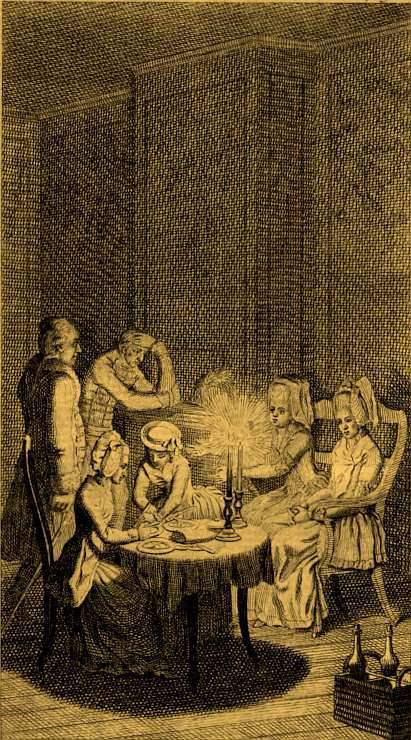
Do you believe the ones I miss will ever return? Alas, not those, not the ones when in half-childish merriment we prepared dinner for ourselves, and you were once so excited about having successfully prepared a damson-plum dish. [2] That memory returned quite vividly to me today when I was preparing precisely the same dish with Mlle. Böhmer.
But none of this will ever be again. And yet it is the best part of life itself; for every person perceives it thus, though rarely at the very moment of enjoyment — and yet I myself did so at that time! I have tasted all the joys of a happy consciousness. And though excellent days and wonderful, diverse scenes of happiness yet await me, those first ones remain as inextinguishable as do the bonds of friendship that grew out of them and out of which they in their own turn grew.
Our dear Meiners and Lesses have returned; [3] I waited impatiently for the latter. I wanted to relate to her in person everything that has happened in the meantime; her approval was to be the seal of my happiness, and I now have it completely. [4]
I confess with tears of joy, my beloved Louise, that I am completely happy. How fortunate for me that I am finally in a safe harbor! The journey was indeed dangerous. Imprudence led me down false paths, passions tossed me to and fro, I could have gone under, but the hand of providence kept me up and only let me experience all the unpleasantness of that path that I might be worthy of its happy goal. And now I give thanks to God for having prepared it for me. I call upon you to rejoice along with me. . . .
Please kiss your wonderful, dear husband’s robe hem and lips in my name for having been willing to put up with me at his house to please you.
Your C.M.
Notes
[*] Brigitte Rossbeck, Zum Trotz glücklich: Caroline Schlegel-Schelling und die romantische Lebenskunst (Munich 2008), 43, interprets this and the preceding letter (albeit without adducing either directly) as evidence that Caroline had become engaged to Franz Wilhelm Böhmer in October 1782, the event to which Caroline is likely alluding in her reference to “everything that has happened in the meantime.” Caroline may also be referring to this event in her letter to Luise Gotter on 5 October 1782 (letter 33); see the editorial note there. Back.
[1] In 1789 Daniel Nikolaus Chodowiecki did a series of twelve illustrations depicting “good human characteristics” that included “love” and “concord”; significantly, the persons portrayed are all women, reflecting the sensibility of sentimentalism at the time and a more expansive understanding of loving and caring relationships and friendship between not just women and men, but also women and women. Much of what Caroline says in this letter and the effusive style she uses to express her fondness for Luise Gotter similarly reflect this sensibility (Gute menschliche Eigenschaften [1789]; Herzog Anton Ulrich-Museum; Museums./Signatur DChodowiecki AB 3.804):

Here Chodowiecki’s corresponding illustrations for men from 1793, both with the title “friendship” (Die Freundschaft [1793]; Herzog Anton Ulrich-Museum; Museums./Signatur DChodowiecki AB 3.968):

See also esp. Friedrich Schlegel’s letter to Wilhelm Schlegel on 5 December 1791 (letter 100a), note 2. Back.
[2] Frontispiece to Johann Jacob Nathanael, Lebenslauf meiner Tochter Therese von Silberbach: Teutschlands edelsten Töchtern gewidmet (Berlin 1782):
[3] Göttingen professors Christoph Meiners and his wife, Luise Friederike, and Gottfried Less and his wife, Wilhelmine. Back.
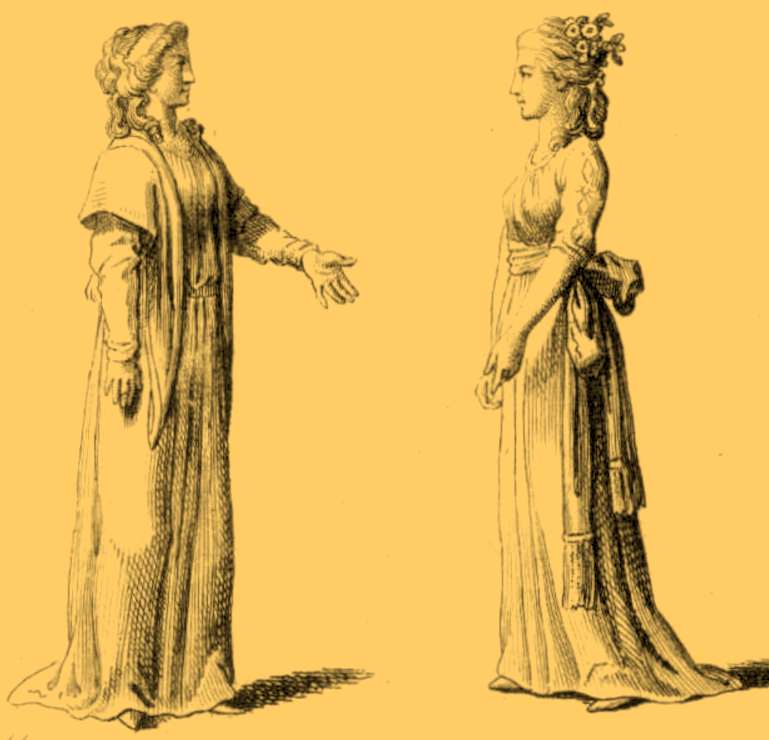
[4] Frauenzimmer-Almanach zum Nuzen und Vergnügen 1785 (Inhaltsverzeichnis deutscher Almanache, Theodor Springmann Stiftung):
Translation © 2011 Doug Stott