• Portraits of Caroline and Auguste
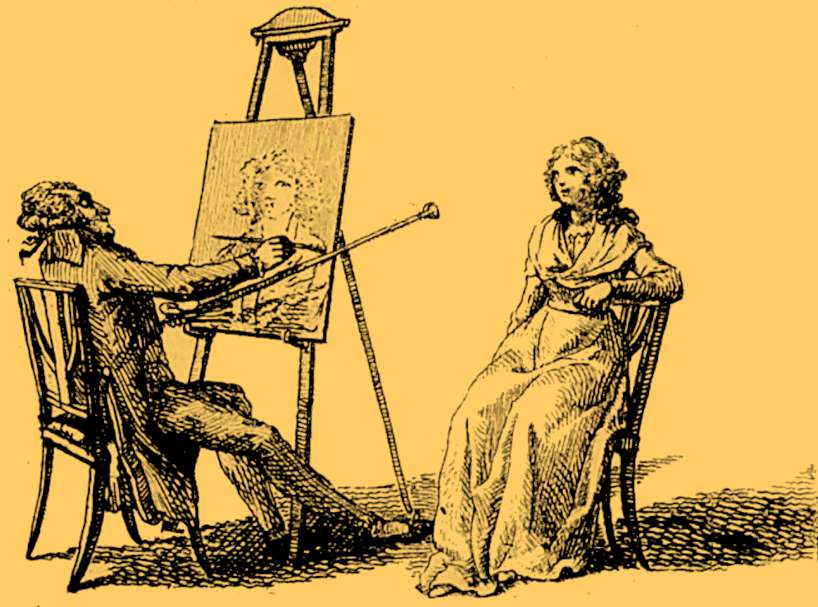
Portraits and silhouettes of Caroline and Auguste. — Johann Friedrich August Tischbein’s portraits of Caroline and Auguste were rendered quite differently in the first edition of her letters and elsewhere. Includes illustrations of persons whom Caroline and Auguste allegedly resembled.
A series of chronological galleries also featuring some of the personalities in Caroline’s life.
Topical Galleries

Historical and contemporary images and maps relating to Caroline’s time in Marburg (1789–91), with special attention given her residence in the older part of town.
Caroline spent one of the most difficult periods of her life in the tiny village of Lucka just south of Leipzig. Although older historical illustrations of Lucka are rare, a combination of historical maps and contemporary photographs provides vivid imagery not only of the town itself, but also of the site of the house where Caroline brought her difficult pregnancy to term; the precise path to the mill in the neighboring village to which she took a walk on 10 October 1793 (the mill complex still stands today); and the cemetery where her son, whom she had to leave behind in late January 1794 in foster care and whom she never saw again, is likely buried.
• Caroline and Auguste’s carriage adventure on their way from Gotha to Braunschweig in April 1795
• Caroline at Salzdahlum Castle
In the spring of 1795, after failing to find social acceptability in Gotha after her escapades in Mainz and difficult period in Lucka, Caroline moved to Braunschweig to live with her mother and sister Luise. In June of 1795, Caroline, Auguste, and Philipp Michaelis visited the grounds and art gallery of Salzdahlum Castle; Caroline visited it again in the autumn of 1795 with Wilhelm Schlegel. The castle was the summer residence that Duke Anton Ulrich von Braunschweig-Wolfenbüttel (1633–1713) built between 1688 and 1694 between Braunschweig and Wolfenbüttel. Caroline just managed to see this complex, its artworks and gardens, before it essentially fell into disrepair and was abandoned by 1813.
Caroline and Wilhelm Schlegel married on 1 July 1796 in Braunschweig and arrived in Jena a week later, remaining there until Caroline left with Schelling in May 1803 and Wilhelm was already living in Berlin. Between those two dates, both played a central role of the emergence, florescence, and demise of what later became known as the early German — or Jena — Romantics. This gallery reflects some of the more practical (e.g., housing) and social (e.g., theater visits) sides that provided the backdrop to their lives in Jena.
• Auguste’s visit to Dieskau Chateau en route from Jena to Dessau in September 1799 to stay with the family of the painter Johann Friedrich August Tischbein (letter 244).
• Auguste’s Confirmation and Catechism Anxiety during the winter 1799–1800 (letter 254).
During the winter of 1799 and 1800, Auguste, together with childhood friend and artist Louise Seidler, took confirmation and catechism instruction from the venerable Jena pastor Christian Oemler. Although Auguste was already reading the likes of Herodotus in Greek and living at the center of the intellectually rather formidable circle of early German Romantics, she could write to a friend only that “I am now also to be confirmed at Easter, and you cannot imagine how much I fear it!” This gallery takes a peak at the potentially grim instructional materials the two girls were facing.
Historical images and maps of Bamberg revisiting some of the locales Caroline and especially Auguste visited during the spring and summer of 1800.
Historical and contemporary images and maps of Bocklet, where Auguste died on 12 July 1800 and is buried.
Caroline, Wilhelm Schlegel, and Schelling paid an official visit to the Bamberg General Hospital on 4 August 1800, signing the guest register and touring the facility presumably in the company of one or both head physicians, Adalbert Friedrich Marcus and Andreas Röschlaub. Caroline, of course, whom Röschlaub had been treating earlier, had in the meantime lost Auguste in Bocklet (12 July 1800), Wilhelm had arrived from Jena, and Schelling was becoming increasingly interested in the interface between medicine and his philosophy of nature.
• Caroline at Söder Chateau October 1800
In October 1800, Caroline, Wilhelm Schlegel, and Christian Rudolph Wilhelm Wiedemann spent several days at the secluded estate of Friedrich Moritz von Brabeck near Hildesheim, where Brabeck had assembled an art collection that attracted visitors from all over Europe. Caroline, in depressed spirits after having just lost Auguste in July 1800, nonetheless provides an animated account of her stay at what she called Brabeck’s “fairy-tale castle” and intriguing descriptions of numerous pieces of art.
• Caroline’s journey through the Lüneburg Heath to visit her brother Philipp Michaelis in Harburg (1 April 1801) (letter 304).
Just short of three years after Auguste’s death in July 1800, Caroline and Schelling moved to Würzburg from Jena after being married in Murrhardt by Schelling’s father in June 1803 and having traveled to Munich to confirm Schelling’s position in Würzburg and then back to Murrhardt. They arrived in Würzburg in early November 1803. Although Caroline had never enjoyed such comfortable and well-appointed accommodations, personal feuds with other professors’ spouses from Jena and elsehwere who had similarly moved to Würzburg quickly developed for Caroline, and professional feuds with adversaries at the university and elsewhere for Schelling. That notwithstanding, they took advantage of life in Würzburg quite apart from the academic sphere proper. This gallery offers a glimpse into those activities.
In 1806, after three turbulent and not entirely pleasant years in Würzburg, geopolitical developments provided the occasion for Caroline and Schelling to move to Munich, where Caroline would spend the rest of her life. Although Caroline remarks that she lived a rather quiet life, the Schellings did indeed enjoy considerable social contacts in Munich and took advantage of the town’s rich cultural offerings. This gallery similarly offers a glimpse into the Schellings’ activities in this new royal residence.
Auguste
Various drafts of the memorial planned for Auguste, its later rendering by the Danish sculptor Bertel Thorvaldsen, and Thorvaldsen’s reworking of Auguste’s bust by Friedrich Tieck at Schelling’s behest.
• Auguste’s Bust by Friedrich Tieck
Photographs of one of at least two, and possibly three surviving original busts Friedrich Tieck did of Auguste Böhmer on commission from Caroline and Wilhelm Schlegel in 1804 (one other is in Coppet, at the estate of Madame de Staël; another from the estate of Luise Wiedemann seems to have been lost). Letters suggest that this particular bust seems to have been the bust Caroline herself had in her apartments in Würzburg and Munich.
• Reproduction of Auguste’s Bust
A photographic account of the reproduction of Friedrich Tieck’s 1804 bust of Auguste Böhmer undertaken by the Thorvaldsen Museum in 2011 at the initiative of the translator.
• Auguste’s Niche in Bad Bocklet
The location of Auguste’s grave site in Bocklet (modern Bad Bocklet) was lost quite early. The markers indicating her presence are now set up in a niche at one of the entrances to the cemetery in Bad Bocklet.
Miscellaneous
• Copper Plate Illustrations and Etchings
Copper-plate illustrations and etchings were arguably the most popular and widespread print illustrations during Caroline’s lifetime and are found throughout this project. This gallery presents a brief look at the production apparatus, tools, preparation, and workshops associated with this form of illustration.
• Musical Instruction in Caroline’s Milieu
Caroline and others speak frequently about musical instruction and the attendant family and even public entertainment anticipated by and associated with it. Auguste herself received instruction in both singing and playing the piano forte.
• Friederike Unzelmann in Performance
Illustrations from the performances of one of the most respected, talented, and artistically successful actresses of the age (and one of Wilhelm Schlegel’s love interests).
• Mining in Clausthal and the Harz Mountains
Although Caroline spent four years in Clausthal in the Harz Mountains, she refers to the ubiquitous operations and business of mining with rather startling infrequency. At the same time, she was around this industry and its representatives daily, lived not far from the mining academy, and was, after all, married to a man whose job description included that of “municipal mining physician.” This gallery provides a glimpse into mining operations in Clausthal and the Harz Mountains during the seventeenth and eighteenth centuries.
Galleries Associated with Specific Letters and Subjects
• Daniel Chodowiecki’s illustrations to Johann Martin Miller, Geschichte Karls von Burgheim und Emiliens von Rosenau (1778–79) (letter 7). Caroline: “I have read Emilie et Burgheim, but it seems to me that the author writes too many novels, that he is getting thus spoiled and has developed an inclination for unhappy lovers, something of which I am not particularly fond.”
• Daniel Chodowiecki’s illustrations to Johann Martin Miller, Siegwart, eine Klostergeschichte, 3 vols. (Leipzig 1776) (letter 7). Caroline: “Ultimately his Siegwart pleases me more even though I do not disapprove of Emilie . . . I agree that a novel without love would be extremely uninteresting; I simply do not want it to be a question solely of that.”
• Daniel Chodowiecki’s illustrations to Johann Timotheus Hermes, Sophiens Reise von Memel nach Sachsen, 6 vols. (Leipzig 1769–73) (letter 7). Caroline: “Sophiens Reisen is my idea of one of the best novels one might wish for.”
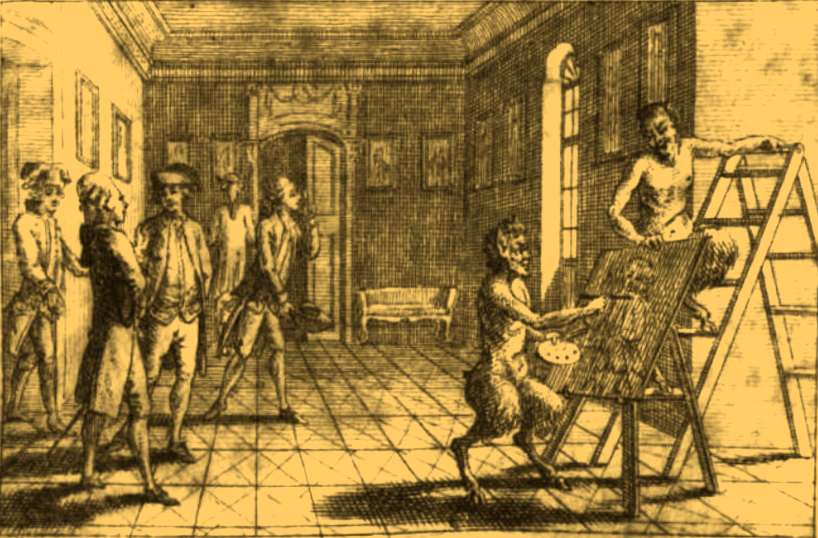
• University Students’ Less-Than-Best Behavior. Caroline laments on 21 July 1779: “Believe me, my dear friend, you have good reason to give thanks to God that you were not born in a university town. It is the most dangerous place for a girl.” University students’ generally unruly and even lewd behavior, which included drinking, carousing, and wenching, was proverbial (letters 8, 63, et passim).
• Daniel Chodowiecki’s illustrations to Gustav Friedrich Wilhelm Grossmann, Nicht mehr als sechs Schüsseln. Familiengemälde in fünf Aufzügen (1777) (letters 23, 25, 108).
• Daniel Chodowiecki’s illustrations to Friedrich Nicolai, Das Leben und die Meinungen des Herrn Magister Sebaldus Nothanker (1773–76) (letter 26).
• Illustrations to August Gottlieb Meissner, Alcibiades, 1st and 2nd eds. (1781–88) (letter 27).
• Daniel Chodowiecki’s illustrations to Johann Caspar Lavater’s Jesus Messias, oder die Zukunft des Herrn: Nach der Offenbarung Johannes (1780) (letter 36).
• Daniel Chodowiecki’s illustrations to Karl Martin Plümicke, Lanassa. Trauerspiel in fünf Akten (Berlin 1782) (letter 37).
• Daniel Chodowiecki’s illustrations to Christoph Friedrich Bretzner, Liebe nach der Mode, oder: Der Eheprocurator. Ein Lustspiel in fünf Akten (Leipzig 1781) (letter 37).
• Daniel Chodowiecki’s illustrations to C. F. Weisse, Cecilia, oder die Geschichte einer reichen Waise (1783–84) (letter 47).
• Illustrations to Andreas Heinrich Bucholtz, Des Christlichen Teutschen Groß-Fürsten Herkules und der Böhmischen Königlichen Fräulein Valiska Wunder-Geschichte (1676) (letter 70).
• Illustrations of a typical bourgeois German residence ca. 1736–1800 (letter 74 et passim).
• Daniel Chodowiecki’s illustrations to Ariosto’s Orlando furiosos (1772) (letters 75, 249a et passim).
• Daniel Chodowiecki’s illustrations to Camille oder Briefe zweier Mädchen aus unserm Zeitalter, trans. J. F. Jünger (1786–87) (letter 77 and supplementary appendix 77.1).
• Thomas Stothard’s illustrations to The History of Sir Charles Grandison by Samuel Richardson (letters 77, 107, 108, 110, 251, 328.1).
• Daniel Chodowiecki’s illustrations to Schiller’s Love and Intrigue (Kabale und Liebe (1786) (letter 94 et passim).
• Illustrations to German (1794) and English (1796 and 1800) editions of Horace Walpole’s The Castle of Otranto (1764) (letter 147) and related illustrations.
• Illustrations to August Wilhelm Iffland’s Die Advocaten (1796) (Caroline’s literary review of June 1797).
• Illustrations to August Lafontaine’s Klara du Plessis und Klairant: Eine Familiengeschichte Französischer Emigrirten (1795) (Caroline’s literary review of the French translation in August 1797).
• Woodcut-illustrations from Veit Warbeck’s Die schön Magelona (1536), a Volksbuch-precursor of Ludwig Tieck’s “Die wundersame Liebesgeschichte der schönen Magelone und des Grafen Peter aus der Provence” (letter 207).
• Selections from John Flaxman’s drawings for Dante’s Divine Comedy (letter 207a, 250, 289a, 330, 340, supplementary appendices 256.1, 403.1, Laocoön Dispute, Athenaeum).
• Illustrations to Valerius Wilhelm Neubeck’s Die Gesundbrunnen: Ein Gedicht in vier Gesängen (1796) (Caroline’s literary review of December 1798).
• Illustrations to August Heinrich Lafontaine, Leben und Thaten des Freiherrn Quinctius Heymeran von Flaming, 4 vols. (1795–96) (Caroline’s review of Lafontaine; passim in letters 113, 199, 200d, 213, 258d).
• Illustrations to Jean-Baptist Louvet de Couvray, Les amours du chevalier de Faublas, 4. vols., 3rd ed. (Paris 1798) (letter 221).
• Daniel Chodowiecki’s Illustrations to Kotzebue’s Die Indianer in England (Leipzig 1790) (letter 224 et passim).
• Daniel Chodowiecki’s illustrations to Clarissa. Or the History of a Young Lady, trans. by Ludwig Theobul Kosegarten as Clarissa. Neuverdeutscht, 8 vols. (Leipzig 1790–93), and Clarisse Harlowe, trans. (French) M. Le Tourneur, 14 vols. (Geneva, Paris 1785–87); (letters 77, 107, 224a, 328.1, supplementary appendix 80.1).
• Daniel Chodowiecki’s illustrations to the Göttinger Taschen Calender Für das Jahr 1799 (letter 235b).
• Illustrations to the Ueberflüssiges Taschenbuch für das Jahr 1800 edited by Johann Georg Jacobi and Friedrich Heinrich Jacobi (letter 258).
• Exterior and interior illustrations of Horace Walpole’s estate Strawberry Hill, an estate similar in some ways to Chateau Söder (Caroline visited Chateau Söder in October 1800) (supplementary appendix 272.2; letter 272).
• Illustrations to Johann Friedrich Cotta’s Taschenbuch für Damen auf das Jahr 1801 with its juxtaposition of “good women” and “bad women” (letter 290).
• Copper engravings of Italy from Friedrich Leopold Graf zu Stolberg’s travelogue Reise in Deutschland, der Schweiz, Italien und Sicilien (1794) (letter 293).
• Illustrations from Voltaire’s La Pucelle d’Orléans (1755) as precursor and, in part, model for Schiller’s Die Jungfrau von Orleans (letter 312).
• Illustrations of dental equipment from Louis Laforgue, Die Kunst des Zahnarztes, trans. Jacob Ezechiel Aronsson (Berlin 1803) (letter 317a et passim).
• Illustrations to Schiller’s Die Jungfrau von Orleans (letters 292, 312, 312c, 315, 318, supplementary appendix 391.2, et passim).
• Illustrations of the visions and Holy Helpers from Mauritius Knauer’s Franconian pilgrimage guide, the Franckenthalischer Lust-Garten (1752) (letter 320).
• Illustrations to the two editions of Ludwig Theobul Kosegarten’s Poesieen (1798, 1802), the first edition with a section dedicated to his “lady friend” Caroline (letters 325, 371a, Caroline’s Draft of a Novel).
• Daniel Chodowiecki’s illustrations to Schiller’s The Robbers (1783) (letter 329p).
• Daniel Chodowiecki’s illustrations to Lessing’s Minna von Barnhelm (1769) (letters 256; 315; 328g; 329l.2; supplementary appendices Friederike Unzelmann; 330.2).
• Illustrations to Wilhelm Schlegel’s Blumensträusse Italiänischer, Spanischer und Portugiesischer Poesie (1804) (letter 230b, 258e, 258r, 358, 374e, 377d, 378).
• Illustrations to Johann Gottfried Ebel’s Schilderung des Gebirgsvolkes der Schweiz (1798, 1802) (letter 381).
• Illustrations to Goethe’s play Die natürliche Tochter (1804) (letters 377d, 388c, 392b, supplementary appendix 392.1).
• Illustrations constituting the custom deck of playing cards of the Karten-Almanach auf 1805, the first of six such decks in the Almanach format by Johann Friedrich Cotta in Tübingen. This edition includes colorized figures of twelve characters from Friedrich Schiller’s play Die Jungfrau von Orleans (1801) (letter 391).
• Illustrations to Christian August Vulpius, Rinaldo Rinaldini, der Räuber-Hauptmann: Eine romantische Geschichte unsers Jahrhunderts in 3 Theilen oder 9 Büchern (Leipzig 1799–1800) (letter 392b; Caroline’s Review of the Bibliothek der Robinsone and Bibliothek des Romantisch-Wunderbaren).
• Friedrich Franz and Christian Johannes Riepenhausen’s illustrations to Ludwig Tieck’s Leben und Tod der heiligen Genoveva (1806) (letter 403).
• Illustrations of residential buildings in Munich in 1805. Before moving to Munich herself, Caroline assiduously scrutinized the Munich newspapers for potential apartments. She writes to Schelling on 25 April 1806: “Ah, and the Munich paper lists so many nice logis!” The Münchner Polizey-Uebersicht (1805), to which Caroline may well have had access, fortuitously includes copious illustrations of citizen residences and street life in Munich at the time; here a selection illustrating the residential environment into which Caroline was soon to move (letter 403 et passim).
• Illustrations to Gottfried August Bürger’s Baron von Münchhausen’s Miraculous Journeys and Adventures (1786) (letters 411, 441).
• Illustrations to Pierre Le Lorrain de Vallemont, La physique occulte, ou Traité de la baguette divinatoire (Amsterdam 1693) in connection with Caroline and Schelling’s interest in dowsers and divining rods (letter 421c et passim).
• Illustrations of laboratories and experiments associated with Johann Wilhelm Ritter’s interest in galvanism and its applications (letters 219, 432d, et passim).
• Illustrations to Goethe’s novel Elective Affinities (1809) (letters 434, 440, 454, 455, supplementary appendix on Francesco Campetti).