
• 19. Caroline to Julie von Studnitz in Gotha: Göttingen, 29 October 1780 (Fr.) [*]
Göttingen, 29 October 1780
|32| I first sought to console myself for having not seen you at least once more, my dear, tender friend, and tried to persuade myself instead that my father had spared me a separation that would have been so sad for me . . .
Sometimes I still doubt that I really was in Gotha. Was it perhaps merely a pleasant dream that beguiled me? — Not at all, I truly did see you, I was happy — though alas, I am no longer. Every step that took me farther away from Gotha increased my sadness; no charming pleasures |33| awaited me in Göttingen except that of seeing my mother again, and even that was ruined for me, since I found her sick. [1] Upon arriving in Gotha, my sentiments were like those I imagine someone from Switzerland might have who, after a long absence, sees once more his beloved country, for which he has yearned in vain for so long. My heart flew ahead to meet yours.
I dare not surrender to my thoughts, dare not compare my stay in Gotha with my stay in Göttingen; I would lose too much. For a girl, Göttingen has so much that is disagreeable and that cannot be avoided. As lively and insouciant as I am, or at least was, for here I am no longer such, the wonderful mood I had in Gotha has passed. Come, my dear Julie, and restore it to me. —
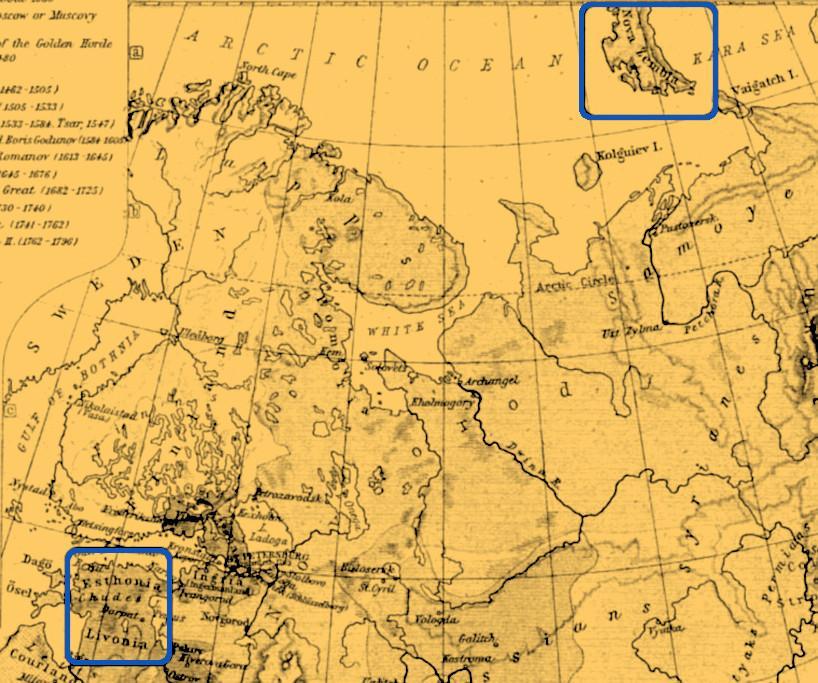
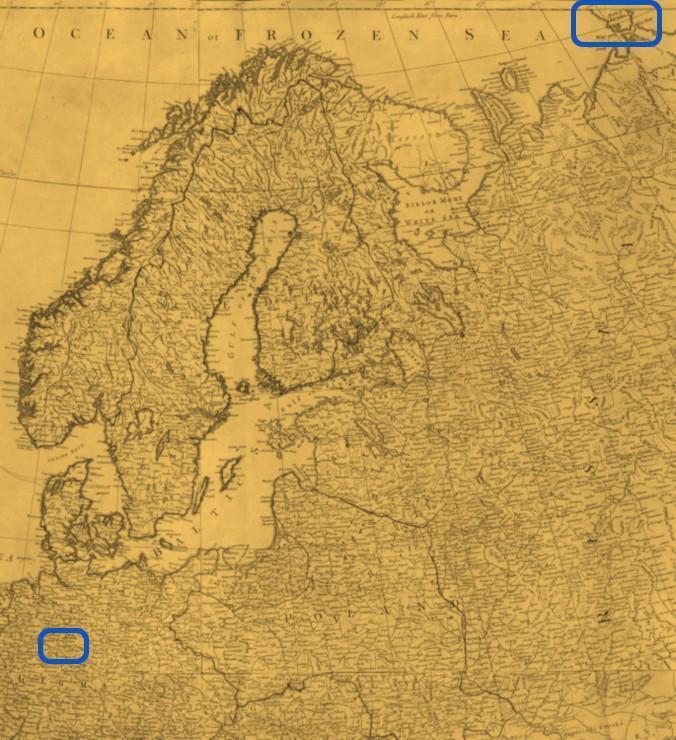
When I think of all that, I would prefer to have been born in Nova Zembla than here, and not just for myself, for my principles and resolve were too firm, and thank heaven I kept them, but for all I see around me [2] . . .
Notes
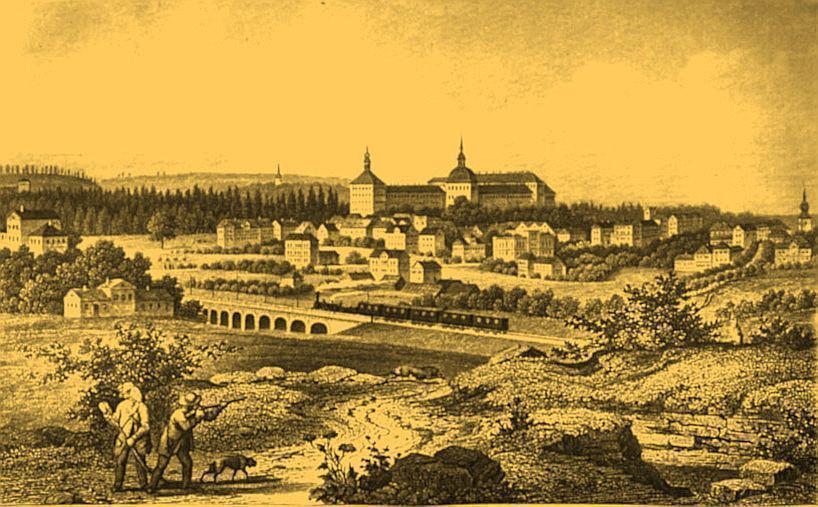
[*] Caroline has just returned from Gotha, ca. 90 km southeast of Göttingen (Post Karte Durch ganz Deutschland, ed. J. Walch [Augsburg 1795]):

Here the towers of Gotha’s Friedenstein Castle from a distance (H. Schwerdt and A. Ziegler, Thüringen, Meyers Reisebücher, 2nd ed. [Hildburghausen 1871], plate following 422):
[1] Christophe Schmid (Christoph von Schmid), La guirlande de houblon [1836], Oeuvres choisies, vol. 4, new ed. (Tours 1867), plate following p. 262:

[2] Novaya Zemlya (Russian, “New Land”; formerly known in English and still in Dutch as Nova Zembla) is an archipelago in the Arctic Ocean in the Arkhangelsk Oblast in the north of Russia and the extreme northeast of Europe, here on a map in relation to the Baltic states of Estonia and Livonia (William R. Shepherd, “The Growth of Russia in Europe, 1300–1796,” in idem, Historical Atlas (New York 1921), 138):
Here the broader view of the location of Nova Zembla (top right) and Caroline in Göttingen (lower left), a vast distance indeed (Thomas Kitchin, (Composite of) Europe divided into its empires, kingdoms, states, republics, &c [1787]):
Translation © 2011 Doug Stott