Project Introduction
It is in translation rather than just reading (where the mind can suspend what it doesn’t quite understand, or at least delay confrontation with it, and where we can lie to ourselves about what words mean) that the nuances of the voice of the lyrical subject and challenging obscurities, thematic and figurative, of [the] original text come to the surface. In translation the cloud of reading is brought to light. Translation involves choosing one word rather than another. It involves interpretation and putting our understanding on show. Reading is private; translation is public. —
(Martin Travers, Rilke, Duino Elegies: Comparing Translations)
Nothing does a woman more honor than when she is able to bring her thoughts to elegant, skillful written expression . . . . Letters should be the result of neither understanding nor rhetoric; rather nature itself must come to expression in them in its purest form and wholly without extraneous embellishment. —
(Das Buch für junges Frauenzimmer, vol. 1 [Dresden 1776], 202–3)
This translation is based on Caroline. Briefe aus der Frühromantik, expanded edition by Erich Schmidt, 2 vols. (Leipzig 1913), which in its own turn was based on Caroline. Briefe an ihre Geschwister, ihre Tochter Auguste, die Familie Gotter, F. L. W. Meyer, A. W. und Fr. Schlegel, J. Schelling u. a. nebst Briefen von A. W. und Fr. Schlegel u. a., edited by Georg Waitz, 2 vols. (Leipzig 1871). Erich Schmidt explains the fundamental differences between the two editions in his introduction.
This project is designed as an essentially encyclopedic companion to the life and letters of Caroline Schelling against the backdrop of her age.
The fundamental materials comprising this edition can always be accessed from the top menu:
- Table of contents
- This project introduction outlining the project’s research context
- A word about the apparatus
- A word about illustrations
- A word about Music
- Acknowledgments
- Biographical materials
- Chronology
- Letters (with an introduction)
- Supplementary appendices (with an introduction)
- Bibliography
- Caroline and Shakespeare
- Caroline’s literary reviews
- Music
- Galleries
- Dramatis personae (biograms, personal glosses)
Readers unfamiliar with Caroline may want to start with this introduction and progress to one or several of the biographical essays before beginning the letters themselves with their accompanying scholarly apparatus, referring all the while to the chronology as needed for a more precise orientation and to the galleries and illustrations in the texts themselves for visual support.
General Biographical Background

In many ways, Caroline Schelling’s circumstances were typical of those of a middle-class woman of the period (2 September 1763–7 September 1809); in many other ways, they were wholly atypical, a situation of particular interest insofar as it was largely a result of her own decisions. It is precisely her often daunting self-confidence and courage in trying to live as authentically as possible (“in defiance of gods and human beings, I am determined to be happy,” she declared) that make these letters riveting personal documents quite apart from her direct involvement in contemporaneous cultural and political events. She lived a life that was remarkable by almost any standards, and certainly by those of the late eighteenth century.
Caroline is best known for having been at the center of the early German Romantic circle in Jena, “without any exaggeration, . . . the first ‘avant-garde’ group in history” (P. Lacoue-Labarthe and J.-L. Nancy, The Literary Absolute [1988], 8) quite in the sometimes even bellicose sense described by Ralph Berry and as copiously illustrated in this correspondence and the accompanying documentation (personal communication):
The term “avant-garde” emerges in the mid-19th century to designate a particular kind of artistic and intellectual group. It presupposes two ideas: that of culture as a historical development (e.g. Hegel) and that of the present as a site of cultural conflict and historical contestation [ed. note, e.g., with Friedrich Schlegel’s desire to become “literary-critical dictators in Germany”].
The “avant” implies that the avant-garde group represents culture’s forward-most development, its forefront or leading edge, while the “garde” introduces a military metaphor. It implies that the avant-garde group does not merely receive its forefront position. It fights for it, specifically against other cultural practitioners (artists, intellectuals, critics, historians) it considers backward-looking [ed. note, e.g., with Wilhelm Schlegel’s anticipated “annihilation of old Wieland”].
The group included, among others, her second husband, Wilhelm Schlegel; his brother Friedrich; the latter’s future wife, Dorothea Veit (daughter of the philosopher Moses Mendelssohn); the writers Friedrich von Hardenberg (Novalis), Ludwig Tieck, and August Ludwig Hülsen; the scientists Henrik Steffens and Johann Wilhelm Ritter; the theologian Schleiermacher (in Berlin); and her later husband, the philosopher Schelling.
The circle had regular contact with the philosopher Johann Gottlieb Fichte, with Goethe and Schiller, and, of even broader cultural significance, with an astonishing, almost bewildering range of prominent academics, journalists, booksellers, artists, and theater personalities. Virtually every figure associated with the Weimar-Jena literary period, as well as many from late eighteenth-century Berlin, either knew her personally or otherwise appears in these letters (Goethe’s Works, vol. 4, trans. G. Barrie [New York 1885], 300):

Caroline, as she is known in German literary history, was the daughter of the renowned Göttingen professor Johann David Michaelis. Her extant correspondence commences in September 1778, when she was but fifteen years old. [1]
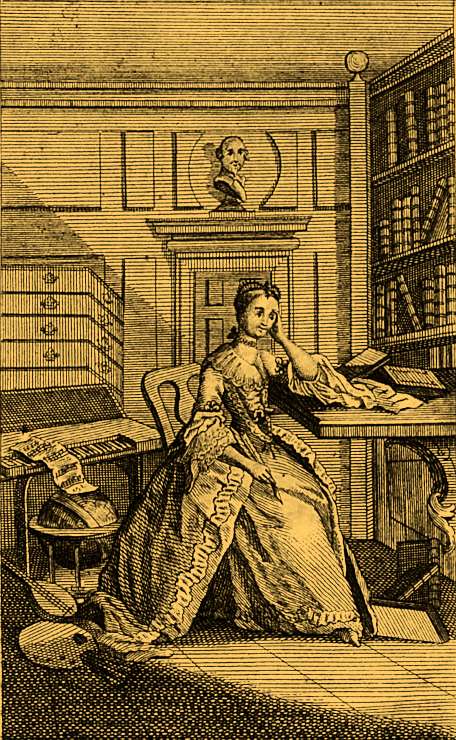
At twenty, however, she married a local physician chosen for her by her family. Widowed four years later, she then lived with various relatives; during this period she also lost her youngest daughter.
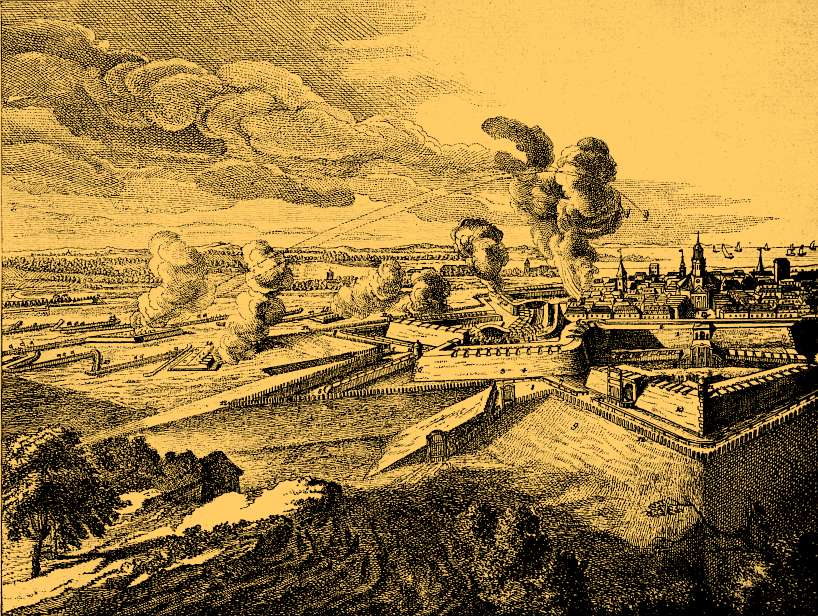
In 1792 she moved to Mainz, where her childhood friend Therese Forster was living with her husband, Georg, a sympathizer of the French Revolution. Here Caroline experienced firsthand and to a certain extent participated in the emergence of the Mainz Republic; her letters document the heated discussions and sometimes startling events associated with this episode, and eventually even the fall of the town itself under Prussian bombardment, albeit only from her prison cell ([1] Bong after V. St-Lerche, Die Clubbisten von Mainz [1888]; [2] Daniel Nikolaus Chodowiecki, Kupfersammlung zu J[ohann] B[ernhard] Basedows Elementarwerke für die Jugend und ihre Freunde: Erste Lieferung in 53 Tafeln [Leipzig 1774], plate lxviii):

That is, she herself was arrested on suspicion of sedition while attempting to flee Mainz, having been mistaken for the wife of her brother-in-law, who was a leading figure in the republic (title vignette to August Gottlieb Meißner, Luise Gräfinn von H**berg: Eine wahre Geschichte [Leipzig 1798]):
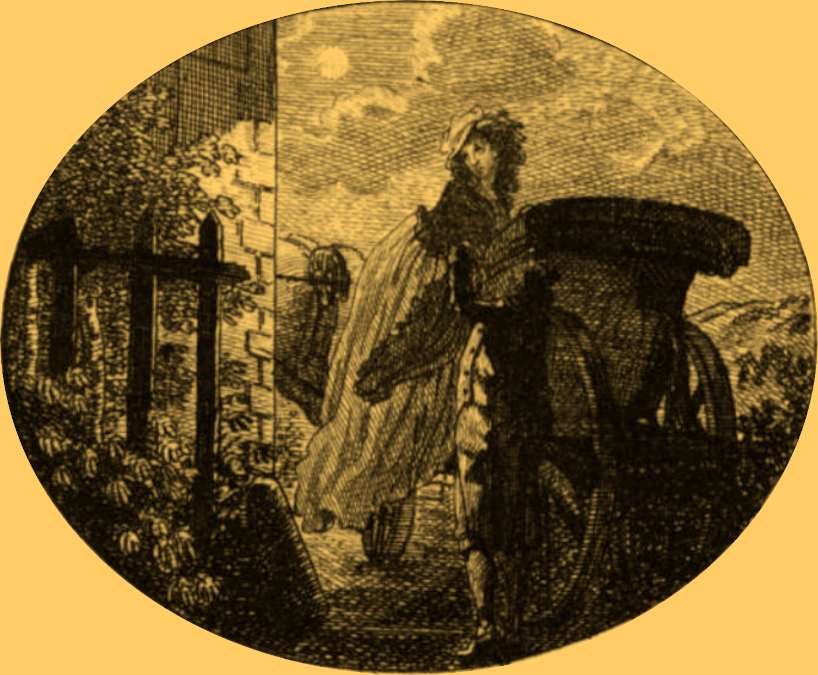
Later she was also suspected of having been the mistress of the French commanding officer in Mainz (illustration: Allmanach auf das Jahr nach der gnadenreichen Geburt Jesu Christi 1786 [Vienna]; Inhaltsverzeichnis deutscher Almanache, Theodor Springmann Stiftung):
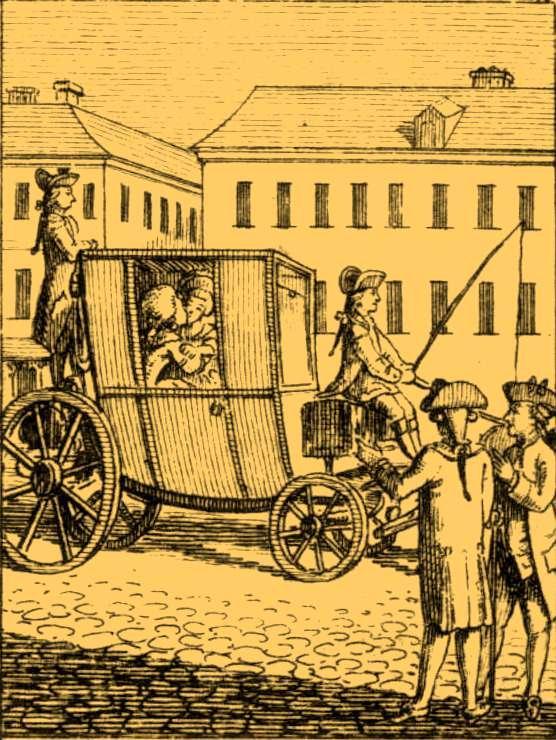
While imprisoned, Caroline realized that she was indeed pregnant by a French officer — in the words of one critic, Caroline “became the spoils” of that officer” at a Freedom Ball in Mainz (Nürnberg, Germanisches Nationalmuseum, Graphische Sammlung, Inventar-Nr. HB 28023; illustration also in Paul Schreckenbach, Der Zusammenbruch Preußens im Jahre 1806 [Jena 1906], 74):

That said, a curious remark by Caroline herself suggests that this relationship was not restricted merely to a single evening but was instead ongoing. If unable to secure her release before her condition was discovered, however, she could be sure not only, as the mistress of a French soldier, of remaining incarcerated but also, as an “unfit mother,” of losing custody of her daughter.
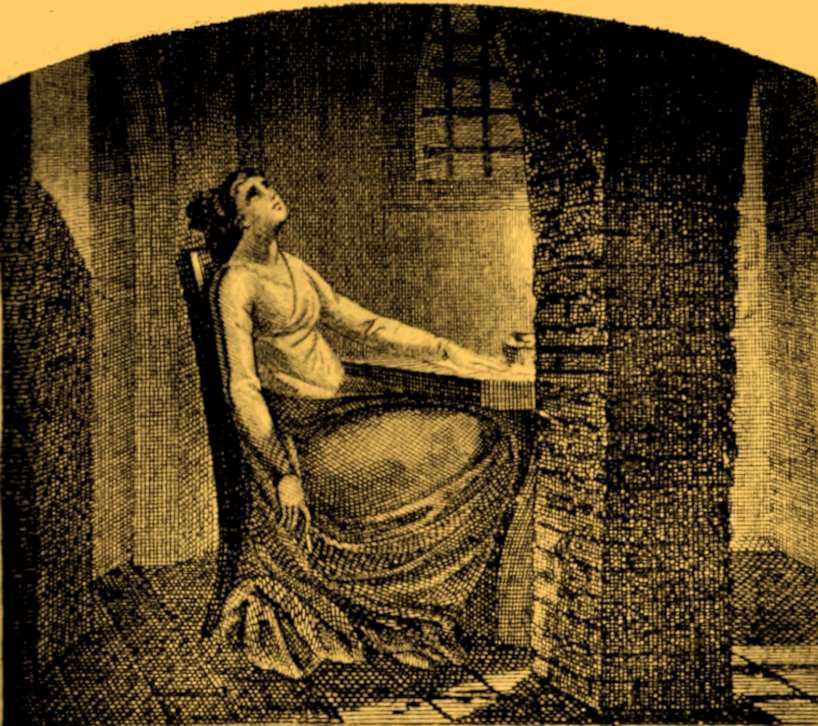
Although her brother managed to secure her release, in the meantime Wilhelm Schlegel, who had known Caroline from his student days in Göttingen, had provided her with the poison she insisted she would use to commit suicide to spare her daughter the inevitable shame (frontispiece to Auguste Lafontaine, Dramatische Werke [Görlitz 1805]):
Although her pregnancy remained a secret to all but a handful of people until Rudolf Haym, in an article published just after the publication of the first edition of Caroline’s correspondence in 1871 by F.W.J. Schelling’s son-in-law, disclosed it based on the correspondence of Friedrich and Wilhelm Schlegel (Waitz had suppressed this information in 1871), her alleged revolutionary activities in Mainz and, especially, her incarceration at the hands of the Prussians rendered her a permanently marked woman in society (Leipziger Taschenbuch für Frauenzimmer zum Nutzen und Vergnügen auf das Jahr 1798; Inhaltsverzeichnis deutscher Almanache, Theodor Springmann Stiftung):

This legacy proved to be stubbornly tenacious, even prompting the publication of a maliciously satirical play (included in this English edition).
Wilhelm Schlegel arranged for Caroline to carry the child to term under a false name in a village outside Leipzig (the child died in infancy; König. Grossbr. u. Churf. Braunschweig. Lünen. Genealogischer Kalender auf das 1779. Jahr; Inhaltsverzeichnis deutscher Almanache, Theodor Springmann Stiftung):

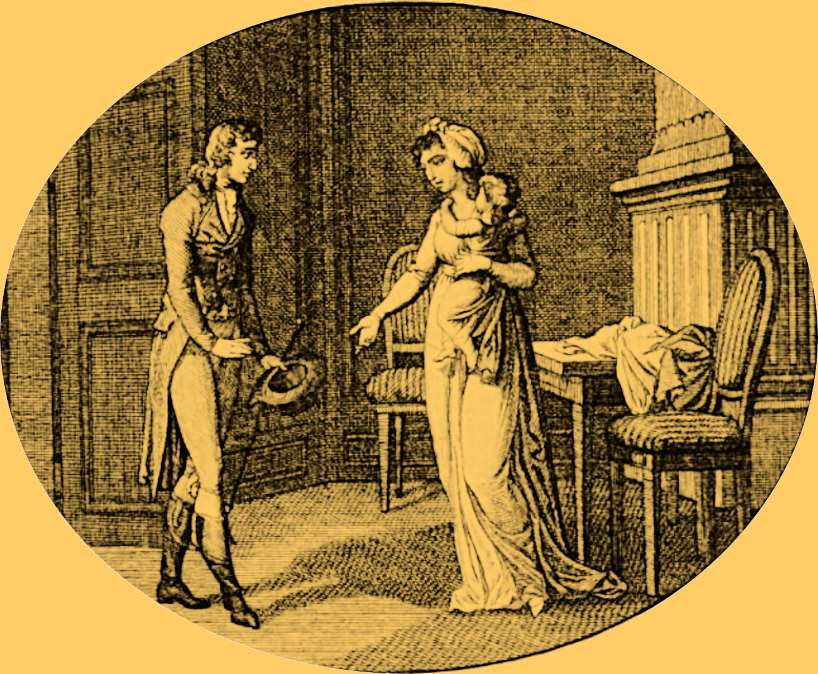
It was there that her closer association with the Schlegel brothers — Wilhelm and Friedrich — began: Wilhelm, living in Amsterdam at the time, had charged Friedrich, living in Leipzig, to run interference for her during this trying period (August Lafontaine, Der Sonderling: ein Gemählde des menschlichen Herzens, vol. 2 [Vienna, Prague 1799]):
Friedrich’s letters to Wilhelm during this episode are included in this edition.
During the summer of 1796, Caroline married Wilhelm Schlegel in Braunschweig and moved to Jena, where in the autumn of 1799 Friedrich and Dorothea Veit joined them as housemates (title vignette to August Lafontaine, Der Sonderling: Ein Gemälde des menschlichen Herzens, vol. 1 [Vienna, Prague 1799]):
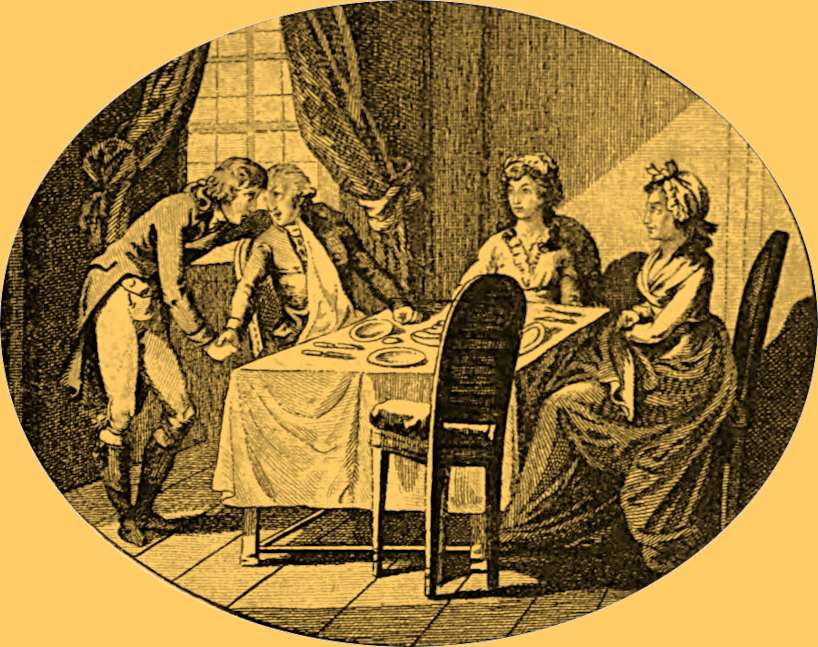
The emergence and florescence of the early Romantic group in that town and Caroline’s eventual marriage to F. W. J. Schelling in 1803 after her divorce from Wilhelm is profusely documented by both correspondence and supplementary material.
During Caroline’s association with that Romantic circle in Jena, an episode took place that has long captivated biographers and even cultural historians: the illness and death of her only remaining child, fifteen-year-old Auguste Böhmer, in July 1800, in which Schelling was implicated as having been at least partially responsible (Daniel Nikolaus Chodowiecki, Höltys Elegie auf ein Landmädchen [1794]; Herzog Anton Ulrich-Museum; Museums./Signatur DChodowiecki AB 3.985):
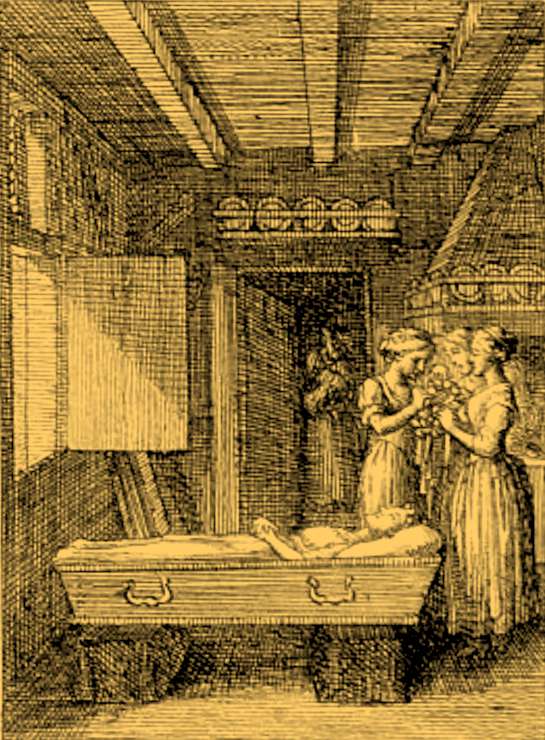
As Oliver Pfohlmann remarks in a review of some of the documentation of this incident, “from this episode of illness and death, a now long-forgotten scandal developed whose significance for medicine can hardly be overestimated.” That resulting bitter, often malicious public dispute is fully documented in this English edition.
This episode involved Caroline’s own earlier illness and apparent cure by Schelling according to the emergent and controversial healing methods of the Scottish physician John Brown and offers a startling glimpse into the practice and perils of early nineteenth-century medicine (Johann Jakob Mettenleiter, Arzt am Krankenbett [1788]; Munich, Kupferstichkabinett):

References to the “Brunonian method,” as it was called, appear frequently in these letters, and plentiful material documents both the method and the course of Schelling’s interest in it.
One of the recurring themes in the correspondence is Caroline’s relationship with Goethe, which began quite early with the schoolgirl’s heady infatuation with the celebrity author of The Sorrows of Young Werther, extended through his serendipitous visit in Mainz just before the city was besieged by Prussian troops (in connection with which Caroline was imprisoned), then moved to Jena itself after Caroline and Wilhelm Schlegel were married in 1796 — years during which Goethe, as Caroline laconically remarks, occasionally stopped by for cordial visits during the day (Blumenstrauß für Musen und Menschen Freunde zum Neujahrsgeschenke 1807; Inhaltsverzeichnis deutscher Almanache, Theodor Springmann Stiftung):
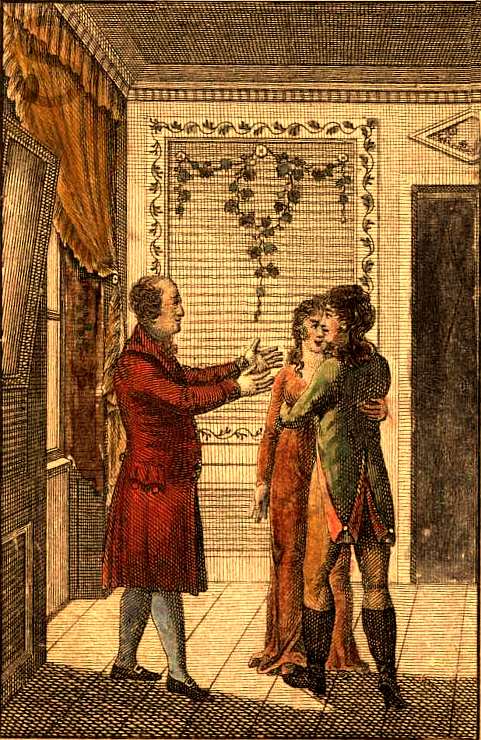
Goethe reserved a loge for them in the Weimar theater; took walks with various members of the group along the Saale River in Jena; personally produced Wilhelm Schlegel’s play Ion in 1802, then Friedrich Schlegel’s play Alarcos that same year; and had Caroline and Wilhelm for dinner along with Johann Gottfried Herder, during which they all merrily toasted the great poet Klopstock (Mode-Almanach fur Damen auf das Jahr 1802):

Goethe also quickly took a liking to Schelling; advised Caroline and Wilhelm extensively concerning the memorial to be crafted for Auguste’s grave; recommended strategies in their literary feuds; and personally facilitated Caroline and Wilhelm’s partial circumvention of the consistory in securing a divorce directly from Duke Karl August of Weimar in 1803 (that complete correspondence is included; see below) (Daniel Nikolaus Chodowiecki, Scheidung [“divorce”] [1788], Herzog Anton Ulrich Museum, Museums./Signatur DChodowiecki AB 3.775):

Not least, Goethe later even published Caroline’s literary reviews in the Jenaische Allgemeine Literatur-Zeitung after she and Schelling had left Jena for Würzburg and, later, Munich.
Within this broader context, Caroline’s relationship with Schelling constitutes an extraordinary, moving, almost cinematic love story quite independent of the high-profile and highly charged cultural environment in which it emerged (Taschenbuch für das Jahr 1825: Der Liebe und Freundschaft gewidmet; Inhaltsverzeichnis deutscher Almanache, Theodor Springmann Stiftung):

That it also involved Auguste, her daughter, on a still-disputed level both before and after the latter’s death makes the story all the more intriguing and at times heartbreaking. Caroline’s correspondence with Schelling (it is probably no accident that, except for one letter, only her letters were preserved) constitutes some of the most riveting yet enigmatic love letters ever written.
By virtue of her marriage to Schelling in 1803, Caroline’s life was also touched, directly and indirectly, by developments in the philosophy of nature and its various ramifications in other fields (most notably medicine; in Würzburg Schelling had more contact with physicians than with philosophers), as well as by the extraordinary and complex developments in European history during the period up to 1809, when she died (Marie-Joseph-Louis-Adolphe Thiers, Collection de 350 gravures, dessins de Philippoteaux, etc. pour l’histoire du Consulat et de l’Empire, 2 vols. [Paris 1870], no. 132):

Although Caroline’s love for Schelling began at an indeterminate time after his arrival in Jena in 1798, and although residents of Jena and Weimar were certainly aware of it in its incipient stages, their closer association as a couple can be traced to her return to Jena from Braunschweig in April 1801 following the death of Auguste in July 1800 (Taschenbuch für Damen auf das Jahr 1801; Inhaltsverzeichnis deutscher Almanache, Theodor Springmann Stiftung):

Wilhelm Schlegel had in the meantime (February 1801) taken up residence in Berlin and returned to Jena for only a brief period in the late summer and early autumn of 1801; he was himself involved in a liaison with another woman at the time, Sophie Bernhardi (“Is something wrong? — It seems I am hearing your husband’s voice”; Jahrbuch zur belehrenden Unterhaltung für Damen [1800]):
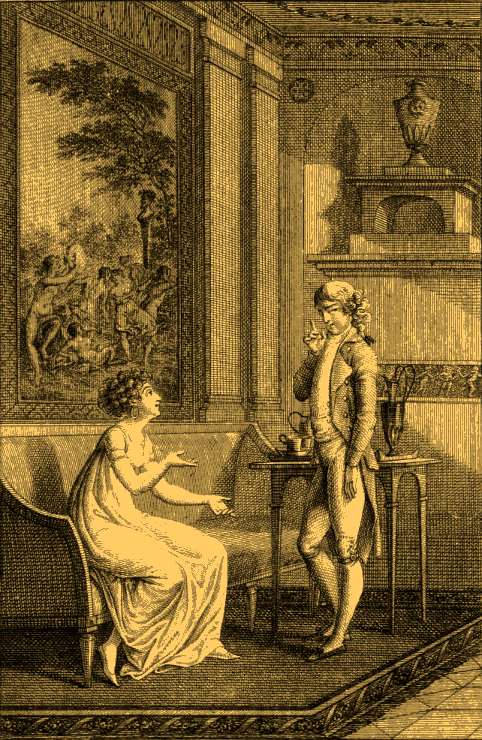
This edition includes their entire correspondence during that autumn of 1801 — during which, incidentally, Wilhelm in his own turn was aware of Caroline’s new romantic ties.
Moreover, even during their stay in Braunschweig after Auguste’s death, Wilhelm was already involved with yet another woman — Minna van Nuys — one whom Caroline did indeed consider a serious rival (this relationship is similarly documented) (anonymous, Galante Szene mit Handkuss [1776–1800]; Herzog August Bibliothek; Museums./Signatur Graph. Res. A: 179):

Nevertheless, over several months in 1802 and 1803 Schelling himself, not least on Wilhelm’s behalf, facilitated the divorce between Caroline and Wilhelm; that complete correspondence is included in this English edition and includes letters documenting Goethe’s intervention and mediation.
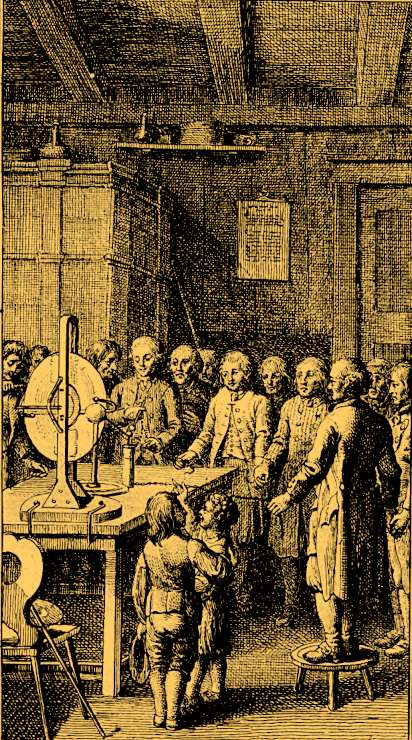
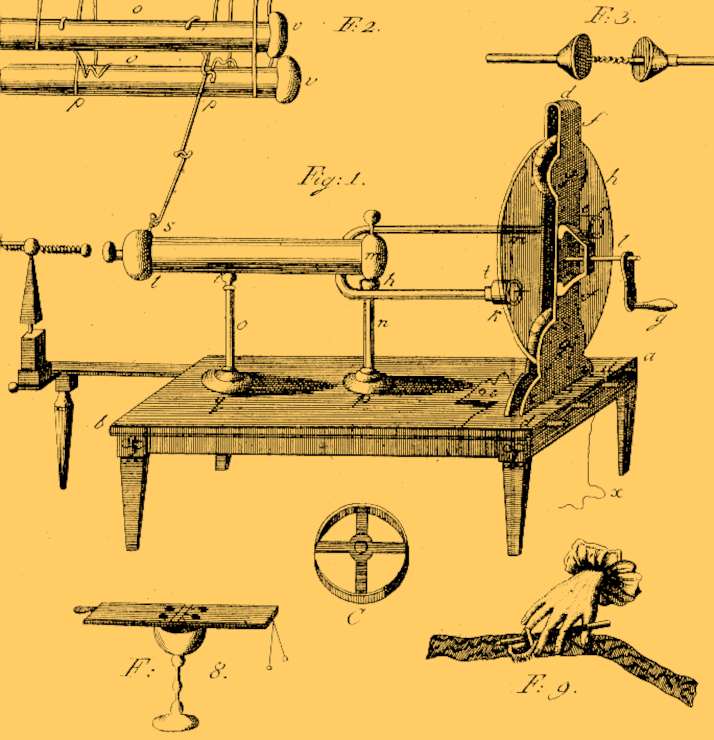
Schelling’s subsequent academic positions took him and Caroline to Würzburg in 1803, then to Munich in 1806, where my English edition’s appendices supplement the letters documenting their interest in, for example, Italian poetry improvisators, the trendy, intriguing phenomena of dowsers and mediums, and the sundry scientific experiments conducted by Johann Wilhelm Ritter and others ([1] Heinrich Heidegger, Der vernünftige Dorfpfarrer: Geschichte wie sie ist, und wie sie durchgehends seyn sollte: Lesebuch für Landgeistliche und Bauern [Zurich 1791], following p. 60; [2] Johann Samuel Haller, Magie, oder die Zauberkräfte der Natur, so auf den Nutzen, und die Belustigung angewandt worden, multiple volumes (Vienna 1783–1803), here 1787, plate 1):
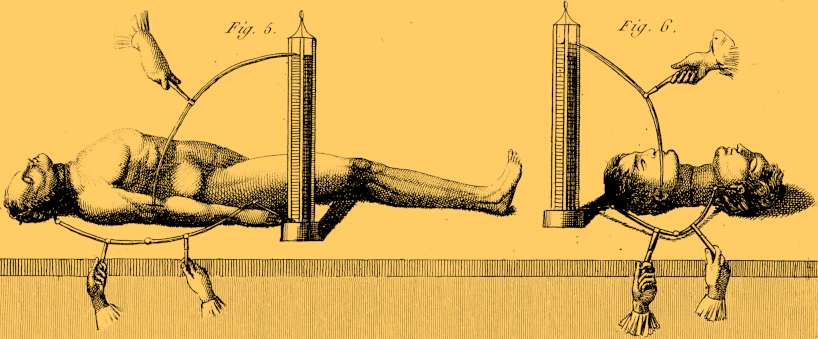
It is worth noting that Ritter’s work on galvanism and his explicit remarks to Schelling about his hopes for the new science of galvanic revivification introduced Caroline and Schelling to the charged atmosphere out of which ultimately Mary Shelley’s Frankenstein; or, The Modern Prometheus emerged in 1818 (illustration: Jean Aldini, Essai théorique et expérimental sur le galvanisme [Paris 1804], plate 4).
It was during a visit to Schelling’s parents in the idyllic setting of the Maulbronn monastery school, where Schelling’s father was headmaster, that Caroline died after a three-day walking tour on 7 September 1809 at the age of forty-six, coincidentally apparently of the same illness that had taken Auguste in July 1800 (Almanac de Gotha contenant diverses connaissances curieuses et utiles pour l’année 1788):
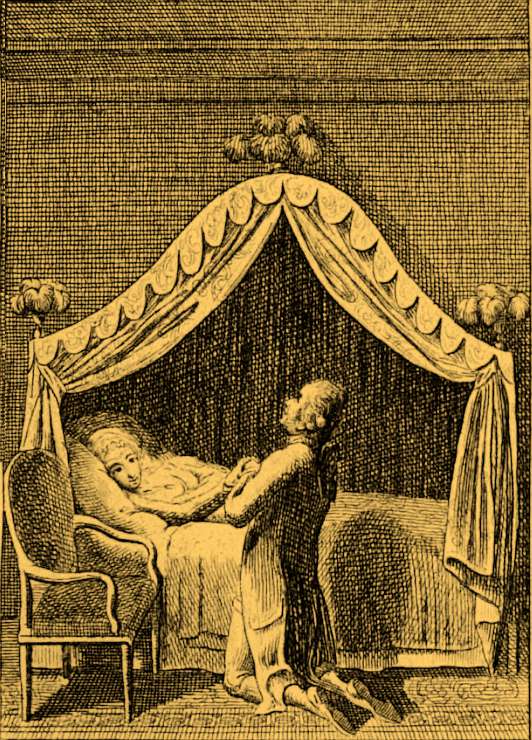
Schelling writes after her death: “Once, while standing at a window in Maulbronn, she said to me, ‘Schelling, do you think perhaps that I might die here?’” (Gothaischer Hof Kalender zum Nutzen und Vergnügen eingerichtet auf das Jahr 1788; Herzog Anton Ulrich-Museum; Museums./Signatur DChodowiecki AB 3.704 [1786]):
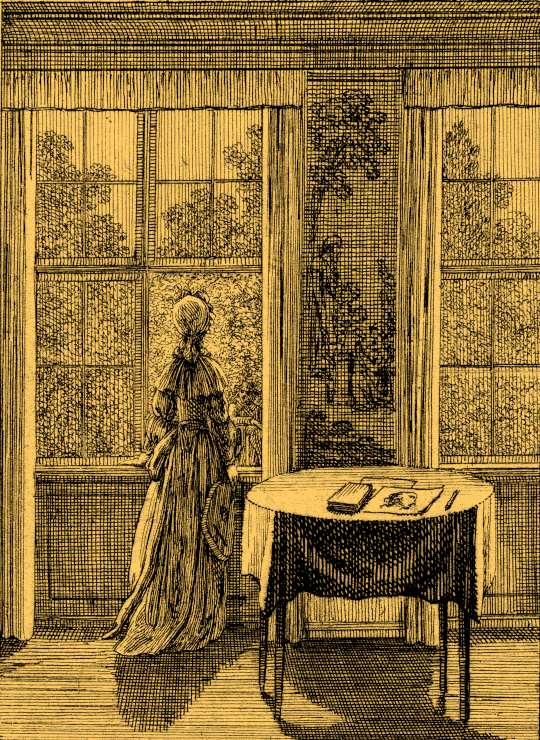
Schelling provides a moving account of her last days and death and of her burial in Maulbronn, and from the letters of others and Schelling himself one can follow his own subsequent despair, which led him during an ensuing illness to stipulate not only that his complete correspondence be burned, but also that his friend Johann Martin Wagner sever his head from his body to ensure his death (Johann Caspar Lavater, Geheimes Tagebuch, 2 vols. (Leipzig 1771, 1773), 1:80):
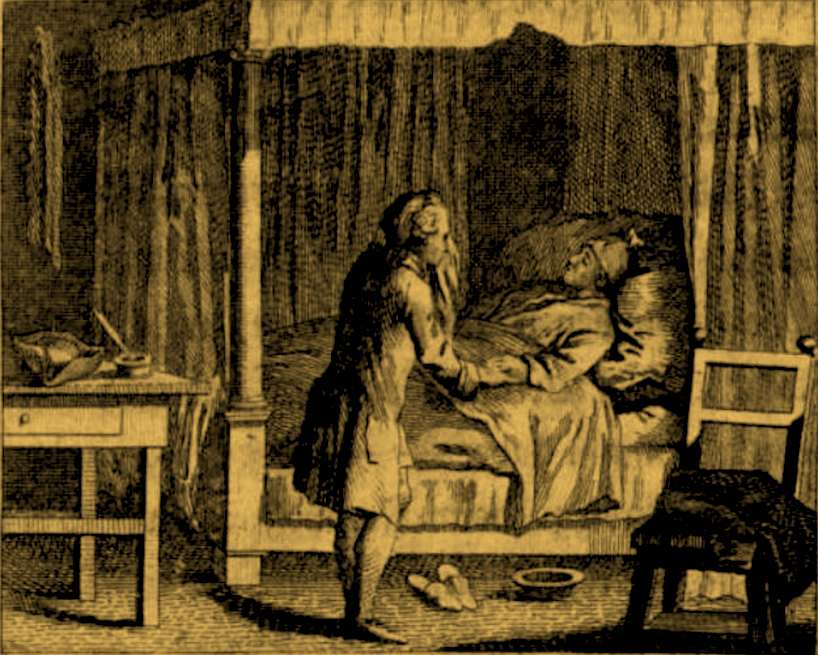
He did not die, of course, and as fate would have it he married, in 1812, Pauline Gotter, one of the daughters of Caroline’s lifelong friend and correspondent Luise Gotter, not without, however, first having inquiries made on his behalf by his publisher to ascertain the status of his future wife’s health, so stunned was he after losing, first, Auguste, and then Caroline.
One of their daughters married Georg Waitz, who, though a constitutional historian by profession, published the first, two-volume edition of Caroline’s letters in 1871, which in its own turn provided the basis for the more comprehensive edition by Erich Schmidt in 1913, the basis of this present translation.
This correspondence copiously documents intellectual and cultural life, daily life (for example, housing concerns, dealing with domestics, infant mortality), the situation of women (including such issues as divorce, property settlements, inheritance, and death from complications during childbirth), and German and European political history during the late eighteenth and early nineteenth century, focusing especially but not solely on the early Romantic school in Jena and, later, on Caroline’s life as affected by the scholarly career of her third husband, the philosopher F. W. J. Schelling.
These more formal scholarly considerations aside, Caroline was a remarkable, even singular woman who lived a fascinating, extraordinary life on myriad levels, and not just in connection with Jena Romanticism. Because, as Robert Richards observes in his study The Romantic Conception of Life, Caroline’s personality consisted of “a mélange of traits that make intellectual men succumb and careful women distrustful,” few people who encountered her came away indifferent, something reflected in F. W. J. Schelling’s assertion, after her death, that “one had to love her entirely or not at all.” And as one scholar has remarked, “Her letters (and life) are shocking, moving, irritating, but always in the center of the action” (Berlinischer Damen Kalender auf das Jahr 1799; Inhaltsverzeichnis deutscher Almanache, Theodor Springmann Stiftung):

The extraordinary panorama of erudite but quirky, all-too-human personalities; of sweeping historical events and lofty cultural engagements alongside vignettes of quotidian life and mundane concerns ranging from infant mortality and bed soiling (!) to rent considerations; of heated, passionate feuds over the life of the mind and of art; and of complex human relationships ranging from the maliciously hostile to the touching and poignant — all these elements and more offer the reader of these letters and documents a remarkable, riveting, and thoroughly entertaining chronicle (Der Freund des schönen Geschlechts: ein angenehm und nützlicher Taschenkalender für das Jahr 1808):
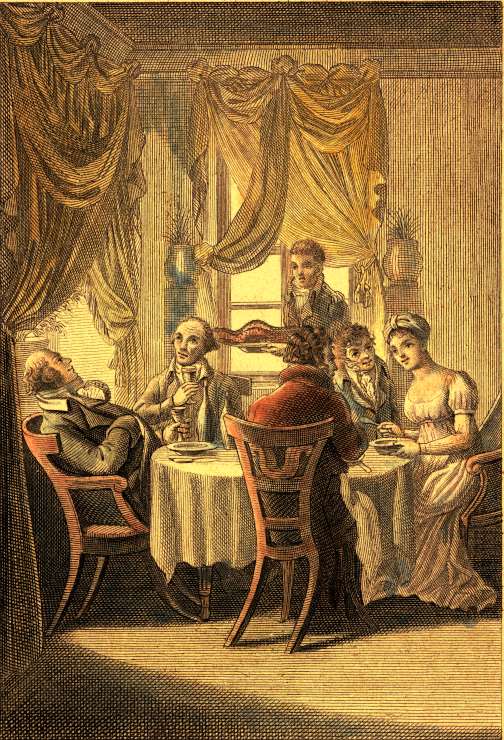
As Wilhelm Scherer put it in the nineteenth century, reacting to the initial publication of her letters in 1871: “Anyone interested in the literary scene and literary factions in Germany at the end of the previous and the beginning of the present century will draw a wealth of information from these volumes, and will encounter the story of a woman one cannot follow without being profoundly moved.”
In his history of German literature (Deutsche Literaturgeschichte, 15th ed. [Stuttgart 1968], 326), Fritz Martini refers to these letters as part of the “essential documentation of early Romanticism. With her, the intellectual emancipation commences of those women who through their literary creations or the ambience of their literary salons were beginning to influence cultural life itself.”
Wilhelm Scherer, reacting to the first (abridged) edition of the letters (1871), called her “one of the greatest epistolary geniuses Germany has produced” (Deutsche Rundschau 32 [1882]: 473), and in his discussion of all the women associated with Romanticism in his history of German literature, he resolutely concludes that “Caroline Schelling ranks first among all the literary women of the time; her graceful chatty letters are full of good sense and imagination, of refined malice and charming raillery, and their clear yet thoughtful descriptions, their charming language, and their hidden poetry raise them to the level of true works of art” (Geschichte der deutschen Literatur [1883], 618; Eng. trans., 2 vols. [1906–8], 2:233).
In the classic monograph on F. W. J. Schelling, Schellings Leben, Werke und Lehre (3rd ed., 1902), Kuno Fischer remarks similarly that “she is not merely a master, but genuinely a genius in letter writing; her letters are completely herself, always just as light and graceful and, should the moment or subject matter so dictate, also just as substantial and profound” (66) (Toiletten Kalender für Frauenzimmer 1799; Inhaltsverzeichnis deutscher Almanache, Theodor Springmann Stiftung):
Notes
[1] Illustration: frontispiece to Johann Christian Koppe, Das wohlgezogene Frauenzimmer, oder Vollständige Anweisung zur weiblichen Erziehung in einer Reihe Briefe einer Mutter an ihre Tochter (Rostock 1767).
See the following discrepancies concerning Caroline’s full name:
Michaelis, Caroline (2 September 1763–7 September 1809) widowed Böhmer, divorced Schlegel, remarried Schelling. Although she is frequently known as “Caroline Schlegel-Schelling,” such was never her legal name, and she never referred to herself as such. Nor, certainly, is it appropriate for her to be referenced by a name indicating essentially a chain of custody.
•Luise Wiedemann Memoirs:
Caroline Albertine Michaelis
•Georg Waitz 1871:Dorothea Caroline Albertine Michaelis
•Erich Schmidt 1913:Caroline Albertine Dorothea Michaelis
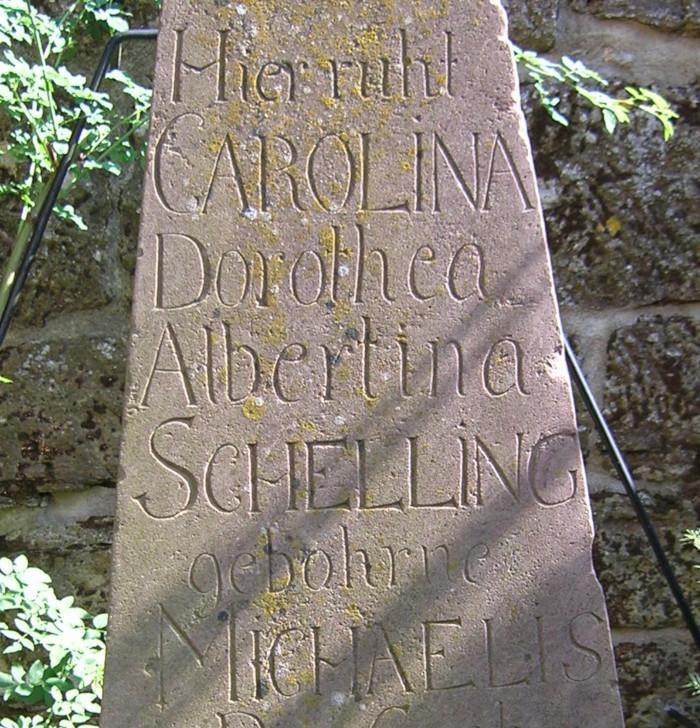
•Obelisk in Maulbronn (photo by editor):
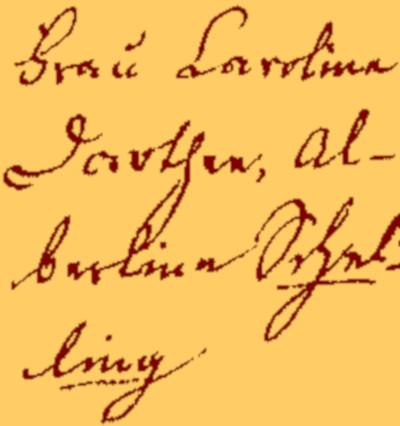
•Church death registry:
Frau Caroline Dorothea Albertina Schelling