
• 77. Caroline to Lotte Michaelis in Göttingen: Clausthal, 28 March 1787
[Clausthal 1787]
Little Frishhouse Square
March 28 [1787], Wednesday
|159| My dear and ever dearest lady.
Such, almost exactly, is how Grandison commences his letters to Harriet Byron. [1]
|160| I just witnessed the most moving scene, one that without fail would have excessively upset Your own delicate heart. Except that this time the reference is not to our excellent Clementine, but to the little peasantkin Auta. You must needs permit me here to sacrifice to nature the extreme delicacy of Your gossamer feelings.
Aforementioned Auta, who for some time now has been but the cleanliest, finest little personage, one who has never desecrated her reclining couch — nay, nary even by an inappropriate breath — has for the past few days developed the whim of soiling it during her afternoon nap. Every possible art has been engaged in the hope of persuading her to change her ways, and yet, such assiduous imploration notwithstanding, the result today was exactly the same. [2]
Burdened with the displeasure of the entire household, aye, which in its entirety did participate even unto the washerwoman herself — well, You should have seen her despair, her broken heart, and her convulsive joy at even the slightest, most ephemeral trace of compassionate sympathy.
Only with considerable effort, however, did we resist the remorseful penitent, yet how gladly would we have counted as happiness indeed the sweet pleasure, one she herself might have granted us, of seeing her revive in arms that half repulsed and half drew her on.
Today, my dear and ever dearest, we are going to see the venerable Dr. Bartlett [3] (Diebeau’s Hannibal) and his meritorious sister. [4] Yesterday (all kidding aside) we spent a delightfully entertaining evening at the home of the neighboring apothecary. I am quite fond of the people there, excepting perhaps the gentleman of the house, and like being there, for I always find prosperity without pretension [5] and ostentation to be quite pleasant. And indeed, I do walk over there sometimes, and they for their part are quite fond of me. The past few days a general forestry meeting has been going on, and because some nonlocals are here as well, the company was terribly large. Everyone nags me about a baby boy, and everyone is interested in my ponderous diminutive figure [6] . . .
|161| You are right about Camille. [7] It is just that some things do not quite sit right with me, including the name. The first volume is and will remain boring — in the remaining, the character soars and is ennobled, and the melancholy brooding certainly exhibits ardor and elicits one’s interest. [8] Of all the various means of death, I like that amid the waves the best: “to end her sufferings in the broad embrace of death” [9] . . .
Notes
[1] Protagonists in Samuel Richardson, The History of Sir Charles Grandison in a series of letters published from the originals by the Editor of Pamela and Clarissa in seven volumes (London 1753–54). Grandison variously addresses Harriet Byron, e.g., as “dearest, loveliest of women,” “my dear and ever dear Miss Byron” (Caroline here: mein theuerstes Leben, lit. “my dearest life”).
“Clementine” in the next paragraph alludes to Clementina Porretta, the high-born love interest in the novel whose unhappiness has caused her derangement; because religious differences prevent her from marrying Charles Grandison, he is free to return from Italy, where she is living, to England to marry Harriet Byron (she reappears later in the novel and is reconciled to Grandison and Harriet).
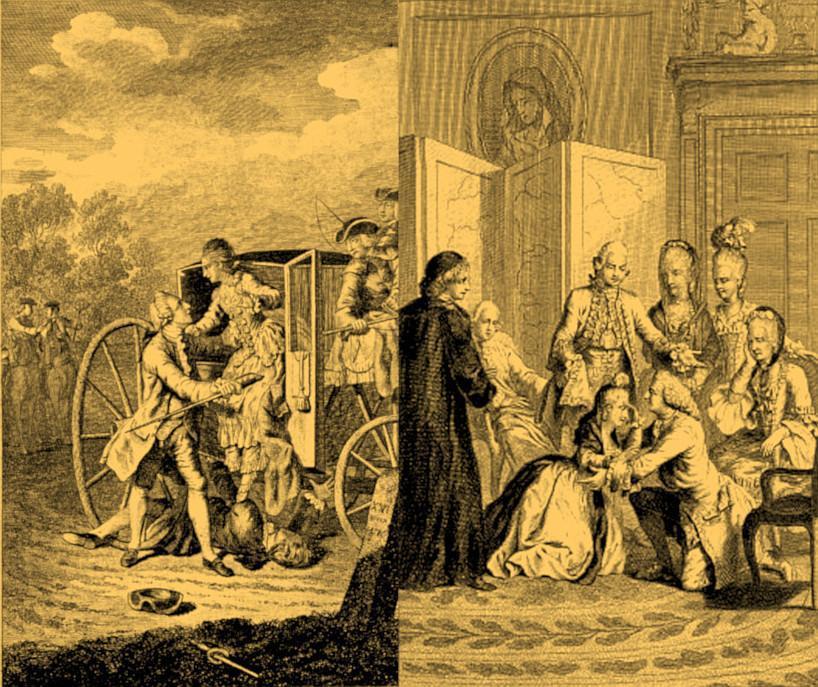
Here illustrations of the two women: “Charles Grandison delivering Harriet Byron from the clutches of Sir Hargrave Pollexfen”; “Clementine and Her Family” (illustrations by Isaac Taylor [1778]; British Museum; repr. in Sir Charles Grandison, Illustrated Gleanings from the Classics 1 [London 1912]):
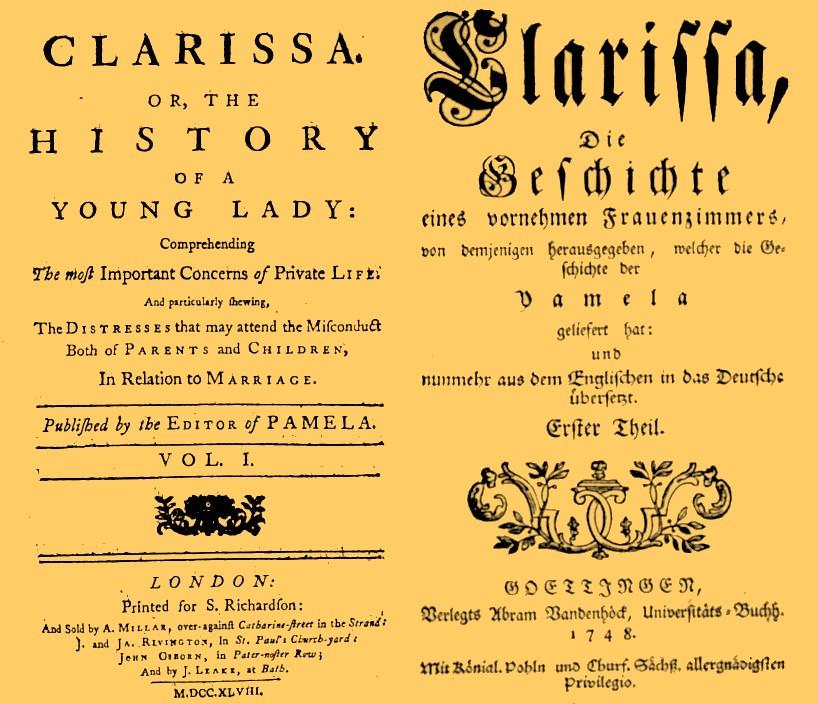
Caroline likely became acquainted with the English novelist through her father, who as young man (1741) had spent time in England and even begun an (albeit rather stiff) translation of Clarissa. Or the History of a Young Lady, 8 vols. (London 1748–49), as Clarissa: die Geschichte eines vornehmen Frauenzimmers, 2 vols., trans. Johann David Michaelis (Göttingen 1748) (Caroline also mentions the novel in letter 80; here the title page of vol. 1 of the original and the translation):
Click on the following image to open a gallery of Thomas Stothard’s complete illustrations to The History of Sir Charles Grandison:

Click on the following image to open a gallery of Daniel Nikolaus Chodowiecki’s illustrations to the German and French translations by Ludwig Theobul Kosegarten, Clarissa. Neuverdeutscht und Ihro Majestät der Königin von Grosbrittanien zugeeignet, 8 vols. (Leipzig 1790–93) and M. Le Tourneur, Clarisse Harlowe, 14 vols. (Geneva, Paris 1785–87), a novel that functions almost as a locus classicus for the various “crises faced by pretty girls” when Caroline, her sisters, and her friends were young women:
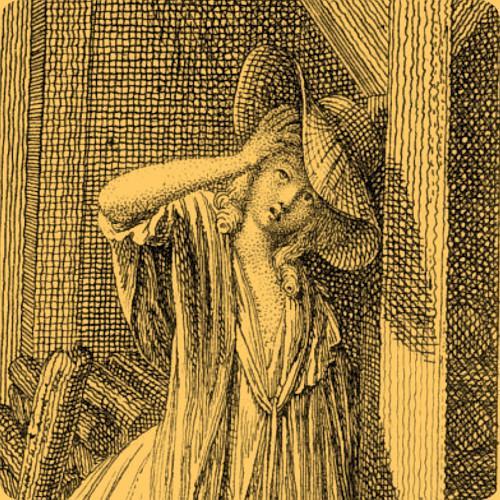
In the following paragraph in this present letter, Caroline affects a slightly stilted style in German (whence also her use of the formal form of address in German in addressing Lotte, here rendered as “You”) modeled presumably on her understanding of Richardson’s own style. Back.
[2] Whim in English in original.
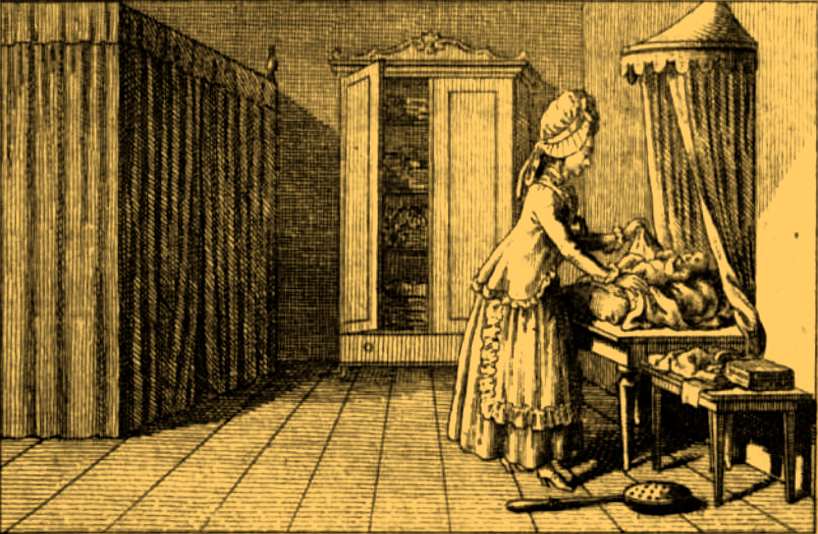
At the time of this letter, Auguste was still a month shy of her second birthday, that is, approximately the age of the young girl being held by her father in the first illustration below and perhaps a bit younger than the young girl with her back to the artist in the second illustration ([1] Daniel Nikolaus Chodowiecki, Häussliche Glückseligkeit [1788]; Herzog Anton Ulrich-Museum; Museums./Signatur DChodowiecki AB 3.766; [2] “Wie gesegnet ist ein gutes Beispiel, das man seinen Kindern gibt!,” Leipziger Taschenbuch für Frauenzimmer zum Nutzen und Vergnügen auf das Jahr 1791; Herzog Anton Ulrich-Museum; Museums./Signatur DBerger WB 3.8; also Inhaltsverzeichnis deutscher Almanache, Theodor Springmann Stiftung; [3] changing table: Raphael Johann Steidele, Verhaltungsregeln für Schwangere, Gebährende und Kindbetterinnen in der Stadt und auf dem Lande [Vienna 1787]):

[3] Dr. Ambrose Bartlett, described in Richardsons’s Charles Grandison as an “excellent clergyman” (Isaac Taylor [1778]; British Museum; repr. in Sir Charles Grandison, Illustrated Gleanings from the Classics 1 [London 1912]):

[4] Uncertain references; see Caroline’s undated letter to Lotte (letter 85a) with its editorial note and note 1. Back.
[5] Caroline uses the word borrowed from Prätension. Back.
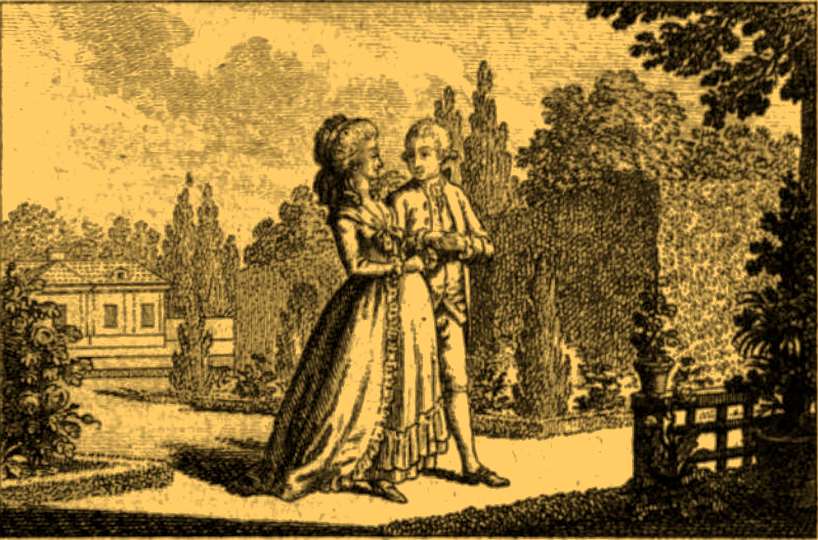
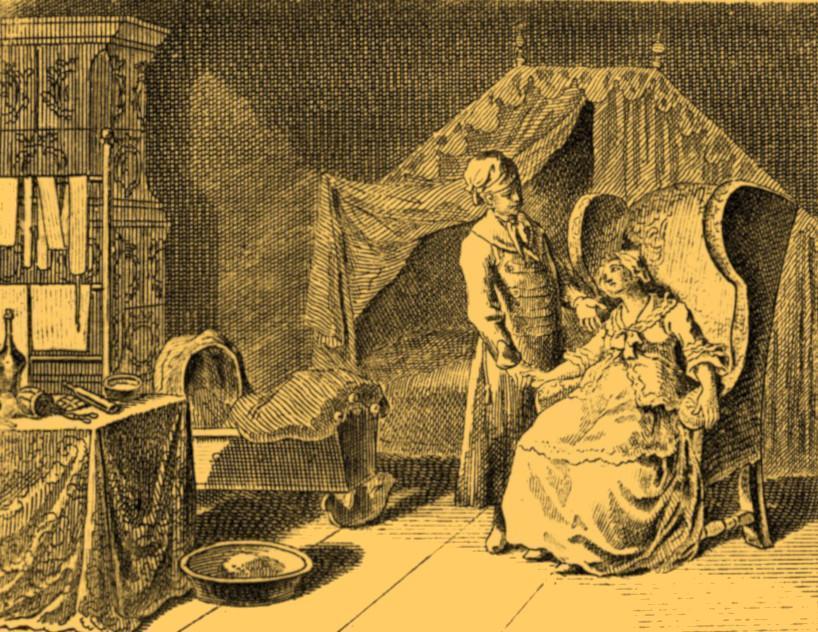
[6] Though of allegedly diminutive stature, Caroline was eight months pregnant at the time of this letter in March of 1787. Therese Böhmer was born on 23 April 1787 in Clausthal ([1] Raphael Johann Steidele, Verhaltungsregeln für Schwangere, Gebährende und Kindbetterinnen in der Stadt und auf dem Lande [Vienna 1787]; [2] Kupfersammlung zu J[ohann] B[ernhard] Basedows Elementarwerke für die Jugend und ihre Freunde: Erste Lieferung in 53 Tafeln. Zweyte Lieferung in 47 Tafeln von L bis XCVI [Leipzig, Dessau, Berlin 1774], plate 29a):
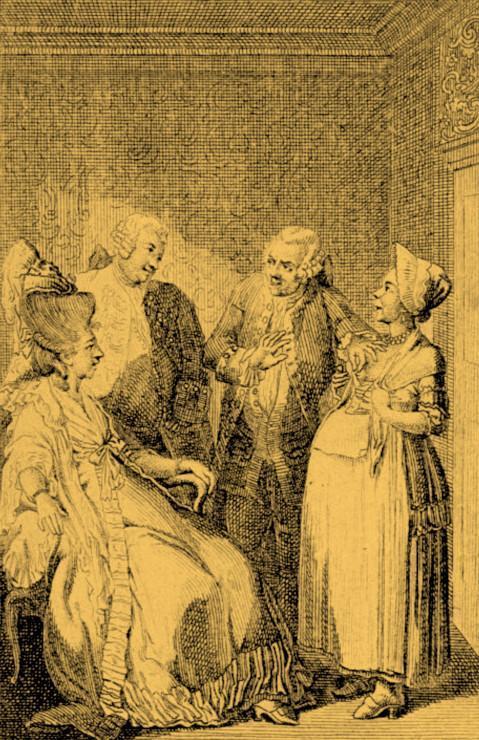
Caroline would have one more pregnancy, in 1793, and it may be that because her pregnancy may have begun to show earlier because of her diminutive stature than might otherwise have been the case, the prospect of the discovery, while incarcerated in Königstein, of her pregnancy by a French lieutenant justifiably prompted considerable, even suicidal anxiety; such became an issue yet again shortly thereafter in Leipzig ([1] Daniel Nikolaus Chodowiecki, Tendres précautions [1779]; Herzog August Bibliothek; Museums./Signatur Uh 4° 47 [207]; [2] A. M. Pachinger, Die Mutterschaft in der Malerei und Graphik [Munich, Leipzig 1906], 65):

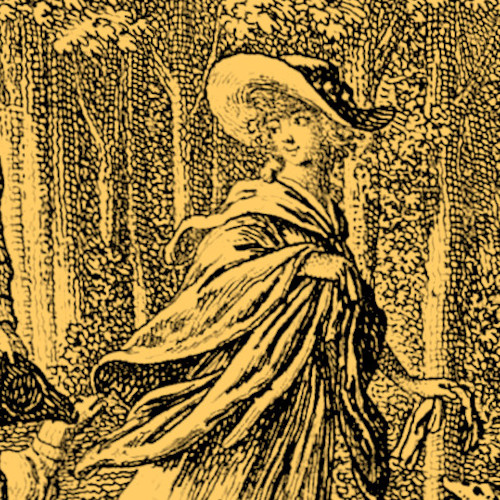
[7] Camille oder Briefe zweier Mädchen aus unserm Zeitalter. Aus dem Französischen, trans. Johann Friedrich Jünger, 4 vols. (Leipzig 1786–87); from Samuel Constant de Rebecque, Camille, ou Lettres de deux Filles de ce siècle, traduites de l’anglais sur les originaux, 2 vols. (Paris 1786). Caroline’s reference to multiple volumes in addition to vol. 1 suggests she has already read them all. Click on the following image to open a gallery of illustrations to the novel:
[8] Concerning the rather quirky succession of reviews of this novel, for Friedrich Schlegel’s assessment, see supplementary appendix 77.1. Back.
[9] Concerning Caroline’s later and slightly different view of such plunging “into the deep” (Werther) “amid the waves,” see the final lines of her letter to Wilhelm Schlegel on 4–5 April 1801 (letter 304).
The concluding quotation is from Goethe’s Die Leiden des jungen Werthers (Leipzig 1774), letter of 12 August, Weimarer Ausgabe 19:71; here The Sorrows of Young Werther, trans. R. D. Boylan, J. W. von Goethe’s Works (London 1903) 50: “She feels herself deserted, forsaken by the world; and, blinded and impelled by the agony which wrings her soul, she plunges into the deep, to end her sufferings in the broad embrace of death.” Caroline alters the German wording slightly. The original reads (Germ.): “um in einem rings umfangenden Tode alle ihre Qualen zu ersticken”; Caroline: “ersticken seine Qualen in einem rings umfangenden Tod.” Lotte Michaelis mentions this same passage in her letter to Caroline in November 1785 (letter 64); for the full text of this passage, see supplementary appendix 64.1. Back.
Translation © 2011 Doug Stott