
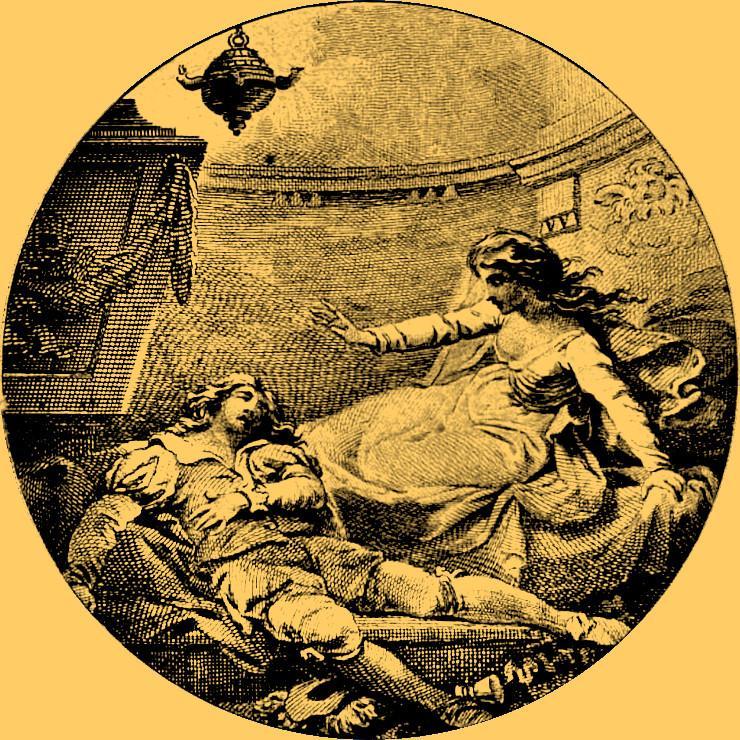
Caroline and Wilhelm Schlegel’s Translation of Shakespeare
The edition to whose initial volumes Caroline contributed was the following:
A. W. Schlegel, Shakspeare’s Dramatische Werke übersetzt von August Wilhelm Schlegel, vols. 1–8 (Berlin 1797–1801); vol. 9 (1810) (see the Project Bibliography for a list of individual volumes); new, revised, and annotated edition by Ludwig Tieck, 9 vols. (1825, 1830–33); revised edition by H. Ulrici and the German Shakespeare Society, 12 vols. (Berlin 1867–71). Numerous reprints.
See the Encyclopedia Americana (1919), 376:
His [Wilhelm Schlegel’s] universal receptivity for poetical values, together with his rare facility for linguistic expression, predestined him to be a translator of the first order. His translations from Shakespeare were his greatest artistic contribution to German literature. It is due to him that Shakespeare is hardly less known in Germany than in England. Only 17 plays of the so-called Schlegel-Tieck Shakespeare were translated by Schlegel (1797–1810); the remainder were added, from 1825 to 1833, by Graf Wolf Baudissin and (very inadequately) by Dorothea Tieck, while Tieck himself acted only as a reviser and annotator.
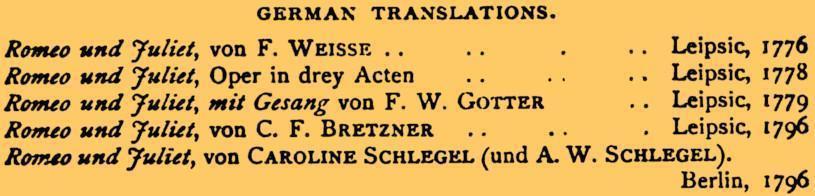
Certain editions of Romeo and Juliet list Caroline as the primary translator, e.g., the edition of H. H. Furness in 1899:
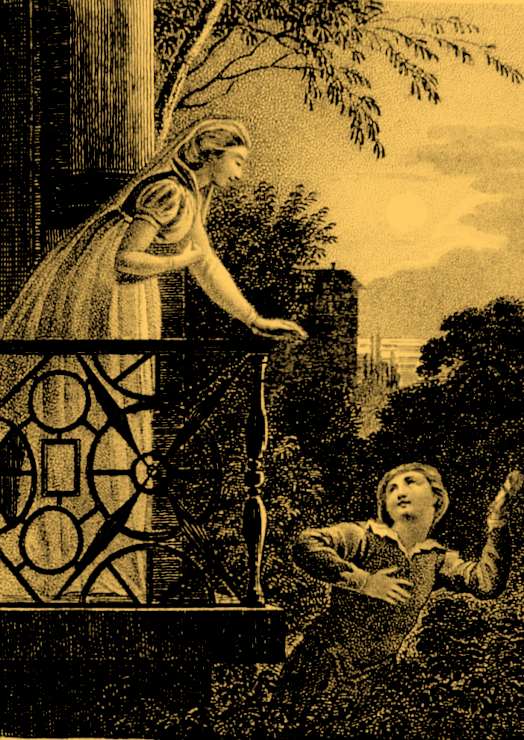
Caroline did try her hand independently on a translation of the Comedy of Errors; a lengthy, heavily corrected fragment has been preserved that Erich Schmidt intended to discuss along with several reviews in 1913 (his death that year, of course, prevented any further work on Caroline). In this context, however, see Schelling’s letter to Goethe on 17 September 1802 (letter 369f in present edition); Goethe responded on 18 September 1802 (letter 369g in present edition). The play was never performed.
Otherwise Erich Schmidt includes only a brief paragraph in the notes to the appendices to volume 2 concerning Caroline’s contribution to Wilhelm Schlegel’s translation of Shakespeare ([1913], 2:666):
The points made by Michael Bernays, and the criticisms leveled by Hermann Conrad and Rudolf Genée, suggest that a more thorough study still remains to be done concerning Caroline’s contribution to Wilhelm Schlegel’s translation of Shakespeare to determine the extent to which, during the process of copying, Caroline also arbitrarily made things worse through otherwise well-intentioned corrections or choices.
Although all three scholars did considerable work on this translation of Shakespeare, Schmidt cites Bernays only in general along with two studies by Conrad and one by Genée.
Because Conrad cites and otherwise takes considerable issue — and in considerable detail — with one of Bernays’s studies (Zur Entstehungsgeschichte des Schlegelschen Shakespeare), and because Conrad includes material from the second study cited for him (on The Merchant of Venice), a lengthier excerpt from Conrad’s study is presented here to give readers an idea of the nature of Caroline’s participation in Wilhelm’s translation of Shakespeare; a shorter excerpt from Genée on Romeo and Juliet is then appended to Conrad’s piece.
Erich Schmidt cites the following studies ([1913], 2:666):
♦ Michael Bernays:
(1) “Der Schlegel-Tiecksche Shakespeare,” Jahrbuch der deutschen Shakespeare-Gesellschaft 1 (1865), 396–405.
(2) Zur Entstehungsgeschichte des Schlegelschen Shakespeare (Leipzig 1872). Conrad takes issue with this study.
(3) “Vor- und Nachwort zum neuen Abdruck des Schlegel-Tieckschen Shakespeare,” Preussische Jahrbücher 68 (1891), 524–69.
(1) “On Caroline and the Translation of Shakespeare”, from:
“Karolinens Textentstellungen im vierten und fünften Akt des Kaufmanns von Venedig (Caroline’s textual distortions in acts 4 and 5 of The Merchant of Venice),” originally published (with a slightly different title) in Deutsche Revue 36 (November 1911), reprinted (slightly altered) in the appendix of Conrad’s Unechtheiten in der ersten Ausgabe der Schlegelschen Shakspere-Übersetzung (1797–1801): nachgewiesen aus seinen Manuskripten (Inauthenticities in the first edition of the Schlegel translation of Shakespeare, demonstrated on the basis of his manuscripts) (Berlin 1912) (reprinted material from Zeitschrift für französischen und englischen Unterricht [1912] issues 4–6, and Deutsche Revue 36 [Nov. 1911]).
(2) Shakespeares Kaufmann von Venedig (Leipzig 1912) (also cited in #1).
♦ Rudolf Genée:
A. W. Schlegel und Shakespeare: ein Beitrag zur Würdigung der Schlegelschen Übersetzungen (Berlin 1903). Excerpt appended to Conrad’s study above.
♦ Romeo and Juliet: Readers should also consult letters 186 and 187 in this present edition along with Caroline and Wilhelm’s essay on Romeo and Juliet, which appeared in Schiller’s periodical Die Horen (1797) 10, no. 6, 18—48:
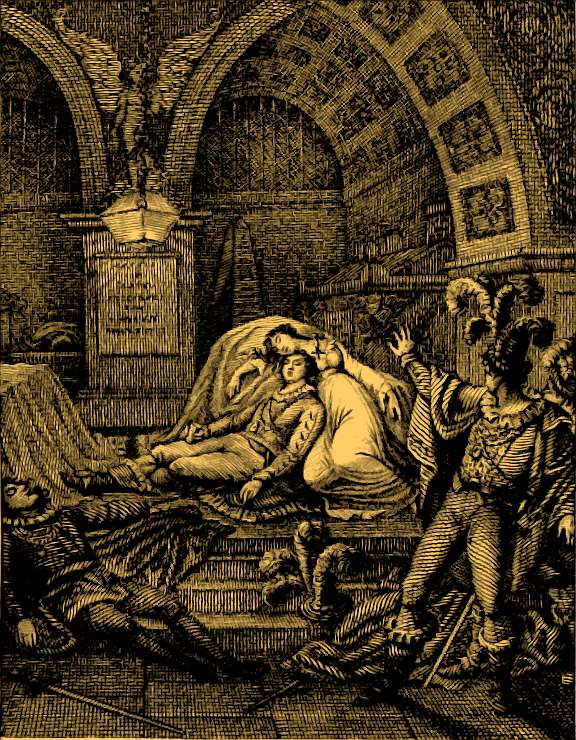
Wilhelm’s essay was then translated by Julius Charles Hare in 1820 as “A. W. Schlegel on Shakspeare’s Romeo and Juliet, with Remarks upon the Character of German Criticism.”
The Premiere of Hamlet in Berlin on 15 October 1799
Numerous references — both brief and lengthy — to August Wilhelm Iffland’s interest in Wilhelm’s (and Caroline’s) translation of Shakespeare and to the anticipated premiere of Hamlet in Berlin are found in a series of letters extending over approximately two years, between late 1797 and late 1799.
The following essay by Ella Horn provides a useful timeline and framework for organizing these references:
♦ Concerning the premiere of Hamlet and Wilhelm’s (and Caroline’s) eventually strained relationship with Iffland and his wife, see Ella Horn, “Geschichte der ersten Aufführung von Schlegels Hamlet-Übersetzung auf dem Kgl. Nationaltheater zu Berlin,” Jahrbuch der deutschen Shakespeare-Gesellschaft 51 (1915), 34–52, translated in this edition as “The Background to the Premiere of Wilhelm Schlegel’s Translation of Hamlet at the Royal National Theater in Berlin”.
It seems only two reviews of the premiere appeared:
♦ A review by the otherwise anonymous “M.,” “Über die Aufführung des Hamlet. Nach A. W. Schlegels Übersetzung,” Jahrbücher für die preussische Monarchie unter der Regierung Friedrich Wilhelms des Dritten (1799) 3 (September, October, November, December), 337–47. Pages 341–47 appear in translation here as “On the Berlin Performance of Hamlet in the Translation of A. W. Schlegel”.

♦ An anonymous review in the Berlin Zeitschrift für Freunde der schönen Künste, des Geschmacks und der Moden (1799) no. 2, 147ff.; see the translation of Alexander von Weilen’s discussion of this review (with a list of the original cast).