
• 268. Caroline to Luise Gotter in Gotha: Bamberg, 18 September 1800 [*]
Bamberg, 18 September 1800
|609| Let me briefly announce the sad prospect of soon seeing your unhappy friend again. |610| I want to visit my mother and sister, and we are thinking of traveling there not by way of Jena, but by way of Gotha and Göttingen, so I would like to rest for a day with all of you there. [1]
Hence might you be able to put me up in your apartment there for perhaps 2 nights? If you cannot easily accommodate Schlegel, he can sleep at the inn, and that would probably be best in any case since I must also inconvenience you with a maidservant who is to come from Jena and meet me in Gotha and whom I must take the liberty of directing to your house as well. [2]
I cannot tell you the exact day of our arrival, at least not yet, though it will be on one of the last days of this month. I just wanted to let you know beforehand, the postal service here is so disorganized that I do not even really know when you will receive this letter and thus could not hesitate sending it any longer. We will not be arriving so late at night that you would not be able to prepare another bed. [3]
In the meantime, please give my regards to my friends and let Madam Schläger know that we will be coming. But prepare yourself and your children to bear the sight of me; I only half live now and am wandering about like a shadow on this earth. [4]
Notes
[*] This letter is the first since Caroline’s letter to Schelling on Monday, 9 June 1800 (letter 262), which was co-written with Auguste. It is also the final letter in the main section of volume 1 of Erich Schmidt, (1913), viz., before the section in which he separates out Friedrich Schlegel’s letters to Auguste, which in this present edition are positioned chronologically among the other letters. Back.
[1] Caroline’s sister, Luise Wiedemann, lived in Braunschweig.
Wilhelm Schlegel and Caroline left Bamberg on 1 October 1800. They arrived in Gotha on 4 October 1800, then traveled to Göttingen (see Caroline’s letter to Schelling from Braunschweig in October 1800 [letter 270], in which she mentions hoping to write him from Göttingen), where they spent two and a half days, after which Wilhelm went alone to visit his mother in Hannover and Caroline back to Braunschweig (see Caroline’s later letter to Luise Gotter on 24 November 1800 [letter 275]).
Schelling and Johann Diederich Gries left the same day — 1 October 1800 — from Bamberg, accompanied Wilhelm and Caroline as far as Coburg, then took a different postal route to Jena (Post Karte Durch ganz Deutschland, ed. J. Walch [Augsburg 1795]):
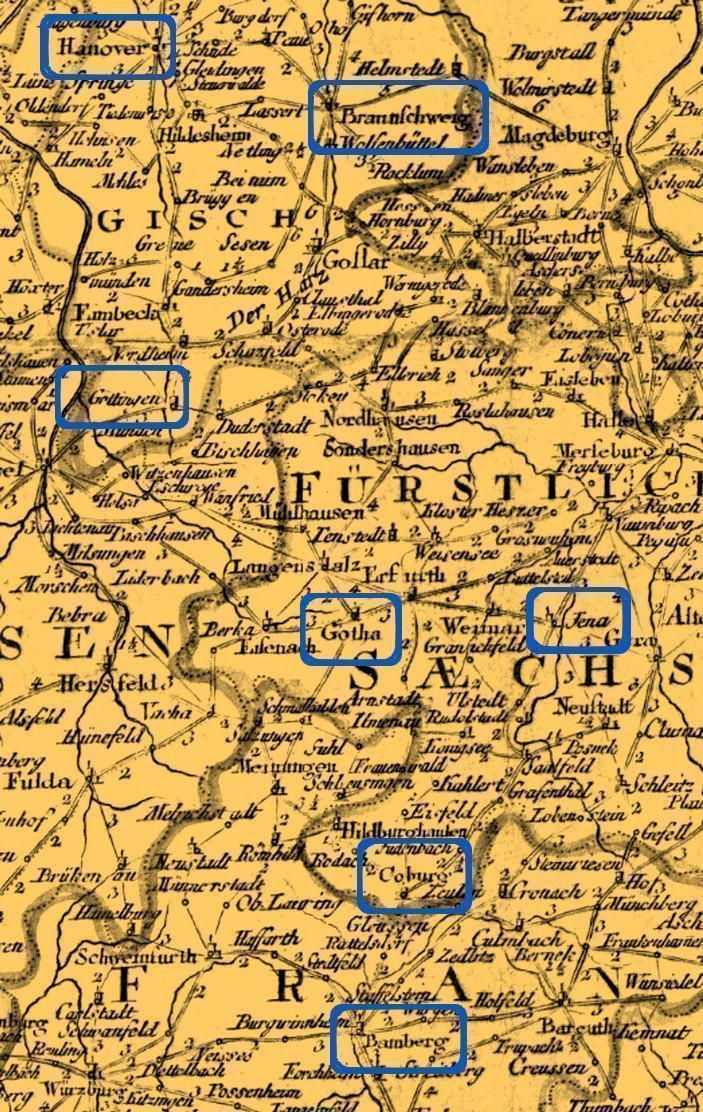
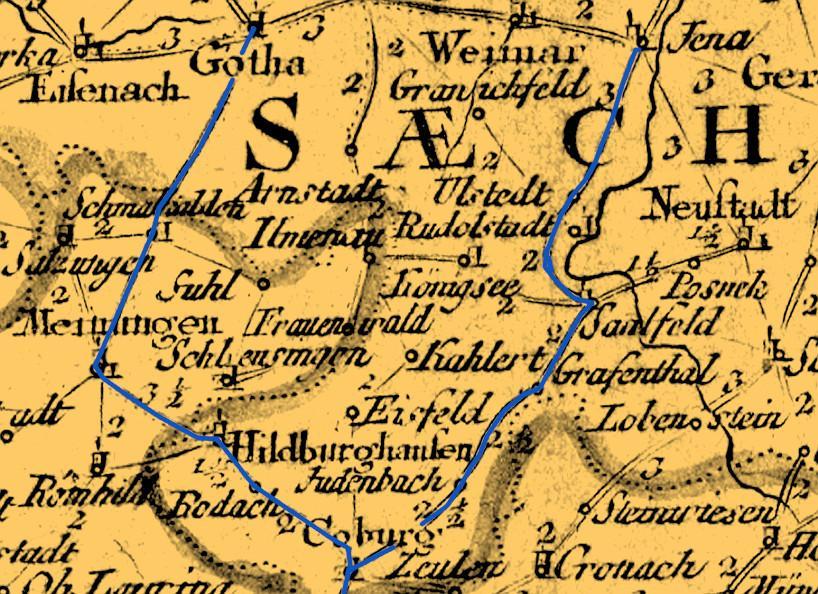
Charlotte Ernst writes to Wilhelm at the end of the year (cited in Josef Körner, [1930], 2:47): “You made my mother very happy indeed with your visit.” Friedrich Schlegel similarly asked Wilhelm to remember him to their family in Hannover (see his letter to Wilhelm on 30 September 1800 [letter 269a]).
The purpose of the stay in Göttingen — which prompted an anticipatory municipal rescript prohibiting Caroline from remaining there (letter/document 269) — was that of attending to inheritance issues involving Auguste. Brigitte Rossbeck, Zum Trotz glücklich: Caroline Schlegel-Schelling und die romantische Lebenskunst (Munich 2008), 196–97, recounts that Caroline was demonstrably in Göttingen prior to 15 October 1800, though without adducing documentation (as mentioned above, Caroline writes to Schelling from Braunschweig in October 1800 that “I will write you from Göttingen, God willing” [letter 270]).
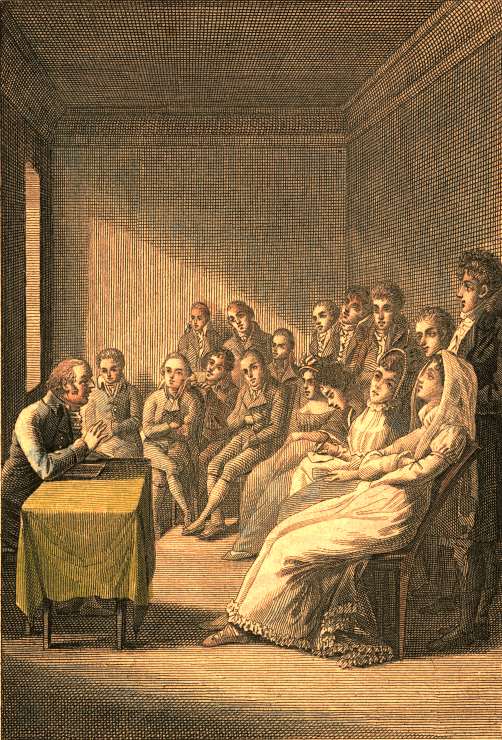
Caroline’s father-in-law, Georg Ludwig Böhmer, who had died in the late summer of 1797, had stipulated that Auguste’s inheritance, including interest, was not to be paid out until three years after his death. Here an attorney reads the last will and testament of the deceased to the assembled family (Der Freund des schönen Geschlechtes 1808):
Since Auguste was already deceased herself, Caroline came to a legal agreement with the executor of Böhmer’s will, Johann Friedrich Eberhard Böhmer, according to which Auguste’s inheritance, 2500 Reichsthaler, would be paid out to her in the spring of 1803 (Berlin-Brandenburgische Akademie der Wissenschaften, Schelling-Nachlass/898), shortly before — as it turned out — her departure from Jena forever with Schelling. Back.
[2] Frontispiece to Georg Christoph Kellner, Familiengeschichte der Rosenbusche: Aus authentischen Quellen, vol. 4 (Leipzig 1790):
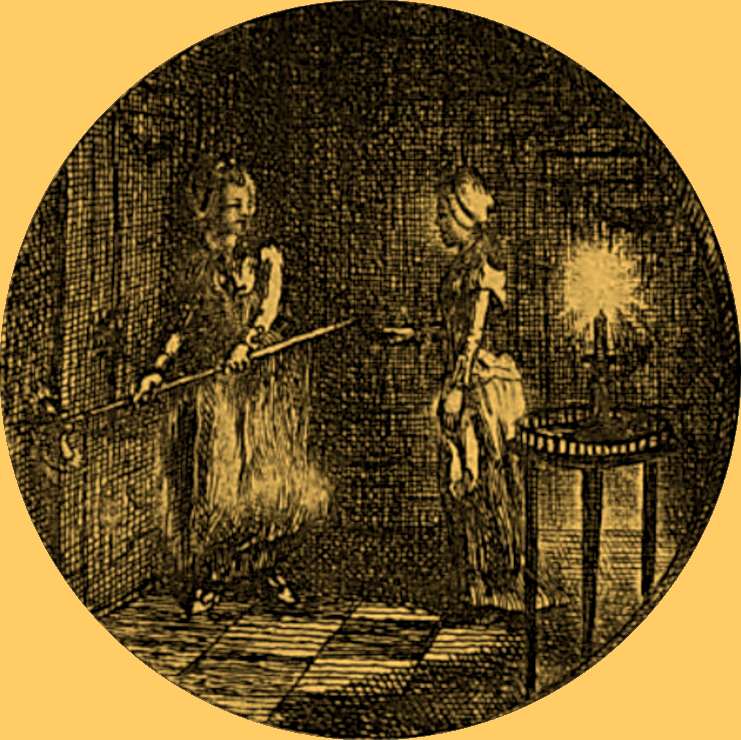
Concerning the maidservant, see Dorothea’s letter to Wilhelm on 4 September 1800 (letter 267b), note 2. Back.
[3] (1) Final illustration in Freiherr Adolph Knigge, Der Roman meines Lebens, in Briefen, vol. 2 (Riga 1781); (2) Almanach und Taschenbuch zum geselligen Vergnügen für 1799 (Becker); Inhaltsverzeichnis deutscher Almanache, Theodor Springmann Stiftung;
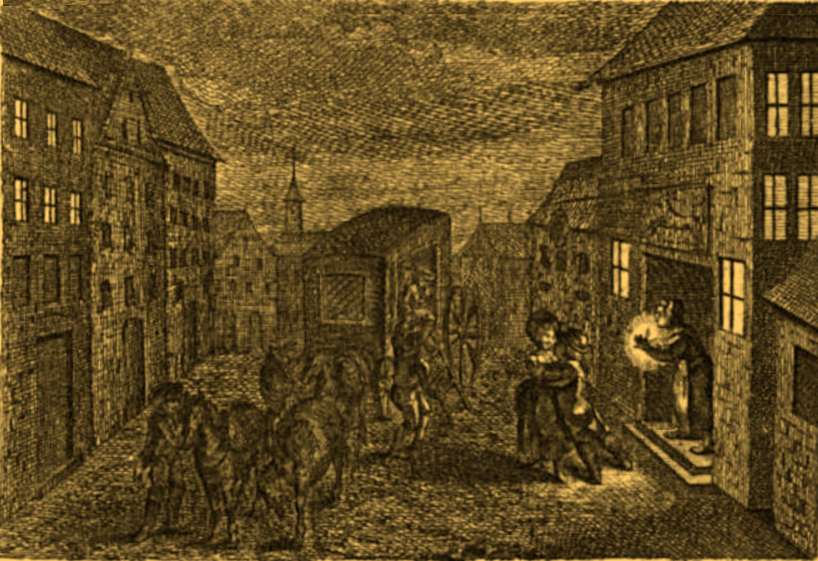

[4] Frontispiece to Georg Christoph Kellner, Familiengeschichte der Rosenbusche: Aus authentischen Quellen, vol. 2 (Leipzig 1790):
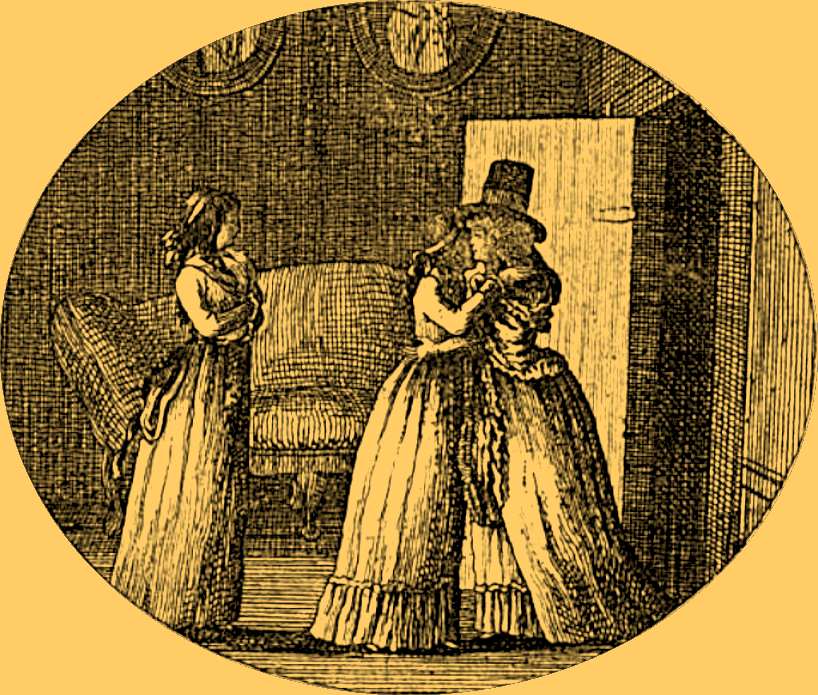
This visit was doubtless one of the most difficult and heartrending for Caroline and Luise Gotter and the latter’s daughters (frontispiece to August Lafontaine, Der Sonderling: ein Gemählde des menschlichen Herzens, vol. 1 [Vienna, Prague 1799]:
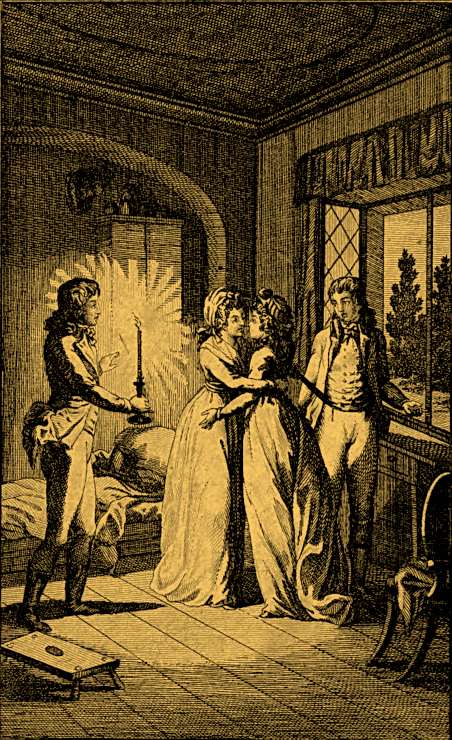
For another witness to Caroline’s disposition during this period and to the conclusion of this stay in Bamberg, see the account of Johann Diederich Gries’s visit with the Schlegels and Schelling in Bamberg during this same period, i.e., in late September 1800 (supplementary appendix 268.1). Gries had departed Frankfurt the day before this present letter was written. Back.
Translation © 2014 Doug Stott