
110a. Friedrich Schlegel to Wilhelm Schlegel in Amsterdam: Leipzig, 5 December 1791 [*]
[Leipzig] 5 December [17]91
The news in your last letter surprised me. [1] — Although I did suspect your intention to go to [Caroline] B[öhmer], this development seemed quite strange to me and — allow me to say this — your extremely manly behavior also almost surprised me. I did not think you capable of that. —
I understand your entire loss — I fear this letter may not find you in the best of spirits, hence I hope it can bring some source of comfort and strength. At the very least, I wish I could pour out all the ardor in my heart onto this page to assure you that you have at least one soul you can call your own.
I thank you for your trust and your news. Please continue to inform me of everything you are thinking and feeling, and be mindful especially to give me some historical background, something you promised in your last letter as well, then I will better be able to understand you and give my own assessment. All your steps have my complete approval. — Now, too, I find your plan to live in Mainz to be nothing less than a “risky, precipitate step,” and I would similarly not be entirely dissatisfied were you to return to Germany and lead this particular life. —
You believe that in this case it would have been quite difficult to assuage our parents. — But it is not that difficult to calm them down. — I cannot see what a civilian position, if such were also immediately open to you, would have over against that particular lifestyle, whereas the magnificent independence and the lilt the mind thereby receives cannot really be offset, not to mention that the path to such a career is never really closed and that with you it is not really an issue of now or later. —
My advice is that, unless your most rigorous demands be satisfied, you not embark on this eight-year service, which would rob you of the best part of your youth.
If [Caroline] B[öhmer] loved you, then perhaps you might also ignore the future in that sense and sacrifice everything. — I cannot tell you how pleased I am with the way you acted afterward, and if everything continues thus, you will be quite justified in saying that you have “gained more than lost.” You have escaped dominion, so might you now want to conclude an alliance? — I want to see whether one can forget female love through masculine love, and I challenge you to assess the advantages of such after a period of years. —
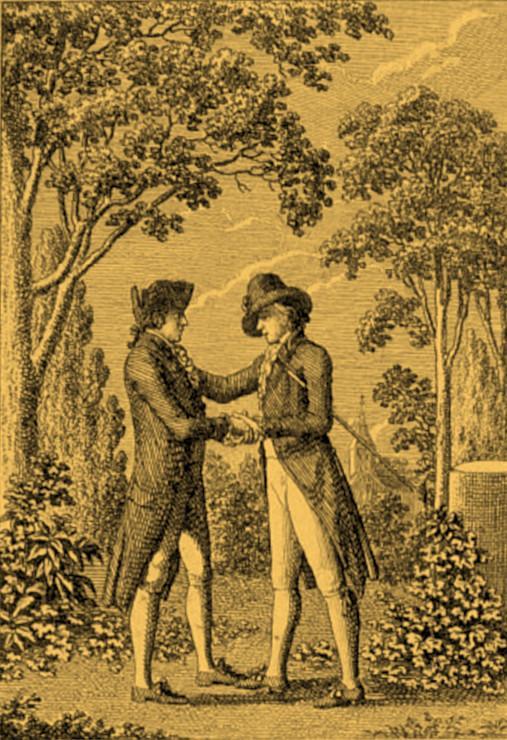
A lofty image of friendship is now dawning in the depths of my soul; if we ever live together again, this image shall become reality. [2] — Do not expect too much of me; — only in one respect may your demands be without limits, namely, with respect to love and sacrifice for you. — Do not think I am speaking in a rapturous condition I will soon forget. . . .
Notes
[*] Sources: Walzel, 29–30; KFSA 23:33. Back.
[1] In his previous letter to Wilhelm on 8 November 1791 (Walzel, 22; KFSA 23:28–29; Wilhelm’s own letters to Friedrich from this period have not been preserved), Friedrich speaks about having been disturbed by something Wilhelm had “touched on in so puzzling a fashion,” and asks Wilhelm to supply more details. Caroline had apparently declined Wilhelm’s offer of marriage, which would have involved his leaving Amsterdam and going with her to Mainz, where Caroline would move in February 1792; Wilhelm would have given up his well-paid position in Amsterdam for that of a freelance writer (to which Friedrich refers as “that particular lifestyle” later in the letter), though also the possibility, at least for the moment, of a civil career. Back.
[2] The notion of friendship increasingly became a theme for both men and women during the late eighteenth century, especially among members of what is broadly known as Romanticism, e.g., between Clemens Brentano and Achim von Arnim and between Bettina Brentano and Karoline von Günderrode (see the biogram for Friedrich Creuzer). See esp. also the editorial note to Caroline’s letter to Luise Gotter on 23 October 1782 (letter 34). Johann Diederich Gries was similarly ardently devoted to his circle of friends in Jena; see Caroline’s letter to Schelling on 9–10 May 1806 (letter 409), note 6.
Daniel Nikolaus Chodowiecki did several illustrations of “friendship” in connection with several other “human characteristics” in 1793 (Die Freundschaft [1793]; Herzog Anton Ulrich-Museum; Museums./Signatur DChodowiecki AB 3.968):
Translation © 2011 Doug Stott