
• 110. Caroline to Friedrich Wilhelm Gotter in Gotha: Göttingen, 13 November 1791
Göttingen, 13 November [17]91
|239| Upon my word, Sir, I cannot understand how you can yet be so bold as to assure me that you have no intention of lowering your admiration for me [1] — it seems I am a person who as a matter of fact is to be greatly admired indeed if all the characteristics with which you adorn my portrait genuinely apply. Because such brittleness is seldom found on this earth, it must doubtless represent a virtue — and having read only Grandison — well, that is innocence itself. [2]
It is true enough that my recollection of him at that time was quite vivid, since the previous evening I had had an argument concerning the novel with Herr Feder, who had just been reading it himself and who finds it to be a work of considerable taste — the taste of the highly educated is occasionally quite innocent indeed.
And yet he was unable to defend Miss Byron, [3] proof that she sinned against nature to a greater extent than even a philosopher can excuse — though Grandison admittedly did so as well, albeit only by excessively idealizing nature rather than by turning away from it completely — hence I would prefer not to be compared to her.
Call me cold if you will — should you find I have a poor understanding of life — but do not accuse me of affected behavior — and I beg also to allow me my own manner of sophistry — since it at least does not share one particular characteristic with that of Miss Byron, namely, that it dissolves into soap bubbles.
I also believe that, by virtue of my own, peculiar |240| manner — and without pretensions to the kind of radiance you so benevolently attribute to me — I may still make some claim to your admiration — did I not act justly toward a respectable man? And is that not the most gracious, meritorious service a woman can render? I could not demonstrate it any more effectively than by closing the door — nor did I do so out of coquettishness merely to prompt yet another knock — nor, however, can I boast of ignoring all considerations of propriety — if one does indeed proceed this openly and this carefully, can one then not hope to have made the most reasonable choice?
If it was such for me, then so also must it be for him. The more I appreciate a man, all the less would I want to be in a position to have to attribute sacrifices to him. If you find such reasoning to be sophistry — well, then do allow it such that one link in the chain of conclusions was missing!
My mother is infinitely obliged to you for the drawings [4] — she has not yet decided whether she wants to have one of them executed in marble, something that might be done in Blankenburg [5] — hence might she keep them yet? The inscription will be in Latin. —
I told Bürger so much about your Zauberinsel [Geisterinsel] that he has now expressed certain wishes that I am pleased to relate to you even though I am not yet quite so confident in supporting them — to wit, he would like to read it — perhaps to reshape on this same pattern the Midsummer Night’s Dream, which until now has been primarily a mere replica of the original whose purpose was more faithfulness to the original than an aesthetic enrichment of the theater. [6] If you feel comfortable entrusting me with it, I will promise not to let it out of my house — indeed, not even out of my own two hands — since I would in that case propose reading it to him myself in the hope that I might transfer into my own voice some of the character still resonating in my ears. [7] —
I read a new |241| theater piece by Iffland today — Die Kokarden — but I cannot deny that I found more evidence of his manner in it than of his spirit — to me it seems to be merely an even worse occasional piece than was Friedrich von Oesterreich. . . . [8]
One more thing — only now are you allowed to speak about the proven, enduring friendship of youth, and, if you will — to sing about it! To maintain love for one another during ten years’ separation can certainly attest the continuation of one particularly fortunate impression — but to see one another again — and even be of differing opinions in essential matters — perhaps different in both volition and desires — and then nonetheless to abide intimately within that previous love — such can only be the fruit of mutual, intimate conviction that not even ten sequential years spent together could extinguish — indeed, it is something worthy enough for Gotter — the singer of the firstborn child of the most charming of beings [9] — to celebrate once more in song.
Caroline Böhmer
Notes
[1] This letter is an answer to Gotter’s letter to Caroline on 3 November 1791 (letter 108). Back.
[2] Samuel Richardson, The History of Sir Charles Grandison in a series of letters published from the originals by the Editor of Pamela and Clarissa in seven volumes (London 1753–54). See Caroline’s letter to Luise Gotter on 31 October 1791 (letter 107), note 1, with cross references. — In his letter to Caroline on 3 November 1791 (letter 108), Gotter had quipped that Caroline’s “reading material does not seem to extend much beyond Grandison.” Back.
[3] Miss Byron (in English in original), one of the main characters in Richardson’s novel. Back.
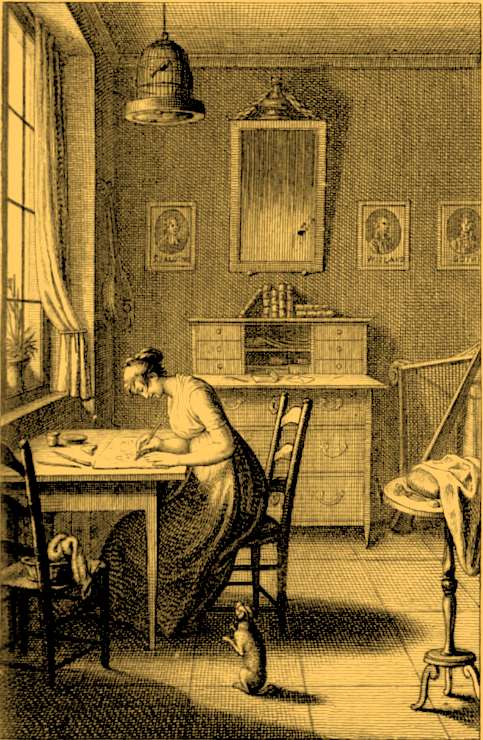
[4] For Johann David Michaelis’s grave marker, though the location of his grave is no longer known (Georg Friedrich Niemeyer, Vermaechtnis an Helene von ihrem Vater [Frankfurt 1809], following p. 12):
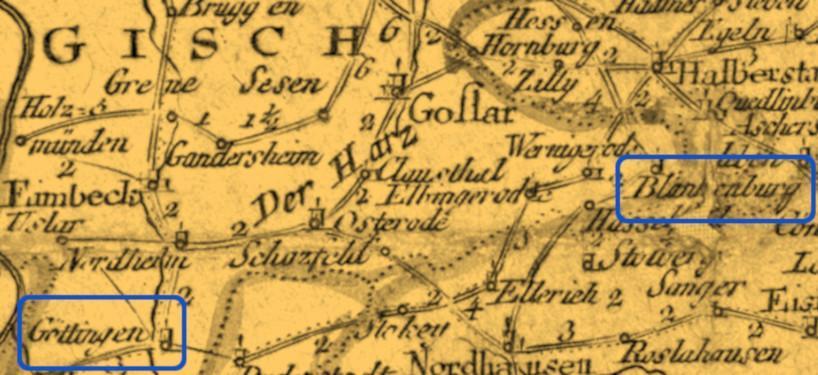
[5] Uncertain allusion; presumably Blankenburg in the Harz Mountains (Post Karte Durch ganz Deutschland, ed. J. Walch [Augsburg 1795]):
[6] Caroline was to contribute advice to the translation of the Midsummer Night’s Dream on which Gottfried August Bürger had previously worked, initially alone, then with Wilhelm Schlegel. The title of Gotter’s piece eventually became Die Geisterinsel. See Bürger’s letter to Wilhelm Schlegel on 31 October 1791 (letter 107a) with note 4. Back.
[7] That is, from when Gotter himself read it aloud. Back.
[8] August Wilhelm Iffland, Die Kokarden. Ein Trauerspiel in fünf Aufzügen (Leipzig 1791), an ultraconservative piece written at the behest of Leopold II but universally rejected and not subsequently incorporated into Iffland’s collected works.
Friedrich von Österreich. Ein Schauspiel aus der vaterländischen Geschichte in fünf Aufzügen (Gotha 1791), written for Leopold’s coronation in Frankfurt (9 October 1790), coolly reviewed by Wilhelm Schlegel, “A. W. Iffland, Friedrich von Oesterreich. Ein Schauspiel (Gotha 1791),” Göttingische Anzeigen von gelehrten Sachen (1791) 44 (17 March 1791), 439–40, here 440 (reprinted in Sämmtliche Werke 10:48–49, here 49):
. . . The haste with which the piece was written is also evident insofar as the characters are, as it were, drawn with a confused and uncertain hand. One of the inconvenient aspects of the historical drama is that a rather large number of secondary characters are generally necessary; the writer must either seek to avoid making such persons particularly significant and to draw the spectator’s attention merely to their actions rather than to their character as such, or he must be quite certain he is able to portray such characters with a few sure strokes. Here it is as if the secondary characters were jostling to possess and indeed to display their own character as well, and yet not quite succeeding.
One might also request more unity of language. To wit, one is occasionally displaced wholly into the age in which the action itself took place, but then frequently also encounters fresh morsels taken directly from our own decade. For example, the characters speak a great deal about feelings and then analyze them quite according to contemporary fashion. Back.
[9] The reference is to Pauline Gotter; see Caroline’s letter to Luise Gotter on 22 June 1785 (letter 57), note 7. Back.
Translation © 2011 Doug Stott