
• 109. Luise Gotter to Caroline in Göttingen: Gotha, 10 November 1791
Gotha, 10 November [1791]
|236| You can easily guess that the content of your letters did not make me particularly glad, my dear Caroline. [1] Although your unexpected declaration initially took me aback, the more I consider the matter the more I also believe one might have reason to hope, namely, that your declaration is in reality not as definitive as it seemed to me at first. Perhaps you merely wanted to test the man, to discern his real disposition toward you, perhaps you wanted to see whether he had sufficient courage and inclination to overcome such difficulties, or perhaps you imagined the whole matter to be less his work and |237| wish than that of your friends.
Hence, dear soul, do allow me yet to have a reasonable word with you, let me persuade you that you have indeed made a genuine, abiding impression on this man’s heart, that he does indeed appreciate your worth (as much as was possible after so short an acquaintance) and is hoping to find in you the happiness of his life.
And what most strongly persuades me concerning the seriousness and steadfastness of his intentions is that his attentions toward you are being made precisely at a moment when, as I know from reliable sources, his relatives in Berlin have been making suggestions to him which, were he reckoning matrimonial happiness according to external advantage and were he not being guided by the inclinations of his heart, might easily have made his intentions waver.
It was only at his insistent request that Mother Schläger could be moved to risk yet another attempt. Were you dealing with a young, impetuous person, he would probably have disclosed his wishes to you himself in a passionate enough tone; but you could not possibly expect a man of his age and character to begin corresponding with you without at least some semblance of hope from your side. [2]
As for the particular reasons you present in opposing the matter, they are, as my husband has quite rightly pointed out, merely lovely sophistry that does not stand up under closer scrutiny. Your imagination has chosen the most charming and delightful colors with which to embellish the plan you yourself have drawn up for your future life, envisioning only flowers along your path while forgetting that there will also be thorns, whereas with regard to the other plan, the plan that is offering itself to you quite on its own, you make a mountain out of every molehill.
How can a woman capable |238| of virtually anything so fear the lesser business of keeping a house, or the more difficult one of raising children, you, who more than any other woman possesses precisely the talent and energy required for this particular calling. Moreover, the children in question here are so charming that they are doubtless more capable of providing encouragement than of scaring someone off, and as far as the small family is concerned that is to come in the future, well, your own fertile imagination, which sees the members of such a family running around by the dozen, [3] has already (with your permission) given me considerable occasion to laugh most heartily.
But seriously, my dear Caroline, let me entreat you as urgently as possible to consider everything most carefully again before composing your answer to Mother Schläger, an answer that will in all likelihood decide things once and for all, and not to allow your decision to be influenced by excessively rapturous or enthusiastic notions of “freedom,” or allow yourself to be swept up by an exaggerated idea of selfless friendship into making a sacrifice you would later regret and which in the final analysis would not make your friend any happier. Moreover, as you yourself admit, you already have his complete approval. Nor can I see why a marriage should disturb the bonds of friendship between you two in the slightest. [4]
But enough of this; may heaven answer my devout and assuredly impartial wishes, though for now I intend to surrender myself to pleasant dreams, for it is late, and my eyes are getting heavy. May God grant that these wishes be soon transformed into reality.
L. G.
. . . One more important bit of news: our friend has put aside his venerable peruke and has for several days now been wearing his own hair; he is right handsome, indeed looks 10 years |239| younger. The day before yesterday, he appeared thus at our tea gathering. Everyone was paying him compliments on that account, and Wilhelmine and I whispered to each other what a terrible pity it was that Caroline was not there! [5]
Notes
[1] Josias Friedrich Löffler’s courtship of Caroline during her visit to Gotha earlier in the autumn of 1791 is discussed in letters 105–10, excepting 107a and 108a. Concerning the similarity between this series of letters and Jane Austen’s Pride and Prejudice: A Novel (London 1813), with Mr. Collins’s proposal to Elizabeth Bennet and the latter’s response, see also Caroline’s earlier letter to Luise and Friedrich Wilhelm Gotter on 27 October 1791 (letter 105), note 3.
Concerning Luise Gotter and her husband’s strategy over the course of these letters and esp. Luise Gotter’s rationale and argumentation in this present letter, and Caroline’s reactions, consider the following passage from Pride and Prejudice (illustration by Hugh Thomson, Pride and Prejudice [London 1894], 132):

“My reasons for marrying are, first, that I think it a right thing for every clergyman in easy circumstances (like myself) to set the example of matrimony in his parish; secondly, that I am convinced it will add very greatly to my happiness; and, thirdly, which perhaps I ought to have mentioned earlier, that it is the particular advice and recommendation of the very noble lady whom I have the honour of calling patroness. Twice has she condescended to give me her opinion (unasked too!) on this subject; and it was but the very Saturday night before I left Hunsford, between our pools at quadrille, while Mrs. Jenkinson was arranging Miss De Bourgh’s footstool, that she said, ‘Mr. Collins, you must marry. A clergyman like you must marry. Choose properly, choose a gentlewoman for my sake, and for your own; let her be an active, useful sort of person, not brought up high, but able to make a small income go a good way. . . .’
Allow me, by the way, to observe, my fair cousin, that I do not reckon the notice and kindness of Lady Catherine de Bourgh as among the least of the advantages in my power to offer. You will find her manners beyond anything I can describe; and your wit and vivacity, I think, must be acceptable to her, especially when tempered with the silence and respect which her rank will inevitably excite.”
“Accept my thanks for the compliment you are paying me. I am very sensible of the honour of your proposals, but it is impossible for me to do otherwise than decline them.”
“I am not now to learn,” replied Mr. Collins, with a formal wave of the hand, “that it is usual with young ladies to reject the addresses of the man whom they secretly mean to accept, when he first applies for their favour; and that sometimes the refusal is repeated a second or even a third time. I am, therefore, by no means discouraged by what you have just said, and shall hope to lead you to the altar ere long.”
“Upon my word, sir,” cried Elizabeth, “your hope is rather an extraordinary one after my declaration. I do assure you that I am not one of those young ladies (if such young ladies there are) who are so daring as to risk their happiness on the chance of being asked a second time. I am perfectly serious in my refusal. You could not make me happy, and I am convinced that I am the last woman in the world who would make you so. Nay, were your friend Lady Catherine to know me, I am persuaded she would find me in every respect ill qualified for the situation.”
“Were it certain that Lady Catherine would think so,” said Mr. Collins, very gravely — “but I cannot imagine that her Ladyship would at all disapprove of you. And you may be certain that when I have the honour of seeing her again I shall speak in the highest terms of your modesty, economy, and other amiable qualifications.”
“Indeed, Mr. Collins, all praise of me will be unnecessary. You must give me leave to judge for myself, and pay me the compliment of believing what I say. I wish you very happy and very rich, and by refusing your hand, do all in my power to prevent your being otherwise. In making me the offer, you must have satisfied the delicacy of your feelings with regard to my family, and may take possession of Longbourn estate whenever it falls, without any self-reproach. This matter may be considered, therefore, as finally settled.”
And rising as she thus spoke, she would have quitted the room, had not Mr. Collins thus addressed her, “When I do myself the honour of speaking to you next on the subject, I shall hope to receive a more favourable answer than you have now given me; though I am far from accusing you of cruelty at present, because I know it to be the established custom of your sex to reject a man on the first application, and, perhaps, you have even now said as much to encourage my suit as would be consistent with the true delicacy of the female character.”
“Really, Mr. Collins,” cried Elizabeth, with some warmth, “you puzzle me exceedingly. If what I have hitherto said can appear to you in the form of encouragement, I know not how to express my refusal in such a way as may convince you of its being one.”
“You must give me leave to flatter myself, my dear cousin, that your refusal of my addresses are merely words of course. My reasons for believing it are briefly these: — It does not appear to me that my hand is unworthy your acceptance, or that the establishment I can offer would be any other than highly desirable. My situation in life, my connections with the family of De Bourgh, and my relationship to your own, are circumstances highly in my favour; and you should take it into further consideration that, in spite of your manifold attractions, it is by no means certain that another offer of marriage may ever be made you. Your portion is unhappily so small, that it will in all likelihood undo the effects of your loveliness and amiable qualifications. As I must, therefore, conclude that you are not serious in your rejection of me, I shall choose to attribute it to your wish of increasing my love by suspense, according to the usual practice of elegant females.”
“I do assure you, sir, that I have no pretensions whatever to that kind of elegance which consists in tormenting a respectable man. I would rather be paid the compliment of being believed sincere. I thank you again and again for the honour you have done me in your proposals, but to accept them is absolutely impossible. My feelings in every respect forbid it. Can I speak plainer? Do not consider me now as an elegant female intending to plague you, but as a rational creature speaking the truth from her heart.”
“You are uniformly charming!” cried he, with an air of awkward gallantry; “and I am persuaded that, when sanctioned by the express authority of both your excellent parents, my proposals will not fail of being acceptable.” To such perseverance in wilful self-deception Elizabeth would make no reply, and immediately and in silence withdrew. Back.
[2] Josias Friedrich Löffler was thirty nine and would turn forty in January 1792; Caroline had just turned twenty-eight in September 1791. See below concerning his allegedly now appearing “10 years younger.” Back.
[3] Caroline had described the situation precisely such in her letter to Friedrich Ludwig Wilhelm Meyer on 29 October 1791 (letter 106):
I admittedly could have made myself quite useful to the state by keeping a proper household for him and by raising another half dozen children just like my own, one and only, dear little girl — but all that will happen just as well without me, and in that case no one’s happiness will be dismembered. Back.
[4] Concerning Georg Ernst Tatter, see Caroline’s letter to Luise Gotter on 31 October 1791 [letter 107]). Back.
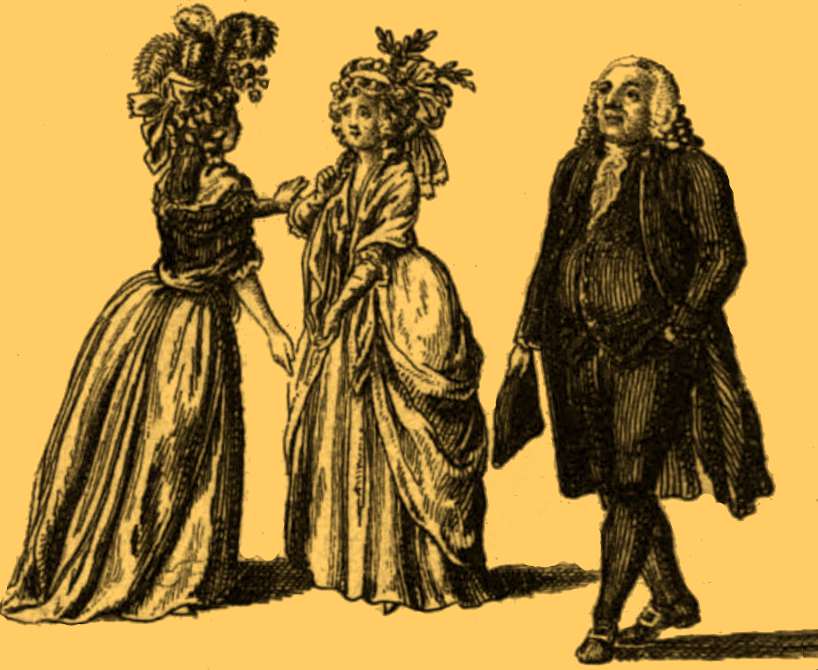
[5] Goettinger Taschen Calender für das Jahr 1791:
Here portraits of Josias Friedrich Löffler with and without a peruke (in order: [1] engraving by Johann Georg Schmidt, ca. 1790, i.e., contemporaneous with his acquaintance with Caroline; [2] frontispiece to Josias Friedrich Löffler, Kleine Schriften von Josuas Friedrich Christian Löffler nach seinem Tode gesammelt, vol. 3 [Weimar 1818]):

Translation © 2011 Doug Stott