
• 105. Friedrich Wilhelm Gotter to Caroline in Göttingen: Gotha, 27 October 1791 [*]
Gotha, 27 October [17]91
|226| It was not my phlegmatic disposition, but rather dietetic necessity that robbed me of the pleasure of enjoying the final moments of your stay here, my most precious friend. I was convinced even beforehand, however, that your gracious disposition would readily excuse this lack of attention on my part, and that a bit of teasing would constitute the entirety of my punishment.
|227| Even, however, had I participated in that particular eventide celebration of friendship, we would in all likelihood not have arrived at such a coherent and definitive explanation as you were gracious enough to leave behind for me with regard to the matter at hand.
As little as the content of this argument of the heart edified me with regard to the wishes of my own heart, just as much do I nonetheless appreciate your noble-minded candidness and irreproachable discretion, and pride myself on the honor of being deemed worthy of your complete trust in this matter.
I followed your instructions to the letter. I encouraged my friend in understanding that neither Mother Schläger nor I had overstepped the bounds of a half-jest toward you and that we had quite made do with lending to our casual hints more the appearance of a hasty, good-natured idea than of any sort of secret commission. Although, as I told him, I had reason enough to presume that the intimation of a possibly more serious purpose had awakened in you, [1] certain remarks had also prompted me to conclude the presence of considerable doubts and concerns that we would probably encounter along our intended path, something which, given my initial view of the plan, I in part had not at all expected and, given my own enthusiastic interest and anticipation of a successful conclusion to the whole, in part had simply overlooked.
I reassured him by pointing out that these doubts (as I ventured to maintain on the basis of my admittedly modest understanding of human nature) quite reliably concerned not so much the object of said choice as its nature; that one was not dealing here with a woman of the ordinary sort; that nothing having to do with propriety in the matter |228| would have the slightest influence on your decision; that your devotion to your plan of leading an independent life, once conceived, seemed all the more difficult to overcome the more removed you were from the frivolity of allowing yourself merely to be driven to and fro by the wind; and that, finally, this steadfastness of your character and personal experience (notwithstanding you had largely gotten to know only the more pleasant side of marriage) perhaps constituted the primary reason why the prospect of subjecting yourself to these circumstances and obligations for a second time would involve you in more than merely a single struggle.
To these explanations I added the request that he examine once more and with the coolest consideration both himself and all the circumstances and, indeed, even the secondary circumstances inseparably associated with such a step lest, without the most extreme urgency of his heart, he subject himself to the risk of a doubtful attempt of this sort. [2] —
And that is how things stand at the moment, and I do hope you will be satisfied with my comportment in the matter. [3]
May love complete what love has begun; and it will do just that — if indeed love it be. I will certainly be cautious lest I inappropriately anticipate its course or insinuate into it the desires of friendship.
Although the news of your safe arrival [4] filled our hearts with joy, we are returning your gratitude with a word of protest, for it is we who are infinitely obliged to you for having provided us with such blessed days through your unfortunately all-too-brief visit.
Please extend a thousand pleasantries to Mamsell Luise from me even should I not receive a single one of the thousand wonderful books concerning which she made such grand promises to me.
|229| Madam Luise can speak on her own behalf.
My friend is better even though he has not yet gone out, and I am to pass along his warm regards.
Although the children’s torrents of tears at your departure have dried, the radiance of joyous gratitude breaks forth anew among them each time they regard the sashes.
My sister joins in extending the warmest greetings of friendship.
And, finally, I myself respectfully kiss your hand.
Gotter
Notes
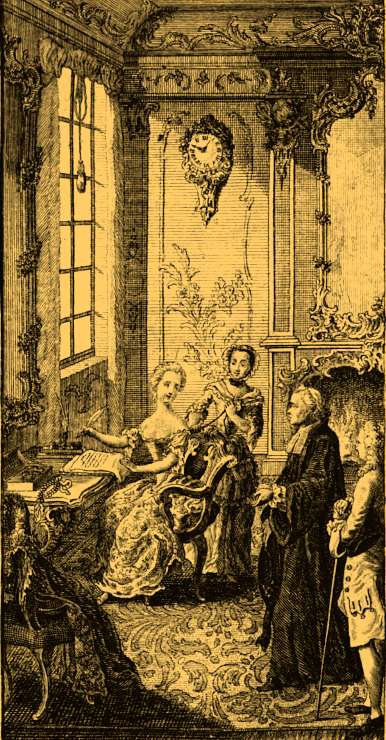
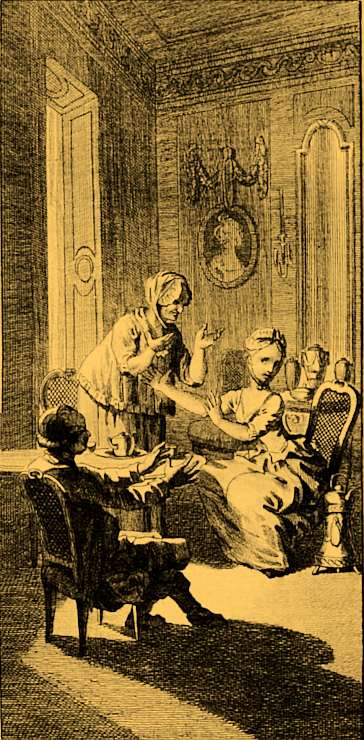
[*] Here Friedrich Wilhelm Gotter, and by proxy his wife, Luise, continues the part of the third-party wooer the two had already commenced on behalf of General Superintendent Josias Friedrich Löffler, who had courted Caroline during a visit she and Luise Michaelis made to Gotha presumably in October 1791 (Luise mentions this visit in her biography of Caroline, p. 79) ([1] frontispiece to Johann Timotheus Hermes, Geschichte der Miß Fanny Wilkes, vol. 2 [Leipzig 1770]; [2] Johann Timotheus Hermes, Sophiens Reise von Memel nach Sachsen, 2nd ed., vol. 5 [Leipzig 1776], following p. 588):
Gotha is located ca. 90 km southeast of Göttingen (Post Karte Durch ganz Deutschland, ed. J. Walch [Augsburg 1795]):

Löffler, known for his prolific homiletical production, had been in Gotha since 1788; his first wife, Dorothea Elisabeth, died in 1789. Gotter composed the following heartfelt verses a few months after the present letter, “An Herrn Löffler, 18 January 1792” (Literarischer Nachlass von Friedrich Wilhelm Gotter. Mit des Verfassers Biographie und seinem Bildnisse, ed. Friedrich von Schlichtegroll [Gotha 1802], lxxi):
To Herr Löffler.
18 January 1792.
Do enjoy the quiet happiness of the wise,
Of him who to the welfare of his brethren
Does consecrate his spiritual life,
Indifferent to whether in Germany's circles
Journalists' clubs do praise him,
Delighting instead in inner contentedness
Heartfelt intimacy,
And ardently childlike gratitude,
In the shelter of his Lares.
Concerning the touching allusion to the Lares, see William Smith, A Smaller Classical Dictionary of Biography, Mythology, and Geography, 11th ed. (London 1868), s.v.:
Lares, inferior gods at Rome, may be divided into 2 classes, Lares domestici and Lares publici.
The former were the Manes of a house raised to the dignity of heroes. The Manes were more closely connected with the place of burial, while the Lares were the divinities presiding over the hearth and the whole house. It was only the spirits of good men that were honoured as Lares. All the domestic Lares were headed by the Lar familiaris, who was regarded as the founder of the family; he was inseparable from the family; and when the latter changed their abode, he went with them. Among the Lares publici we have mention made of Lares praestites and Lares compitales.
The former were the protectors of the whole city; the latter were those who presided over the several divisions of the city, which were marked by the compita, or the points where two or more streets crossed each other. The images of the Lares, in great houses, were usually in a separate compartment, called lararia. When the inhabitants of the house took their meals, some portion was offered to the Lares, and on joyful family occasions they were adorned with wreaths, and the lararia were thrown open.
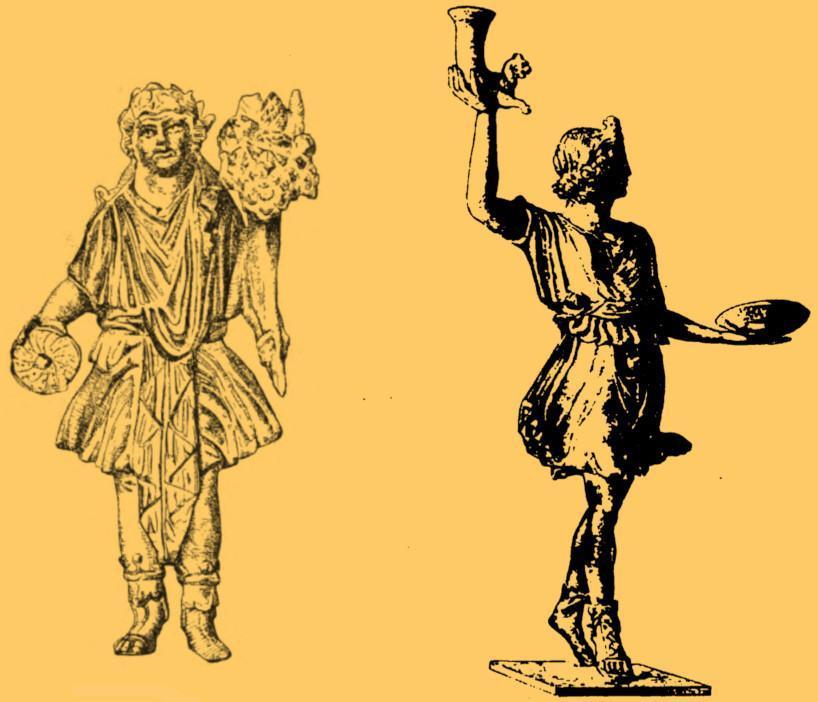
The following illustrations depict different stylings of lares in Roman history (Margaret C. Waites, “The Nature of the Lares and their Representation in Roman Art,” American Journal of Archaeology: The Journal of the Archaeological Institute of America 24 [1920] second series, 241–68, here 252):
[1] Viz., a proposal of marriage. Back.
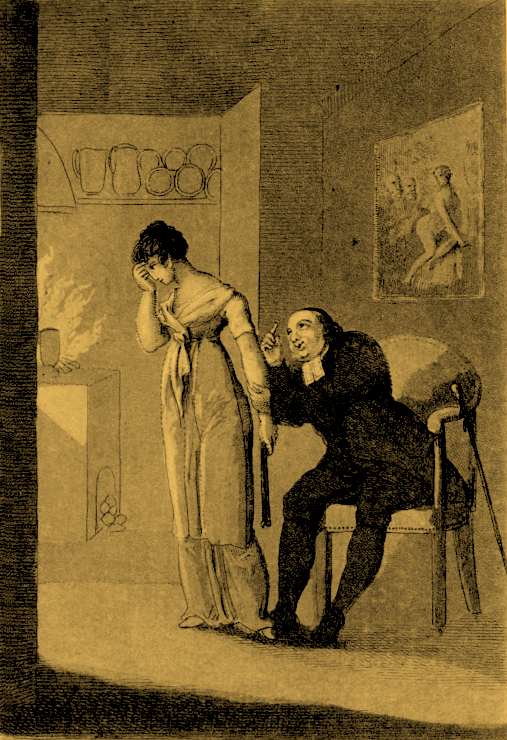
[2] Both Löffler and, of course, Gotter were doubtless apprehensive that if the clergyman himself were to approach Caroline with such an offer, the resulting scene might well resemble the following (Neoterpe: Auf das Jahr 1810; Inhaltsverzeichnis deutscher Almanache, Theodor Springmann Stiftung):
Here similar portrayals of (1) an encounter in which the man is indeed uncertain and insecure, with the accompanying text “I stood there, I think, foolish and awkward enough,” and (2) the conceivably awkward conclusion to such a meeting ([1] Daniel Nikolaus Chodowiecki, Ich stand da, albern und betroffen genug [1794]; Herzog August Bibliothek; Museums./Signatur Chodowiecki Sammlung [6-444]; [2] Theater-Kalender, auf das Jahr 1787; Inhaltsverzeichnis deutscher Almanache, Theodor Springmann Stiftung ):

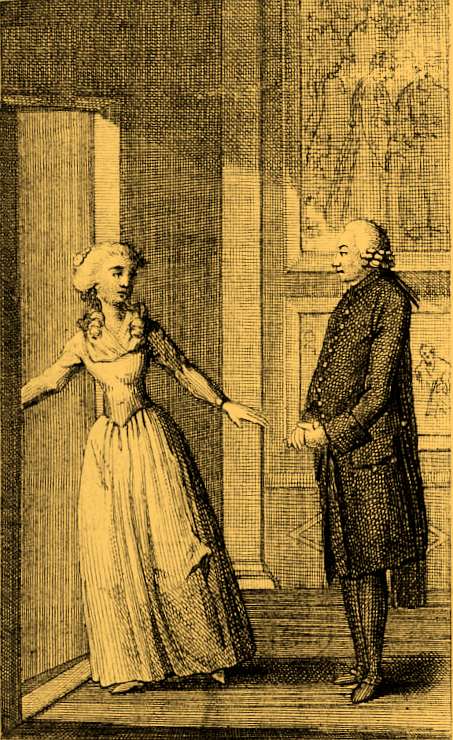
[3] Here a portrayal of such a marriage proposal when the clergyman himself rather than a go-between makes the offer in person (Daniel Nikolaus Chodowiecki, Heirahts Antrag des Predigers [1781]; Herzog Anton Ulrich-Museum; Museums./Signatur Chodowiecki Sammlung [3-190]):

One is, of course, reminded of Mr. Collins’s proposal to Elizabeth Bennet and the latter’s reaction in Jane Austen’s Pride and Prejudice: A Novel, 3 vols. (London 1813), a novel set essentially contemporaneous with the setting in this letter (illustration by Hugh Thomson, Pride and Prejudice [London 1894], 132):

See esp. Caroline’s quite similar reaction in her continuing correspondence during the coming weeks with Friedrich Wilhelm Gotter and Luise Gotter (letters 107, 108 109, 110). Back.
[4] Back in Göttingen after visiting the Gotters in Gotha. Back.
Translation © 2011 Doug Stott