
• 154. Caroline to Luise Gotter in Gotha: Braunschweig, 20–21 August 1795
Braunschweig, 20 [–21] August [17]95
|367| How precise you are with your calculations in your letters, my good Louise — you doubtless think you must not write |368| because there is some doubt concerning exactly who answered last. Frugal soul! Or have you genuinely lost sight of me? I myself have been almost too diligent, otherwise I would have inquired about it; the trade fair gave us much to do. You should see how eye-catching our works were in the gallery. And almost everything did indeed sell under a foreign firm. It will probably go even better another time. [1]
You can imagine how greatly I welcomed the news that the manuscript had been sent off and that I had engaged my zeal needlessly. [2] I have since heard nothing more from Göschen, otherwise I would doubtless be able to calm your excessively modest mistrust with more specific news. But how can you say that the work has not yet passed the censorship of connoisseurs? Did not we admire and criticize it?
What have your children been doing? [3] Do they still love me and my child? Not a day goes by that I do not speak about all of you with Gustel, and you would certainly see proof of that more often if only the days did not fly by so quickly. Although I never lack for work, I never have enough time despite the fact that I never play casino. [4] Nor has good weather robbed us of particularly much time this summer.
The theater is similarly not at fault — it is not good enough for that. The best thing I have seen was a piece to which the Braunschweig residents react like — like I know not which people — as in the verse: “Amor, lord of the gods and of human beings” [5] — they are in love with it and hear and see nothing except Der grosse Bandit. Read it for yourselves — the title is actually Abällino. [6] The piece is certainly striking enough and is performed quite well here. Indeed, if our children could see it together, they would be enormously entertained.
The latest news is that I have heard from our friend in Berlin through |369| a third party. Madam Campe was there, made his acquaintance by chance, and thereafter saw him almost daily. I did not say a word to her about any Berlin acquaintances before her trip, so I must probably believe that she really did receive the plethora of greetings she brought back to me from Zöllner, Biester, etc. She mentioned Meyer last — she said they spoke a great deal about me — that he started and threw up his hands when he heard I was here — and that I allegedly have a warm and upright friend in him.
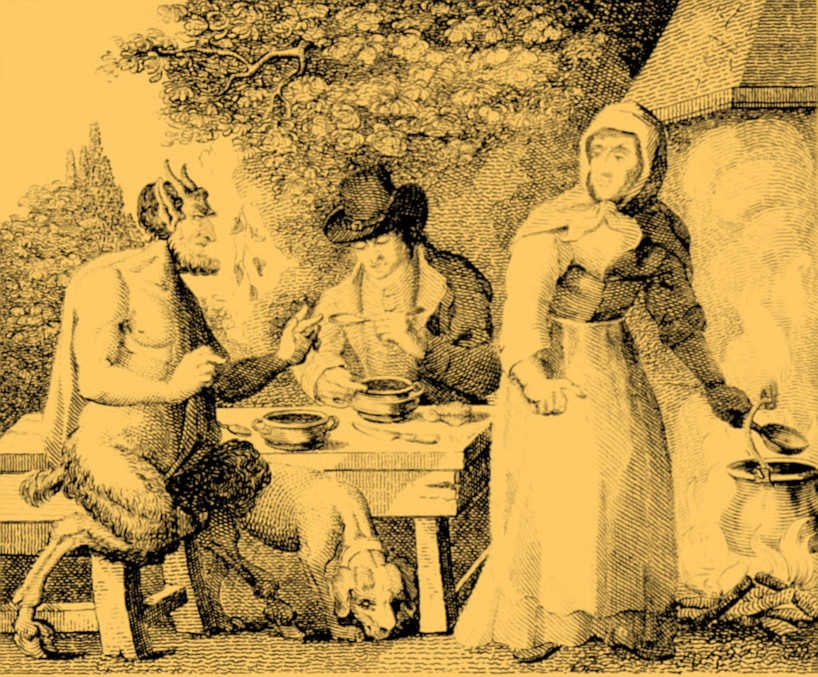
Now, you tell me whether that is not the person in the fairy tale who is able to blow hot and cold from his mouth at the same time? [6a] I would wager that all this did not proceed without certain anecdotes being related. He is leading an extremely orderly life, she tells me. That is a virtue of his egoism. He is no longer an aristocrat, presumably because people in Berlin in general are starting to give in to their inclinations for France and may do so publicly because it now involves an ally; [7] hence he, too, deemed it appropriate to conform. He completely played the democrat toward Madam Campe and praised Braunschweig as the premier city in Germany. She was quite captivated by his wit. Of course, it does indeed require wit to assert certain things. . . .
21 August
I am not yet finished — but let me relate something myself instead of asking questions. Bollmann, La Fayette’s rescuer, if we may take the intention for the deed, since as a matter of fact the poor fellow languishes yet in an extremely harsh prison [8] — Bollmann has been released and came through here on his journey to England. [9] He visited the Campes, with whom he was already acquainted.
According to his own account, he has endured much, though once he gets to America, where he is thinking of settling, he will |370| be sufficiently rewarded. Féronce was very eager to see him — he had learned by accident that he would come, and had asked the general who receives gate-toll receipts to inform him immediately — except that by the time the receipt got to him, Bollmann had already left. Féronce queried absolutely everyone about him. Once upon a time, Bollmann could never have imagined he would one day become so interesting. [10] . . .
Notes
[1] See Eduard Döring, Handbuch der Münz- und Wechselkunde: oder, Erklärung der Wechsel-, Geld- und Staatspapiere-Kurszettel (Frankfurt am Main 1837), 109–10: Two trade fairs were held annually in Braunschweig: (1) the first commenced on the Thursday of the week of 2 February, on which the purificatio Mariae was celebrated (the Feast of the Presentation, i.e., of the infant Jesus and Mary’s purification); (2) the second commenced on the Thursday of the week of 10 August, on which the Feast of St. Lawrence was celebrated. Should either celebration fall on a Thursday, the corresponding trade fair was moved to the Thursday of the preceding week.
Wholesale business began the preceding Monday and was permitted to the Thursday of commencement. The trade fair itself then continued to the following Thursday, so that the overall business lasted eleven days.
In 1795, 10 August fell on a Monday; hence the August trade fair proper commenced on Thursday, 13 August 1795 and continued to Thursday, 20 August 1795, i.e., the day on which Caroline begins her letter here. That is, the trade fair had just concluded this same day.
Caroline’s allusion here is presumably to embroidery. Caroline and possibly Luise herself were skilled at the art form; see Friedrich Schlegel’s letter to Wilhelm Schlegel on 23 October 1793 (letter 135.3) and Sophie von La Roche’s letter to Luise on 25 February 1794 (letter 142a). Back.
[2] See Caroline’s letter to Georg Joachim Göschen on 9 August 1795 (letter 152d) with note 3 (with cross references). Back.
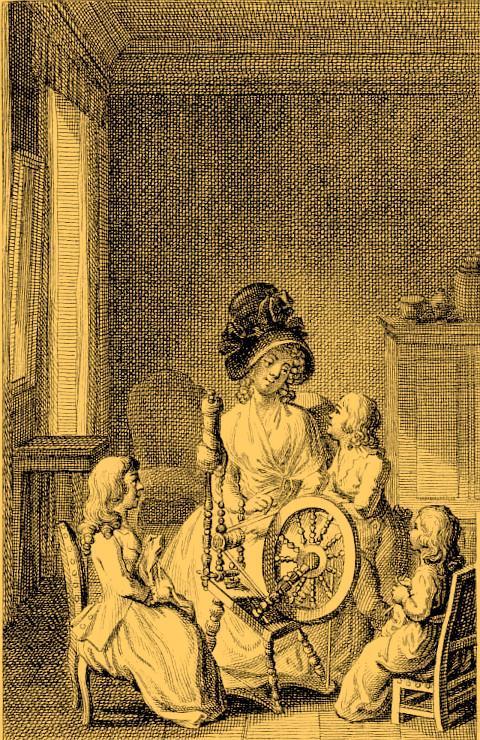
[3] The Gotters’ three daughters, Cäcilie, Julie, and Pauline (representative illustration with two daughters and a son: Leipziger Taschenbuch für Frauenzimmer zum Nutzen und Vergnügen, aufs Jahr 1790):
[4] Casino, a fishing-card game that first appeared at the end of the eighteenth century in London and shortly thereafter in Germany. Back.
[5] Possibly a conflation of lines from Psyche (Psiché), the ballet by Molière, Philippe Quinault, and Pierre Corneille, with music by Jean-Baptiste Lulli, first produced in January 1671, an adaptation of the fable of Cupid and Psyche from Apuleius. In act 4, scene 3, Psyche speaks with Cupid (illustration: The Dramatic Works of Molière, vol. 5, trans. Henri van Laun [Edinburgh 1876], 408):
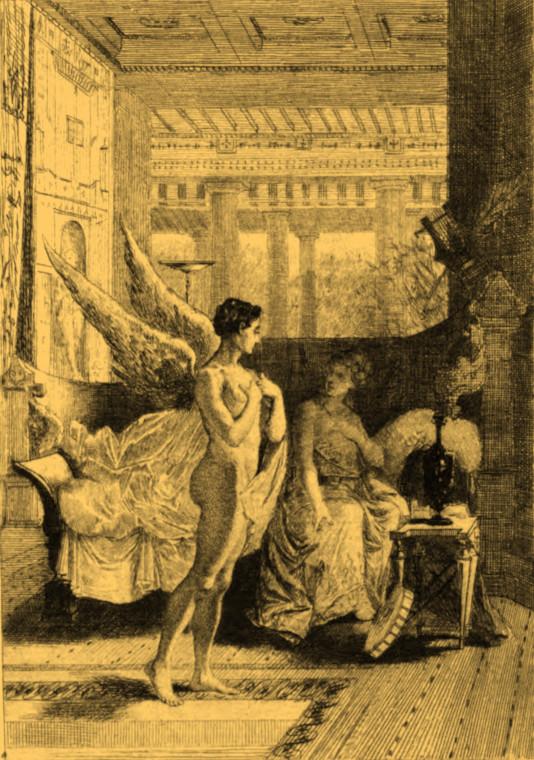
In the immediately following scene, act 4, scene 4, after Cupid has departed, Psyche then speaks to the River God (ibid., 412):
Oh Heaven! when Cupid abandons me, why does he leave me the love which he gave me? Source of all good inexhaustible and pure, master of men and of gods, dear author of the ills which I endure, are you for ever vanished from my sight? Back.
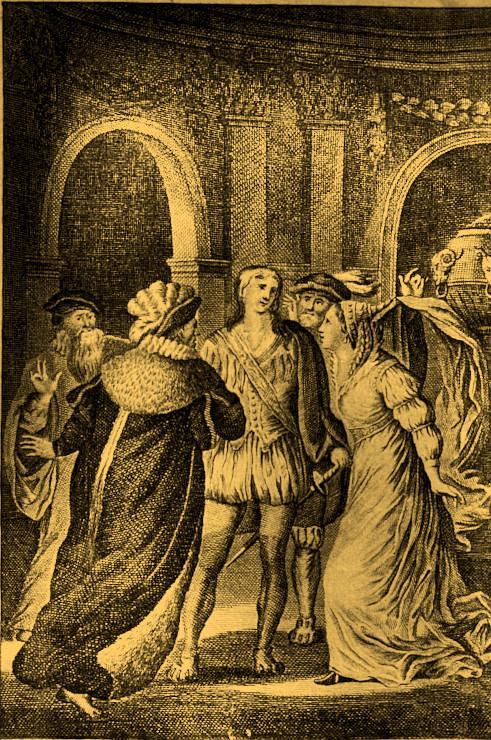
[6] Heinrich Zschokke, Abällino der grosse Bandit: Ein Trauerspiel in 5 Aufzügen, nach der Geschichte dieses Namens von demselben Verfasser (Leipzig, Frankfurt/Oder 1795) (English translation, Abaellino. The Great Bandit. A Grand Dramatic Romance in Five Acts, trans. William Dunlap [New York 1802]), the dramatic adaptation of his own novel, Abällino. Der grosse Bandit, which had appeared the previous year (Frankfurt, Leipzig 1794) (note title discrepancy in Goedeke, vol. 3, section 2 [Dresden 1881], 668: Abällino [1794 novel], Abellino [1795 play]). Here the frontispiece to the translation Abällino, de groote bandiet: Treurspel (Amsterdam 1798):
See Jess Nevins, The Evolution of the Costumed Avenger: The 4,000-Year History of the Superhero (Santa Barbara 2017), 84 (illustration from Gotthelf Wilhelm Rupert Becker, Einige Charaktere aus den Darstellungen der churfürstlichen sächsischen Hofschauspielergesellschaft [Leipzig 1804]):
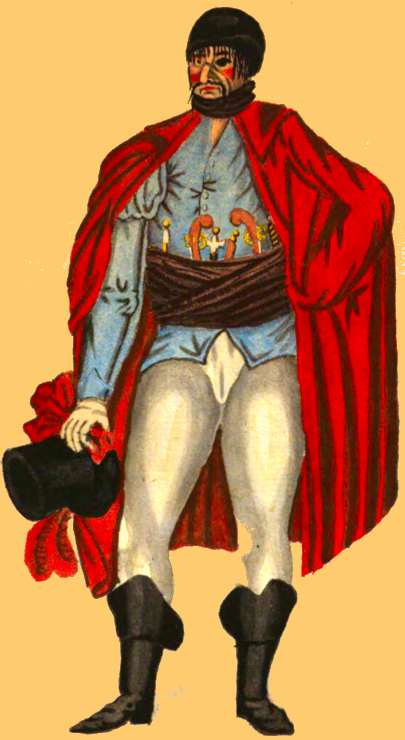
Heavily influenced by it [Schiller’s Die Räuber (Frankfurt, Leipzig 1781], but an influential best seller in its own right, was Heinrich Zschokke’s Abällino der grosse Bandit (1794). Set in Venice, Abällino is about Count Rosalvo, who has taken on himself the onerous task of ridding Venice of conspirators, thugs, and assassins. He does this using two assumed identities: one is Flodoardo, a handsome, virtuous man who labors unceasingly to improve Venice; the other identity is Abällino, a huge, monstrous, and ugly outlaw. Ultimately Rosalvo succeeds in capturing and trapping all the criminals of Venice and turning them over to the friends and advisers of the Doge. Back.
[6a] The Fables of Aesop: With a Life of the Author: and Embellished with One Hundred & Twelve Plates, 2 vols. [London 1793], 103–6:
The Satyr and the Traveller
A Satyr, as he was ranging the forest in an exceeding cold, snowy season, met with a Traveller half-starved with the extremity of the weather. He took compassion on him, and kindly invited him home to a warm comfortable cave he had in the hollow of a rock. As soon as they had entered and sat down, notwithstanding there was a good fire in the place, the chilly Traveller could not forbear blowing his fingers’ ends. Upon the Satyr’s asking him why he did so, he answered, that he did it to warm his hands.
The honest sylvan having seen little of the world, admired a man who was master of so valuable a quality as that of blowing heat, and therefore was resolved to entertain him in the best manner he could. He spread the table before him with dried fruits of several sorts; and produced a remnant of cold cordial wine, which, as the rigour of the season made very proper, he mulled with some warm spices, infused over the fire, and presented to his shivering guest.
But this the Traveller thought fit to blow likewise; and, upon the Satyr’s demanding a reason why he blowed again, he replied to cool his dish. This second answer provoked the Satyr’s indignation as much as the first had kindled his surprise: so, taking the man by the shoulder, he thrust him out of doors, saying, he would have nothing to do with a wretch who had so vile a quality as to blow hot and cold with the same mouth.
Application
Though the poor Traveller in the fable was not guilty of any real crime in what he did, yet one cannot help approving the honest simplicity of the Satyr, who could not be reconciled to such double dealing. In the moral sense of the fable, nothing can be more offensive to one of a sincere heart, than he that blows with a different breath from the same mouth; who flatters a man to his face, and reviles him behind his back.
Some again, just like this man, to serve a present view, will blow nothing but what is warm, benevolent, and cherishing; and, when they have raised the expectations of a dependent to a degree which they think may prove troublesome, can, with putting on a cold air, easily chill and blast all his blooming hopes.
But such a temper, whether it proceeds from a designed or natural levity, is detestable, and has been the cause of much trouble and mortification to many a brave deserving man. Unless the tenor of a man’s life be always true and consistent with itself, the less one has to do with him the better. Back.
[7] Since the Treaty of Basel between France and Prussia on 5 March 1795. Back.
[8] I.e., not Bollmann, but Lafayette, who would not be released until 19 September 1797. Back.
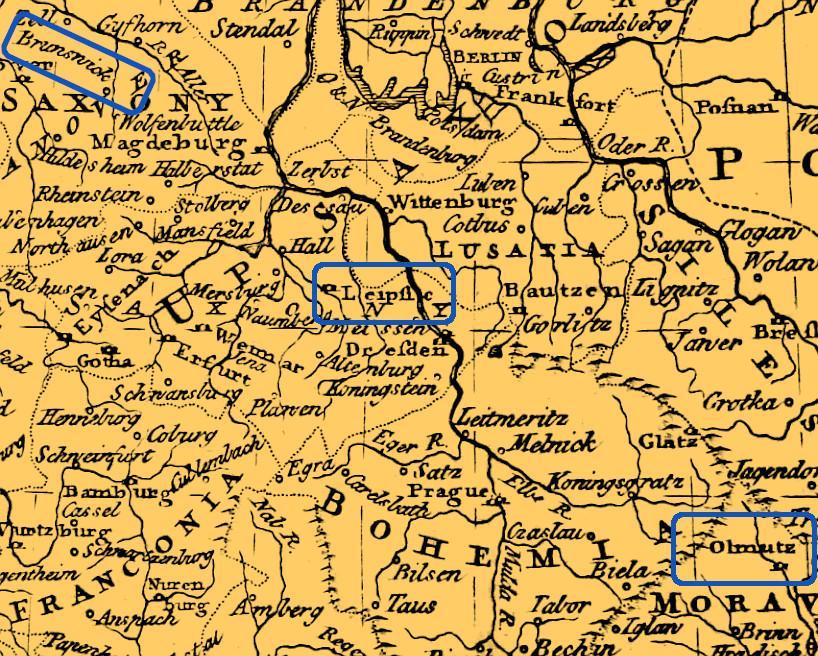
[9] According to an essay by Karl August Varnhagen von Ense (as related by Friedrich Kapp, Justus Erich Bollmann. Ein Lebensbild aus zwei Weltteilen [Berlin 1880], 209–50), on 8 November 1794 Justus Erich Bollmann boldly attempted to free Marie-Joseph Marquis de Lafayette from the Olmütz dungeon in Austria (contemporary Olomouc, Czech Republic; Thomas Kitchin, Map of Germany [ca. 1780]; illustration: Raymond Augustin Vieilh de Varennes, Olmütz Prison):

Kapp provides an extensive and detailed account of Lafayette’s imprisonment beginning with his being taken into coalition custody on 19 August 1792 after his flight from Paris, his various transfers under coalition guard, and especially — drawing from varied sources — Bollmann’s attempt, along with an American whom he recruited in Vienna, Francis Kinloch Huger, to free Lafayette by surprise and, as it turned out, by force during one of the latter’s carriage rides that took him outside not only the prison, but also Olmütz itself on doctor’s orders (Lafayette’s attempted escape from the Austrians at Olmutz with the aid of the young American, Francis Huger, 8 November 1794, after Felix O.C. Darley [1858]):
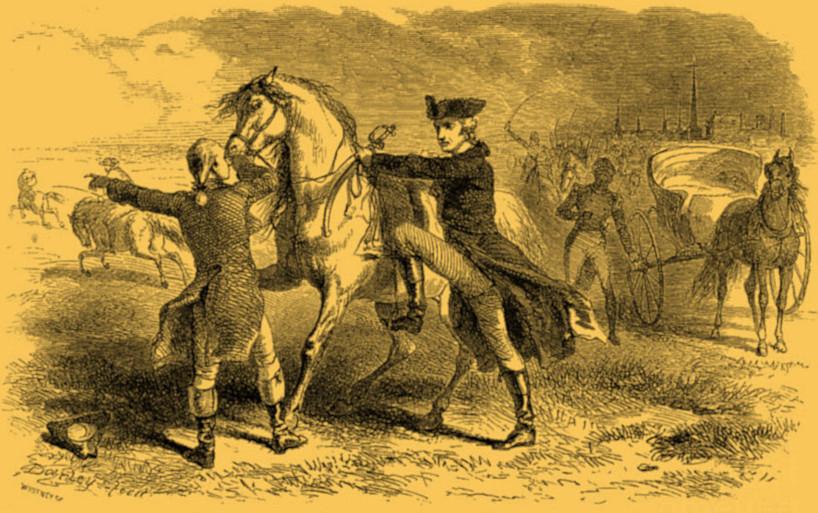
The plot is replete with multiple episodes of reconnoitering between Vienna and Olmütz, smuggled letters, secret notes written in invisible ink (lemon juice), false starts, unforeseen events (Lafayette severely underestimated the courage of the enlisted soldier who accompanied him and whom he tried, with Bollmann and Huger’s help, to overcome), poor luck (one of the getaway horses bolted at the sight of the guard’s sword), and vigilant peasants.
Lafayette was returned to the prison in Olmütz the following day but, in odd twist, given less harsh conditions, though his carriage rides understandably ceased. Bollmann and Huger, after an initial period of harsh subterranean incarceration in chains, also received not only better treatment, but also, because of Lafayette’s status as a coalition prisoner, also lighter sentences than expected and even a measure of admiration from their captors because of the noble goal motivating their attempt (Lafayette’s incarceration had earlier been a cause célèbre among liberal educated Europeans and Americans, generating all sorts of plans to secure his release).
Although Lafayette remained interned until 19 September 1797, Bollmann seems to have been freed from prison at the end of July or in early August 1795 (he was back in Leipzig on 10 August 1795, and, according to Caroline here, in Braunschweig before 21 August). He left for England at the end of October and eventually emigrated to America. Earlier (1791) he had been an intimate friend of Georg Forster, a contributor to Ludwig Ferdinand Huber’s periodical Friedens-Präliminarien (10 vols., Berlin 1793–96), and in 1794, as a former university friend, had visited Wilhelm Schlegel in Amsterdam. Back.
[10] As a matter of fact, according to Friedrich Kapp, Justus Erich Bollmann, 214, Bollmann did indeed imagine just such a thing, at least when resolving to attempt Lafayette’s rescue in the first place:
It was relatively easy to win Bollmann over to this difficult undertaking. After all, insofar as after his initial attempts [to gain information about Lafayette’s whereabouts] he became increasingly interested in the task with which he had been charged, and insofar as the risk itself corresponded to an even greater degree to his own bold spirit of adventure, the failed previous attempts [at freeing Lafayette] now spurred him on to even more intense engagement on behalf of the venture.
These factors were enhanced by the general interest and sympathy for the prisoner on the part of educated people in both Europe and America, the flattering confidence of Bollmann’s friends to the effect that, if anyone, then certainly he was the only person capable of successfully carrying out such a dangerous plan, then also the prospect of honor, fame, and the attainment of a respected status in the world, as well as finally — last, not least — the confident hope of gaining the hand of his beloved, whom he had met during his most recent visit to Hamburg, namely, Christine Reimarus, daughter of a respected Hamburg physician, Johann Albert Heinrich Reimarus (1729–1814) and granddaughter of Dr. Hermann Samuel Reimarus (1694–1765), the famous author of the Wolfenbüttel Fragments rendered immortal by Lessing. . . .
Impetuous and passionate as he was, he wanted to take her by storm and, as it were, wrest her from her parents. Waiting to win his beloved by establishing a stable position in the world through a vocation seemed much too normal and quotidian. Whence his restless zeal and impatient drive to act.
Unfortunately, Christine Reimarus, though secretly engaged to Bollmann, whom she had met in Hamburg in 1793, broke off the engagement after his release from prison, having been prohibited by her parents (who never approved of the alliance in the first place) from seeing him, and in the spring of 1796 became engaged to Karl Friedrich Reinhard (see Almut Spalding, Elise Reimarus (1735–1805): The Muse of Hamburg; A Woman of the German Enlightenment [Würzburg 2005], 292–94]). Back.
Translation © 2011 Doug Stott