
135.3. Friedrich Schlegel to Wilhelm Schlegel: Leipzig, 23 October 1793 [*]
[Leipzig, 23 October 1793]
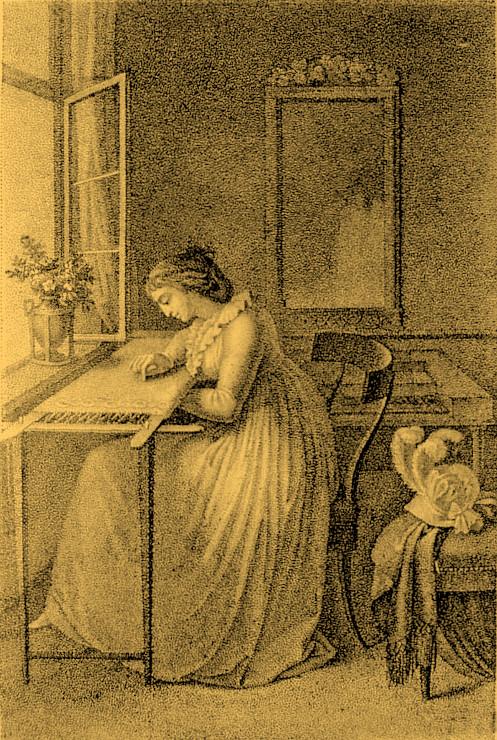
I finally had a chance to go out to visit her [Caroline] again after such a long interim. I found her well, sitting with her embroidery frame, with which she spends most of her day. [1] She is sleeping well, feels good in the morning, then in the evening suffers greatly from hot spells and other ills. She must be quite satisfied that, despite her emotional suffering and the lack of better care, she is suffering no more than earlier under similar circumstances. —
Meyer spent several hours with her; she was glad to have seen him again and seemed far more satisfied with him than she seemed to have anticipated beforehand. [2] I did not make his acquaintance. —
While she had to spend several hours with the town clerk and Frau Dearest [3] (the latter recounted to her, among other news, that people were saying Siberia had perished), she gave me the letters to read that she had written from Mainz to Louise in Hamburg and her mother. [4]
When I consider this together with what she is telling me now or even previously in person, I find everything that has happened to her rather incomprehensible, though admittedly from another perspective quite comprehensible indeed, given the well-known inhumanity of the princes and their minions. —
If I cleanse her view of the whole of those few features deriving more from a rather unjust peculiarity of her personality or from the initial heat of the moment, I find it to be quite the same as my own. She had to let me have one particular letter she wrote after the loss of Frankfurt, one smoldering with the most beautiful sense of indignation. [5] —
I can almost forgive her now for having potentially been capable of the nonsense of drawing you into that cauldron and down into your own ruin. This sort of enthusiasm for a grand, public cause makes a person drunk and foolish as regards ourselves and our own paltry concerns, indeed it must do so if it is genuine. . . .
What? You want me to “prove” to you that Schiller is a great man? “Prove,” you say? — Let petty shopkeepers tally up virtue; we in Germany are wont merely to justify our love and respect. —
Be so good, my friend, and “prove” to me that you are a poet; “prove” to me that [Caroline] B[öhmer] is what your love made her out to be; “prove” that you have sensibility and feeling. — And let me know as well just where you intend to begin with such “proofs” and where you intend to end. —
B.’s question “What has he done that is so great other than perhaps write fine books” was typically female. [6] Greatness is necessary to assess a person according not to concrete deeds, but the interior life; the wise person alone is capable of such; or is the poet of Prometheus less great than Alexander because an entire people is capable of recognizing the latter for what he is, and only a few the former? . . .
Notes
[*] Sources: Walzel, 127–28; KFSA 23:144–45. Dating according to KFSA 23:144. Back.
[1] Young women in middle-class families often learned embroidery; Caroline seems to have been quite deft at it (illustration from Johann Friedrich Cotta’s Taschenbuch für Damen auf das Jahr 1800 [Tübingen 1800]):
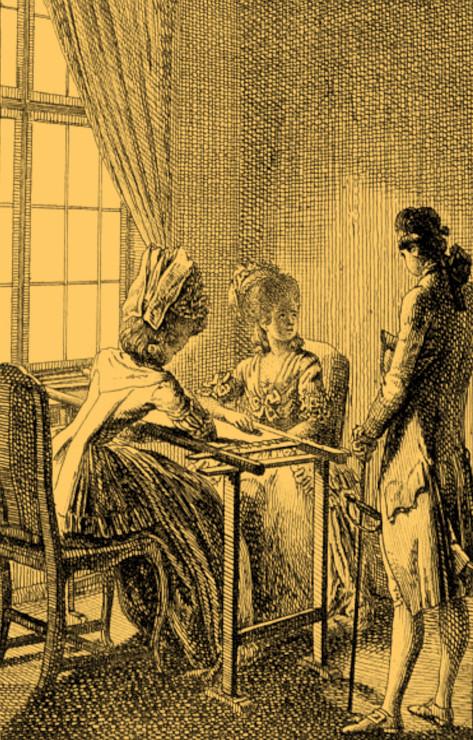
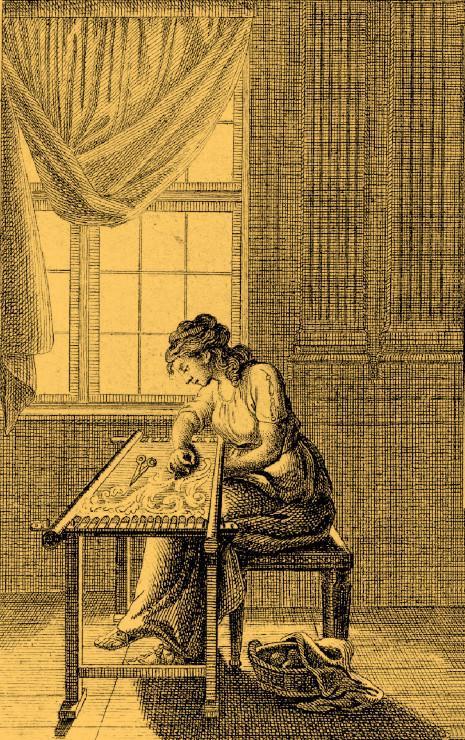
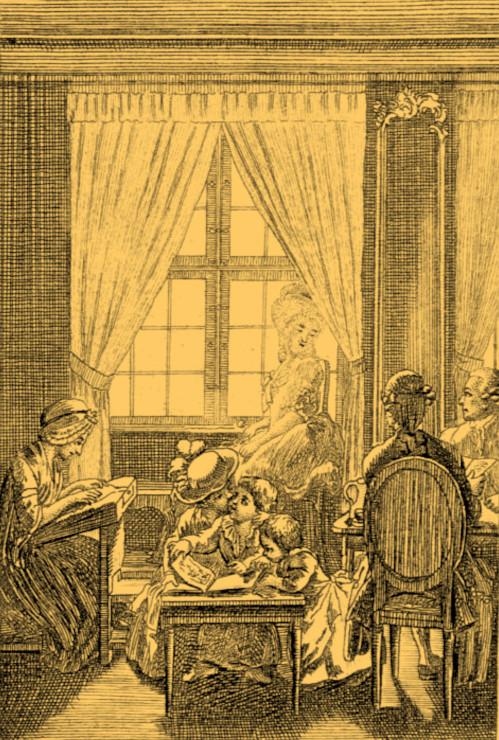
Daniel Nikolaus Chodowiecki did a series of vignettes in 1780 with the title Occupations des dames; one of those vignettes, “Embroidery,” features two women seated at the kind of embroidery frame common at the time; a second, also from 1780, portrays a woman embroidering at home, and a third shows a maidservant embroidering within the context of a family scene (Das Sticken [1780]; Herzog August Bibliothek; Museums./Signatur Uh 4° 47 [163]; Penelope [1780]; Herzog August Bibliothek; Museums./Signatur Uh 4° 47 [235]; Wir sind alle zusammen schon lange Ihre Unterthanen; Herzog August Bibliothek; Museums./Signatur Uh 4° 47 [261]):
[2] Frontispiece to Johann Friedrich Ernst Albrecht, Leben und Thaten des Dokter Pillpullklystropfius der Glückliche genannt, vol. 1 (Leipzig 1783):

It was the last time Caroline ever saw Meyer.
Concerning the timing of Friedrich Ludwig Wilhelm Meyer’s visit, see Friedrich’s letter to Wilhelm on 16 October 1793 (letter 135cd), with note 5 (map: Post Karte Durch ganz Deutschland, ed. J. Walch [Augsburg 1795]; illustration: Daniel Nikolaus Chodowiecki, Von Berlin nach Danzig: Eine Künstlerfahrt im Jahre 1773, von Daniel Chodowiecki. 108 Lichtdrucke nach den Originalen in der Staatl. Akademie der Künste in Berlin, mit erläuterndem Text und einer Einführung von Wolfgang von Oettingen [Leipzig 1923], plate 13):


[3] Otherwise unidentified; possibly someone associated with Caroline’s imminent delivery (see KFSA 23:438n3). Caroline’s pregnancy had now almost reached term. Back.
[4] Concerning these letters, which do not seem to have been preserved, see the the editorial note to Caroline’s letter to Friedrich Ludwig Wilhelm Meyer from Mainz on 16 October 1792 (letter 117). Concerning Luise Michaelis’s time in Hamburg in 1792 and the letters she received from Caroline and shared with others, see her own account in her Erinnerungen, pp. 30–31. Back.
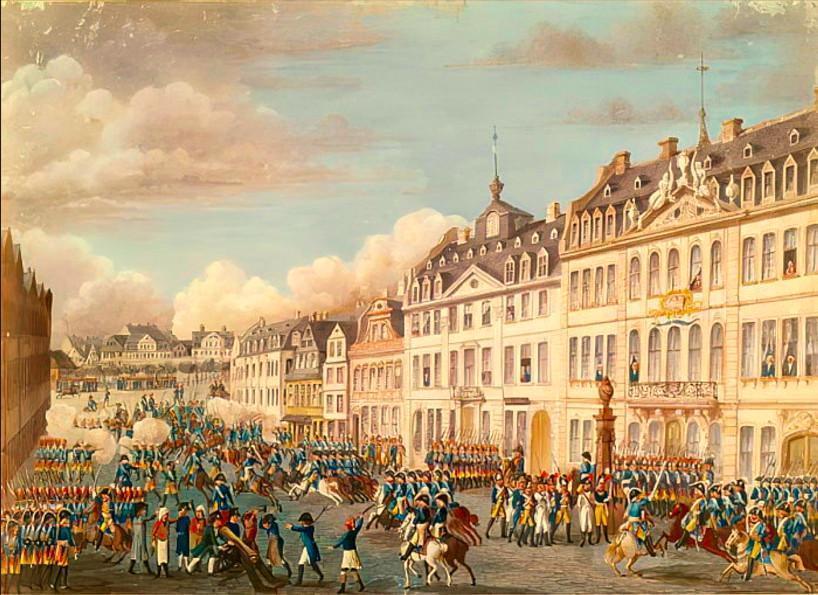
[5] The French had occupied Frankfurt on 22 October 1792, Prussian and Hessian troops retook it on 2 December 1792; Caroline was still in Mainz at the time of both events. Here the entry of Prussian and allied troups into Frankfurt on 2 December (anonymous, Einzug der Vereinigten Truppen von Preußen und Hessen nach Frankfurt, 2. Dezember 1792; Historisches Museum, Frankfurt):
[6] Caroline never warmed up to Schiller’s works, or Schiller personally, for that matter, and that disinclination may have affected both Friedrich and Wilhelm later on, especially in Jena, where there was at least a nominal break between them and Schiller.
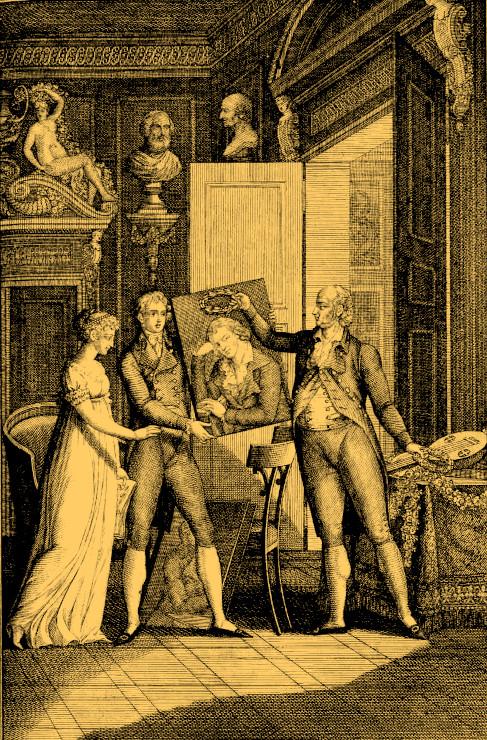
Although Caroline did display a bust of Goethe in her apartments with both Wilhelm Schlegel and, later, Schelling, she would never have dreamed of joining the couple in the following illustration (Wiener Hof-Theater Taschenbuch auf das Jahr 1807; Inhaltsverzeichnis deutscher Almanache, Theodor Springmann Stiftung; Schiller’s portrait within the illustration: 1794, by Ludovike Simanowiz):
Translation © 2011 Doug Stott