
• 135cd. Friedrich Schlegel to Wilhelm Schlegel: Leipzig, 16 October 1793 [*]
[Leipzig, 16 October 1793] [1]
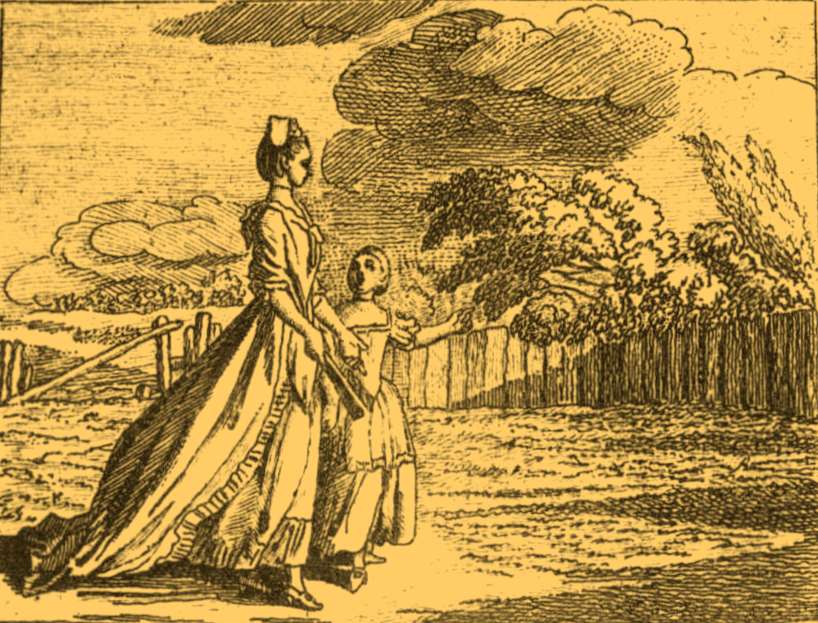
[Lucka, Friday] 11 October [1793]. “The beautiful weather enticed me outside yesterday, and I walked as far as Berndorf Mill — but now today, as a result, I am literally having to crawl around; it is enough to make even your sympathy laugh. Otherwise everything is going quite well. [2]
Are you really writing every postal day? You are conscientiousness personified —
Wilhelm will ultimately cease making anything of all your reports, will set the bülletins aside, and in the very next minute will have forgotten whether the news was good or ill, as if the reference were to some elderly, consumptive lady-in-waiting at court. Start being a bit coquettish with what you pass along to him — in my name. For I can assure you, we trifle coquettishly with both life and death.”
[Lucka, Sunday] 13 October [1793], evening. “What can you possibly be thinking when you say I ought to give you a ‘medical’ report? That could happen only under the condition that you not read it. Here, however, is a resumé of my health — it is no worse than in similar cases. When I can sleep, I am inclined to think it better, and lately I am indeed that fortunate most of the time. I must eat only very little, and I can walk for only five or ten minutes if I am to avoid having considerable trouble. Nothing can be anticipated — many ills can well be silent for now only to rise up petulantly later — we will find out in — about as much time as the devil needed to tempt Christ. [3] Just now I am suffering from swollen gums and tongue blisters, no doubt signs of heavenly condemnation.” [4]
I myself have not been out there [to Lucka] for over four weeks now, and I still do not yet know whether it will be possible this week either. I also have various business associated with the trade fair, and then all my friends were here. Schweinitz stayed with me for a week. Hence it may well be that Meyer, who is currently here, will see her before I do. He knows where she is staying and will be visiting her. I have not yet made his acquaintance. [5] . . .
Notes
[*] Sources: Walzel, 121–22; KFSA 23:139–40. – Friedrich’s letter to Wilhelm here is the original source of the embedded excerpts constituting letters 135c and 135d in Erich Schmidt (1913), 310–11. Dating according to KFSA 23:139; because the manuscript seems not to be dated, and precise internal evidence for dating lacking, the editor (Ernst Behler) seems to have deduced the date from Friedrich’s remark that it has been “over four weeks” since he had been in Lucka. In his letter to Wilhelm on 16 September 1793 (letter 135.1), Friedrich remarks that he went out to Lucka on 11 September just as he had received Wilhelm’s letter to Caroline of 5 September, and did not return to Leipzig until Saturday, which was 14 September. Whether the present letter genuinely is to be dated precisely to 16 October 1793 must probably be left in abeyance. Back.
[1] What follows in quotation marks are the extracts from Caroline’s letters to Friedrich mentioned above. Back.
[2] Kupfersammlung zu J[ohann] B[ernhard] Basedows Elementarwerke für die Jugend und ihre Freunde: Erste Lieferung in 53 Tafeln. Zweyte Lieferung in 47 Tafeln von L bis XCVI (Leipzig, Dessau, Berlin 1774), plate LIV:
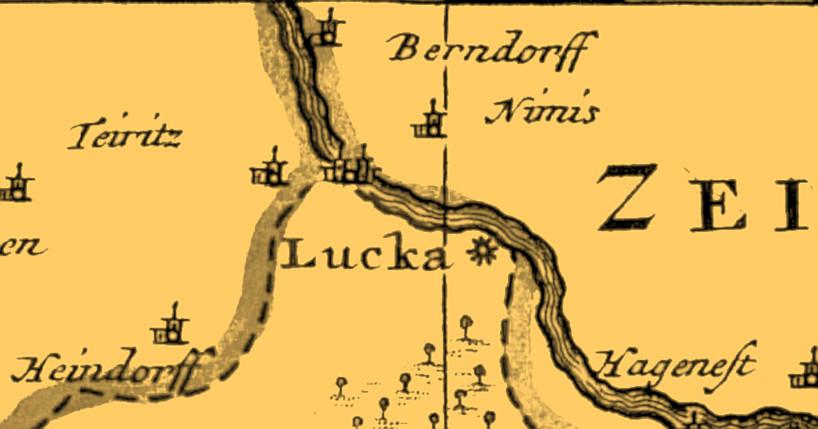
Eugen Huhn, Comptoir- Amts-, Post-, Reise-, und Zeitungs-Lexikon von Deutschland, vol. 1 (Hildburghausen 1845), 449, still lists the Berndorf Mill in the village of Berndorf approximately 2 km north of Lucka in Saxony, district of Leipzig (the village itself was partially replaced in 1976 by an open-pit mine). This water-driven mill has long been characterized by a peculiarly shaped linden tree, whence the popular reference “Tree House” (Baumhaus).
The village also functioned as a customs station on the boundary with Lucka (first map: excerpt from P. Schenk, Land-Charte vom Fürstenthum Altenburg wie solches in seinen Enigegräntz [Eingegräntz?] Bezircke gegen unterschiedene Angräntzende situiret lieget [Amsterdam 1710]; photo: Manuela Woyda, Hohendorf):

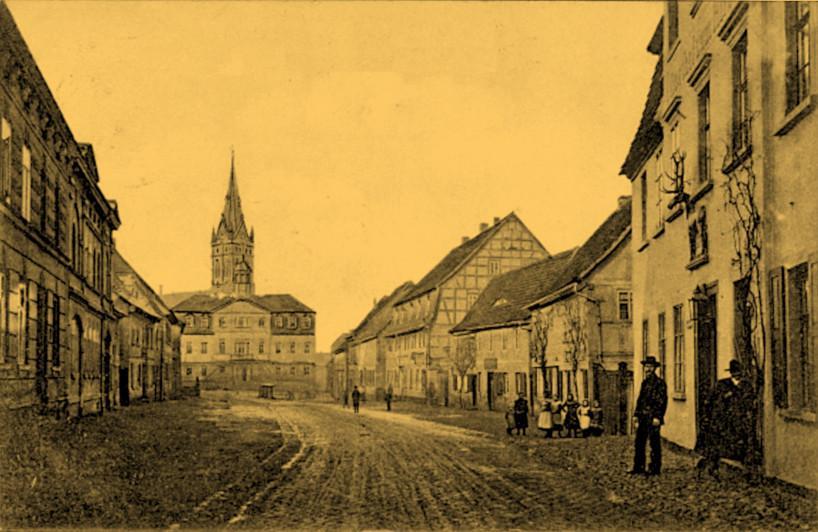
Caroline would have walked initially toward the center of town down the street just off Hirtengasse, where she and Auguste were residing, namely, Altenburger Strasse, here on a postcard from 1912 (second map, on which Caroline’s route can still be traced: P. Schenk, Land-Charte vom Fürstenthum Altenburg wie solches in seinen Enigegräntz, Bezirckegegen Unterschiedene Angräntzende situiret lieget [Amsterdam 1710]):

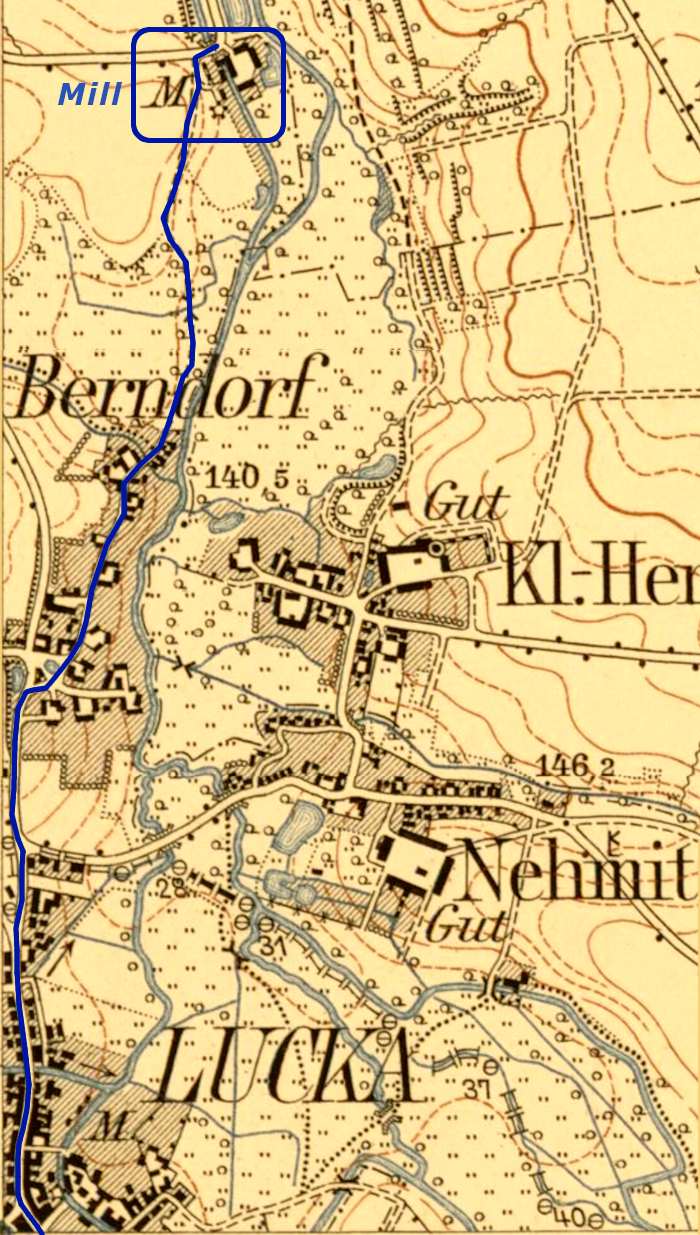
Here Caroline’s route from Lucka (at the bottom) to the mill (at the top; Topographische Karte [Messtischblätter] Sachsen, Borna [Leipzig, 1914]):
An important side note to Caroline’s excursion is that Friedrich had written to his brother Wilhelm on 30 August 1793 (letter 134) that “in Saxony the police are so vigilant that it would be extremely difficult for her to remain unrecognized for long.”
That is, as an essentially proscribed person in Saxony, once Caroline crossed the border from Thuringia to Saxony during her walk to the mill, she was at risk of being arrested or expelled.
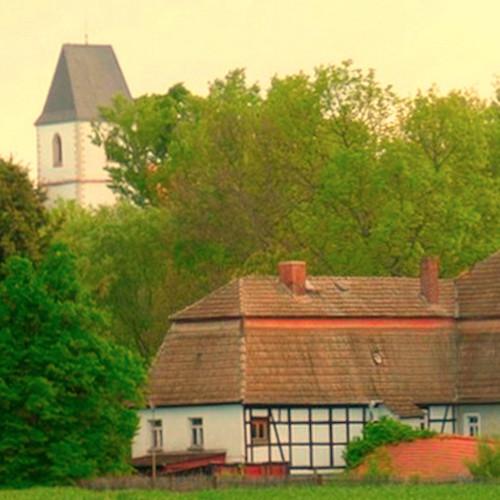
Click on the image below to open a gallery of a photographic reconstruction of Caroline’s walk to Berndorf Mill and photographs of the mill itself, which is still standing today; the gallery includes a photograph of the state lines between Thuringia and Saxony:
The following aerial video is copyrighted © by the current owners of the mill — Wassermühle Berndorf Neuseenmühle, Berndorf 28, 04539 Groitzsch, — who are also the proprietors of the restaurant, excursion and recreational facilities, and overnight accommodations on the premises. Video production by Philipp Matschoss, 3faces, Leipzig). Audio sequencing, arranging, editing, and production © 2025 by Dave Moyer, Lonesome Studios Productions (“Shepherd’s Air,” from Nina, ou la folle par amour: Comédie en un Acte et an Prose; mise en musique par M. Dal*** [Paris 1786]).
Caroline’s walking route from Lucka to the mill and back is still used as a pedestrian and cycling route as illustrated in detail by the gallery above. The path is clearly visible in its charming setting in the initial video frame below (looking back toward Lucka) and beginning at 0:22 as the narrower strip running roughly adjacent to the main road between Lucka and the mill:
[3] A curious remark that presumably betrays when Caroline was expecting her child to be born. Her reference is to the traditional forty days the devil tempted Christ in the wilderness (Matt. 4:1–11, par. Mark 1:12–13, Luke 4:1–13, the latter specifically [NRSV]): “in the wilderness, where for forty days he was tempted by the devil” (Anton Wonnesam, Die Versuchung Christi [1526]; Herzog Anton Ulrich-Museum; Museums./Signatur Z 989 recto):

The remark is curious because she herself would then be expecting the birth around 21 November, whereas it in fact happened on 3 November. That she may indeed have been anticipating a later birth may be confirmed by her being “utterly persuaded” on 2 November that “things were happening too soon” (as recounted in Friedrich’s letter to Wilhelm on 4–5 November 1793 [letter 136.1]).
One conclusion, of course, assuming she had been paying sufficient attention to the calendar regarding her pregnancy and no otherwise unknown medical factors were present, is that she had had an ongoing relationship with Jean-Baptiste Dubois de Crancé during February 1793 rather than on merely a single night around 3 February.Back.
[4] Concerning the understanding of scurvy at the time, see, e.g., The American Medical Lexicon on the Plan of Quincy’s Lexicon Physico-medicum (New York 1811), s.v. scorbatus:
Scorbutus, the scurvy. A genus of disease in the class cachexiæ and order impetigines of Cullen; characterized by extreme debilitation; complexion pale and bloated; spongy gums; livid spots on the skin; breath offensive; œdematous swellings in the legs; hæmorrhages; foul ulcers; fœtig urine; and extremely offensive stools. M.M. [recommended medications] Recent [fresh] vegetables; vegetable, carbonic, and sulphuric acids. Back.
[5] Meyer did indeed visit Caroline in Lucka (frontispiece to Johann Friedrich Ernst Albrecht, Leben und Thaten des Dokter Pillpullklystropfius der Glückliche genannt, vol. 1 [Leipzig 1783]):

This present passage provides the terminus a quo (Wednesday, 16 October 1793) in dating Meyer’s visit to Caroline in Lucka, whereas Friedrich’s next letter, on Wednesday, 23 October 1793 (letter 135.3), provides the terminus ad quem, which would have to be on or before 22 October, since on 23 October Friedrich himself mentions having had a chance to get out to Lucka to visit her again but having not met Meyer (letter 135.4). Back.
Translation © 2011 Doug Stott