
Erich Schmidt’s Introduction to Caroline’s Time in Lucka
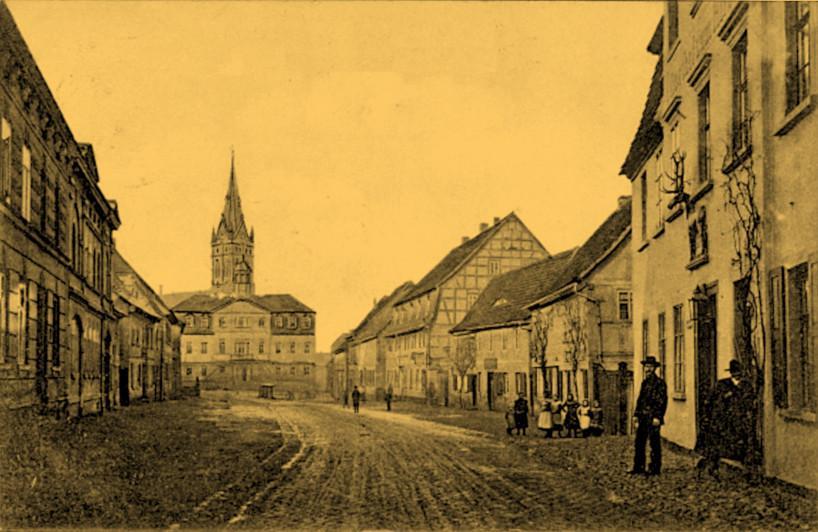
|702| Lucka. [1] In July 1793, Wilhelm Schlegel accompanied Caroline to Leipzig, where Georg Joachim Göschen, who was only half-initiated and who did not know Caroline’s real name, |703| offered accommodations and assistance, and where Friedrich Schlegel, at the time a student [in Leipzig], met his future sister-in-law for the first time [2 August 1793].
Shortly thereafter Wilhelm took Caroline to the quiet village of Lucka near Altenburg. He himself returned to Amsterdam, putting his brother in Caroline’s service as she awaited the birth of her son alone; except for vague rumors, e.g., that she had been Custine’s mistress, Friedrich had learned nothing about her except Wilhelm’s own resolve to help her by any and all means in his power.
Friedrich was unclear about his own role, and despite Wilhelm’s alleged interest in a certain Sophie in Holland, [2] he may have suspected that the two had had a love affair whose weighty consequences were now apparent; eventually, however, he did recognize the truth, since letters from Philipp Michaelis and others passed through his hands and since Caroline herself, who at first was rather reserved toward him, must have revealed those past events to her loyal and attentive visitor.
Oskar Walzel’s collection attests how devotedly Friedrich kept Wilhelm informed of everything, even small external circumstances, and how from week to week his own admiration grew for this woman who even amid such circumstances remained intellectually extraordinarily stimulating.
Little Auguste, who joked about the “Schlegel affliction” and who at first made an unfavorable impression by her appearance, soon won his heart as well. Friedrich’s own assertion concerning her mother was that only those who either loved or were loved by her could really get to know her. She may have been a “paramour” for a time — but he resolved to adhere to the simple relationship of the respectful son, the open and frank brother, the guileless child, the undemanding stranger with this woman who was capable of penetrating deep into the heart of poesy, of doing such a marvelous job reading Iphigenie out loud, [3] and who even found pleasure in his beloved Greeks.
Being around her both gladdened and strengthened him; “she does now have my friendship forever. I have become better through her, though she herself perhaps does not even realize it.” [4] “My trust in her is completely unconditional. She is no longer the singular, unfathomable one from whom one never ceases to learn something, but rather the kindest, best of persons, someone before whom I am ashamed of my own shortcomings.” [5]
The godfather of the little citoyen, [6] whom Caroline had to leave behind in Lucka, was deeply moved as he watched her depart for Gotha and Braunschweig, and when Wilhelm was considering the possibility of a lasting relationship with her, Friedrich reflected on the plans involving Germany, America, and Rome as if they involved his own future.
Pastor Strümpfel [7] has kindly related to me two different entries in the church register that attest what today would be an impossible bit of deception:
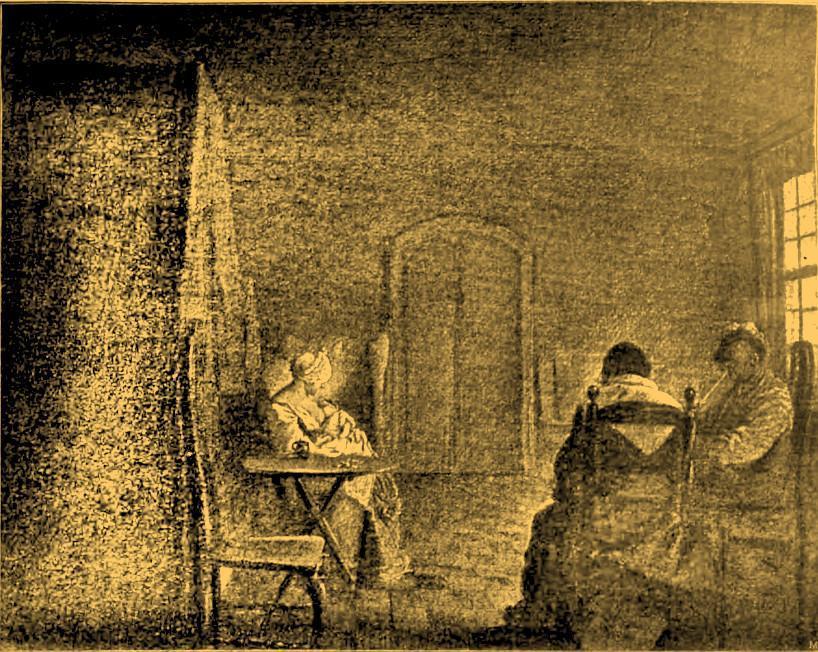
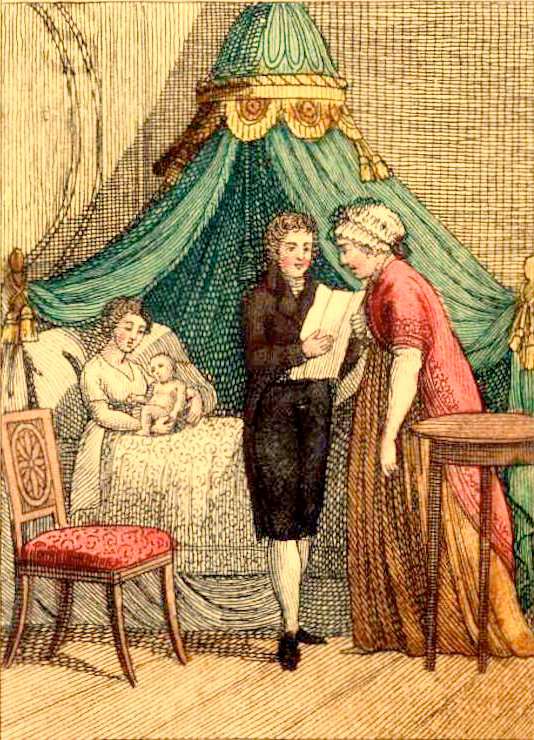
(1) Wilhelm Julius, born 3 November 1793, baptized eod. die [on the same day] in Lucka, mater [mother]: Madame Julie Krantz from Hamburg, a person residing here for a time, wife of Herr Julius Krantz, transport and commercial businessman currently away on journeys. |704| The godparents are: 1. Frau Kornschreiber, Christiane Elisabeth, widowed Wismann (Schmidt: “Weismann?” in all likelihood Caroline’s landlady, Johann Sophie Wilhelmina Wismar). 2. Johann Heinrich Königsdorfer, Dr. med. 3. Friedrich Schlegel, stud. jur. in Leipzig. [8]

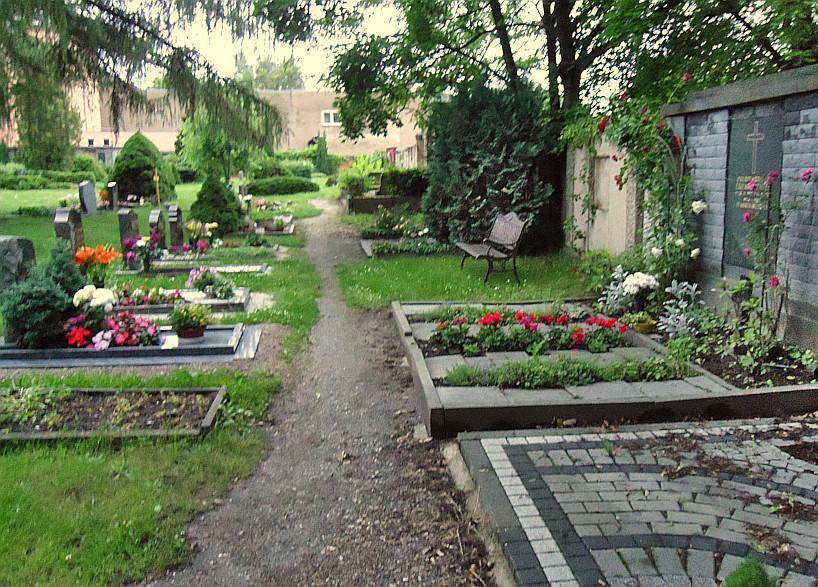
(2) A small son, Herr Julius Krantz from Hamburg, died on 20 April 1795, and was quietly buried on 23 April; 1 year old. [9]

Notes
[1] Caroline seems to have arrived in Lucka on 7 August 1793; the small village (photograph above from a 1912 postcard) is situated approximately 30 km south of Leipzig and 15 km northwest of Altenburg; population in 1831: 1090 persons, today part of the district Altenburger Land in Thuringia (Thüringen), at the intersection of the states of Saxony, Saxony-Anhalt und Thuringia (here also showing the proximity to Weimar and Jena; Ludwig Ravenstein, Atlas des Deutschen Reichs [Leipzig 1883], no. 5; second map: Johann Baptist Homann, Tabula geographica in qua…principatus Gotha, Coburg et Altenburg cum omnibus eorundem praefecturis tam in Thuringia quam Misnia et Franconia sitis ostenduntur [1724]):
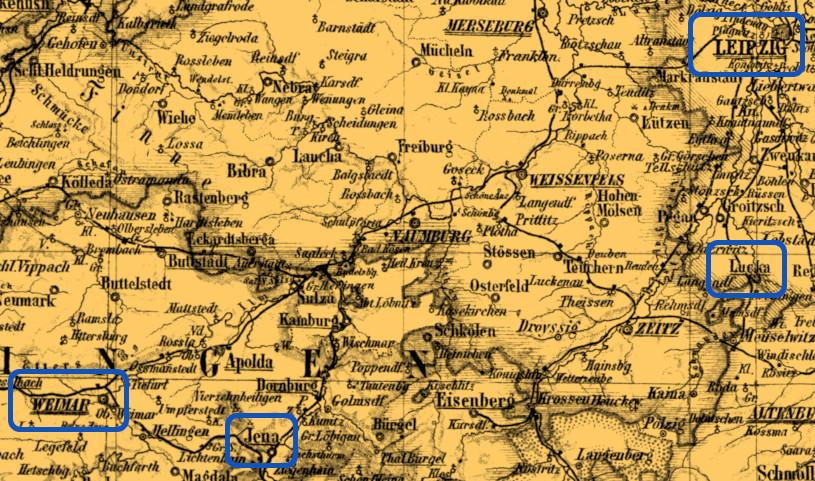

Concerning Caroline’s surroundings and activities in Lucka, see especially the gallery Caroline in Lucka. Back.
[2] The mysterious Dutch “Sophie” mentioned in Friedrich’s letters to Wilhelm was likely Sophie Tischbein. See the supplementary appendix on Sophie Tischbein as the Amsterdam Sophie. Back.
[3] Goethe, Iphigenie auf Tauris. Ein Schauspiel, in Goethe’s Schriften, vol. 3 (Leipzig 1787). Friedrich mentions this trait in his letter to Wilhelm on 29 September 1793 (letter 135.2). For the original illustrations to the 1787 volume with Iphigenie and for additional remarks concerning Caroline’s relationship with the play, see Caroline’s letter to Luise Gotter and Wilhelmine Bertuch on 28 May 1784 (letter 41), note 8. Back.
[4] Friedrich Schlegel to Wilhelm Schlegel on 11 December 1793 (letter 136c). Back.
[5] Friedrich Schlegel to Wilhelm Schlegel on 21 January 1794 (137d). Back.
[6] Fr., “citizen,” also the form of address during the Revolution. Back.
[7] Otherwise unidentified pastor in Lucka. Back.
[8] Illustrations: (1) Die Wochenstube, from Chodowiecki, Künstler-Monographien, ed. H. Knackfuss xxi [Bielefeld, Leipzig 1897], 16; (2 left) infant baptism at home by Daniel Nikolaus Chodowiecki (Eintritt in die Welt [1797]; Herzog August Bibliothek; Museums./Signatur Graph. A1: 437) and (3 right) Elisa oder das weib wie es sein sollte, 3rd ed. [Leipzig 1798]; (4) examining the certificate of baptism, Der neuesten Moden Almanach auf das Jahr 1808.
The actual entry in the church register differs slightly from Erich Schmidt’s rendering (see Brigitte Rossbeck, Zum Trotz glücklich. Caroline Schlegel-Schelling und die romantische Lebenskunst [Munich 2008] 118; it should be kept in mind that technically this document gives a false last name; strictly speaking, the child’s last name was Böhmer):
A small son Wilh. Julius nat. 3 Novbr. renat eodem die [baptized on the same day] mater [mother] MADAME JULIE KRANTZIN from Hamburg, a person residing here for a time, wife of Herr JULIUS KRANTZ transport and commercial businessman currently away on journeys. The godparents:
1) Madam Christine Elisabeth Kornschreiber
2) Herr Johann Heinrich Koenigsdörffer Doctor Medicinae
3) Herr Friedrich Schlegel Studiosis Juris Leipzig Back.
[9] Death Registry of the Lucka Church Registry 1795, no. 24, p. 246. Daniel Nikolaus Chodowiecki, Totes Kind (1774–75); Herzog August Bibliothek; Museums./Signatur Chodowiecki Sammlung (1-56). Photo of the Lucka cemetery by Manuela Woyda. Back.
Translation © 2011 Doug Stott