
• 132. Caroline to Friedrich Ludwig Wilhelm Meyer in Berlin: Leipzig, 30 July 1793
[Leipzig] 30 July 1793
|302| You do not realize the effect your letter of 26 July could not but have on me, though perhaps you can sense it a bit more clearly since my last letter. [1] Your advice has now robbed me of the only refuge I thought appropriate for me. [2]
I hesitated to answer you immediately, not because I might be harboring even a single indignant impulse toward you — but merely because I feared I might surrender to the entire breadth of my consternation and besiege you with it. I will try to be as calm as I can — I merely ask you to bear in mind that I am being assaulted from every possible quarter from which a woman can suffer.
The issue here is not some trifle or foolish act about which a man who knows the world will merely shrug his shoulders — and just as little some ignoble, demeaning act — but rather a misfortune concerning which I have to reproach myself bitterly in a single respect, but for which I am paying too dearly for any external reproaches to affect me. [3] From you I expected a willingness to view it the way I do myself, namely, without coddling myself with excuses but nonetheless still considering myself worthy of deliverance. —
I forgot what I owed to my child — in a tense emotional situation and out of careless boldness, I gave myself to someone, and the consequences are now taking their revenge in the very name against which I sinned. [4] Now you have an overview of my sufferings during the past months.
When I left Mainz, I was not aware of my condition, [5] |303| discovering it only in — [Königstein], at which time I was yet able to muster more courage than I can now — I set a certain time limit; if within this period I were not rescued, I would have ceased to live, since it was, after all, better that my poor child be a complete orphan than have a dishonored mother. [6]
I had acquired the necessary means through the help of a friend whom I had convinced of the necessity — these means were to serve me only in the most extreme case — hence I would first have attempted to flee — he came to me with the intention of standing by me in life or in death — a few days later, I was released, and he accompanied me here. [7] He could go no further because his employment required his return [8] —
I was disinclined to choose that particular state as my place of refuge because I was quite apprehensive about price inflation and the climate. [9] In Berlin I thought I could find all kinds of help, secrecy, and a man whose intellect might have occupied my own during times when I cannot really entrust myself solely to the latter — a man on whose humane feelings and uprightness I could depend.
At the same time, my residence there would have reassured my relatives more than were I to reside outside Germany, nor did I doubt that political protection would be forthcoming — or rather, I did not think I really had to worry further about it, since the king has quite clearly taken up my cause in that sense and because those at whose advice he did so advised me first of all to go to Berlin, because there, should I want to use my own name, I could have received excellent letters of protection, since my brother [10] is currently a volunteer physician in Prussian service and, one hopes, will receive not inconsiderable promotions — and finally because the passport of the Frankfurt commandant would initially have guaranteed my security in Berlin as well.
I must tell you that were I allowed to use my own name, |304| all these considerations would prompt me to decide against your advice, which I must now probably follow if you persist. But perhaps your view will change; I will await your answer here. —
But is Berlin really not large enough to hide a woman? I would like to move away from the idea of being out in the country. — Can a room to rent not be found where a woman with a child might receive a few domestic services from the people in the house and otherwise exist as inconspicuously as do thousands of others?! Whatever people would see of me would raise no suspicions, nor would my appearance. Except for you, no one would visit me — and even that would not happen every day — let people think whatever they like about that.
For the rest, I would have hoped for some news from you. If there were institutions as good as the one now in Göttingen, I would have used them and would have arranged beforehand for accommodations for the poor creature with a good farmer’s wife. [11] If my ruined health succumbed, you would take Auguste to Gotha and carry out the rest of my instructions. [12]
If I survived, I would then leave Berlin and go to where I initially wanted to go [13] — since in the meantime all the negotiations concerning [lacuna] would presumably have been completed, and I would no longer need to remain concealed for the sake of my security, such as I currently am leading people to believe and as pretext for which I adduce the only careless act I genuinely did commit from a political perspective. [14]
What will I do if all that fails? Gotter knows me — he is discreet. I enjoy the sympathetic concern of both him and his entire family to a degree eliciting my heartfelt gratitude, but can I entrust myself to him completely? He advised me against residing in the countryside here, since in the summer the countryside around this town is |305| even worse than the town itself — one arouses even more curiosity there. And by the way, the orders here are so strict that they will not even tolerate Mauvillon because he was Mirabeau’s friend — even though he was also an officer in the service of the Duke of Braunschweig. —
I cannot stay in this house until the book fair, that is, two more months — since by then anyone who had ever seen me before will invariably have discovered me. [15] If you persist in advising me against Berlin, then I will have to urge Göschen to find me a place to stay out in the country [16] —
I will have to tell him the same thing I used as a pretext for my mother, and you will then pick me up after taking care of your engagemen[t] and I will remain till the end of November or the beginning of December wherever we think is most advisable. You can see that I have developed no mistrust toward you, and you were wrong to protest so vehemently against the notion. My conviction is that you are an honest man capable of treating a serious matter seriously. It may well be that I would have the same trust even if you deserved it less, since being suspicious cannot be one of my talents as long the experience of my own heart tells me that sincerity is possible. Should I consider everyone to be less good than I myself am? —
I do not doubt that you will overcome a slight embarras [17] in order to help me. I am demanding no more than that — it would never occur to me to ask for the sacrifice of a word once given, and even in the larger sense I would shy away from becoming obliged to you for anything if you yourself might thereby become obliged to me in the slightest. Perhaps it is precisely this manner of thinking, this indelibly necessary manner of behavior that at this moment robs me of all protection. But so be it! —
Just as, deserted by everyone, unable even to secure the possibility of putting an end to my own existence, |306| I confided in a man whose attentions I had rejected, whom I had sacrificed and wounded, to whom precisely on account of the nature of my confidence I could offer no species of compensation after having made it — and he did not deceive me. The gentler emotions that his boundlessly noble goodness reawakened in me also rekindled my hope that the trials that I can now no longer end by force — for that it is too late [18] — might yet pass in a more tolerable fashion than I had supposed. That this has not smothered my courage, however, I can sense today even though I must acknowledge anew that my neglect of a sacred duty will be making every step I take laborious.
I am not angry with you — I do not despair. You will do what you can — If you can do nothing, then that helplessness itself will become a means of deliverance.
[Conclusion of letter is missing.]
Notes
[1] None of Meyer’s letters to Caroline seem to have been preserved (Königl. Großbrit. Genealogischer Kalender auf das 1786 Jahr; Inhaltsverzeichnis deutscher Almanache, Theodor Springmann Stiftung):

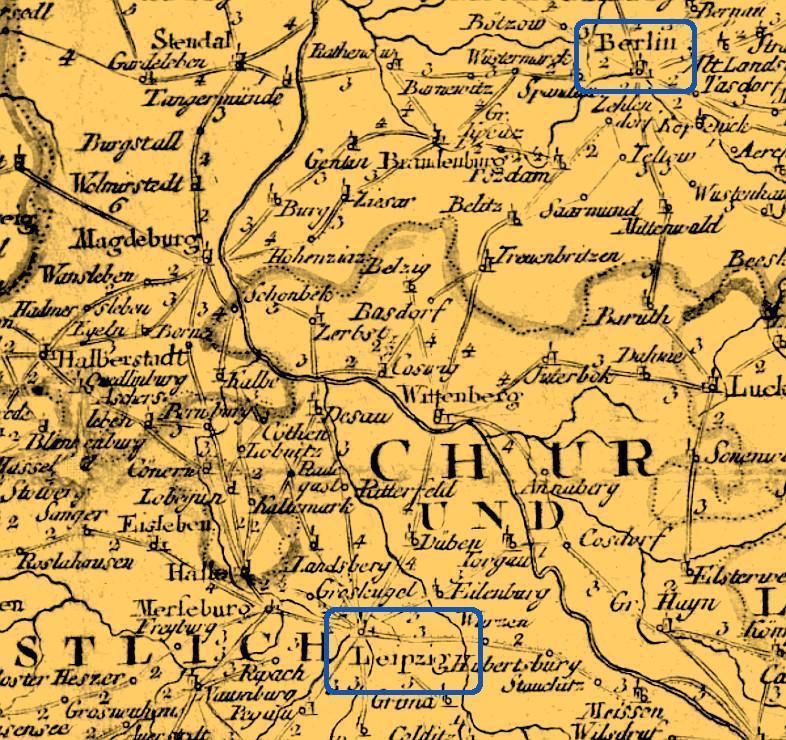
[2] Caroline had turned explicitly to Meyer for help; as emerges in this letter, at issue was the possibility of Caroline moving to Berlin (Post Karte Durch ganz Deutschland, ed. J. Walch [Augsburg 1795]):
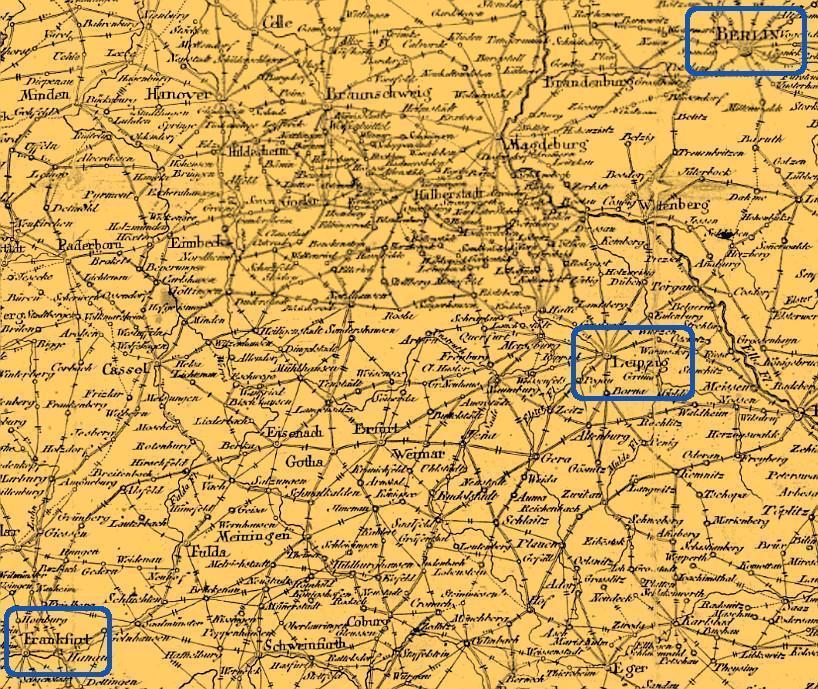
Concerning intimations of this plan in an earlier letter, see the remarks (with note 13) in her letter to Meyer from Kronberg on 15 June 1793 (letter 129). Berlin is situated ca. 425 km northeast of Frankfurt(Post Karte Durch ganz Deutschland, ed. J. Walch [Augsburg 1795]):
[3] Caroline was now almost six months pregnant. Back.
[4] I.e., “mother, motherhood.” Back.
[5] Caroline was not quite two months pregnant when she left Mainz on 30 March 1793. Back.
[6] Quite apart from the disgrace of an unwanted pregnancy, and that by a French officer, Caroline would have stood to lose her widow’s pension. Back.
[7] Caroline left Frankfurt on 13 July 1793 and seems to have arrived in Leipzig — some 300 km to the northeast — between mid-July and 20 July (see map above). Back.
[8] To Amsterdam. Back.
[9] Wilhelm Schlegel had apparently suggested Caroline return to Amsterdam with him. Back.
[10] Philipp Michaelis had secured Caroline’s release with a petition to Friedrich Wilhelm II through the mediation of Sophie Bethmann; see esp. Luise Wiedemann’s account in her biography of Caroline in her Erinnerungen, pp. 81–82. Back.
[11] The reference is to the relatively new (1751), recently renovated (1785, 1792), and surprisingly forward-looking institute for obstetrics in Göttingen. Concerning this institution, see supplementary appendix 132.1. Back.
[12] The plan seems to have been to have the Gotters take in and rear Auguste. Back.
[13] I.e., Gotha. Back.
[14] Uncertain but intriguing allusion that remains otherwise undocumented. Back.
[15] The Leipzig book fair during the autumn was also known as the Michaelmas book fair, Michaelmas falling on 29 September, and attracted visitors from all over Germany and beyond. Back.
[16] The Leipzig bookseller and publisher Georg Joachim Göschen, in whose home Caroline was staying at the time, did indeed quickly arrange for Caroline’s accommodations in Lucka, in the administrative district of Altenburg and ca. 30 km south of Leipzig. Back.
[17] Fr., “embarrassing circumstances,” but also “encumbrance, hindrance, impediment.” Back.
[18] Presumably a reference to abortion, which at the time was wholly under and copiously covered by penal jurisdiction alongside infanticide, and even midwives were stringently required to report any queries made to them to carry out such procedures, though, as legal corpora often remark, the lure of financial reward often outweighed their scruples.
In some instances, such aiding and abetting in cases of abortion could end in the death penalty for the midwife if performed after the pregnancy was halfway to term, in others with lesser punishment if the pregnancy was not yet halfway to term, the thinking being that “life” and “soul” were not imparted at the moment of conception (though even that condition was vigorously challenged, e.g., Unterricht vor Hebammen … deme ein Gebet-Buch in Geburts-Fällen u. eine Instruction für Wart-Weiber mit angefüget ist [Gotha 1746], 366).
On the other hand, the stipulations in the Lexikon der K. K. Medizinalgeseze, vol. 5:1, ed. Iohann Dionis Iohn, (Prague 1796), 3–5 (K. K., Königlich Kaiserlich, imperial, viz. under the auspices of the Catholic emperor of the Holy Roman Empire of the German Nation), still betray some of the means and circumstances generally thought to attend cases of abortion by legislating certain prohibitions and responsibilities, which included, under penalty of law:
• prohibiting apothecaries or any other merchants or rural citizens from selling or dispensing abortion-inducing substances;
• charging all persons to be alert to the behavior of pregnant women and to report such to all local authorities, surgeons, and midwives;
• prohibiting unauthorized women to practice midwifery;
• prohibiting authorized midwives from independently administering medications or from bleeding pregnant women;
• prohibiting apothecaries from dispensing emetics or powerful purgatives without orders from a physician;
• prohibiting surgeons from bleeding pregnant women or administering any of the previously mentioned substances;
• prohibiting merchants, peddlers, or grocers from selling medications retail under severe penalty;
• enjoining stewards and heads of house, to the extent they suspect a maidservant of being pregnant, to immediately to alert a midwife, have the maidservant examined, and in the case of probable pregnancy personally to remain watchful and if necessary keep them under watch to prevent any danger to the unborn child through careless behavior or other transgression; local authorities are accordingly also charged with taking the necessary actions and with alerting the appropriate physicians. Back.
Translation © 2011 Doug Stott