
The Institute for Obstetrics in Göttingen
On 30 July 1793, just past mid-term in her pregnancy, Caroline writes from Lucka to Friedrich Ludwig Wilhelm Meyer in Berlin about her difficulty in finding an appropriate and private locale in which to bring the pregnancy to term: “If there were institutions as good as the one now in Göttingen, I would have used them and would have arranged beforehand for accommodations for the poor creature with a good farmer’s wife.”
The reference is to the relatively new (1751), recently renovated (1785, 1792), and surprisingly forward-looking institute for obstetrics in Göttingen. The following outline is summarized from Heinrich Fasbender, Geschichte der Geburtshülfe (Jena 1906), esp. 287–91, and from Das Accouchierhaus am Geismartor, ed. Regina Lanage and Heike Ernestus (Göttingen n.d.).
A new institute for midwifery and obstetrics, with six beds in a wing of the Church of St. Crucis at the Geismas Town Gate, had been established in Göttingen in 1751, with Johann Georg Röderer as its head, though theoretical lectures on obstetrics had commenced in Göttingen as early as 1739. Although Röderer was highly respected for his work with the obstetrics institute, he died at the age of 37 in April 1763, the year of Caroline’s birth. He is in any case said to have “elevated German obstetrics from a condition of a despised profession and soiled trade to that of a noble science and art.”
He was succeeded by one of his students, Heinrich August Wrisberg, who ceased lecturing on obstetrics in 1785, however, and switched to anatomy instead. His successor was Johann Heinrich Fischer, who had studied in Kassel and abroad and while in Göttingen initiated the construction of a new and innovative building for obstetrics to replace the older one, which could no longer handle the needs of the institute and was otherwise hygienically and structurally deficient (here the new institute built between 1785 and 1790; first illustration: from the student autograph album of Johannes Carl Wiederhold; second illustration: Das Accouchierhaus am Geismartor, 7):
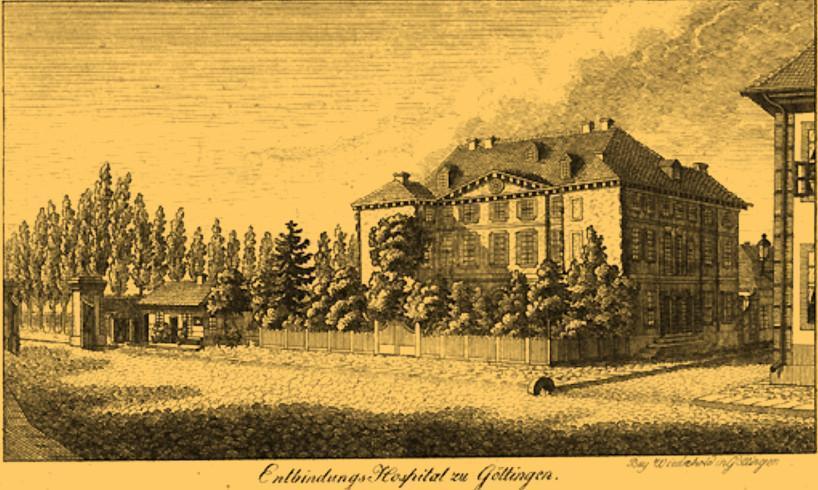
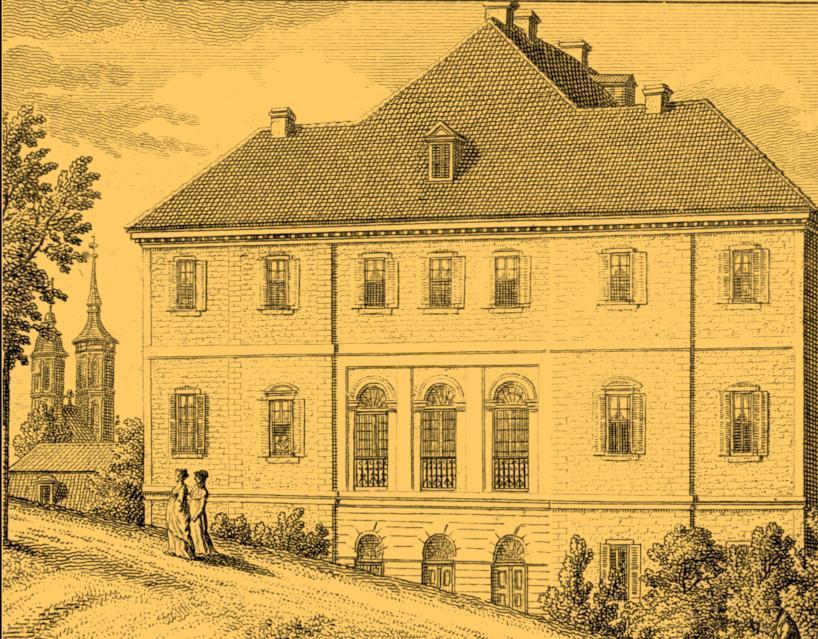
He was succeeded in 1792 by Friedrich Benjamin Osiander both as professor of obstetrics and as director of the recently completed new (since March 1791) obstetrics institute itself; here the institute as the frontispiece to vol. 1 of Osiander’s own Denkwürdigkeiten für die Heilkunde und Geburtshülfe aus den Tagebüchern der Königlichen practischen Anstalten zu Erlernung dieser Wissenschaften, in Göttingen ausgehoben (Göttingen 1794):
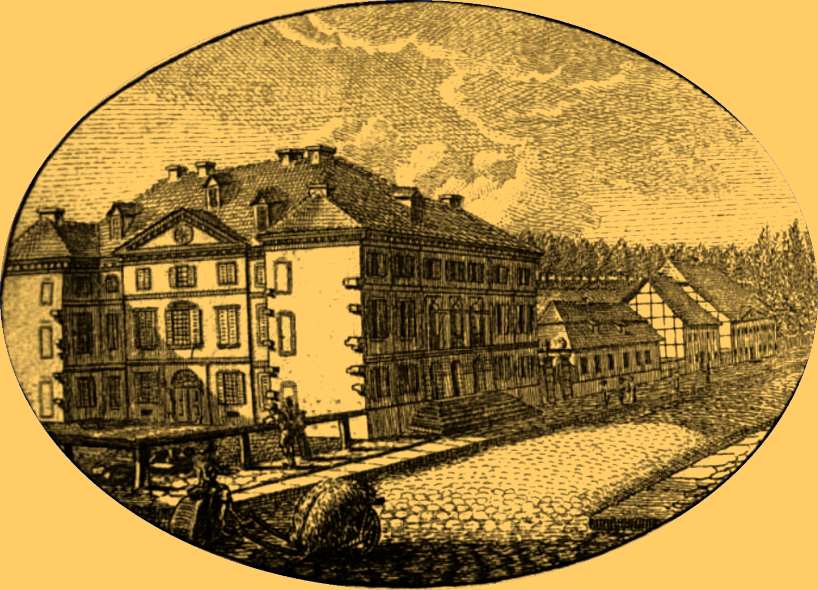
Osiander modeled his obstetrics theory after that in both France and England and emphasized the operational features of the French by developing obstetrics more into the “art of obstetrics,” which included, however, a dependency on and preference for using forceps. His tendency to terminate as quickly as possible any birth whose course exhibited even the slightest abnormality brought him into conflict with proponents of “natural midwifery.” He did, however, publish the first reliable history of obstetrics, and the Göttingen obstetrics institute had in the meantime developed a good reputation.
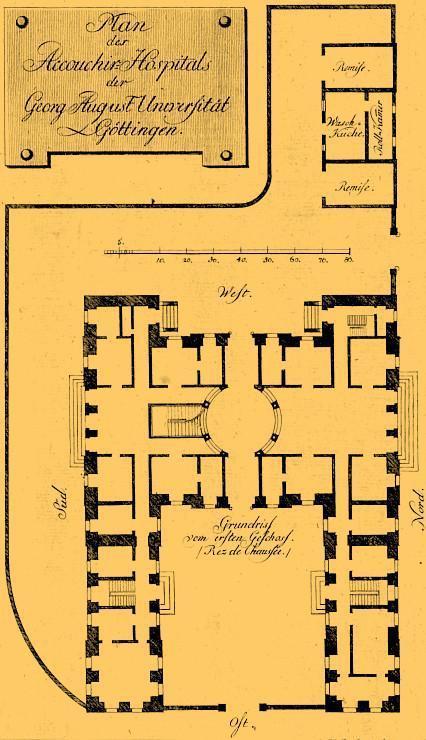
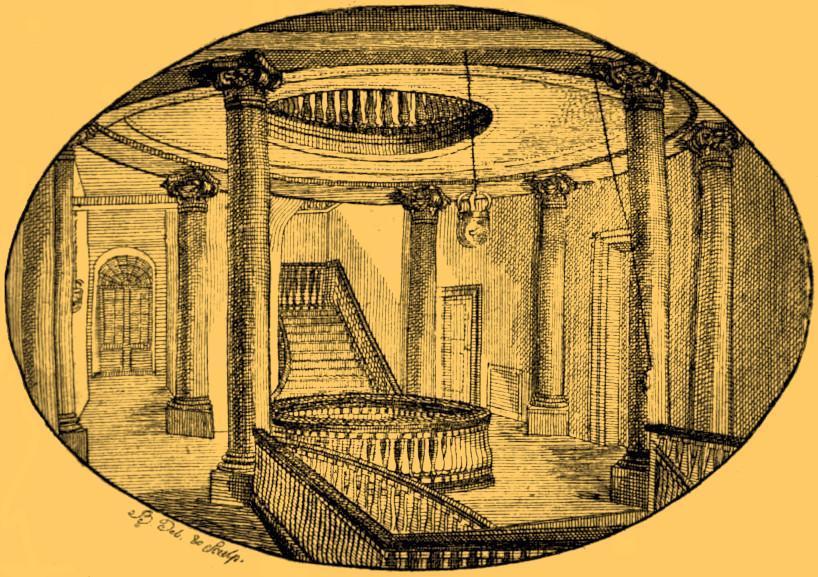
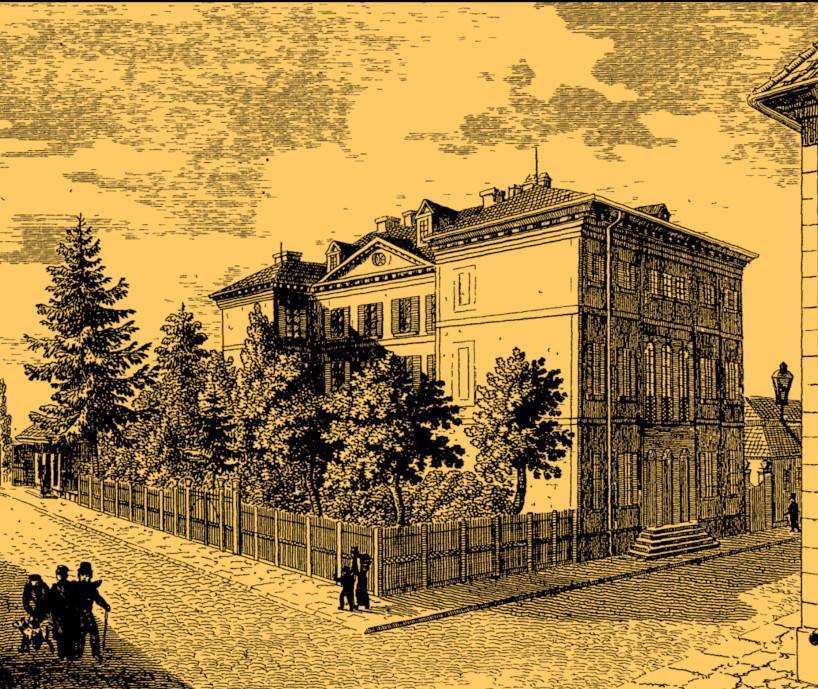
Here the original plans for the institute and two initial renderings, neither of which, perhaps understandably, concur entirely with the preceding and following illustrations here
Architectural plans and two renderings: Georg Heinrich Borheck, Plan des Accouchirhospitals der Georg August Universität Göttingen [1788]; Herzog August Bibliothek; Museums./Signatur Top 16a:19.
First illustration: foyer and central staircase of the middle floor (bel etage) of the institute in 1795, which had been finished in 1791 and is visible in the architectural plans above. Source: frontispiece to Friedrich Benjamin Osiander, Denkwürdigkeiten für die Heilkunde und Geburtshülfe aus den Tagebüchern der Königlichen practischen Anstalten zu Erlernung dieser Wissenschaften, in Göttingen ausgehoben, vol. 2 [Göttingen 1795].
Second illustration: Eastern side of the institute. Source: Das Accouchierhaus am Geismartor, 11):


At the same time, Caroline seems, in hindsight, to adduce precisely this institute as a model rather facilely insofar as it was Osiander himself who attended Lotte Dieterich, née Michaelis — Caroline’s younger sister — during the latter’s childbirth, which had ended that very spring (2 April 1793) with Lotte’s death and clouded by scandal.
Caroline, however, had not lived in Göttingen since her marriage in June 1784, so would not have been personally familiar with this recently renovated institute. For a detailed account of the events associated with Lotte’s death, see supplementary appendix 123a.1 and supplementary appendix 123a.2.
But foremost in her mind at the moment, was not that episode, however recent and tragic, but rather her own socially precarious situation. An important consideration for Caroline was likely that women without any means of support — generally unmarried women (96% of cases between 1791 and 1829) such as maidservants — could bring their pregnancies to term at the institute at no cost while taking advantage of advanced medical treatment during their pregnancies in exchange for participating in the instruction of medical students at the university, i.e., as examples of birthing techniques and the birthing process. They could, moreover, avoid the initial social embarrassment of their child’s illegitimacy by having the child discreetly and officially baptized in the hospital’s chapel and by taking advantage themselves of official ecclesiastical acts of penitence.
Women of higher status in society — precisely the situation in which Caroline found herself — were not surprisingly also inclined to take advantage of such discretion, and a separate staircase led from the rear door up to the sixteen private rooms on the upper floor. During their pregnancies, some women also performed light domestic tasks for the hospital. As a rule, the women arrived at the institute four to six weeks ahead of the anticipated birth and left two to three weeks after giving birth, though some understandably arrived only at the last minute to avoid the sooner less popular regular examinations by medical students.
Given her present situation and circumstances in Leipzig and the social liability of having been associated with the French occupation forces in Mainz and with (now imperially outlawed) Georg Forster, Caroline would doubtless have seen the advantages of such an institute, albeit in her hometown. As it was, she ended up in quite the opposite circumstances, namely, in a tiny, relataively remote village south of Leipzig under the care of an aging physician who, though allegedly experienced in such cases, nonetheless died just before she was about to give birth. Caroline did indeed, however, end up placing the child much as she describes.
In any event, Berlin did indeed also have a respected obstetrics institute, which, like that in Göttingen, had been established in 1751, but could sooner be understood as a midwifery school and was attached to the broader military hospital of the Charité.