
195a (was 226). Friedrich Schlegel to Caroline in Jena: Berlin, mid-February 1798 [*]
[Berlin, mid-February 1798]
|517| Let me thank you for your letter, my dear Caroline, and request even more. I cannot speak calmly with you until I know for sure you are coming. [1] Probably or, better, hopefully, Brinckmann brought you his portrait and my wrath. [2] My first wish is that Athenaeum be there, my second that you and Auguste will come and that you — but there is hardly time. I intend to make you pay for this barbarism, you Frenchwoman, as soon as I have even a moment’s time.
Because I have already written quite specifically what my position is toward the Charité, [3] there is nothing more to write. — You will thus probably stay at the Charité d’amour, [4] namely, with old lady Anger. [5] Fortunately, she is sufficiently self-sufficient to love herself and make herself unhappy. She has promised to reside in the School Garden then, [6] and he is a German gentleman through and through. [7] The room is very nice, and I wish you would come, but with Auguste, otherwise I will be forced to hate you.
Notes
[*] Additional source: KFSA 24:85.
Formerly letter 226 in Erich Schmidt (1913), 1:517. Redated from March 1799 to mid-February 1798 according to KFSA 24:370, though an earlier dating is possible (see KFSA 24:371n49.15, which considers a possible dating for both this and letter 195b [formerly 227] to several days before mid-February 1798).
The basic argument for redating apart from considerations involving Anton Klette’s Verzeichniss der von A.W. Schlegel nachgelassenen Briefsammlung, nebst Mittheilung ausgewählter Proben des Briefwechsels mit den Gebrüdern von Humboldt, F. Schleiermacher, B.G. Niebuhr, und J. Grimm (Bonn 1868) concerning the present letter and letter 195b, is that during precisely this time — February 1798, not 1799 — Karl Gustav von Brinckmann was on his way from Berlin to a new diplomatic post in Paris (KFSA 24:370n48.1), where he would remain until 1801.
Caroline also mentions in her letter to Luise Gotter on 21 February 1798 (letter 196) that Brinckmann had just visited them in Jena and was on his way to Paris (Maurille-Antoine Moithey, L’Europe: Divisée en tous ses Royaumes et subdivisée en ses principales parties [Revue et Corrigée] [Paris 1785]; Bibliothèque nationale de France, département Cartes et plans):

Friedrich alludes in this present letter to Brinckmann having brought to Caroline both his (Brinckmann’s) portrait and his (Friedrich’s) wrath, the latter presumably because of Friedrich’s uncertainty whether Caroline would indeed be coming to Berlin. One source of confusion was that Wilhelm and Caroline planned trips to Berlin in the spring of both 1798 and 1799, though only Wilhelm journeyed there (ca. 20 May) in 1798 (Rudolf Koch and Fritz Kredel, Deutschland und angrenzende Gebiete [Leipzig 1937]):

Caroline did not visit Berlin until the spring of 1802. Back.
[1] As pointed out in the explanation of this letter’s dating above, neither Caroline nor Auguste visited Berlin in the spring of 1798. She and Auguste journeyed to Dresden in early May and remained until October, though Wilhelm did go to Berlin ca. 20 May 1798 and then arrived in Dresden with Friedrich on 30 June. Back.
[2] Namely, because Caroline and Auguste might not be coming to Berlin with Wilhelm. See Friedrich’s letter to Wilhelm on 17 February 1798 (Walzel, 353; KFSA 24:89); after discussing some of Wilhelm’s literary plans with which he, Friedrich, was not particularly satisfied, Friedrich remarks: “I understand this just as little as why Caroline suddenly does not want to come along to Berlin.” Back.
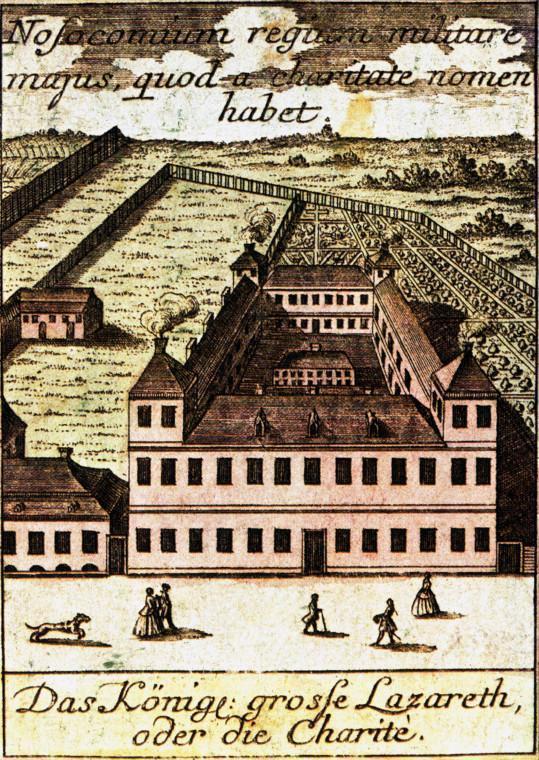
[3] Friedrich had moved in with Schleiermacher in the Charité Hospital complex in Berlin on 21 December 1797; Schleiermacher had been a chaplain there since September 1796, and there were apparently plans for Caroline and Auguste to stay there during their anticipated visit (here in an illustration by Matthäus Seutter ca. 1740):
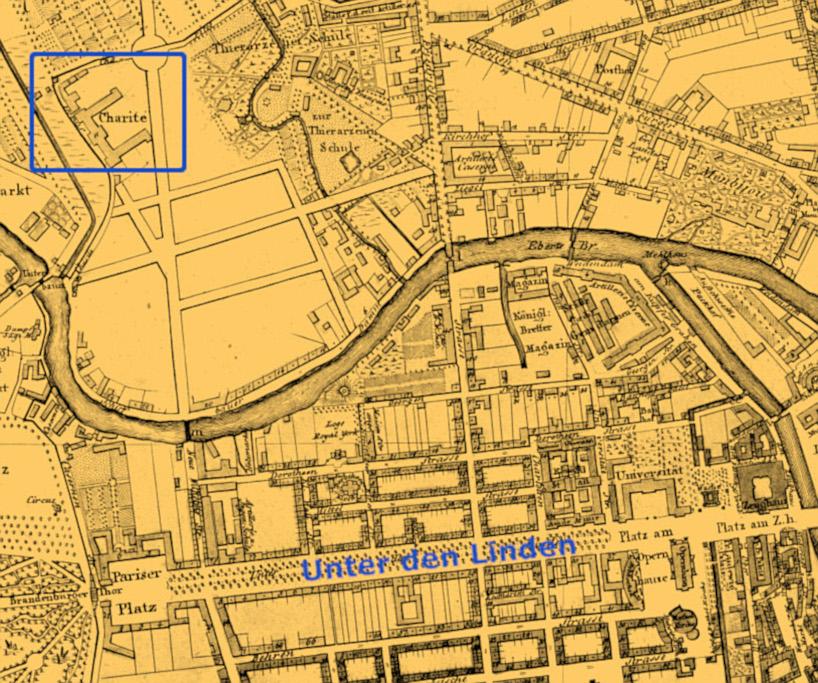
The hospital was located in the far northwest section of Berlin (the boulevard Unter den Linden at bottom; D. G. Reymann, Neuester Grundriss von Berlin [1826]):
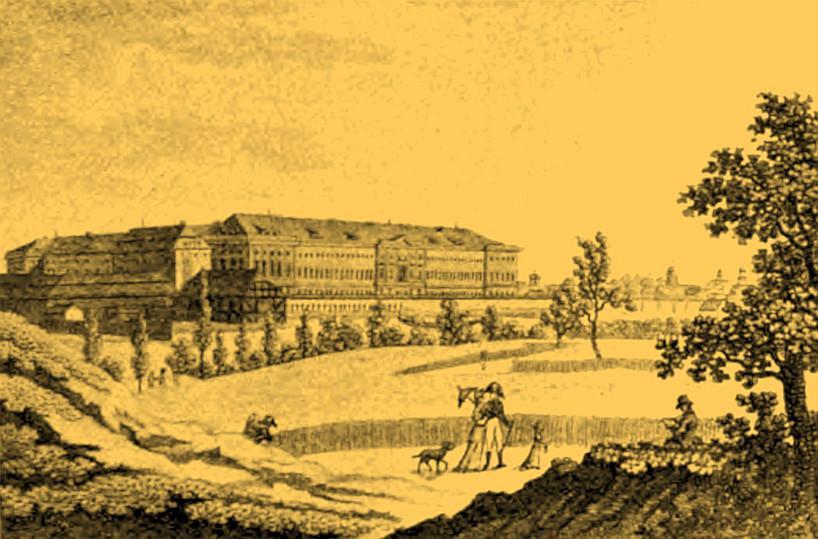
By 1809 the hospital complex had expanded considerably (Adolf Streckfuss and Leo Fernbach, 500 Jahre Berliner Geschichte: Vom Fischerdorf zur Weltstadt, Geschichte und Sage [Berlin 1900], 249):
[4] Fr., “charity, mercy of love,” here tongue-in-cheek. Back.
[5] Friedrich regularly indulges plays on words with Friederike Unger’s last name in later letters, including in letters to Auguste. The present jest engages the similarly sounding German adverb ungern, broadly “involuntarily, with regret or reluctancy, against the grain, unwillingly, with an ill-will, against one’s inclination, to be loath to do a thing, etc.” Because his nicknames are not always easy to transfer into English, some liberty is taken in this edition. That said, Friedrich was — oddly perhaps, given his inclination to poke fun at Friederike Unger — likely currently having an affair of sorts with her. See esp. his letter to Caroline on 20 October 1798 (letter 205). Back.
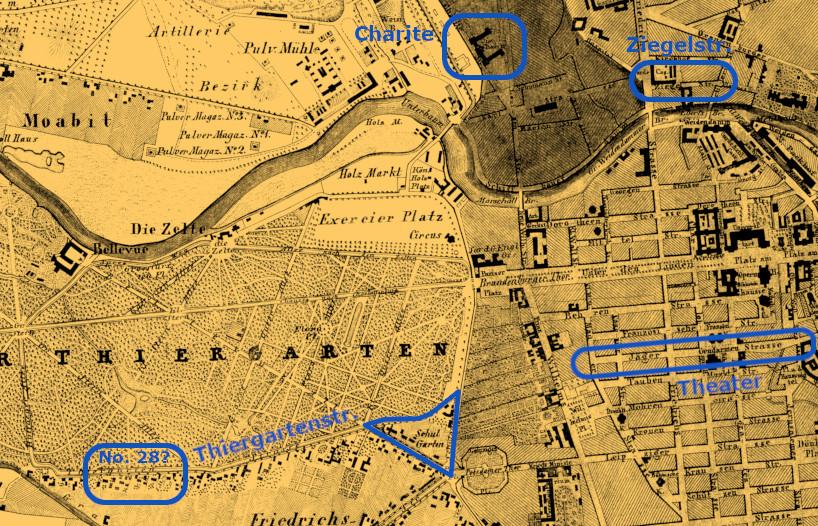
[6] In 1789 Johann Friedrich Unger and his wife, Friederike, moved into a house at Jägerstraße 43 in Berlin that previously had housed the Royal Lottery Administration (the street is circled on the map below; no. 43 seems to have been toward the east end of the street, i.e., to the far right).
They later purchased a summer house (allegedly built ca. 1800, though Friedrich seems to refer to it in his letter to Caroline in early March 1799) at the edge of the Tiergarten in Berlin, later Tiergartenstrasse 28, next door to August Wilhlem Iffland (Iffland’s house was at no. 29), which does not entirely square with Friedrich’s information here, since that address on Tiergartenstrasse is located toward the other end of the road from what Friedrich here calls the “school garden,” which is also shown on the following map (the triangular parcel).
The Charité is at the top, Dorothea Veit’s later apartment on Ziegelstrasse is at top right (see Friedrich’s letter to Friedrich von Hardenberg on 17 December 1798 [letter 212b], note 2), and the approximate location of the house at Thiergartenstrasse 28 is at lower left (Bernhard Metzeroth, Berlin [Hildburghausen 1832], from Meyer’s StädteAtlas, vol. 2 [Berlin 1832]; Zentral- und Landesbibliothek Berlin B 54/97 a:1832):
That said, the Berlin “school garden” — Germ. Schulgarten, specifically: Realschulgarten — was established in 1750 by Johann Julius Hecker for the purpose of agricultural pedagogy, a reform effort designed to combine normal schooling with vocational preparation.
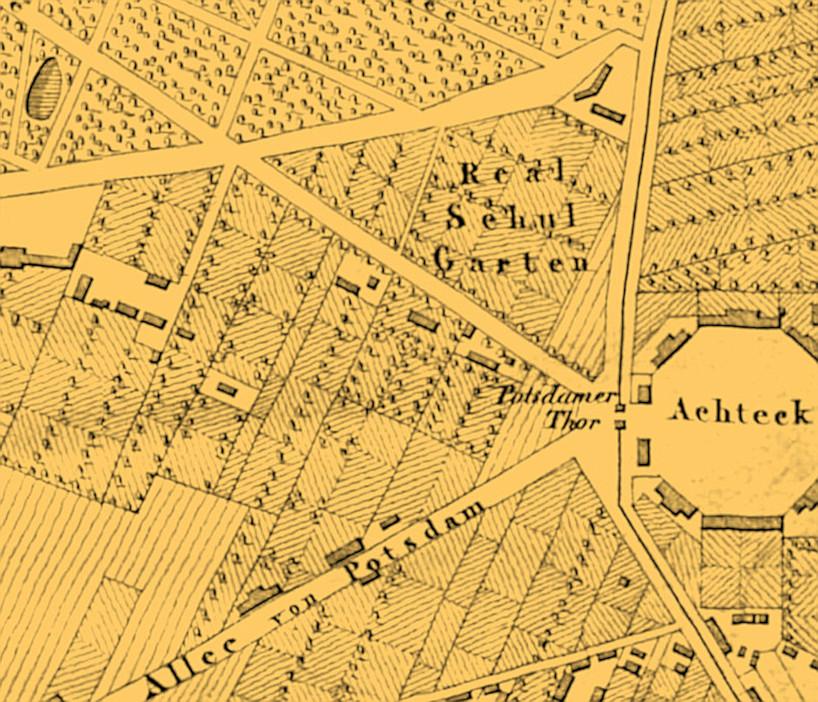
It was located on what today is known as the Lenné-Dreieck, the area between Lennéstrasse, Bellevuestrasse, and Ebertstrasse on the Potsdamer Platz in the central Berlin borough of Mitte, a merger of the former districts of Mitte, Tiergarten, and Wedding, here in an illustration from 1765, “Der Thiergarten im Jahre 1765,” from Georg Wilhelm von Raumer, Der Thiergarten bei Berlin: seine Entstehung und seine Schicksale nach bewährten Nachrichten (Berlin 1840); the Realschulgarten is on the right, clearly marked at the upper left of the Achteck (octagon) at the Potsdam city gate:
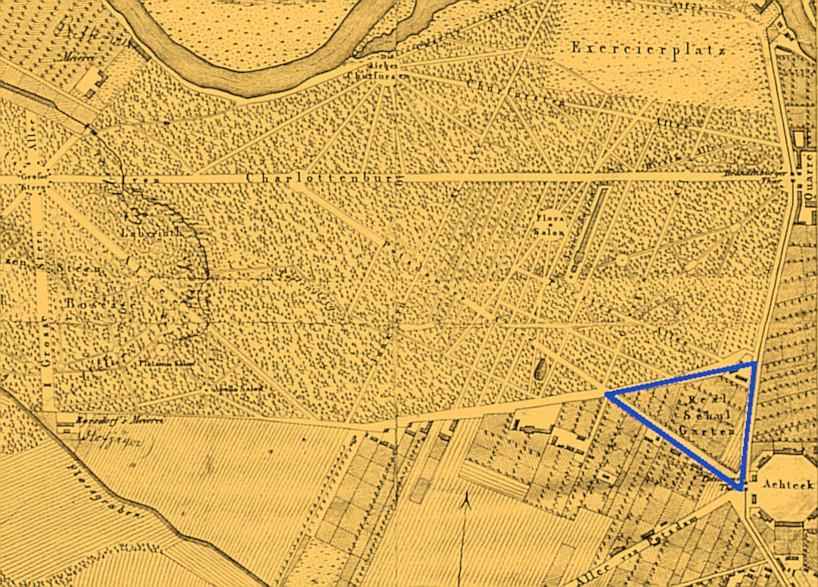
And a closer view in an excerpt from the above illustration:
If Friedrich’s allusion is to be taken literally, the Ungers apparently had a residence in the area or were planning to rent such, but it is not clear at least in his statement here whether he intends for Caroline to reside with Madam Unger in town or in the summer house, where he suggests the latter will be staying; in his letter to Caroline in early March 1799 (letter 224c), however, it is clear that he opposes Caroline (and Auguste) staying in the Ungers’ summer house in the “rural” Thiergarten because Madam Unger’s intention — he argues — will be to cut them off from contact with him, Schleiermacher, and Dorothea, and even from the theater. Back.
[7] “Gentleman” in English in original. Back.
Translation © 2012 Doug Stott