
• 179. Caroline to Luise Gotter in Gotha: Jena, 13 February 1797 [*]
Jena, 13 February [17]97
|415| I had already planned to write you today, my dear, and to give you my honest opinion, then your own letter arrived entreating me even more urgently to do so, a letter which, moreover, itself has finally decided my opinion. [1] Schlegel, who is by no means a friend of revolutions, did admittedly remark to me on several occasions concerning the girl, “Child, you know what you already have, but not what you might get” — except — even had you had a fairly stimulating sujet to suggest to me, I still would have done what I liked.
Well, — since she has a cataract in her left eye, what am I to say? My entire household is offended by that cataract, and no one spoke more zealously in trying to drown out my indecisiveness than Gustel, who otherwise is quite wont to complain bitterly about Hannah. We discussed this the entire afternoon — she listed all the points at issue, which I am here sending along to you.
The Hannah I have hitherto engaged has as many points for as against her — the other one has the cataract and a raucous personality, which we certainly cannot use because we would end up allowing ourselves to be duped, since I for my part am simply not suited for keeping a person under my thumb. [1a]
The net effect of all these useless words is that I am ashamed to have put you through so much trouble for |416| nothing, since I want to stick it out with Hannah for another six months. She persuaded Gustel that she was only 25 years old (she must be at least 35), and the good child would now stake her life on it and is also afraid, since you spoke about “middle years,” that the other one might well be 80 years old or so, to which she is utterly averse. There is nothing she tolerates less than surliness or peevishness. Forgive me, moreover, for having filled up 2 entire pages writing about matters involving servants.
Your good news about Gotter made me very glad indeed. [2] I view his verses as the first genuine sign of life — some sick people sneeze when they are getting better — Gotter composes verses, and they are indeed charming, with a very nice pointe — I am hoping for the best for him. His poesy and his appetite are, after all, beginning to stir again. How glad you will be in the spring when you see his strength returning. Grimm basically has a tender heart, and aesthetic elements have more influence over him than he himself realizes. Hence it cannot fail that he be able to treat and cure your husband quite properly with love.
Hardly had I heard that Jacobs really did receive an appointment in Oldenburg than I also learned he is declining it for the sake of his family and will be receiving an additional allowance. [3] I am glad he will be remaining our neighbor, particularly since he was intending to move north. Give him my regards. . . .
Schütz is still doing quite ill [4] — I really know not what will become of the Gotha plan, though I do fear she can be enlightened only through bitter experience with the hardheartedness of the residents of Gotha. [5]
Louise continues to do well, her nursing is going well, and yesterday the child was baptized a Christian. [6] . . .
Did |417| I write and tell you that my youngest brother is almost beside himself with marital bliss — it has been maybe a month since he was wed, and he is already asking me to be a godparent. [7] One must say that although for a time things did not quite seem to move forward with some members of our family, we have ended up being quite fortunate in this business of marriage and accordingly are praising the Lord all our days. [7a] If only we were as rich as we are blessed! Though that is not really my primary wish. . . .
But, dearest, Schlegel is going to have to inconvenience you once again. He also needs the unbound Bibliothek der schönen Wissenschaften. [8] Schütz does not have the latest volumes at all. Please be so good as to pack them up and deliver them for the chamber coach to take along. [9] Gotter can rest assured that not a single hair will be disturbed. Schlegel is the most organized person in the world and cannot see even a single thread lying about without stumbling over it.
We know not who wrote Agnes. [10] — Schiller is buying the garden that Frau Mereau had last year. [11] Wolzogen has become Kammerherr and Kammerrath in Weimar — I wish it were in Petersburg instead! Madam Humbold[t] had her third child 3 weeks ago, as ugly as the first two. [12]
Stay well, you dearest. Why has the Chanoinesse not written? — that grieves me. Cäcilie could also similarly make Auguste quite glad. Is the pastor giving her so much to write? [13]
Notes
[*] Chronological note: A few days before this letter was written, Caroline’s review of Wackenroder and Tieck’s Herzensergiessungen eines kunstliebenden Klosterbruders appeared in the Allgemeine Literatur-Zeitung on 10 February 1797, and her review of Mistress Elizabeth Inchbald on 11 February 1797. Back.
[1] At issue is the possible procurement of a new maidservant in the Schlegel household.
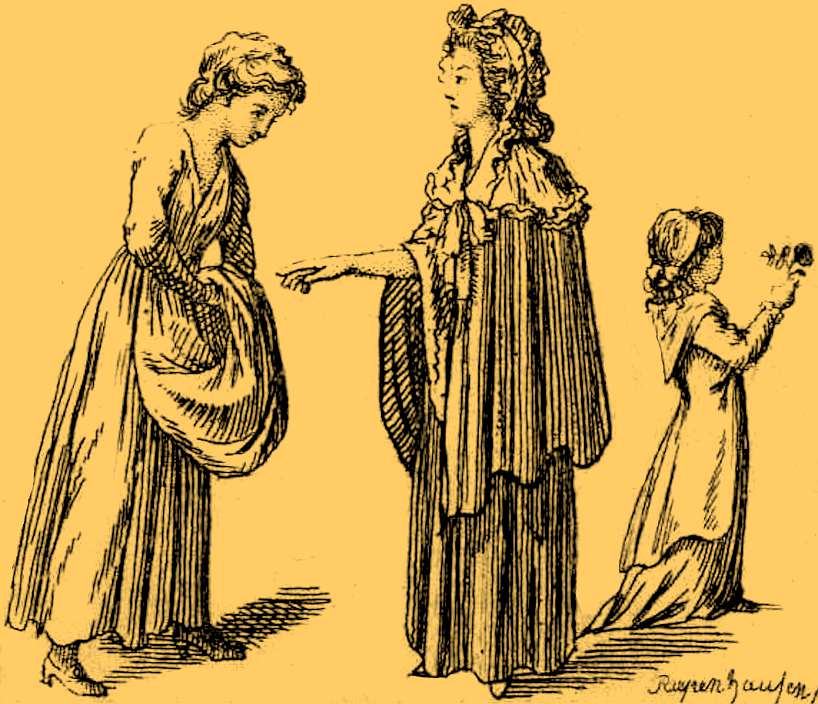
Although maidservants and menservants were rarely captured in portraits by name, they were indeed often depicted in engravings as a genre (Allmanach auf 1786 [Vienna]; Inhaltsverzeichnis deutscher Almanache, Theodor Springmann Stiftung):
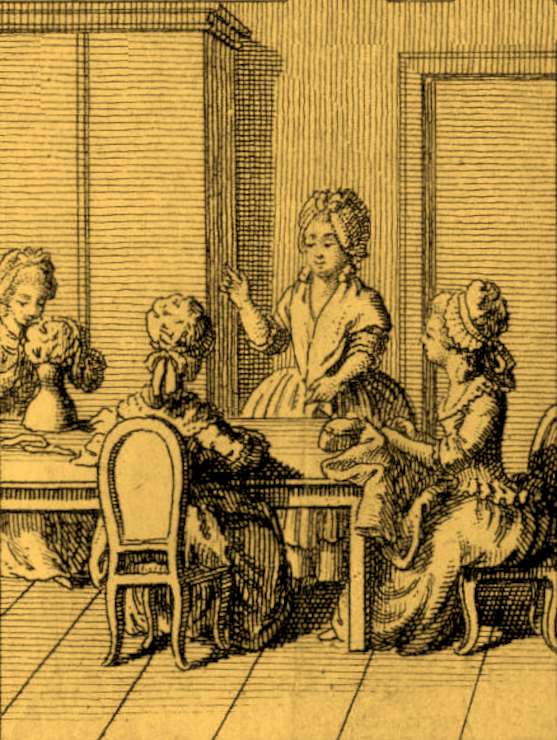
Because the children of the household had contact with them on a daily basis, it is not surprising that Auguste, a precocious girl in any case, plays a role in the following discussion.
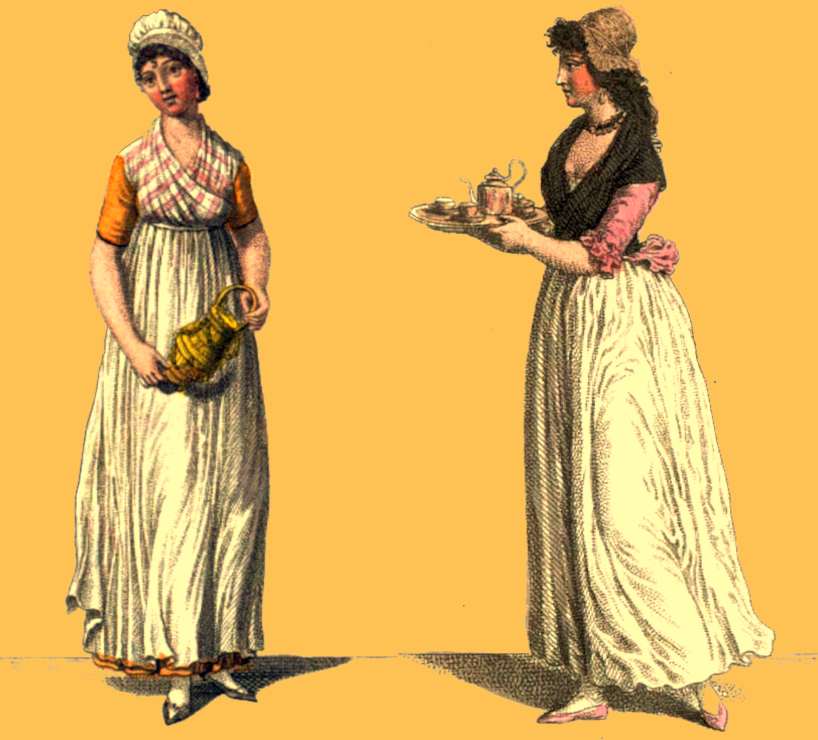
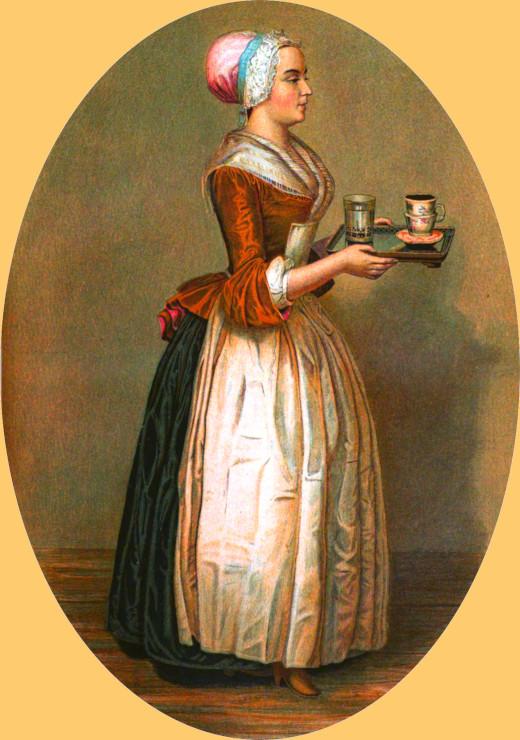
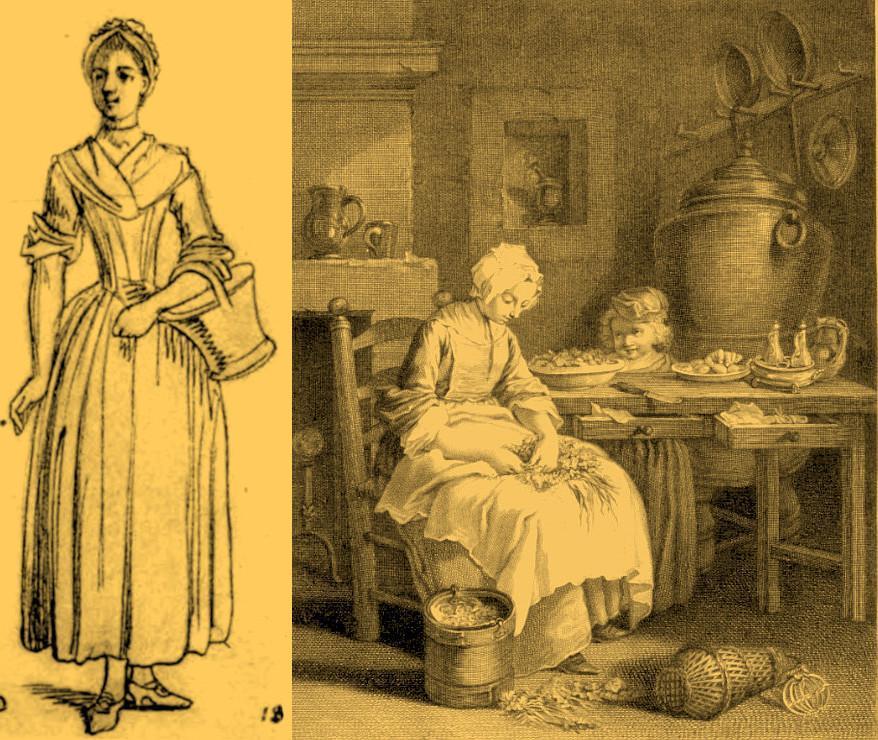
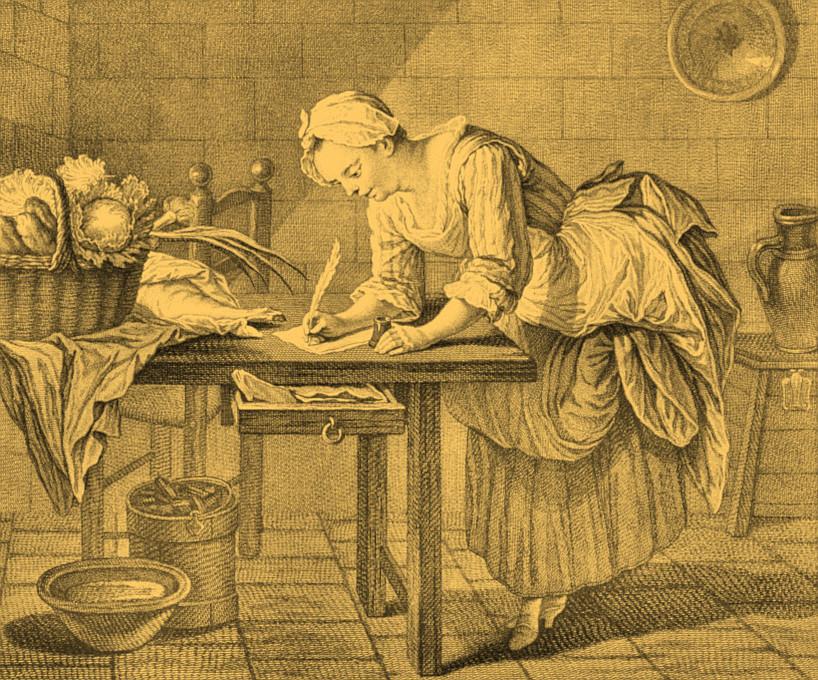
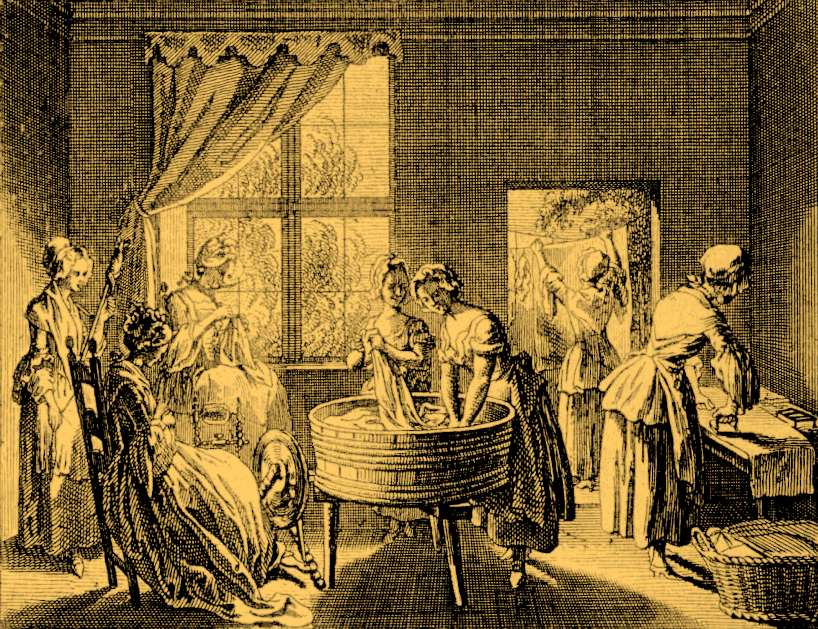
Here several illustrations of maidservants: (1) maidservants in 1804 from Vienna (left) and Hamburg (right); (2) a maidservant with coffee service; (3) a maidservant sketched by Daniel Nikolaus Chodowiecki during a trip to Danzig in 1773; (4) a contemporary depiction of a maidservant preparing a salad in a kitchen while being observed by a young girl such as Auguste; (5) a cook — Nicole — preparing her kitchen purchasing accounts for her mistress; and, finally, (6) “Some of the forms of useful tasks for women: sewing, spinning washing, ironing, etc.”
(Sources in order: [1] Both images: Göttinger Taschenkalender [1804]; [2] Freÿa: Illustrirte Blätter für die gebildete Welt 7 [1867], plate following p. 24; (also black-and-white as Die schöne Wienerin, second frontispiece engraving from the Volkskalender für 1843, ed. Karl Steffens [Frankfurt 1843]); [3] Daniel Nikolaus Chodowiecki, Von Berlin nach Danzig: Eine Künstlerfahrt im Jahre 1773, von Daniel Chodowiecki: 108 Lichtdrucke nach den Originalen in der Staatl. Akademie der Künste in Berlin, mit erläuterndem Text und einer Einführung von Wolfgang von Oettingen [Leipzig 1923], plate 49; [4] Etienne Jeaurat, L’eplucheuse de salade [1752], Herzog Anton Ulrich Museum, Museumsnr./Signatur JFBeauvarlet Vasel 3.310; [5] Pierre-Louis Dumesnil, La Cuisiniere [Paris 1762], Herzog Anton Ulrich Museum, Museumsnr./Signatur CDuflos AB 3.37; [6] Chodowiecki, Kupfersammlung zu J[ohann] B[ernhard] Basedows Elementarwerke für die Jugend und ihre Freunde: Erste Lieferung in 53 Tafeln. Zweyte Lieferung in 47 Tafeln von L bis XCVI [Leipzig, Dessau, Berlin 1774]), plate XIX b.):
[1a] Königlich Großbritannischer und Churfürstlicher Genealogischer Kalender auf das 1786. Iahr (Inhaltsverzeichnis deutscher Almanache, Theodor Springmann Stiftung):
[2] Friedrich Wilhelm Gotter had been seriously ill with consumption for several months and would die on 18 March 1797, i.e., in just over a month. Back.
[3] See Caroline’s undated letter to Luise Gotter in early 1797 (letter 177) with note 1. Back.
[4] Christian Gottfried Schütz had been suffering from cramps; see also Caroline’s letter to Luise Gotter in October/November 1796 (letter 173). Back.
[5] Uncertain reference, though it may involve the Schützes’ plan to send their son to Gotha for secondary-school instruction, initially preferably under Friedrich Jacobs. Christian Gottfried Schütz wrote to Jacobs not quite two weeks earlier, on 1 February 1797 (Christian Gottfried Schütz. Darstellung seines Lebens, 1:243–44):
Notwithstanding I have been suffering on the torture rack of cramps just this evening as never before, I cannot forbear, even in doloribus, offering you my heartiest congratulations, my dear friend, on your recently confirmed appointment to Oldenburg. . . .
Although I am concluding that you genuinely have declared your acceptance of the position, I do confess I am quite chagrined at losing you, and yet am quite glad at the prospects of your improved circumstances. May God grant that things go very well for you indeed in Oldenburg. You will doubtless be joining a circle of very good people.
Of course, for the sake of my son I would admittedly have preferred that an adequate financial supplement had kept you in Gotha. Could my wife but bring her maternal heart to send her only son 50 [German] miles away [ca. 350 km], I would certainly have him move to Oldenburg with you. As it is, however, our decision remains to bring him to Gotha at Easter, though I had quite been counting on the advantage he might have enjoyed under your tutelage . . .
Please do inform me with a couple of lines by return post whether you genuinely, and, if so, in which month you will be departing for Oldenburg.
Schütz, having learned of Jacobs’s decision to stay in Gotha and of Ernst II’s gesture of granting Jacobs a supplement, then writes to Jacobs again on 19 February 1797 (ibid., 1:244):
You can imagine how the unexpected turn of events with respect to the Oldenburg appointment delighted me! . . . I do not know where the error arose that those in Oldenburg were already so reliably counting on you. No one can insinuate anything implying that you yourself were the source, and I must praise your duke for having been savvy enough to keep you there, and praise you yourself, since you would prefer to remain in Gotha in any case rather than go to Oldenburg. Back.
[6] Taschenkalender auf das Jahr 1798 für Damen (Inhaltsverzeichnis deutscher Almanache, Theodor Springmann Stiftung):

A problem arises here with respect to the identity of Luise Wiedemann’s child.
Although Erich Schmidt (1913), 1:717, identifies it as Emma Wiedemann, she was not born until October 1798, whereas Conrad Rudolph Wiedemann (the Wiedemann’s first child; they had married on 28 March 1796) was born on 29 February 1797 and died on 14 March 1798 (dates for both children from Luise Wiedemann’s Erinnerungen, 98).
That Luise Wiedemann herself admits to memory problems while she was composing her memoirs may account for the discrepancies with Caroline’s account here, which was written on 13 February 1797; that is, Conrad Rudolph Wiedemann may in fact have been born several days (or weeks) prior to Caroline’s letter here. Back.
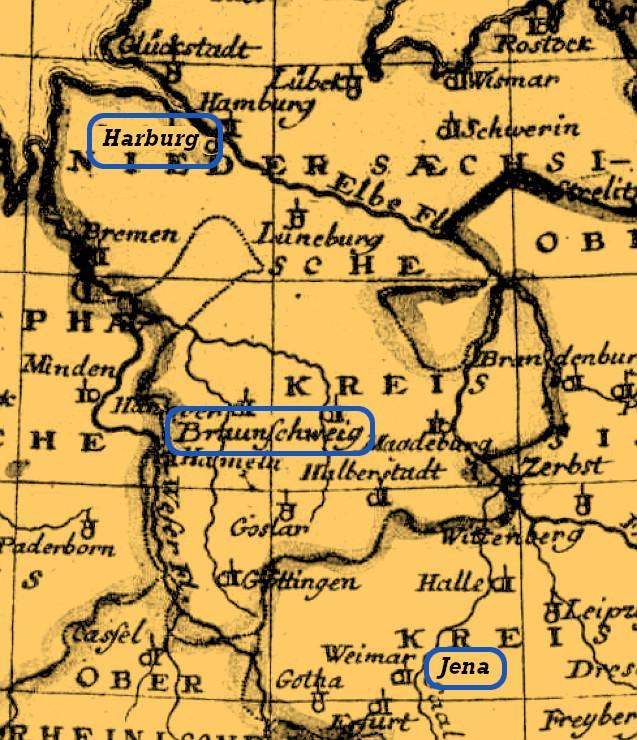
[7] Philipp Michaelis, now a physician in Harburg (Haarburg) just across the river from Hamburg, had married the Harburg native Auguste Katharine Sympher on 8 January 1797 (Taschenbuch auf das Jahr 1805 für edle Weiber und Mädchen, Inhaltsverzeichnis deutscher Almanache, Theodor Springmann Stiftung):

Here Harburg’s location and setting; Caroline visited Philipp in Harburg during the early spring of 1801 ([1] Rudolf Koch and Fritz Kredel, Deutschland und angrenzende Gebiete [Leipzig 1937]; [2] Daniel Nikolaus Chodowiecki, Besetztere und illuminierte Landkarte von Deutschland, from the Kupfersammlung zu J[ohann] B[ernhard] Basedows Elementarwerke für die Jugend und ihre Freunde: Erste Lieferung in 53 Tafeln. Zweyte Lieferung in 47 Tafeln von L bis XCVI [Leipzig, Dessau, Berlin 1774], plate xlv; [3] Harburg ca. 1824, Haldenwang after A. Radl, also in K. J. H. Hübbe, Ansichten der freien Hansestadt Hamburg und ihrer Umgebungen [Frankfurt 1824], plate following p. 8):


Praise the Lord!
Praise the Lord, O my soul!
I will praise the Lord as long as I live;
I will sing praises to my God all my life long.

Do not put your trust in princes,
in mortals, in whom there is no help.
When their breath departs, they return to the earth;
on that very day their plans perish [etc.] Back.
[8] Neue Bibliothek der schönen Wissenschaften und der freyen Künste, ed. Christian Felix Weisse and Johann Gottfried Dyk, vols. 1–72 (Leipzig 1765–1806). See esp. Caroline’s letter to Luise Gotter on 25 December 1796 (letter 175) with note 21 concerning Wilhelm’s later criticism of the periodical. Back.
[9] Such “chamber carriages” (Kammerwagen) were originally long, vaulted, covered carriages associated with royal courts that transported not only chamber servants but also associated items; in several regions they also served a traditional and colorful role in weddings (the “bride’s chamber carriage”).
The reference is generally to a covered transport carriage or wagon driven or managed by a professional carter imitating those mentioned above but now in the service of a municipality. Normal land coaches could also be called such if they originated as such “chamber carriages” (Adelung, 2:1488). Shipping by “carter” generally referred to such conveyances, though “carters” could also refer to rural conveyances used in agriculture and general delivery.
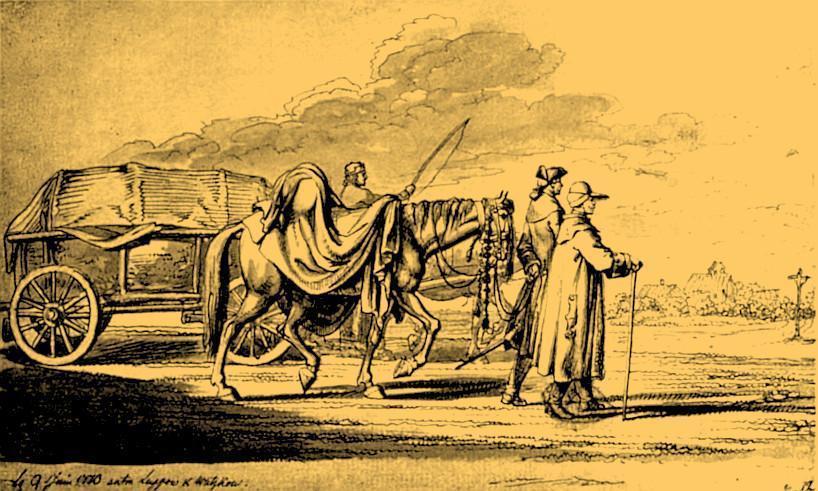
In 1756, the Geographisches Reise- Post- und Zeitungs-Lexicon von Teutschland: oder gesammlete Nachrichten von denen in Teutschland liegenden Städten, Marktflecken, Flecken, Schlössern, Klöstern, Dörfern u.s.w.: in alphabetischer Ordnung samt deren Lage … zum allgemeinen Nutzen derer Postämter, vol. 1, A–L (Jena 1756), 580, remarks that the royal Kammer-Wagen to Gotha, Eisenach, etc. by way of Weimar and Erfurt departed each Wednesday morning and returned on Friday evening. Here two illustrations of the basic transport wagon of this type (Daniel Nikolaus Chodowiecki, Von Berlin nach Danzig: Eine Künstlerfahrt im Jahre 1773, von Daniel Chodowiecki. 108 Lichtdrucke nach den Originalen in der Staatl. Akademie der Künste in Berlin, mit erläuterndem Text und einer Einführung von Wolfgang von Oettingen [Leipzig 1923], plates 12 and 17):

[10] See Caroline’s letter to Luise Gotter on 12 December 1796 (letter 174) with note 9. Back.
[11] Schiller acquired this property in March 1797 for 1050 Thaler, albeit as a secondary rather than primary residence. At the time it was yet located just outside the town gates, and the Schiller family used it during the summers between 1797 and 1799, when they moved to Weimar.
Schiller’s two boys and his maidservants had rooms on the ground floor, his wife on the second (including a salon for receiving visitors), and Schiller himself on the third, where his workspace had a charming view of the surrounding gardens and forested areas. The family otherwise resided in apartments in town.
In 1798 he also had a small garden tower built as a workspace. The house, still extant, stands on property outside the Löbder Gate just southwest of what at the time were the town walls; Caroline’s residence at Leutragasse 5 is indicated at the upper right in the engraving (Stadtplan von Jena [Hamburg 1806]; Verwalter: Dresden, Sächsische Landesbibliothek – Staats- und Universitätsbibliothek Dresden (SLUB), Kartensammlung, Signatur/Inventar-Nr.: SLUB/KS 30125):
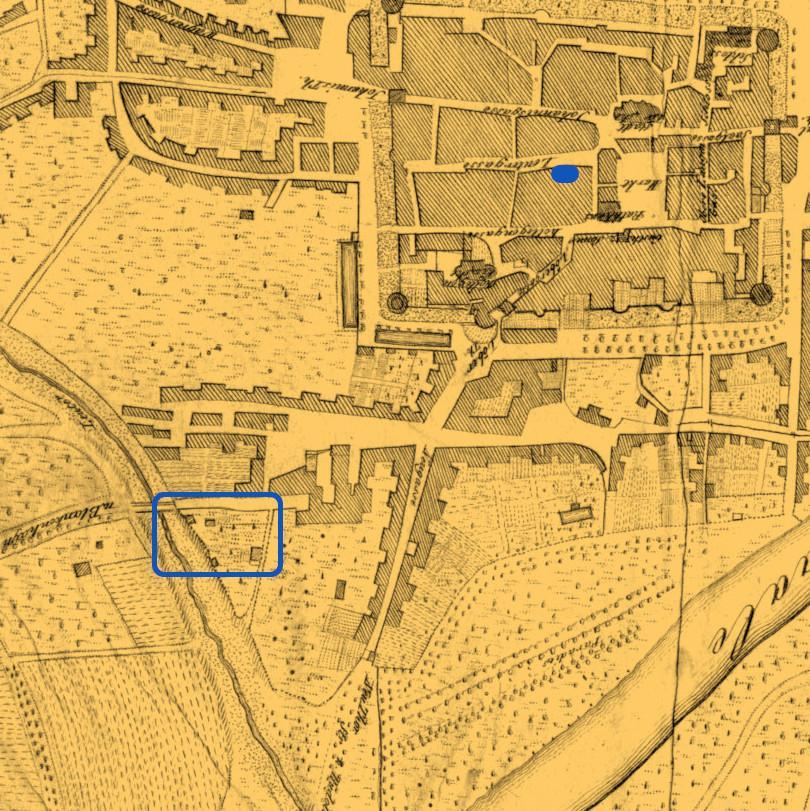
Here the property in a contemporary drawing by Goethe; the bridge at the left in the drawing is indicated on the map above:

[12] The previous two Humboldt children were Caroline (1792–1837) and Wilhelm (1794–1803). Theodor von Humboldt had been born on 19 January 1797 in Jena. (Caroline von Humboldt did not do well after the birth, prompting the family to move from Jena to Dresden in June 1797.) Erich Schmidt (1913), 1:717, suggests that all the evidence contradicts Caroline’s assessment of the children’s appearance.
In any event, Caroline von Humboldt, writing from Vienna to Charlotte Schiller on 29 September 1797 (Charlotte von Schiller und ihre Freunde 2:173 [not 1:173 as in (1913), 1:717]) remarks:
I am glad to hear you are no longer seeing Madam Schlegel at all, since she is a snake. Friedrich Schlegel told some of my acquaintances in Berlin that his sister-in-law was my only social contact in Jena. What do you think about that?
She writes Charlotte von Schiller from Paris on 16 February 1798 (ibid. 176): “Vieweg from Berlin told me here that Wilhelm Schlegel intends to move to Dresden with his Donna. Is that right?” Back.
[13] I.e., in confirmation class; Cäcilie Gotter, born 1782, was likely about to be confirmed (Thomas Stothard, Confirmation [1792]; Herzog August Bibliothek; Museums./Signatur FBartolozzi V 3.223):

Concerning Auguste’s own, not entirely neurotic anxiety at the prospect of traditional confirmation and catechism instruction in 1799, click on the gallery below:

Translation © 2012 Doug Stott