
• 53. Caroline to Lotte Michaelis in Göttingen: Clausthal 1785
[Clausthal 1785]
|110| You always have to make do with wastebasket paper, my little chicken. Ever since you accidentally reminded me of your diminutiveness, |111| I cannot call you anything but “Chicken Little.” Do you remember the little chicken — “Cluck! Cluck!” — Alas, no one wanted to call, “Cluck! Cluck!” It would have come straightaway, would have eaten out of our hands. Böhmer would have had to have it, so much does he love our feathered friends — as soon as he comes home, I will suggest he fetch it from Duderstadt, where it has lived since the fat nièce moved to Hamburg with her dainty husband. [1] It can first become my confinement aide. [2]
Apropos, give my regards to old Madam Köten, and please let her know — what you yourself already very well know. [3] But it has probably already happened; how could you, who are so good in drawing small boys, ever have kept one in your heart? You have indeed sent me a beautiful little budkin, no doubt about that. Is his hair not already fairly bristling with all that virility? Is he not at the same time still living in a state of innocence? Is he not anxious to love and fly?
Phooey, girl, he belies so much skill that I can hardly even imagine it was you who made him. And yet — do not get unnecessarily angry or feel insulted. There is no harm, [4] little Caroline says after she has wet the bed [5] — there is no harm, and when Schir [6] dries it again, it is no longer wet. What an innocent, mischievous, naive angel Caroline is! even though Emmy is my favorite; I wish she were my daughter.
Amid all this prattle I can forget the tears that ran down my cheeks when I read your query yesterday about the English gauze and realized I had already cut it up and used it for making cuffs. I am just so sorry I cannot be of service to Mother in that regard, I really would give my right hand could I but have it back. That beautiful gray taffeta dress! I would also like one, and I long ago already bought batavia for thirteen Gulden, very pretty, but have not yet |112| had it made, nor will I do so until after May, when I come to Göttingen and pay cour to Prince Edouard. [7] It would be appropriate if all girls were first banned from the university; I would take in a half dozen here out of Christian charity. Does one really want to put these girls and the prince and the chamberlains and the apprentice cooks in such danger d’amour?
I do wish that Göttingen might receive preference; that would certainly be sweet; on the other hand, I certainly would not wish for Father to have to sacrifice his comfortable residence during his older years, not even to a king’s son! I am hoping nothing will come of it [8] . . .
The students are miserable riffraff on the whole and even as students; they gossip and backbite even more loathsomely than do old women and gossipmongers. I seriously implore you not to lift even a single finger on his [Ahlefeld’s] behalf; [9] he is, moreover, allegedly utterly incapable of loving anything but his own face.
I would so much like to see you persevere in your current course of behavior. Always tug secretly on your own dress when you feel you might make one remark too many. I am consistently suspicious that Kotzebue will not actually come; in any event, I would be willing to bet he will not mention it to you if you but present yourself appropriately, [10] and certainly not in Mother’s presence — in the presence of such women, these fops always get tongue-tied . . .
Notes
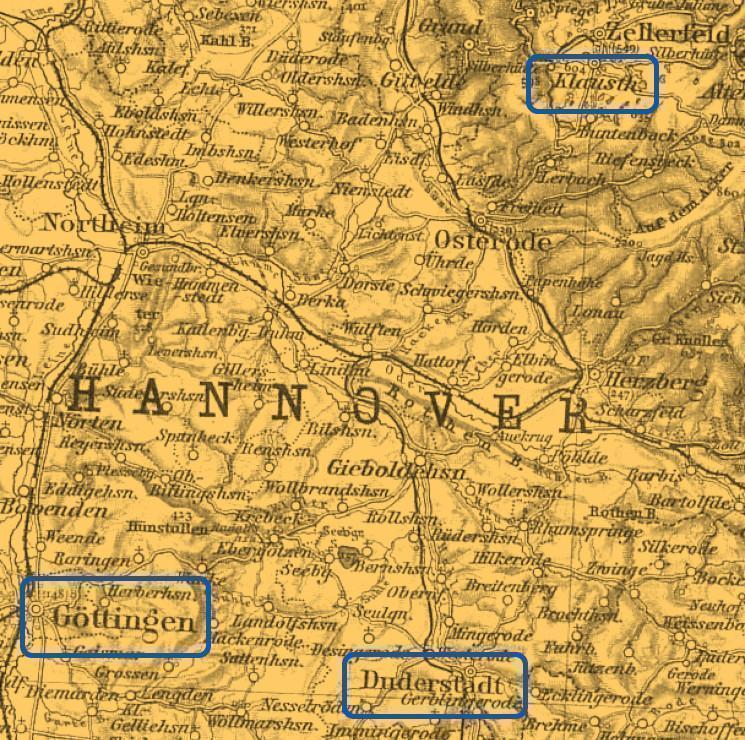
[1] Caroline’s personal references are unclear. — Duderstadt is located ca. 32 km south of Clausthal; the identity of the niece there is unknown (Karte des deutschen Reichs, ed. C. Vogel [Gotha 1907], no. 13):
[2] A distinction came to be made between a midwife (Hebamme), confinement aide (Wochenwärterin), and wet nurse (Amme). See, albeit later in the nineteenth century, E. G. Orthmann, “Die die Hebammenthätigkeit betreffenden Schreiben des Königs. Polizei-Präsidium,” Berliner klinische Wochenschrift: Organ für practische Ärzte 35 (1898) 43 (Monday, 24 October 1898), 960–61, here 960:
In the case of well-off women in childbed [scil. confinment], the midwife is usually joined by a confinement aide who then takes over the care of both the woman and the child, whereas the midwife is generally engaged only for a specific period of time to ensure the well-being of the woman in childbed by monitoring her temperature etc. In individual cases, separate confinement aides are often engaged for mother and child, or, if the mother is unable or is instructed not to nurse the child herself, a wet nurse, who then also [scil. as a dry nurse] takes over care of the child.
Here an illustration of such an aide ministering to the mother during the latter’s recovery from the confinement period and birth (Étienne Jeaurat, L’Ac[c]ouchée [1744]):

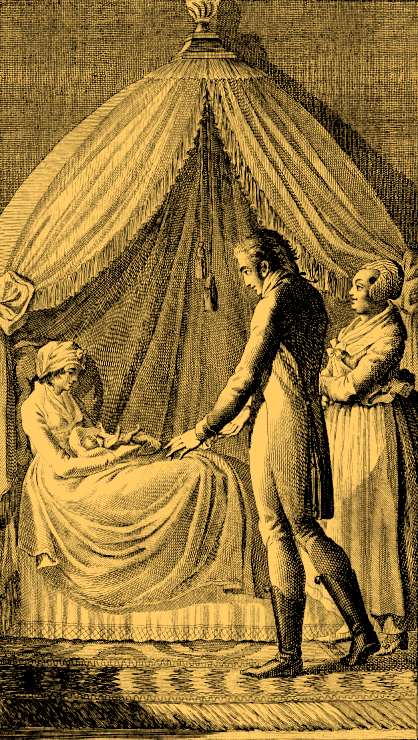
Here an illustration of parents with their newborn child and one (otherwise unidentified) of the three aides (Gottlieb Böttger der Ältere, Eltern mit Kind [1803]; Herzog August Bibliothek; Museums./Signatur Graph. A1:235)
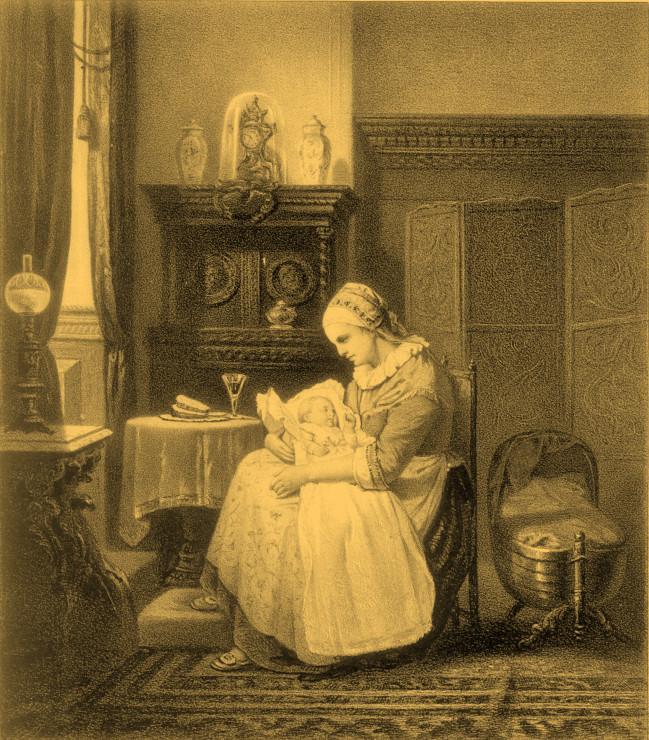
Here a wet nurse, or Amme (Moritz Ulffers, Die Königs-Amme, lithography after a painting by Franz Wieschebrink [ca. 1855]):
Concerning childbirth, including esp. its perils, see also Caroline’s unsettling account of her own childbed in her undated letter to Luise Gotter in 1785 (letter 57), and, concerning the tragic episode with her sister-in-law, her letter to Wilhelm Schlegel on 26–27 March 1801 (letter 303), esp. with additional cross references, including to the equally tragic episode with Lotte Michaelis herself, in note 6 there. Back.
[3] Presumably an allusion to Caroline’s pregnancy. — The reading “old Madam Köten” (die alte Köten) is uncertain. Back.
[4] “There is no harm” in English in original. Back.
[5] “Caroline” and “Emmy” are otherwise unidentified. Back.
[6] Unknown reference; the maidservant? Back.
[7] King George III had intended to send Prince Edward to the university in Göttingen, but on the advice of the Duke of York the prince went to Lüneburg instead, “to keep Edward away from the fleshpots of larger centres such as Hanover or Göttingen” (William D. Naftel, Prince Edward’s Legacy: The Duke of Kent in Halifax: Romance and Beautiful Buildings [Halifax 2005], 23). Back.
[8] The “Michaelis House” was to be vacated were the prince to come to Göttingen. Georg Christoph Lichtenberg writes to Samuel Thomas von Sömmerring from Göttingen on 7 March 1785 (Lichtenberg, Briefe 2:213): “Prince Edward will not be coming here after all. They wanted to buy the Michaelis house for him, and Michaelis was demanding 20,000 Thaler, or 2000 Thaler rent, but in which case he would move out; Grätzel wanted 1200 Thaler rent if he had to move out. The prince will now be going to Lüneburg.” Back.
[9] Waitz (1871), 1:17, heavily abridged this letter; Erich Schmidt (1913), 1:112, added Ahlefeld’s bracketed name in his text. Back.
[10] I.e., presumably mention the encounter between Lotte and himself in Gotha in the summer of 1781; see esp. Kotzebue’s letter to an unknown recipient in Göttingen on 27 October 1781 (letter 25a).
Erich Schmidt (1913), 1:683, remarks that the name “Kotzebue” does not appear in the register of matriculated students, but such is not at issue in this letter. After he went to Russia in late 1781 as secretary to General Bauer in St. Petersburg, Catherine the Great appointed him administrator and assessor at the court of appeals in Reval (Tallinn), Estonia.
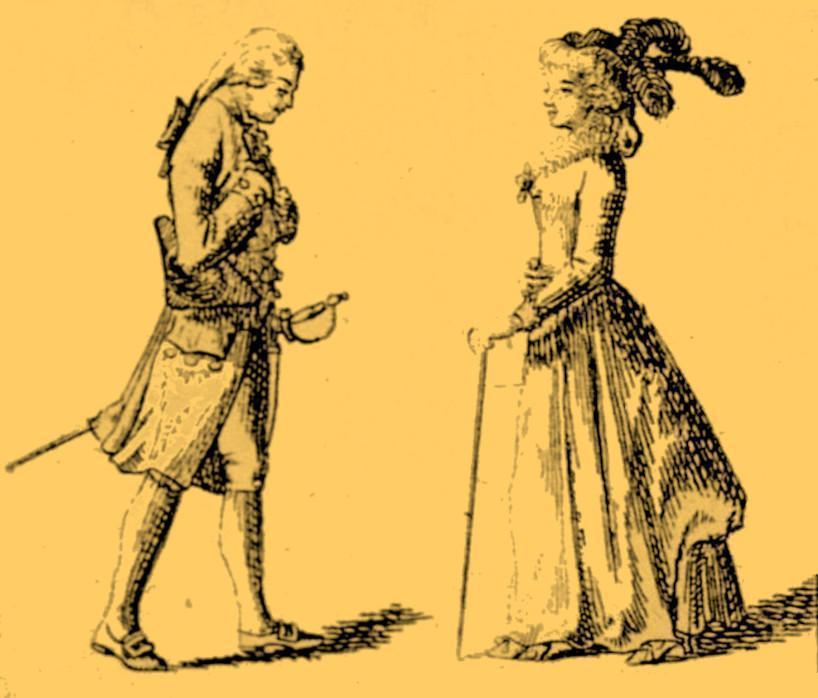
In early 1785, however, he traveled to northern Germany to do research in the libraries in Wolfenbüttel and Hannover for a history of Henry the Lion. It is apparent from this letter that Caroline was anticipating his visiting Göttingen and quite possibly seeing Lotte, though no documentation yet attests he genuinely did come (illustration: Goettinger Taschen Calendar vom Jahr 1784; Inhaltsverzeichnis deutscher Almanache, Theodor Springmann Stiftung):
In any event, he returned to Reval and in the same year, 1785, married Friederike von Essen, was appointed president of the provincial government in Estonia, and also ennobled. He reappears in connection with Lotte in 1791; see Caroline’s letter to Philipp Michaelis on 22 June 1791 (letter 102). Back.
Translation © 2011 Doug Stott