
• 175. Caroline to Luise Gotter in Gotha: Jena, 25 December 1796 [*]
Jena, [Sunday] 25 December [17]96
|408| Your package arrived yesterday at just the right time, you good soul, and Auguste and I would like to thank you from the bottom of our hearts for being so kind and good. . . . I think of all of you every day and every hour, [1] and were Weimar no further from Gotha than from here, I would not have rested until I had made my way to you from there. [2]
|409| Nor should you entirely let your guard down against the possibility of such ambush in any case. Once I have concluded that something of that sort is even remotely possible, it is as good as done, though admittedly most of the time it does not even seem possible for me to leave my 4 walls here. Even going to Weimar, it was not so much that I myself was going as that the horses were riding off with me in tow.
That said, afterward I was admittedly quite satisfied — even though I was again unable to make the acquaintance of the Kammerherr von Einsiedel. [3] What crafty deliberations of fate are behind all this?
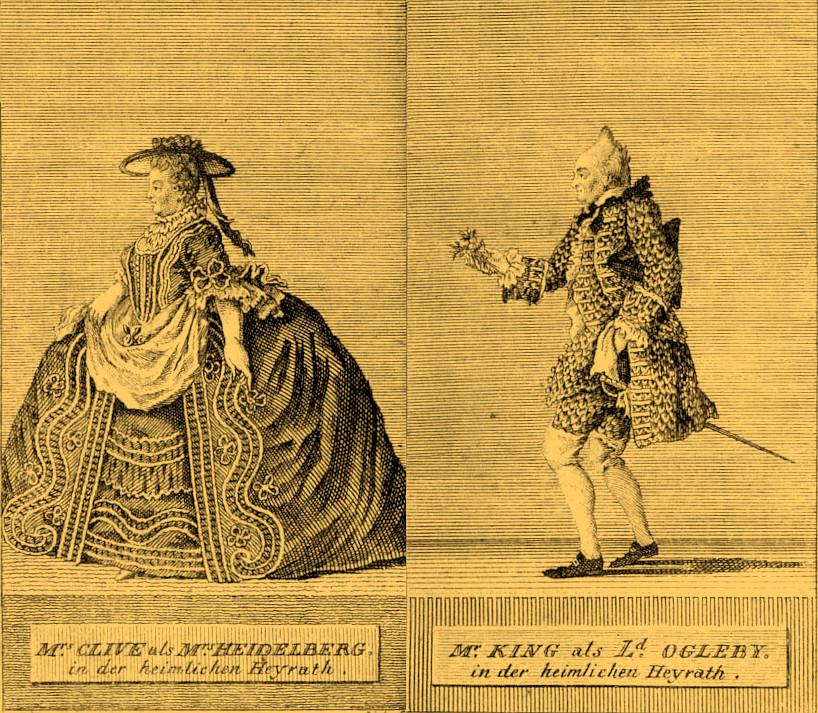
On the first evening, we went to the theater. We did not even know what was to be performed; fortunately, it was nothing more uninteresting than an opera, Die heimliche Heirath, Italian music, by Cimarosa, which I heard performed in Braunschweig by the Italians and always quite enjoyed. [4] We attended with Everyman’s cicerone, namely, our dear Bötticher, and his good wife, who is as sweet as she is ceremonious, and who rolls her eyes until the whites show and clasps her hands and cries out “Beautiful! Beautiful!” [4a]
Mademoiselle Schröder sat in front of me. [5] I, suspecting it could be her, noticed that she queried my neighbors concerning the strange face, and examined me as well. Then we were introduced. And on the 2nd morning I went to visit her at 11:00 after I had informed her earlier. [5a] Schlegel went along and wanted to visit Einsiedel, but the latter had just been called away.
That evening at 5:00, just as we had come back from Göthe’s and were about to depart, Einsiedel announced he was coming and was perhaps even already on his way over, but we, too, were already underway, but in the carriage — and that is my sad story of how people miss one another!
After the initial, stiff formality had been made a bit more supple through conversation at Mademoiselle Schröder’s, we, and especially Schlegel, found her quite pleasing. [6] I urged her to accept my invitation to visit us in Jena, |410| and when all of you come this summer as well, we will see whether she might come over for a day. —
I also saw Madam von Kalb, and say what you will, but at the Last Judgment she will pass muster as a true member of the nobility, and will surely be found to be such. I have absolutely no complaints with regard to any lack of courteous behavior — though her intellect — and she does indeed possess such — has indeed been cast in a somewhat peculiarly crooked form. —
But the person who absolutely charmed me and almost made me fall in love, that would be Herder. We went there for tea, to which Wieland had also been summoned and whom I allegedly encountered in an extraordinarily good mood; and indeed, he came up with some very funny remarks, grumbling on about, among other things, pigs, for whose creation he simply could never forgive our dear Lord — and which in a severe fit of displeasure he called anti-graces [6a] — and then about the Xenien — and about Mademoiselle von Berlepsch, Genlis, Staal, etc.
But he did say some nice things about me afterward even though he had caught a horrible head cold from the evening. He also could have broken his neck, since it had gotten as slippery as (is this not the way proper style expresses it?) “the eldest of people” could ever remember.
I had imagined Madam Herder as being smaller, gentler, more feminine. [6b] In any event, those failed expectations were certainly compensated by her husband. His Courland accent is already enough to steal your heart, [7] and then the simultaneous ease and dignity in his whole being, the witty grace in everything he says — and he says not a word one is not glad to hear — it has been a long time since a person has pleased me as much as this, and even now it seems to me that in my zeal I have expressed myself quite confusedly in that regard.
At midday the next day, we were at Göthe’s, Herder as well, and I sat next to him and Knebel, except that my head was always turned toward only one side. [7a]
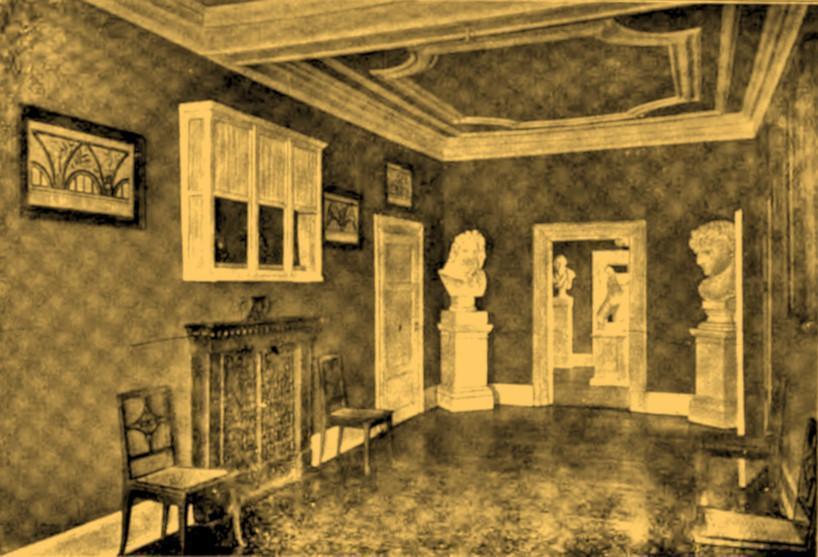
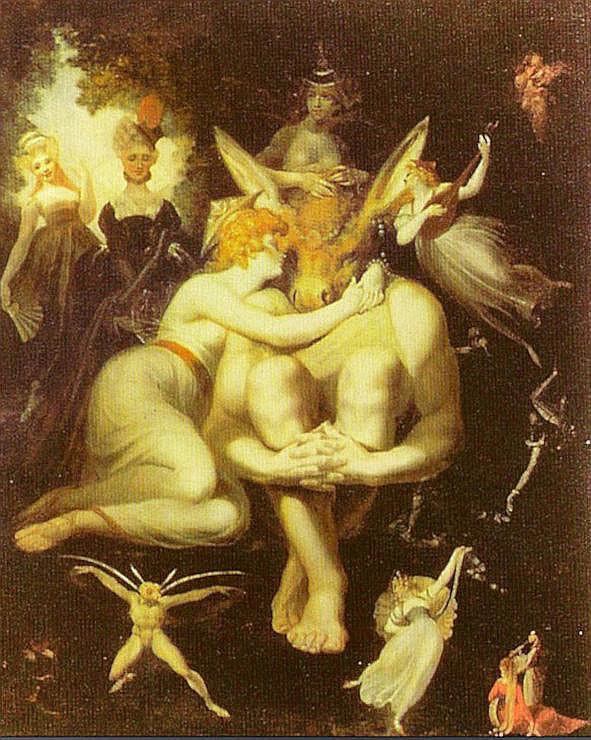
Göthe |411| gave a most charming diner, very nice, without extravagance, serving everything himself, and so adroitly that he always found time in between to describe some beautiful picture or other for us in words (he described, for example, a picture by Füssli from the Midsummer Night’s Dream, where the fairy queen caresses Bottom with the donkey’s head) or to say other lovely things. [8]
When the sweet wine was being served for dessert, Schlegel recited an epigram aloud that Klopstock had recently composed in reference to Göthe, allegedly because Göthe “despised” the German language, and so we all made a toast, though not at all to deride Klopstock; quite the contrary, Göthe spoke as uprightly and properly about Klopstock as was appropriate. [9]
I would gladly have stayed longer not merely to listen to Göthe, but also to see him, and in the meanwhile — admittedly, also to listen to him, but that must now be postponed until the summer. Everything I did see suited its owner perfectly — he has organized his surroundings with precisely the same artistic sensibility he brings to everything, excepting his current love affair, if his connection with Mademoiselle Vulpius is to be called such (whom I saw fleetingly in the theater). Just today I spoke with Madam Schiller about it, wondering why he did not bring back a beautiful Italian woman. [10] Now it is probably merely that it would pain him to turn Mademoiselle Vulpius out, and yet he has little pleasure in keeping her. —
So, you can see that we spent our time in Weimar quite well indeed. If we manage to get to Weimar again, I intend to ask Schlegel to make his presence known to Duchess Amalia, [11] and Einsiedel will surely not escape us then.
Knebel has in the meantime been here to visit us — what an upright soul of a nobleman! — Whenever we — or even just I alone — were at the inn, Falk kept us company, the satire writer, the most good-natured child in the world; [12] he is now staying in Weimar and |412| has made himself quite the darling of the Weimaraner, who always need someone of this cast. In the spring it was Jean Paul Richter, in whose books Gotter surely would read not even a single page. [13]
I hear that the supplement in the Hamburger Zeitung was greatly appreciated among you there. [14] And indeed, it really is not so bad at all, though it would still have to be done a bit differently before the Xenien-authors would cry “Ouch!” Although I thought I recognized Trapp in it, [15] we now know that Ebeling in Hamburg is the author, and even my initial conjecture had brought me up short because Trapp would never have taken sides with Stollberg, nor with any count and Christian, nor would he have confused my Schlegel with his brother. [16]
The latter has published an essay on Göthe in the journal Deutschland under his own name, an essay that might at most identify him as a panegyrist notwithstanding its complete candor. By contrast, my Schlegel has never written anything about Göthe specifically even though in his innermost soul he is quite fond of Göthe and certainly appreciates him. [17]
The most vehement response is found in the 10th volume of Deutschland and comes from Reichard’s hand. We will have to wait and see what the reaction is. [18] The review of the Allmanach there does unfortunately contain several unfortunate transgressions, for example, everything is attributed to Schiller, whereas the epigrams referring to Reichard come from Göthe, and thus it was also Göthe who composed the epigram that is otherwise quite wittily attributed to Schiller as a naive epigram. [19] —
These latter bits of information will probably be of interest to Gotter or Jacobs if not to you as well, dearest Louise.
Mademoiselle von Berlepsch had just departed Weimar for Dresden in order to look up Mounier, the famous ex-deputy. Word has it she wants to marry him. [20]
|413| In conclusion, my husband has a request for your husband. Might he be able to send him, through Rousseau, the last 5 years of the Schöne Bibliothek, which one cannot find here because they all immediately end up in the dungeon at Schütz’s. [21] He knows almost nothing about them and yet needs them for some general notes. In the meantime, however, do not tell Jacobs anything about it lest he think something hostile is going on. Only please do not forget it, dearest. . . .
Notes
[*] Chronological note: A few days after this letter was written, Caroline’s review of Marianne Ehrmann appeared in the Allgemeine Literatur-Zeitung (1796) 401 (Wednesday, 28 December 1796) 747–48. Back.
[1] Friedrich Wilhelm Gotter was gravely ill with consumption and would die on 18 March 1797. Back.
[2] Caroline and Wilhelm Schlegel had just made their first trip to Weimar, which is located approx. 20 km from Jena, 44 from Gotha (Post Karte Durch ganz Deutschland, ed. J. Walch [Augsburg 1795]; Rudolf Koch and Fritz Kredel, Deutschland und angrenzende Gebiete [Leipzig 1937]):


Goethe writes to Schiller on Wednesday, 21 December 1796 (Correspondence between Schiller and Goethe 1:279; translation altered): “The Schlegels will probably tell you of a large and purely literary banquet they attended” (Caroline will describe this dinner here). Wilhelm Schlegel similarly writes to Georg Joachim Göschen from Jena on Thursday, 22 December 1796 (Körner [1930], 1:45):
A few days ago I was in Weimar with my wife, where on several different occasions people spoke about you with great warmth. We in our own turn also had occasion to learn with what warmth and with what cordial enthusiasm you yourself have spoken about us to people there.
Although Caroline herself is writing here on Sunday, 25 December 1796, several days further removed from the trip even than Goethe or Wilhelm, one can determine with some reliability the dates of their trip based on the performance they attended in the Weimar theater “the first evening” (see below), which makes it clear that their visit included Saturday, 17 December (the evening of the performance) and concluded on Monday evening, 19 December. Back.
[3] See Caroline’s letter to Luise Gotter on 12 December 1796 (letter 174) concerning her attempts to speak with Einsiedel during a theater performance; see also note 5 there. Back.
[4] Domenico Cimarosa and Giovanni Bertati, Il matrimonio segreto, based on George Colman and David Garrick, The Clandestine Marriage (1766), premiered in Vienna in 1792 to considerable success before the emperor Leopold II. It was adapted by Friedrich Ludwig Schröder as Die heimliche Heirath. Ein Lustspiel in fünf Aufzügen (Vienna 1781), and reprinted in Friedrich Ludwig Schröders dramatische Werke, ed. Eduard von Bülow, introduced by Ludwig Tieck, vol. 1 (Berlin 1831), 1–54. Following illustration: Thomas King (as Lord Ogleby) and Sophia Baddeley (as Miss Fanny Sterling) in a scene from “The Clandestine Marriage,” act iv by George Colman and David Garrick (London 1772); Herzog Anton Ulrich-Museum; Signatur REarlom AB 2.21:
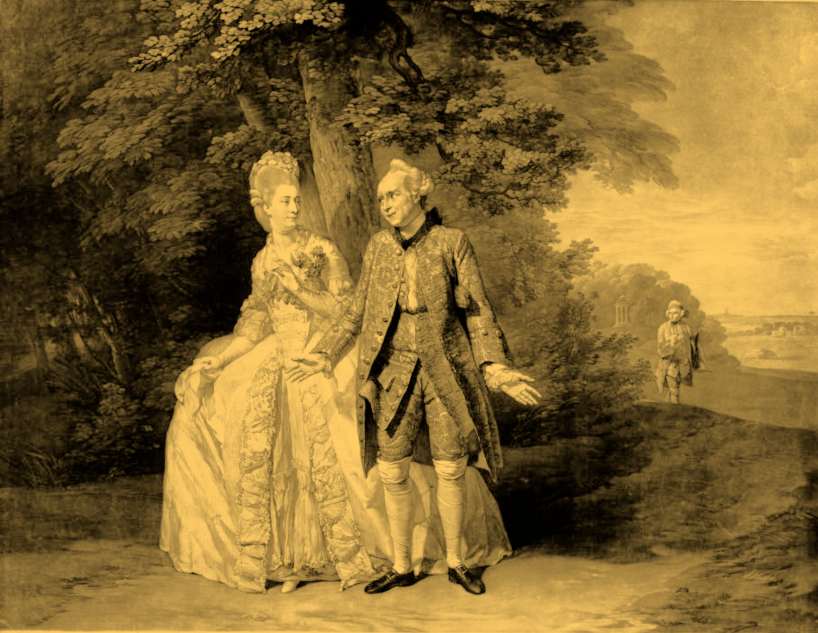
The translation of Cimarosa’s Il matrimonio segretto that was performed in Weimar first on Saturday, 3 December 1796, however, was by Christian August Vulpius (Goethe attended, as noted in his diary, Weimarer Ausgabe 3:2:49); it was repeated in Weimar on Saturday, 17 December 1796, confirming the arrival date for Wilhelm and Caroline’s visit in Weimar (Das Repertoire des Weimarischen Theaters, 23).
Here “Mrs. Clive as Mrs. Heidelberg” and “Mr. King as Ld. [Lord] Ogleby” (Taschenbuch für die Schaubühne auf das Jahr 1781 [Gotha]; Inhaltsverzeichnis deutscher Almanache, Theodor Springmann Stiftung):
See the summary of December performances in Weimar in the Intelligenzblatt of the Journal für Theater und andere schöne Künste, 1 (1797) 1:153–54, 233 (brackets indicate different wording in the two announcements):
Royal Theater in Weimar
Theater Productions During
December 17963 December: Die heimliche Heirath, opera in 2 acts, newly [freely] adapted after the Italian by Vulpius, music by Cimarosa. (An excellent, quite pleasant piece of music, with a simple plan that nonetheless exhibits both sensibility and common sense. The opera was performed [quite] well.) . . . 17 December. Die heimliche Heirath, opera.
It is uncertain on what date Caroline had seen the play performed in Braunschweig. Back.
[4a] Almanac de Goettingue pour l’anneé 1786; Inhaltsverzeichnis deutscher Almanache, Theodor Springmann Stiftung:

[5] Corona Schröter, the first actress to play the role of Iphigenie in Goethe’s play (1779), was also Friedrich Hildebrand von Einsiedel’s secret lover. Back.
[5a] Monday, 19 December 1796, assuming the “second morning” was Monday, i.e., that Wilhelm and Caroline had driven over to Weimar on Saturday, 17 December for the theater performance, and that Sunday, 18 December, was thus the first morning of their visit. Caroline will go on to say that they were about to depart Weimar at 5:00 after their visit with Goethe, which seems to have been on the same day as the visit with Corona Schöter and the day after they had tea with Johann Gottfried Herder (see below). If the “first morning” was in fact Saturday, 17 December 1796, then the dates of the visit would have to be shifted accordingly. Unfortunately, Goethe does not mention dinner with the Schlegels in his diary (Weimarer Ausgabe 3:2:49–50). Back.
[6] Goettinger Taschen Kalender für das Jahr 1791 (Inhaltsverzeichnis deutscher Almanache, Theodor Springmann Stiftung):
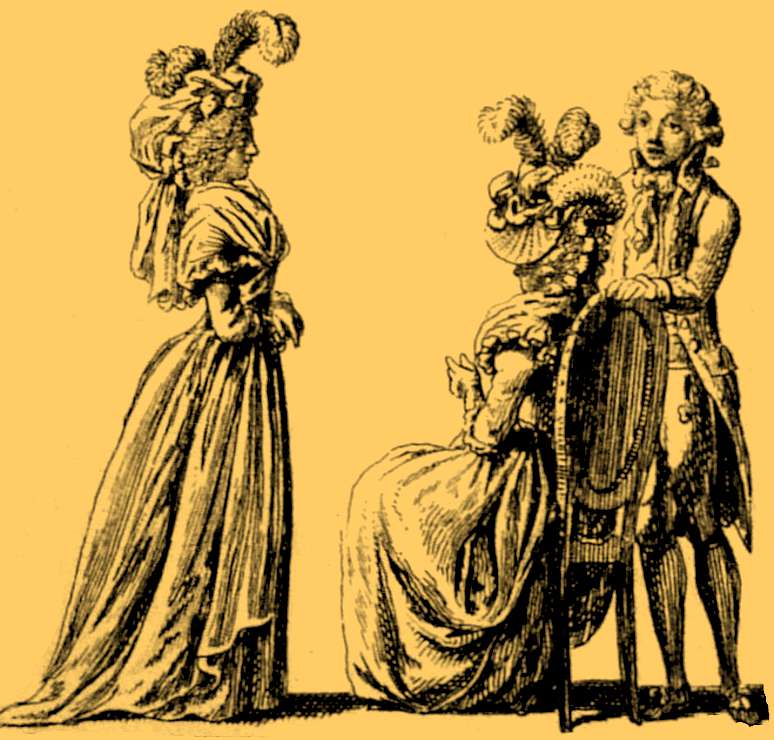
See Goethe to Schiller on 11 January 1797 (Correspondence between Schiller and Goethe 1:283): “When you see Schlegel, tell him that I have been commissioned to present to him the compliments of a very pretty woman, who seemed to take a lively interest in him.” Schiller responded the same day (ibid., 284): “Your commissions shall be attended to.” That the “very pretty woman” was Corona Schröter is not certain. Back.
[6a] Representative illustration: Daniel Nikolaus Chodowiecki, Und ich zur ewigen Glückseeligkeit bestimmt werde herzlich lachen, wenn Ihr verdammt werdet (1781); Herzog August Bibliothek; Museums./Signatur Uh 4° 47 [232]):

This tea took place presumably on Sunday, 18 December 1796, i.e., the day before dining with Goethe and departing for Jena (see below). — Herder’s residence was (and still is) located next to the Church of St. Peter and Paul in Weimar; here in an anonymous contemporary illustration):
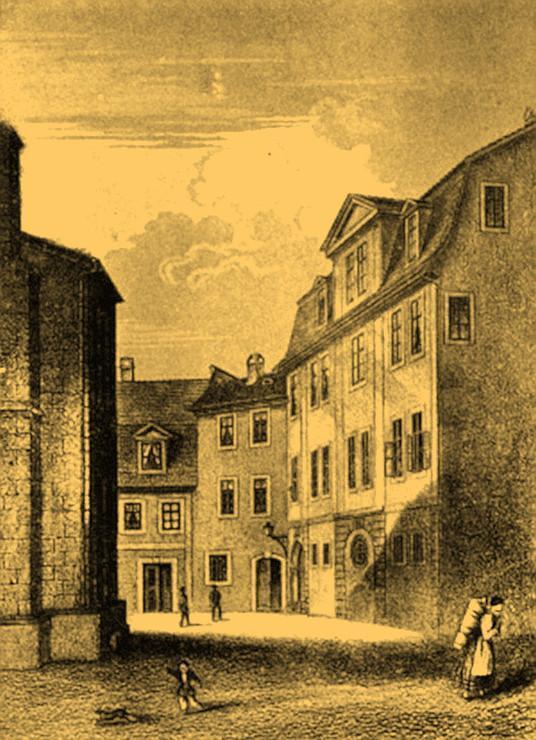
[6b] Karoline Herder ca. 1800 (anonymous):
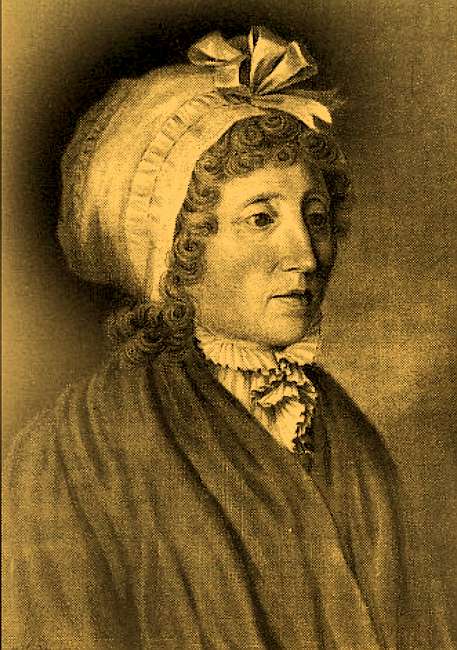
[7] Goettinger Taschen Calender vom Jahr 1789 (Inhaltsverzeichnis deutscher Almanache, Theodor Springmann Stiftung):

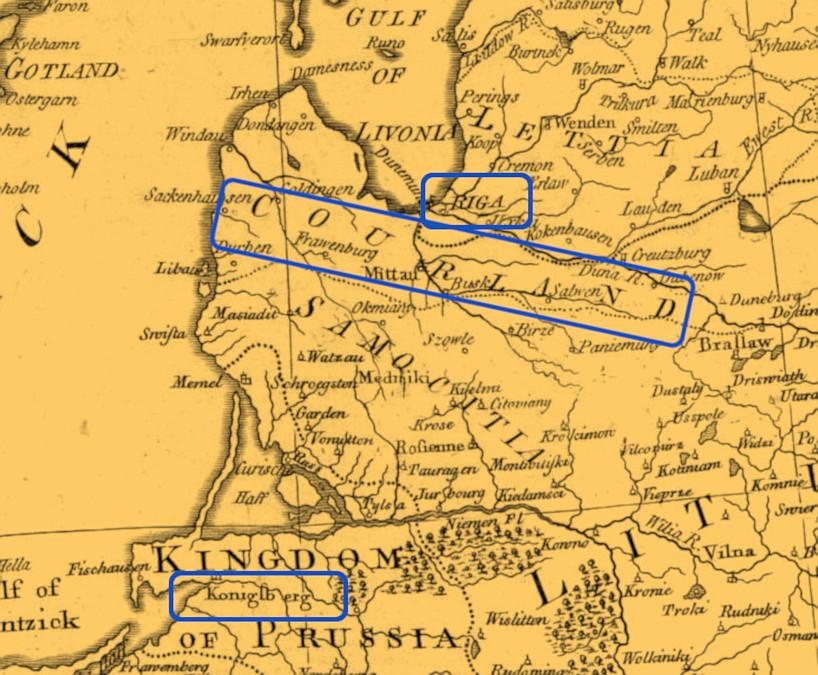
Herder was born in Mohrungen in eastern Prussia (contemporary Poland) and studied in Königsberg (Kalinengrad), near the present-day Lithuanian border (Generalkarte von Europa, ed. Joseph Scheda [Vienna 1845–47]):
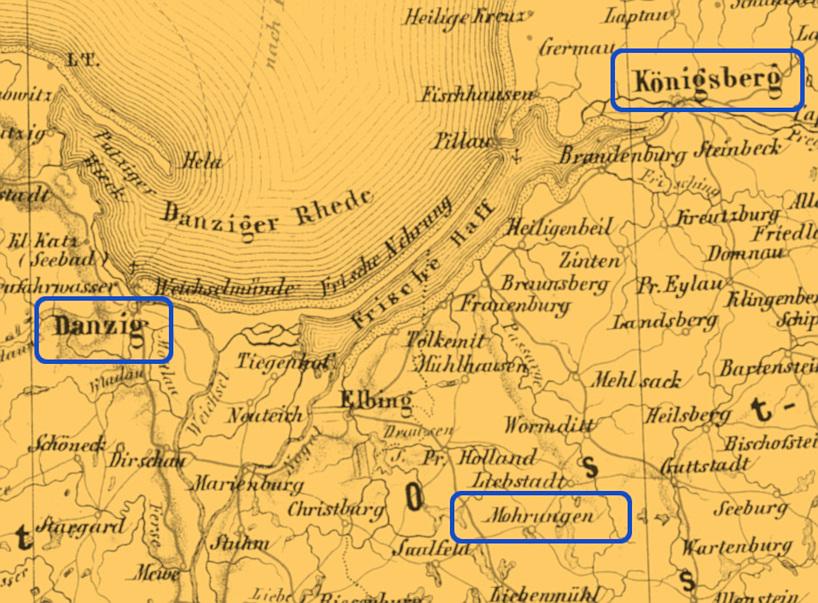
He then lived in Riga, Latvia, 1764–69, Courland being one of the historical regions on the Baltic Sea associated in varying historical configurations with the region of Livonia (Thomas Kitchin, A new map of the Northern States containing the Kingdoms of Sweden, Denmark, and Norway [London 1790]; illustration of Riga: P. Schenk, Riga, emporium in Livonia [ca. 1700]):

[7a] Monday, 19 December 1796. Here Goethe’s house in Weimar (illustration on an early postcard: “Vor dem Goethehaus zu Weimars klassischer Zeit”):

Goethe generally dined with his guests in what is known as the “Yellow Room,” so named after the color of its walls (illustration from Franz Neubert, Goethe und sein Kreis, 2nd ed. [Leipzig 1922], 182; representative illustration by Daniel Nikolaus Chodowiecki, “Die Abendgesellschaft bei Pastor Bocquet,” Von Berlin nach Danzig: Eine Künstlerfahrt im Jahre 1773, von Daniel Chodowiecki. 108 Lichtdrucke nach den originalen in der Staatl. akademie der künste in Berlin, mit erläuterndem text und einer einführung von Wolfgang von Oettingen [Leipzig 1923], plate 76):

[8] Although Füsslie did at least two paintings of this motif, the one that seems best to fit Caroline’s description here is Titania Caressing Bottom (1786–89):
[9] Mode-Almanach fur Damen auf das Jahr 1802:

The reference is to verses Klopstock published in “Der zweite Wettstreit” in the Berlinisches Archiv der Zeit und ihres Geschmacks (1796) 2 (July–December), November, 425–48, here: 439; the piece was a continuation of his Grammatische Gespräche (Altona 1794) and was directed against the twenty-ninth epigram in Goethe’s “Epigramme Venedig 1790,” in which the German language is called “this worst of materials.” Most of these epigrams were initially published in Schiller’s Musen-Almanach für das Jahr 1796, 205–60. No. 29 reads:
Much have I attempted, drawn, engraved in copper,
Painted in oil, even pressed into clay,
But inconstantly, neither learning nor accomplishing anything;
In but one talent have I approached mastery:
Writing German. And thus do I, unlucky poet, unfortunately
Ruin both life and art in this worst of materials.
Schiller had copied Klopstock’s verses out for Goethe on 22 November 1796 (Correspondence between Schiller and Goethe 1:262 ):
You have probably already seen the ninth number of the Archiv der Zeit, which contains a hit at you from the hand of old Klopstock. He has taken offence at your having in one of your last year’s epigrams complained about being obliged to write in German, and he therefore gives vent to his ill-will in an epigram, which, it is true, is very lamentable. It is given in a continuation of his grammatical dialogues, and the judgment he pronounces against you is this:
Goethe, thou pitiest thyself that thou writest me? If thou knewest me,
This were not grief to thee. Goethe, I pity thee too!
Wilhelm Schlegel, in a review of the Berlinisches Archiv der Zeit und ihres Geschmacks in the Allgemeine Literatur-Zeitung (1797) 66 (Tuesday, 28 February 1797) 521–27 (reprinted Sämmtliche Werke 11:11–12), takes Klopstock’s “Der zweite Wettstreit” to task in various respects, including translation, metrics, and the notion of syllables in languages. With respect to Klopstock having taken Goethe to task, Wilhelm writes there:
In another epigram in the second dialogue, the German language takes revenge on Goethe (who in several epigrams had complained about its rigid and awkward nature) by accusing him of not really being sufficiently acquainted with it [the German language]. Klopstock himself is otherwise so skilled at reverently veiling the recalcitrant elements of the beloved German language that one finds it incomprehensible how, by placing such a strange reproach in its [the German language’s] mouth against precisely that great master and formative artist who has the entire breadth of the magic of expression at his disposal, he subjects it to such willful mockery.
Wilhelm returns to Klopstock’s piece in “Die Sprachen. Ein Gespräch über Klopstocks grammatische Gespräche,” Athenaeum (1799) 3–69, the initial essay in that first volume of Athenaeum, significantly and consciously juxtaposed with the final essay in the volume, Friedrich’s “Über Goethes Meister,” 323–54. Back.
[10] Goethe had traveled to Italy first from September 1786 to June 1788, beginning his relationship with Christiane Vulpius in July 1788, just after his return to Weimar. He returned to Italy (to Venice) during March and June 1790. Back.
[11] Caroline and Wilhelm seem never to have made inroads into court society in Weimar, even peripherally, presumably because of Caroline’s imputed Jacobin reputation in connection with the Mainz Republic and her incarceration in the fortress Königstein.
Georg Ernst Tatter had assiduously avoided the appearance of any association with her during that period for precisely the same reason, his employer at the time being a member of the royal house of England. See his letter to Luise Wiedemann on 11 May 1793 (letter 125c), in which he explains that “my entire circumstances and situation, however, do not permit even the faintest appearance of my being in any way involved in this matter.”
Concerning Caroline’s reputation at the time, see her letter to Friedrich Ludwig Wilhelm Meyer on 7 June 1794 (letter 145), note 13. Back.
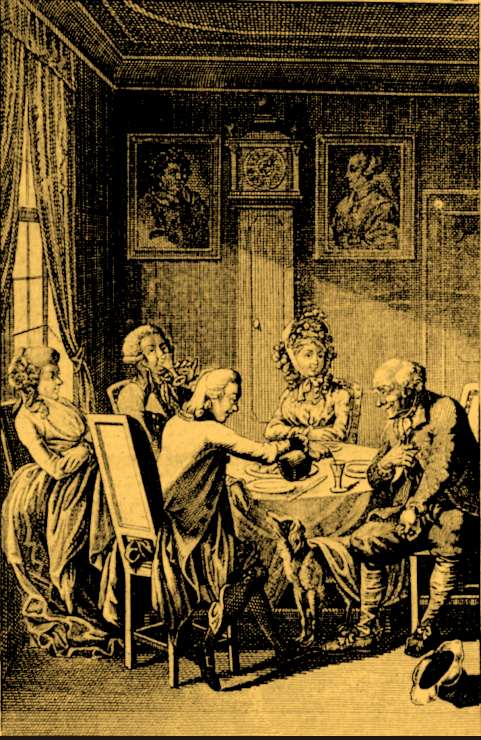
[12] Frontispiece to Johann Gottwerth Müller, Sara Reinert: Eine Geschichte in Briefen, dem schönen Geschlecht in Deutschland gewidmet, vol. 2 (Berlin 1796):
Johann Daniel Falk, who was later assessed quite unfavorably by the Romantics, wrote to Wilhelm Schlegel in April 1799 (Waitz [1882], 40):
Please extend a thousand greetings from me to your diminutive, charming wife. Tell her that the moments I spent in both your company in Weimar count among the most interesting in my entire life. Back.
[13] Jean Paul had spent time in Weimar during the spring of 1796. Back.
[14] “Der unparteiische Correspondent,” Hamburger Neue Zeitung (1796), Beiträge von gelehrten Sachen 3; a satirical piece in distichs against the Xenien. Back.
[15] Caroline had made Ernst Christian Trapp’s acquaintance during an excursion to Wolfenbüttel while she was yet living in Braunschweig; see her letters to Luise Gotter on 28 June 1795 and during the autumn of 1795 (letters 151, 156). Back.
[16] Christoph Daniel Ebeling was indeed the author of the review, “Der unparteiische Correspondent.” See Eduard Boas, Schiller und Goethe im Xenienkampf, 2 vols. (Stuttgart/Tübingen 1851), 2:26–35, who reprints Ebeling’s entire review (in distichs) of the Xenien, remarking that “among the whole swarm of anti-Xenien, this opusculum [trifle] walked away with the laurel of universal praise. Contemporaries praised it as a model of pleasing satire, sophisticated wit, and exquisite persiflage” (26). Concerning authorship, Boas continues (2:33–35):
I myself originally suspected, not without considerable evidence, that Professor Ebeling . . . was behind it . . . He himself had been attacked in the Xenien, was known to possess a satirical sense of humor, lived in Hamburg, moreover the political remarks in the review also completely accord with those of his piece on the United States of North America (1793–96). . . .
Böttiger, however, testifies contra all other witnesses; he recounts (K. W. Böttiger, Karl August Böttiger. Eine biographische Skizze [Leipzig 1837], 133) that the author of this Xenien review — whom even Madam Schlegel found witty even though her own husband appears in it as Goethe’s panegyrist — is Trapp in Wolfenbüttel. . . . from whom, however, we have writings relating solely to education . . . and who never betrayed any real inclination for satire.
Böttiger insists so irrefutably on his authorship, however, that I became unsure until Varnhagen von Ense, who recalls this entire affair from his own youth, provided certainty. “The review of Schiller’s Musenalmanach in distichs . . . is without a doubt by Ebeling; he was named explicitly in Hamburg as the author, moreover I remember other jesting reviews by him that similarly exhibit this sort of mocking disposition.” Ebeling was, moreover, an extremely liberal-minded and amiable man, who despite being deaf was still quite capable of wielding the lance of wit. Although his fellow citizens loved and appreciated him, he found modern philosophy and poesy, which he simply could not comprehend, quite repugnant. Back.
[17] The Gotters had apparently naturally suspected Wilhelm of having authored that review, though that impression was due to an error. As Jakob Minor points out in Friedrich Schlegel’s Jugendschriften, 1:114fna, Friedrich’s essay in the journal Deutschland (1796) no. 2, 258–61, an essay subsequently incorporated into his Griechen und Römer (Jugendschriften, 114–15), was indeed given the incorrect title “Göthe. Ein Fragment von A. W. Schlegel”; this error was corrected at the end of issue no. 3 and the piece correctly attributed to Friedrich Schlegel. Back.
[18] Johann Friedrich Reichardt, who had been inundated with Xenien directed against him, issued his declaration “Erklärung an das Publikum über die Xenien im Schiller’schen Musenalmanach,” Deutschland, ed. Johann Friedrich Reichardt (1796) issue 10, 103–6; reprinted in Eduard Boas, Schiller und Goethe im Xenienkampf, 2:37–38:
Declaration to the Public concerning the Xenien in Schiller’s Musen-Almanach
The authors of the Xenien have tried, through the most malicious slander and crudities, to take revenge on this journal [Deutschland] with respect to its opinions concerning their participation in the Horen and Schiller’s Musenalmanach of last year. The present editor considers it beneath his dignity to respond to vulgar insults; refuting these particular insults is all the more superfluous insofar as this journal, along with Frankreich [Reichardt’s other journal], which was treated with equal maliciousness, are open for everyone to see in any case, such that any objective reader can easily decide whether those opinions be candid but just, and the accusations [in the Xenien] by contrast the most blatant insults or not.
No attacks will ever be able to shake, even for a single moment, the editor’s courage in venerating truth everywhere and at all times, least of all such pasquilic nonsense as this, which so obviously derives from nothing more than indignant vanity. Indeed, he would not have said even a word about the entire affair had the Xenien merely insulted him as a writer rather than, as was the commendable fashion of slanderers, implied considerably more than they said. He owes it to himself to assure the public loudly and ceremoniously — something he can document if necessary by reprinting the most cordial and respectful letters extending back into the very first issues of Deutschland — that those opinions alone prompted these abusive invectives.
Moreover he could not let these abominations pass by wholly without censure not least because Herr Schiller, in what can only be described as a most comical delusion, has forgotten himself to the point of threatening with severe discipline, in the “Warning” adduced by the reviewer of the Almanach [xenion 242] [concerning that review, see below], those whom he has insulted in case they might respond.
[Xenion 242: Warning.
There are thousands more like us [i.e., more xenia] waiting in ambush in case you
Advance in a bit too hot-tempered a fashion, with bare shoulders and backs.]
Nothing would be more painful for this editor than for precisely that to be true which he cannot even imagine thus without shrinking in horror — namely, that a man whose singular genius he will always gratefully acknowledge should desecrate his greatness by debasing himself to participate in such intentional slander. But not even this would change things. No name is so great as to ennoble injustice.
By contrast, the editor of Deutschland can quite easily get over the part that Herr Schiller may have as an author in this affair. His ardent contempt for Schiller’s unworthy and base comportment is wholly unmixed insofar as Schiller’s literary talents and efforts are in no way situated on the same level as that particular true genius which even when it taints through immorality nonetheless can still elicit reverence. —
He focuses on him as the editor of that Almanach and herewith demands that he disclose the initiator of the slander or, if he admits to being such himself, to attest his own culpability openly. If he cannot do so, then he is not worthy of respect, for every liar is dishonorable, though twofold so the coward afraid even to risk revealing himself and his connections with his insults. There are still courageous men enough among our fellow citizens for whom justice is worth more than a joke. And these will, the editor hopes with some confidence, have contempt for the man culpable of such dishonorable lies, and will do so as if he had been condemned in a court of law.
(Daniel Nikolaus Chodowiecki in 1780, “Die Philosophen” [The philosophers], Illustrationen zu Erasmus’ Lob der Narrheit in sechs Abteilungen [1780]; Herzog Anton Ulrich-Museum; Museums./Signatur DChodowiecki WB 3.31):

[19] The review to which Caroline refers is in the same issue of Deutschland ([1796] issue 10, 83–102); it is reprinted partially in Eduard Boas, Schiller und Goethe im Xenienkampf, 2:35–37, and in its entirety in Friedrich’s Schlegel’s Jugendschriften, 22–32. The xenion to which she is referring (and mentioned in the review) is number 91:
91. The task.
To whom do these verses belong? You will not easily guess;
But separate them out, if you can, O chorizontoi, here as well.
(Chorizontoi [“separators”]: among scholars of ancient Greek literature those who assert that the Iliad and Odyssey derive from different authors.)
It was, however, Friedrich himself rather than Reichardt who committed the error in (reprinted Jugendschriften, 2:32) when, as the concluding trump in his review, he referred to xenion 91 as “a perfect example of a naive epigram” and made fun of Schiller as the brazen Patroclus in the armor of the great Peleus (Boas, Schiller und Goethe im Xenienkampf, here 2:36–37):
The chorizontoi will ask the connoisseur whether at least one of the distichs directed at them, namely, “The task” (xenion 91) is not a perfect example of a naive epigram. For even if the Trojans otherwise everywhere run the risk of mistaking the perhaps imprudently brazen Patroclus [Schiller], because of his borrowed armor, for the great Pelide [Goethe], nonetheless anyone can easily enough recognize the voice of him [Schiller] who is frolicking here such that he might appear as the other [Goethe].
The literary allusion, one understood by Friedrich’s readers, is to Schiller’s treatise “Über naive und sentimentale Dichtung,” first published in Die Horen (1795) 4, no. 11, 43–76; no. 12, 1–55; (1796) 5, no. 1, 75–122, in which Schiller distinguishes between two fundamentally different modes of artistic perception, understanding himself as a “sentimental” artist — one conscious of being separated from but longing for a return to nature — and Goethe as a “naive” artist — one at one with or with more immediacy to nature — the former tending to reflect artistically on nature in a satirical or elegiac fashion, the latter being more inclined to artistic realism. Friedrich’s barb is that in xenion 91 Schiller was in effect masquerading as a naive artist in Goethe’s borrowed armor. Back.
[20] See also the final paragraph in Caroline’s letter to Luise Gotter on 12 December 1796 (letter 174). Back.
[21] Caroline repeats this request on 13 February 1797 (letter 179): Neue Bibliothek der schönen Wissenschaften und der freyen Künste, ed. Christian Felix Weisse and Johann Gottfried Dyk, vols. 1–72 (Leipzig 1765–1806).

The periodical would later be subjected to Wilhelm’s contempt in the “Reichsanzeiger” in Athenaeum (1799) 337 (regarding its derisive conditions for contributors):
Help Wanted
Seeking a man of mature years, a man who has never in all his life been ardently moved by a work of genius, has a general, natural disinclination toward all originality, has perhaps occasionally written some verse, who is prepared to take the oath to the symbolical books of Correctness, translated by Ramler as batteur, and who otherwise writes with a legible, flowing, and broad hand, to be engaged as a collaborator of the Bibliothek der schönen Künste und Wissenschaften for moderate honorarium. Other perquisites include gratis copies of the comedies and political writings of the bookseller and Magister Dyck, as well as, on request, appointment as a Leipzig Magister.
Wilhelm similarly criticizes the same journal later in his Berlin Vorlesungen über schöne Literatur und Kunst, 2:33:
It is served by priests of good taste who are so abstemious that they never get anything that tastes good. Even though the critiques, like the works of art themselves, are supposed to reflect content through form, they excel instead by incomparably portraying the boring nature of the cold, sober, so-called “correct” works of the spirit, which alone they extol. Back.
Translation © 2012 Doug Stott