
• 149. Caroline to Luise Gotter in Gotha: Braunschweig, 16 April [17]95 [*]
Braunschweig, [Thursday] 16 April [17]95
|353| It was in absolutely no wise easy for me to leave all of you, my dear, good Louise; [1] the journey was extremely arduous, but — well, here we are now, the dangers and tribulations are all forgot, and though there can be no talk yet of tranquility or ease, we are nonetheless all well and merry enough to make do for now with our hopes.
A mere half hour outside |354| Gotha, the coachman already began inquiring about the road to Mühlhausen, [2] with which he was familiar only as far as Dingen, which one normally simply travels past but where he stopped with considerable satisfaction to tell me that he was born there and that the field next to us was Dingen farmland. [3] It made me extremely nervous that his attachment to this tiny speck of ground may well have prevented him from, let us say, expanding his knowledge of the roads, and that I may well get no farther than Dingen itself; as it was, however, we arrived in Mühlhausen toward 8:00 in a tempestuous rainstorm. [4]
Here he disclosed to me that he intended to continue the trip by way of Göttingen, which I vehemently opposed because it would have caused me endless embarras and required me to present all sorts of explanations. [5] The innkeeper helped me convince him such that on the following morning we started out directly across the fields. [6]
I later regretted not being as attached to my own birthplace as the coachman was to his, for we encountered the most atrocious roads I have ever seen. The horses genuinely did get stuck in a sunken, deeply rutted, narrow road leading down a sizable mountain. We scarcely had enough room to get out of the coach and then also scarcely enough to proceed ahead on foot. A hunter came along and assisted the driver, though we stood at the foot of the mountain for probably half an hour before even being able to hear the coachman’s voice again. Gustel became extremely fretful, weeping for the horses because she could not imagine they would ever be able to get up again.
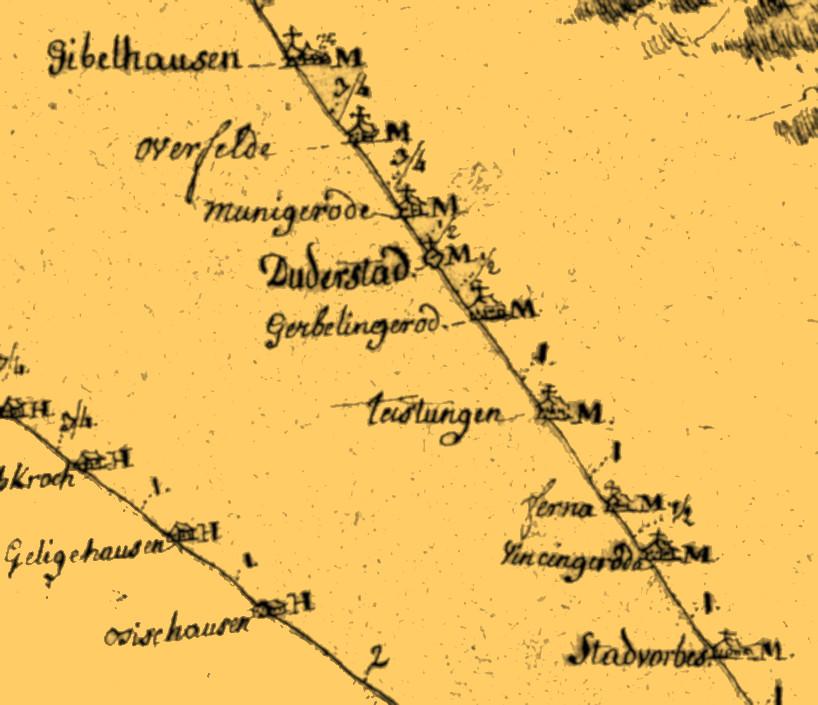
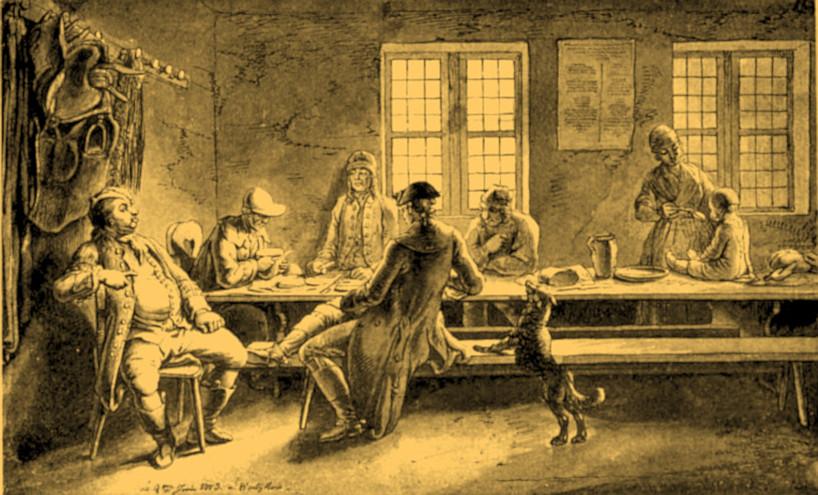
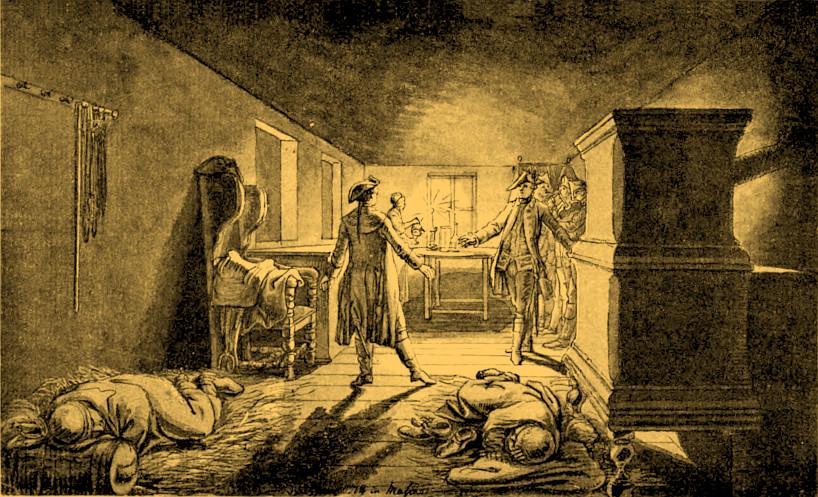
But get up they did, and at midday we then stopped in the town of Worbes in part of the territory of Mainz [7] — where, however, only the horses ate their fill. We stayed overnight in Gibelhausen, [8] where I made Gustel some chocolade soup so she would have the courage to spend the night in our horrible room with its filthy floor and nothing but a bed of straw and a wooden stool. [8a]
On the |355| morning of the third day, [9] we came in sight of the Harz Mountains and traveled on toward Catelnburg and below the windows of a very familiar house. [10] The chausée was worse than the road he had just left; but now there came yet another stretch of countryside where we fell into one hole after another and every carter with his draft team came up toward us on the road. [10a]
Our driver, at the point of wailing at the rutted road out of sheer impatience, yelled at one of the horses, “Ach, were you but back standing in your stall!” for the horse was a bit old and unresponsive, and Weibezahl [11] had only half kept his promise of securing good horses for us — but our driver had gotten into a good mood being around us and actually laughed more than he swore. Here, too, we finally passed through and then rested in Eisfeld. [12]
Then we had better roads, except that now the old one no longer wanted to proceed, so it was resolved to give him cold brandy soup [13] in Seesen, [14] like the tailor bridegroom on his wedding day. [15]
In Seesen we heard that a chaise with rented horses had just passed without paying the station fee; a postilion set out after it. We were absolutely sure it was Mother, and the coachman now pursued it on the wonderful Braunschweig chaussée and with our crazy, sated horse — the fire of youth raged in the veins of the other one — as far as Lutter. [16] “My heart is pounding,” Gustel said, and, truly, it was keeping pace with the horses — but we did not yet find Grandmother. She did not arrive until a half hour after us, assuring us we could not possibly have had a more unpleasant route than she. She was also quite fatigued, though otherwise calm even though Lottchen was still sick when she left. [17]
There was much to talk about, and among other things she immediately told me about a theft that during her last days in Göttingen had much occupied the Schlözer household, where they were staying. [18] |356| The greater part of a coin collection worth about 1000 rh., was stolen from Schlözer in the middle of the night; someone had managed to jimmy the doors open. Through the acumen of Madam Schlözer, and through her diligence and that of her people, the perpetrator was discovered, a locksmith, and at his house they found even more things that had recently been stolen. Now people even suspect that it was he — for a time charged with supplying the keys for the public buildings — who also stole the silver-ore block. [19] He had assistants and accomplices, all of whom have already been apprehended as well. What an episode that was; it is just as well the theft story is not a direct part of the description of the journey.
In Lutter, we took the extra-post, laden with the maidservant and all the packages and luggage. We found the roads quite pleasant until just before Braunschweig itself [19a] — here the landscape becomes a bit too flat; but the town itself is anything but gloomy.
I can see that Gustel has already made a bit of a mess of the apartment, but the painters and wallpaper hangers are already at work making things as bright on the inside as its location outside. . . . I went out yesterday to buy wallpaper; I saw a fair amount of the town and was not at all displeased. [20] We have not yet seen anyone except our lady acquaintance from the convent, with whom my mother and the others have just gone for a walk; I stayed at home to write this letter.
We have been invited to the convent for Sunday, and I will probably already be seeing the mesdemoiselles Jerusalem then. The duke must not have to know yet that I am here, since he has not indicated he would want me to leave his territory. There is, after all, peace now; [21] the courier arrived here at midday yesterday. [22] — He brought along a letter for me from my brother in which he offered to pick me up from Gotha. We are hoping to see him soon now.
|357| At first we could not stop Fräulein Isabelle’s tears; [23] she cried herself asleep, though her ill mood then changed to tenderness toward her doll. After every event, she said, “I want to write and tell the Gotters about that”; from morning till evening, getting out of bed and then going to bed, she accompanied her little girlfriends as loyally as they presumably did her, [24] and I for my part kept her company with all my heart amid the memories of what we were leaving behind . . .
There is a theater here — a certain Tillian company. We will be going soon. Today they are presenting Allzu scharf macht schartig. [25] Gustel insists she has already seen it.
The package contained — nothing. Nothing other than a dozen — letters from Therese that I myself had sealed up. [26]
Notes
[*] Caroline’s peculiar itinerary as described in this letter clearly did not follow standard postal routes at the time, perhaps because, as she explains, she was intent on avoiding Göttingen, which was not situated conveniently on the route between Gotha and Braunschweig (altogether ca. 160 km) in any case.
The route between Gotha and Göttingen itself — not a direct postal route at the time — had its detractors. In her letter to Julie von Studnitz on 8 August 1780 (letter 17), Caroline remarks how “Niebuhr, who took that grand journey to Egypt, remarked one day to my father that between Göttingen and Arabia there was no worse road than the road from here [Göttingen] to Heiligenstadt and Gotha”; Heiligenstadt is located between the two locales (see second map below).
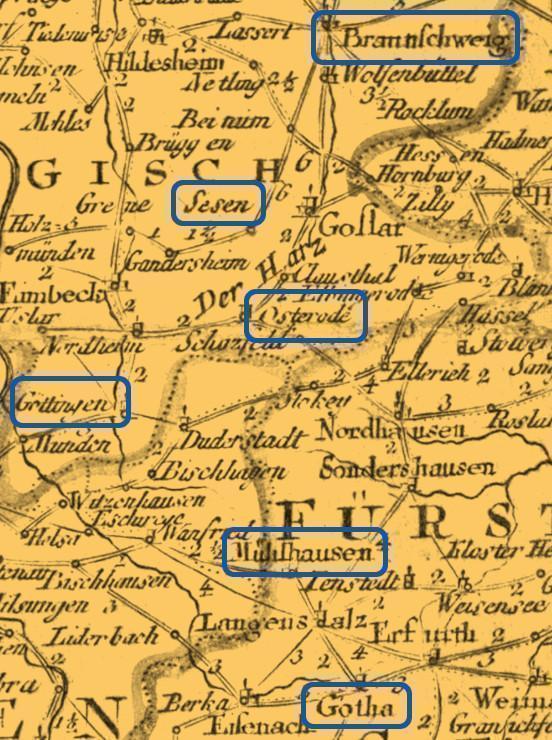
Here a map of the standard postal routes for the same year (1795), demonstrating the more direct route between Göttingen and Braunschweig but the difficulty in getting from Gotha to Göttingen to access that route. According to Caroline’s account here, however, she could have picked up the postal route in Osterode but for some reason did not, and it may be noted that none of the towns on Caroline’s itinerary prior to Sesen (Seesen) are listed as postal stations except the first, namely, Mühlhausen (Post Karte Durch ganz Deutschland, ed. J. Walch [Augsburg 1795]):
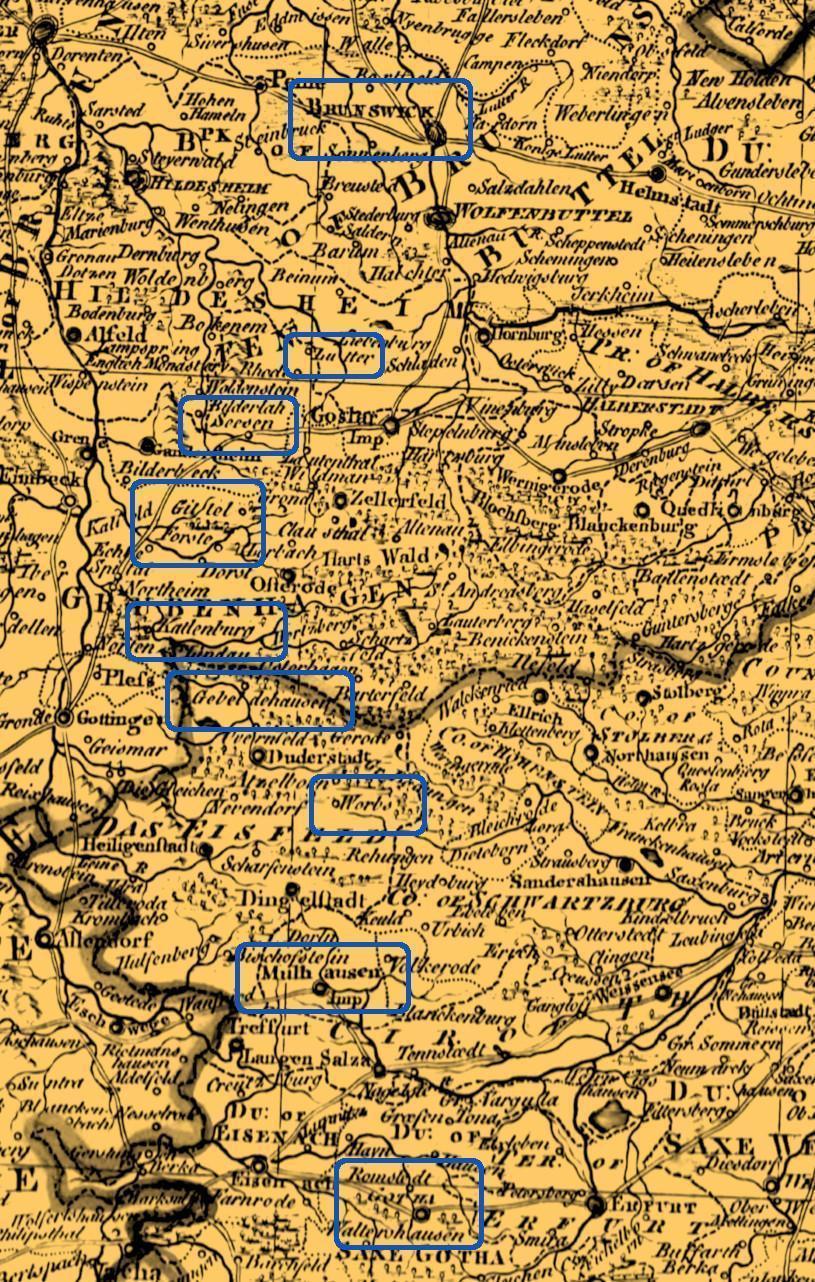
The following map traces her route with two exceptions. The first is Eisfeld (Eisdorf, Eischdorff), which although not attested is located between Forste and Gittelde, the latter of which Caroline had visited during her stay in Clausthal. The other is Dingen, the coachman’s home village, which, as explained in the note, seemed to have been located just outside Gotha. Map of the Empire of Germany including all the states comprehended under that name with the Kingdom of Prussia, &c. (1782):
[1] Caroline and Auguste seem to have departed Gotha on Sunday, 12 April 1795 (Friedrich Schlegel’s letter to Wilhelm Schlegel on 7 April 1795 [letter 148e], note 3, where Friedrich refers to her “present place of sojourn”), though Brigitte Rossbeck, Zum Trotz glücklich: Caroline Schlegel-Schelling und die romantische Lebenskunst (Munich 2008), 124, dates the departure to an undetermined day in March 1795, maintaining, moreover, that Caroline signed an inheritance protocol (ibid., 125; 308n52: Archiv der Berlin-Brandenburgischen Akademie der Wissenschaften Berlin, Nachlass Schelling, Sign. 5) in Göttingen on 1 April 1795. It is difficult to reconcile these two views, especially given Caroline’s own account of her travel route in this letter. One possibility is that she is not being completely straightforward with Luise Gotter in this present letter or that she visited Göttingen in March before departing Gotha once and for all. Back.
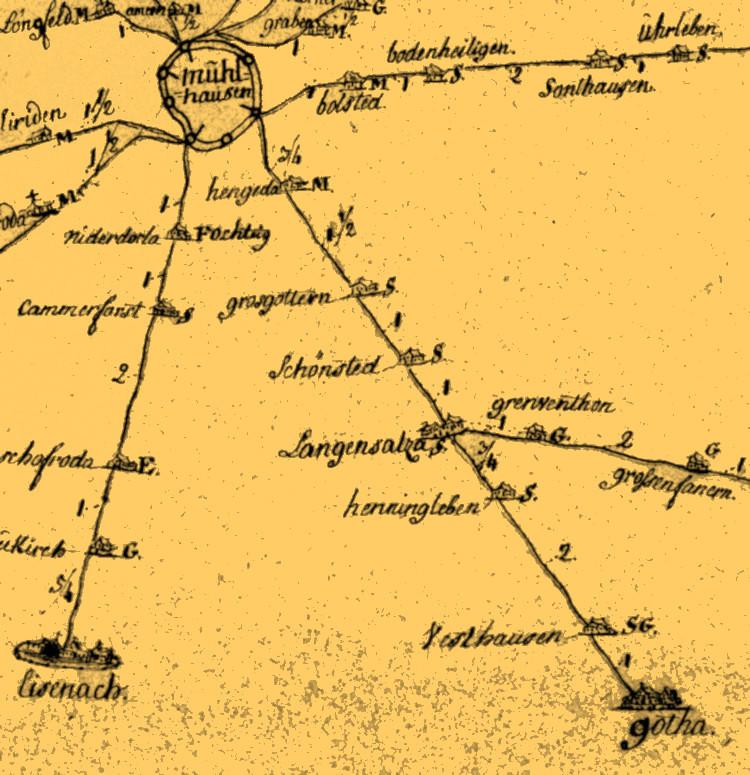
[2] Mühlhausen is located approx. 39 km northwest of Gotha (Carte des Routtes qui partent de Muhlhausen sur différents points [1757]):
Josef Körner (1930), 2:11, remarks that Caroline had “already moved to Braunschweig on 15 April,” which concurs with Caroline’s own itinerary here if she did indeed depart Gotha on 12 April. Back.
[3] Concerning this village, see the following information from August Beck, Geschichte des gothaischen Landes, vol. 3, Geschichte der gothaischen Landstädte, Marktflecken und Dörfer in alphabetischer Ordnung, part 2, Mentroda–Zella (Gotha 1876), 296–301; also Luise Gerbing, Die Flurnamen des Herzogtums Gotha und die Forstnamen des Thüringerwaldes etc. (Jena 1910), 28.
On one of the bells in the Jesuskirche in the tiny village of Tüngeda (495 residents in 1816), one reads: “I hang in Dingeda, I send my sounds forth, I peal to all Christians, Hieronymus Moering in Erfurt cast me.”
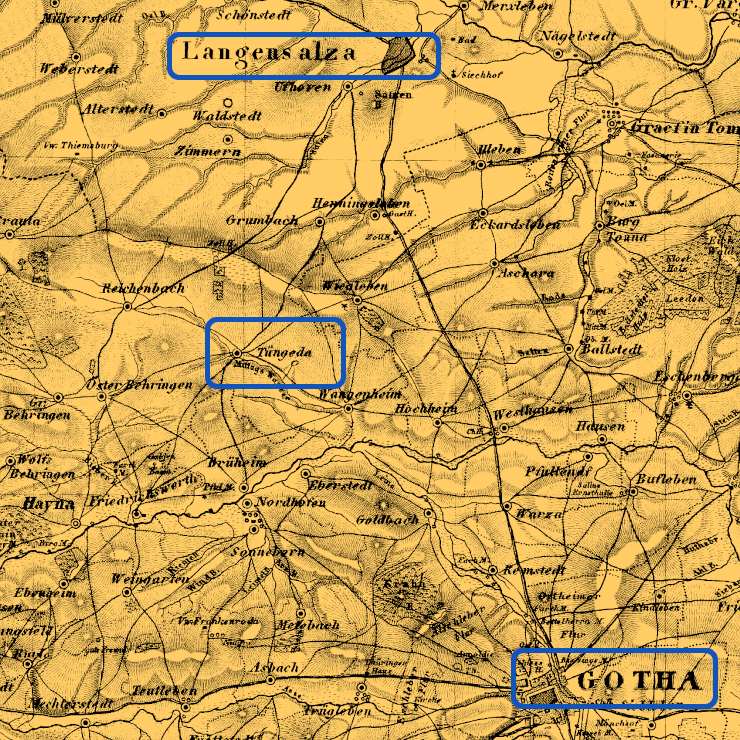
To wit, the village Tüngeda was in local dialects and documents variously also called Tungedi, Tungede, Tungidi, Dungide, Tungeden, and finally — the case here — Dingen, at least as Caroline seems to have understood phonetically what the coachman said.
The village is located ca. 10 km southwest of Langensalza and 13 km northwest of Gotha, but not directly on the normal route between those two towns (Joseph Meyer, Neueste Karte vom Herzogth: Gotha und angranzend: Landern. Nach den neuesten Quellen entworfen und gezeichnet, 1844 [Amsterdam 1860]; David Rumsey Historical Map Collection):
A rural community, it was originally a fief of the Lords of Wangenheim and, with lesser property rights, the Lords of Erffa. The primary estate was later sold to the ducal chamber in Gotha. It was later a district in Wangenheim (to its southeast on the map) and ultimately Waltershausen. The manor lord’s chateau was originally built in 1580, destroyed by the Swedes in the Thirty Years War essentially down to its foundations, and then rebuilt in 1880 (Deutscher Hausschatz in Wort und Bild 10 [1883–84], no. 41, p. 652):
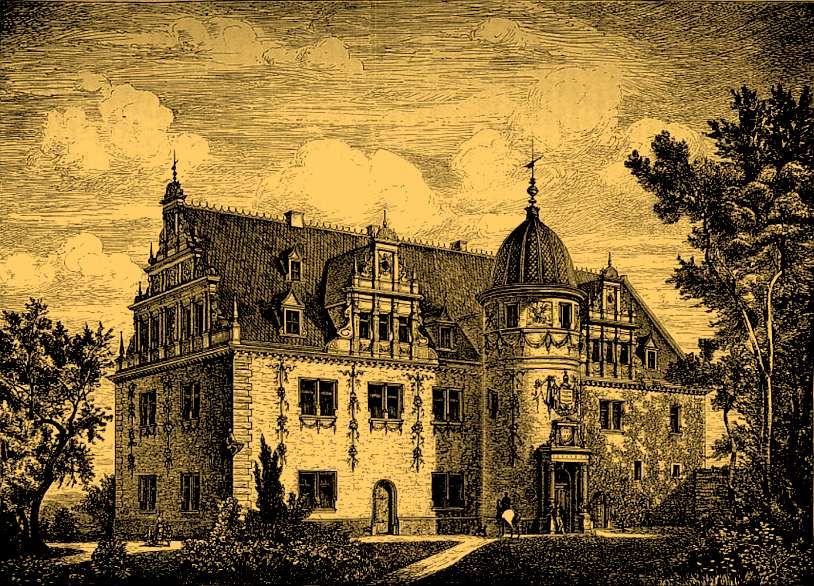
What apparently evokes feelings of pride for the coachman — a native of Tüngeda — is that the area through which he was driving Caroline and Auguste — whether on the primary route or across open fields — though perhaps not contiguous with Tüngeda, was nonetheless part of its extended holdings. Tüngeda itself is situated barely 4 km to the west of that main route. Back.
[4] Rainstorms and other inclement weather could make such journeys by coach or carriage extremely difficult and unpleasant, as Caroline relates not merely here, but especially later in this letter (llustration from Daniel Nikolaus Chodowiecki, Von Berlin nach Danzig. Eine Künstlerfahrt im Jahre 1773 von Daniel Chodowiecki. 108 Lichtdrucke nach den Originalen in der Akademie der Künste in Berlin. Mit erläuterndem Text und einer Einführung von Professor Dr. W[olfgang] von Oettingen (Berlin: Amsler & Ruthardt, Kunsthändler o.J. (1883)], plate 64):

Caroline is, moreover, travelling not by normal postal coach, and similarly, as just seen, straight across open fields rather than chaussées. Concerning road conditions in Germany at the time, especially in view of Caroline’s account of the next day of their journey, see W. H. Bruford, Germany in the Eighteenth Century: The Social Background of the Literary Revival (Cambridge 1935), 161–63; illustration: excerpt from Peter Paul Rubens, Schelte Polstert [engraver], [Landschaft mit einem Pferdewagen bei Nacht] [ca. 1620–59]; Herzog Anton Ulrich-Museum; Museums./Signatur SBolswert AB 2.30):
It seems that none of the European countries had a really good system of roads before the nineteenth century. France was far ahead of the rest. In the second half of the eighteenth century it had a good system of metaled main roads, “chausées,” radiating from Paris, but the by-roads were still bad. In England the first turnpike trust had been created in 1663, but in spite of dozens of turnpike acts the roads, even the roads leading to London, remained very indifferent, and the side roads often mere unmetalled tracks, with ruts sometimes four feet deep. . . .

It can be readily imagined what the state of German roads must have been, with a less insistent demand, a greater multiplicity of authorities and even less possibility of coordination for large areas. It is true that in autocratic states with a fairly efficient bureaucracy it was easier to overcome local indifference if the prince took it into his head to have good roads.
In this way some of the South German states obtained improved metalled roads in the course of the century. The first chaussées were made in Hesse in 1720, in Baden in 1733, in Württemberg in 1772. Nicolai, who travelled all over Germany in 1781, tells us that the roads were infinitely better in the south than in the north, where owing to the lack of stone the material difficulties were very much greater.
Even the main roads of Prussia were execrable; sand in summer and mud in winter, in spite of all the efforts of Frederick the Great. At the end of the century Reichard, perhaps the chief forerunner of Baedeker, in his popular Guide des Voyageurs [Guide des voyageurs en Europe, multi-volume, 7th ed. 1812], informed travellers that in the south they could go from Frankfort or Nürnberg to Vienna, from Vienna to Switzerland or Italy, and from Switzerland back to Italy without finding an unmetalled main road or a bad service of posts.
Nicolai had said much the same in 1781, but had added that it had not long been so. Reichard singles out the roads of Bavaria, Fulda and the Palatinate for special praise, then Würzburg and Württemberg, then Baden and Bayreuth. . . .
In the north, Reichard says, the roads are in general very bad. “In certain seasons and in rainy weather, one is often obliged to leave the ordinary road.” Even in 1842 Howitt tells of “ruts which swallowed the carriage up to the axle and piles of mud which stood, ground up by the action of the wheels, like walls” in the Harz. The state of the roads was the ostensible reason (there were other obvious reasons) for the state regulations fixing the minimum number of horses to be hired by passengers travelling post.
In Prussia for instance, even in the early nineteenth century, it was only a light carriage carrying one passenger and a single trunk that was allowed the minimum hire, two horses. For two people three horses were required, for three people four horses. For a heavier carriage with four passengers or more, the number of horses would be flve, six, or even eight, if there was much luggage.
In Austria the regulations were less stringent, no doubt because of the better roads. Another indication regarding the state of the roads is the warning given by Nicolai, Reichard and others to strangers travelling in their own carnage about the frequent changes in rut-gauge in the north.
The ruts on the roads east of Hamburg for instance were wider than on those to the west. Either the track of the carriage wheels had to be adjustable, or one had to leave the road and drive over the fields. There were few stone bridges. In Bavaria and Austia bridges were usually of wood.
On the Rhine below Basle, there were only floating bridges until the end of the eighteenth century. Small streams had usually still to be forded. Back.
[5] Embarras, Fr., here: “embarrassing circumstances.”
See letter/document 146 and note 1 above. This statement similarly makes it difficult to understand why Caroline would not mention a stop in Göttingen in this letter; moreover, the trip’s progress as she describes it in in this letter and the dates one can deduce from her description, as well as her mention of the courier in Braunschweig arriving with a letter for her on 15 April 1795 and the fact that this letter itself was written on 16 April, i.e., seemingly shortly after arriving in Braunschweig, and its dating, make the stop in Göttingen difficult to reconcile. An explanation, mentioned above, is that she did indeed travel to Göttingen in March, returned to Gotha, and departed Gotha for Braunschweig on 12 April 1795. Back.
[6] Monday, 13 April 1795. The implication is that Caroline and the innkeeper were indeed able to convince the driver not to proceed by way of Göttingen. Here travelers similarly secure refreshments and apparently directions at a tavern associated with a postal or general coach station (Taschenbuch für Reisende jeder Gattung durch Deutschland auf das Iahr 1797 [Erlangen]; Inhaltsverzeichnis deutscher Almanache, Theodor Springmann Stiftung):
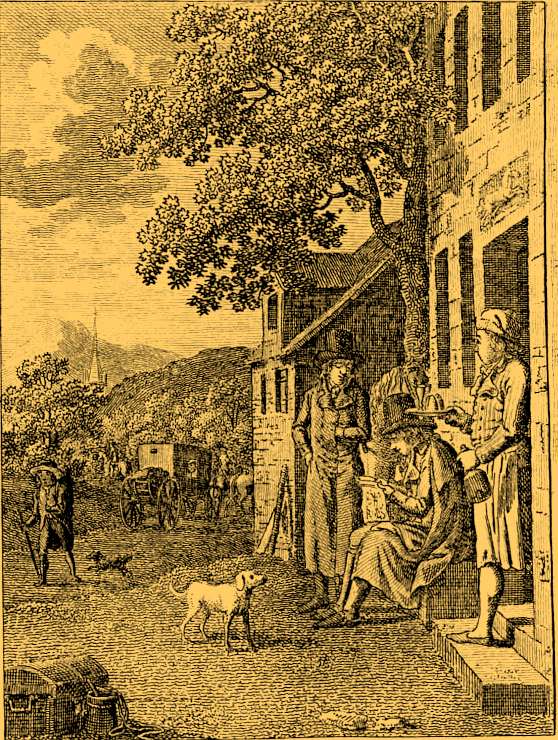
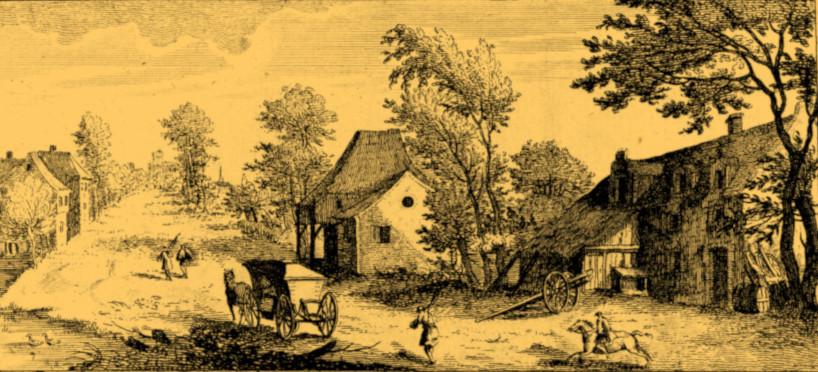
See the following illustration of a typical village road (as opposed to a postal route) at the time (Claude René Gabriel Poulleau, Dorfstrasse [ca. 1776–1850]; Herzog August Bibliothek; Museums./SignaturGraph. A1:2097a):
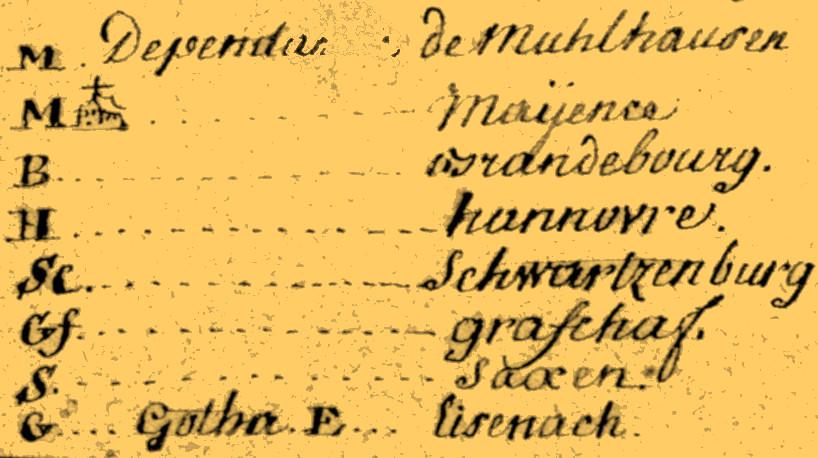
[7] Concerning the territories of Mainz, see the chapter on the Lower Rhine in the supplementary appendix on Germany in the late eighteenth century, esp. the section on the dominions of the Elector of Mentz [Mainz]. That Worbes was part of the territory of Mainz (Maÿence) can be read from the icon-key (Dependences) to the following map:
Worbis (Worbes, here: Stadvorbes), approx. 23 km northeast of Mühlhausen (Carte des Routtes qui partent de Muhlhausen sur différents points [1757]):
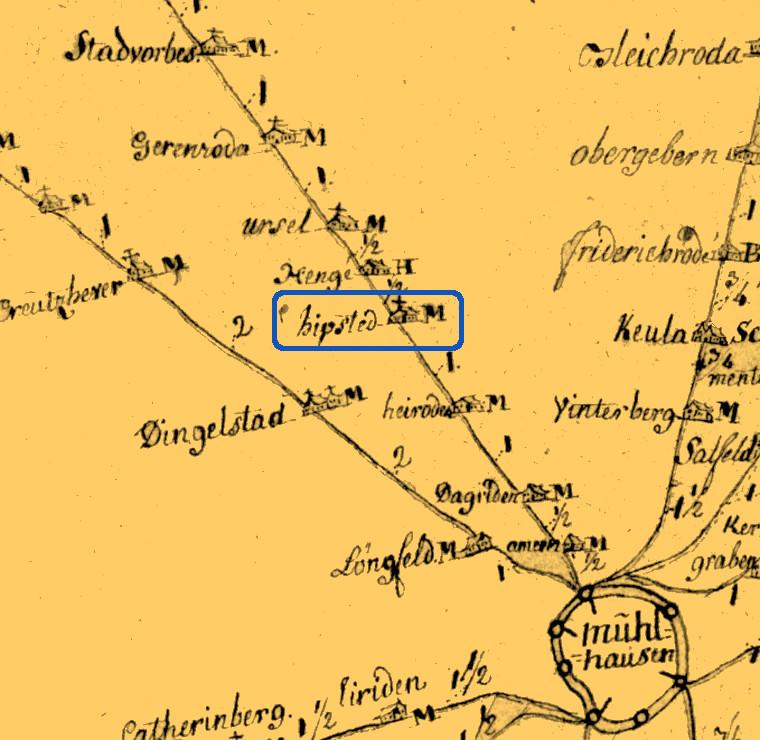
Caroline and Auguste’s adventure with the stuck carriage and horses took place just north of the village of hipstedt on the above map (modern Hüpstedt, at the time another dependency of Mainz), situated on the southern edge of what is known as the Dünengebirge or Dünenwald in Thuringia, the Dune Mountain Range or Forest, at this particular point also known as the Hüpstedter Wald, which here runs approximately east-west and is connected in the east to the Keula Forest (note the village of Keula on the right edge of the map above).
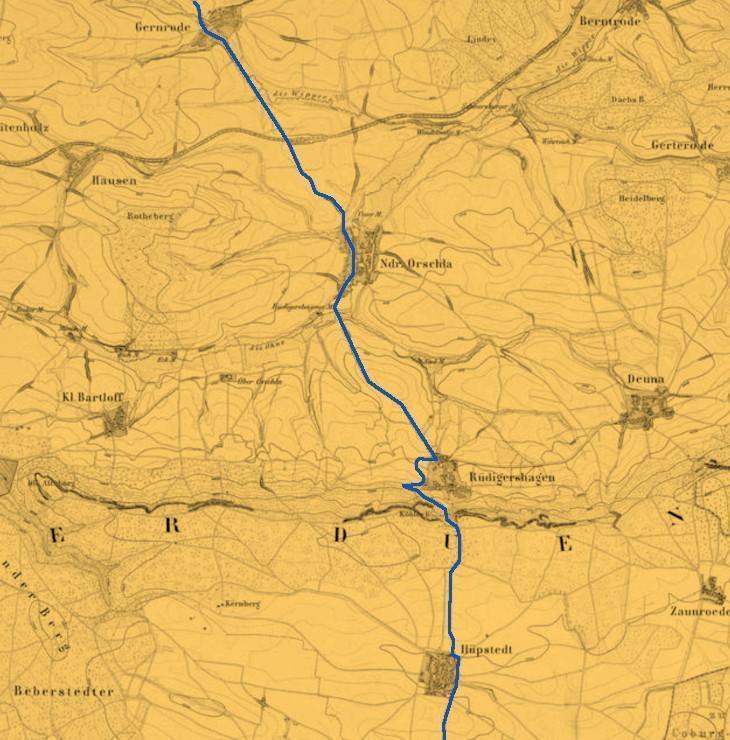
This sharply delineated elevation in the topography begins just after hipstedt and prompts the road even today (2.8 km) to wind through the forested elevation following the circuitous topography through the hills until descending 168 serpentine meters (9% grade at its steepest descent, enough to cause problems for a carriage on a rutted, unpaved road) on the other side at what is today Rüdigershagen, a village that seems to appear on the map above as Henge (?); the next village, ursel, is known today as (Nieder)Orschel. The map below shows the overall route from Hüpstedt to Gernrode, just south of Worbis (Topographische Karte (Meßtischblätter), 4628 [1872]; Ndr. Orschla. [1853] [Berlin: Reichsamt für Landesaufnahme, 1872], Dresden, Sächsische Landesbibliothek – Staats- und Universitätsbibliothek Dresden, Kartensammlung, Signatur/Inventar-Nr.: SLUB/KS 16291):
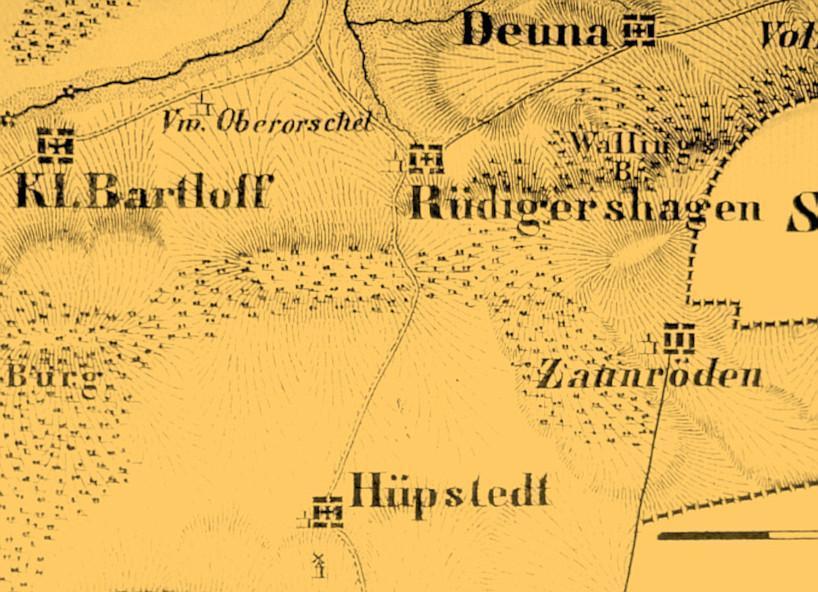
The first topographical map below attests the forested elevation between the two villages (Albrecht Platt, Karte des Kreises Worbis im Jahr 1840 [Langensalza 1840]):
The second topographical map (excerpt from above, Topographische Karte (Meßtischblätter), 4628 [1872]) provides a close-up of the circuitous carriage road through the forested elevation (note the designation Köhler B[erg], attesting the coal mining in the area) between Hüpstedt and Rüdigershage:
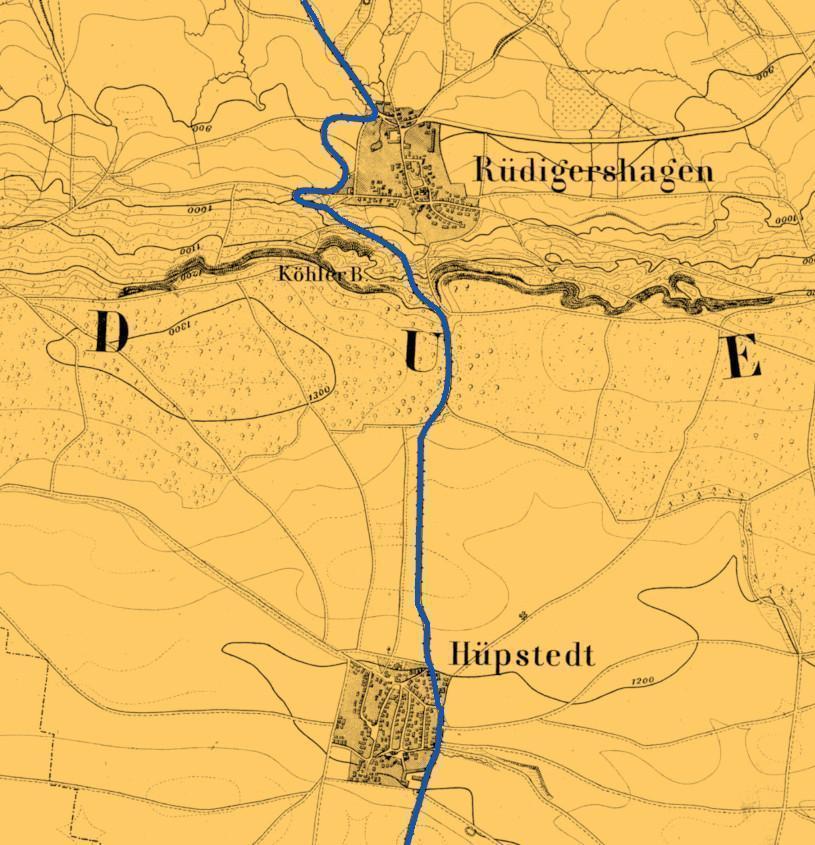
It was here that Caroline and Auguste’s carriage and horses got stuck, forcing them to climb out and proceed ahead on foot before standing “at the foot of the mountain” awaiting the driver and carriage (Taschen-Kalender auf das Jahr 1811, mit sechs Fabeln von Lafontaine [1811]; Inhaltsverzeichnis deutscher Almanache, Theodor Springmann Stiftung):
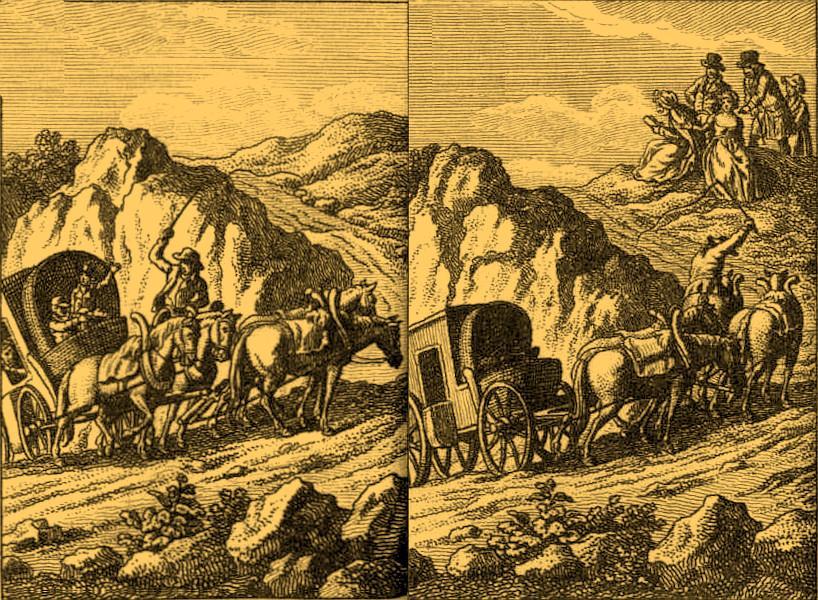
Today this stretch attests even more acute serpentine curves than are depicted on these maps.
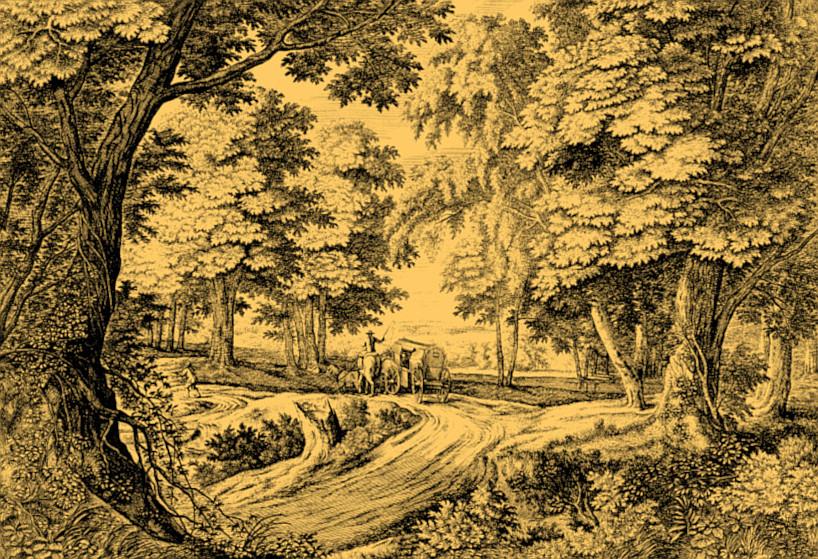
At the time Caroline and Auguste were traversing this stretch, roads, especially in more rural areas, were frequently deeply rutted and difficult to navigate (illustration 1: carriage traveling through a similarly dense forest with a serpentine route: Adam Frans Meulen, Waldinneres mit Kutsche [ca. 1688–1724]; Herzog Anton Ulrich-Museum; Museums./Signatur JC Hafner AB 3.10; illustration 2: cart and horses caught in precisely such a rut: excerpt from Peter Paul Rubens, Schelte Polstert [engraver], [Landschaft mit einem Pferdewagen bei Nacht] [ca. 1620–59]; Herzog Anton Ulrich-Museum; Museums./Signatur SBolswert AB 2.30):
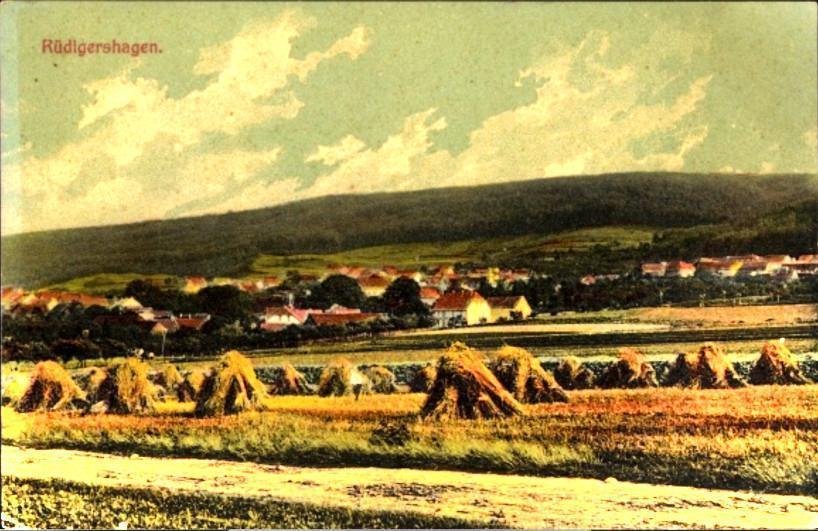
Here, on a 1916 postcard looking south, Rüdigershagen against the backdrop of the elevated forested area over which Caroline and Auguste have just journeyed:
Click on the following image to open a gallery of a contemporary cycling journey along precisely this route (illustration: Simplicisissimus 43 [1938] 14 [10 April 1938], 169):
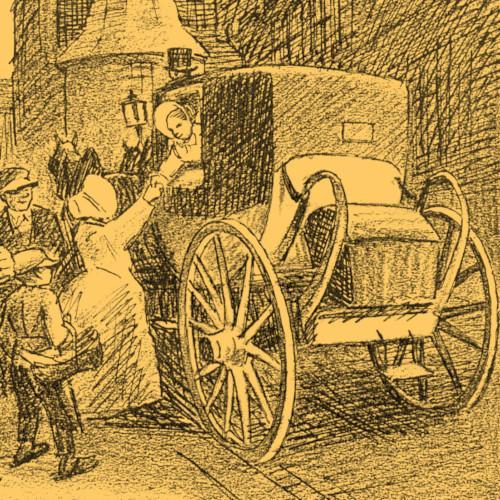
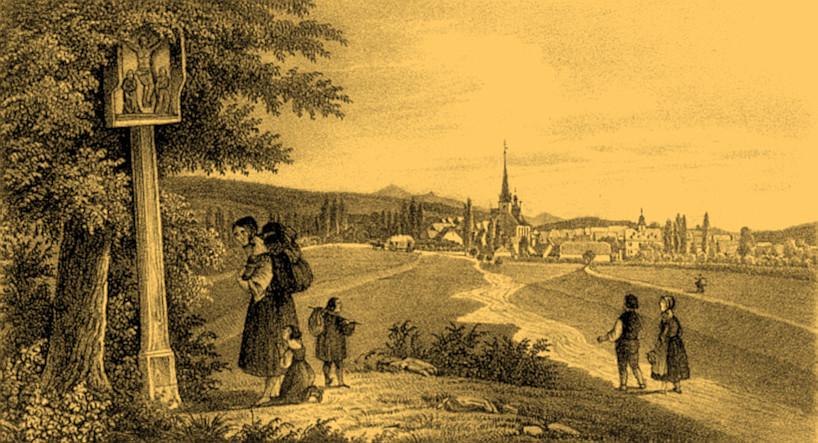
[8] Gibelhausen (Gieboldehausen), approx. 22 km northwest of Worbis (Carte des Routtes qui partent de Muhlhausen sur différents points [1757]; illustration: Carl Duval):
[8a] See these scenes from inns at the time, ca. 1773. Note the mother and child on the dining table at right in the first illustration, and the man at bottom left sleeping on just such a straw bed in the second (Daniel Nikolaus Chodowiecki, Von Berlin nach Danzig. Eine Künstlerfahrt im Jahre 1773 von Daniel Chodowiecki. 108 Lichtdrucke nach den Originalen in der Akademie der Künste in Berlin. Mit erläuterndem Text und einer Einführung von Professor Dr. W[olfgang] von Oettingen [Berlin, Amsler & Ruthardt, Kunsthändler o.J. [1883], plates [in order] 13 and 5):
This chocolate soup (“a nourishing food for children,” thus The New Lucile Cook Book [New York 1906], 13; “for the children’s table,” so The American Kitchen Magazine 16, no. 2 [November 1901], 71), seems to have been a chocolate variant of Iles Flottantes or Oeufs à la Neige, viz., Oeufs à la Neige au Chocolat.
First a recipe with which Caroline was likely generally familiar, from a contemporary cookbook for young women, Unterricht für ein junges Frauenzimmer, das Küche und Haushaltung selbst besorgen will, aus eigener Erfahrung erteilt von einer Hausmutter [Magdeburg 1784], 21):
38. Chocolate Soup with Milk.
Grate the chocolate (half a bar for each measure of milk), bring to a short boil with milk, then stir in 4 egg yolks; whisk the eye whites to a soft peak and put them on the soup; sprinkle with sugar and cinnamon
See also Ella Oswald, German Cookery for the English Kitchen (London 1906), 15:
Schockoladen-Suppe. (Chocolate Soup.)
3 pints milk.
4 oz. chocolate.
2 yolks of eggs.
1 teaspoonful potato flour.
Sugar and salt to taste.
2 whites of eggs.Put the milk on to boil with the chocolate grated finely, reserving a small quantity to mix cold with the potato flour.
When the milk boils, stir in the dissolved potato flour and then the yolks of 2 eggs. Sweeten with sugar to taste.
Whisk the whites of eggs to a stiff snow, and place in rough heaps on the soup when in the tureen.
This soup may be served hot or cold.
Also Margaret Remington, “Ins and Outs of Housekeeping,” The Puritan 9 (October 1900 to March 1901), no. 3 (December 1900), 489–96, here 492:
Chocolate Soup — A delicious soup is made with chocolate. The idea is borrowed from the German haus frau, to whom we are indebted for the fruit soups so much in vogue at summer luncheons.
To make the soup, put half a cake of chocolate to soak in a pint of water; when soft, put it to cook. When it boils, add two tablespoons of sugar, and a tablespoon of flour rubbed smooth in half a cup of cold water. Let it cook slowly for five minutes; add one quart of hot milk, strain, stir in a teaspoon of ground cinnamon and a cup of whipped cream. Serve at once with crisp bread sticks or wafers. Blanched almonds, toasted, are passed with the soup. Back.
[9] Tuesday, 14 April 1795. Back.
[10] Catlenburg (Katlenburg, Katlenbourg), approx. 11 km northwest of Gibelhausen (Carte des Routtes qui partent de Muhlhausen sur différents points [1757]):
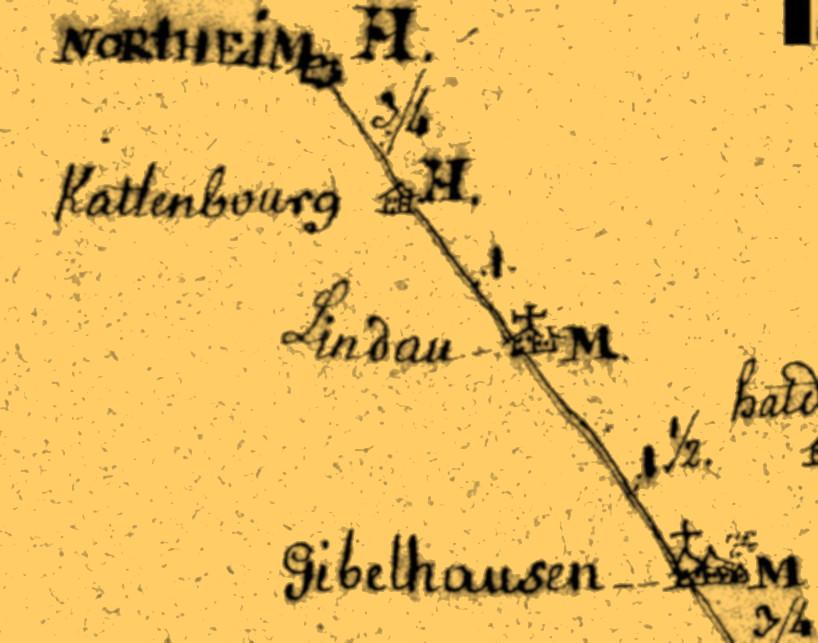
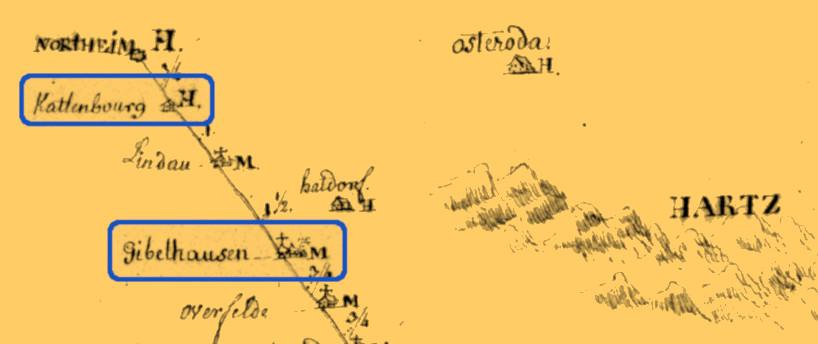
Here the broader vista with the Harz (Hartz) Mountains just to the east after Gibelhausen; note Osterode northeast of Gibelhausen:
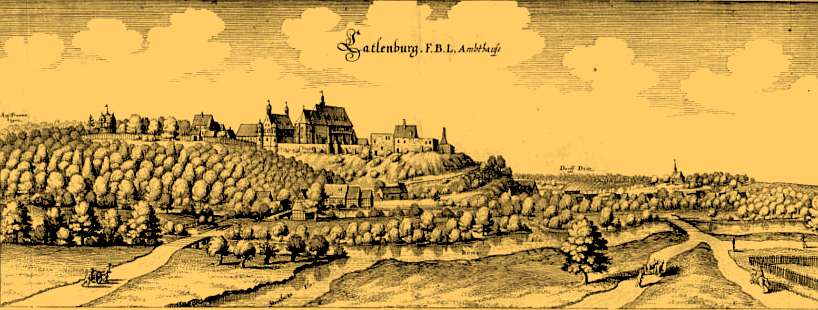
The “familiar windows” were doubtless those of the former Katlenburg bailiff Johann Arnold Reinbold, Caroline’s mother’s uncle, who had died in 1793. The house does indeed face the road toward the south (here the house and road in an engraving from 1654, Catlenburg. F. B. L. Ambthauss, engraving by Matthäus Merian, Topographia und Eigentliche Beschreibung Der Vornembsten Stäte … in denen Hertzogthümer Braunschweig und Lüneburg … [1654]):
See esp. Caroline’s letter to Luise Gotter on 22 June 1785 (letter 57) with note 9. Back.
[10a] A carter was generally associated with freight conveyances or wagons rather than with passenger conveyances, though often enough the two could be combined depending on space in a carriage or cart and the route.
It could also refer — and one imagines such to be Caroline’s reference here — more specifically to carters or transport wagons on rural roads with draft (or livestock) teams in front used for agriculture and general moving services and needs (Christoff Weigel, Abbildung Der Gemein-Nützlichen Haupt-Stände Von denen Regenten Und ihren So in Friedens- als Kriegs-Zeiten zugeordneten Bedienten an biß auf alle Künstler und Handwercker Nach Jede Ambts- und Beruffs-Verrichtungen meist nach dem Leben gezeichnet und in Kupfer gebracht etc. [Regenspurg 1698], illustration following p. 164):
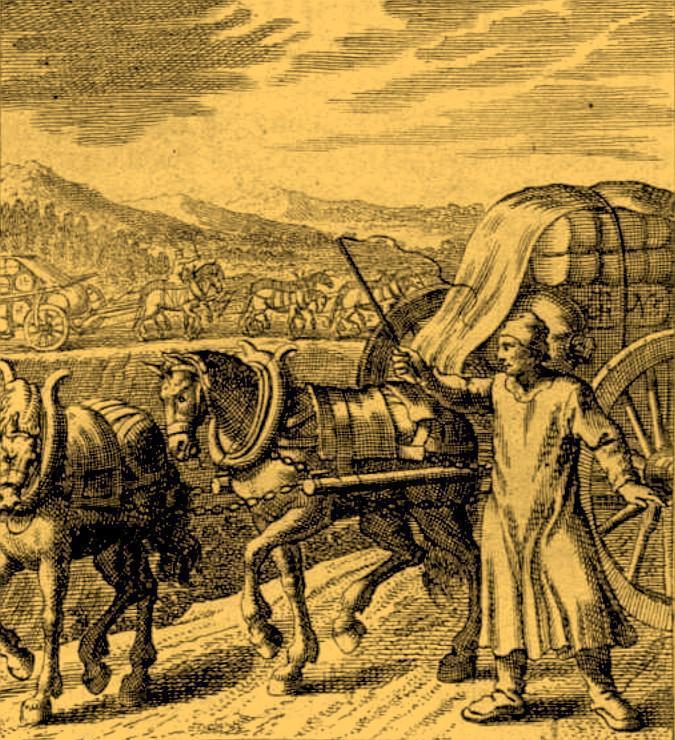
Here several other period illustrations of such rural iterations of the sort Caroline’s carriage might have encountered (in order [1] Matthäus Merian, Dellsperg [ca. 1601–25]; Herzog August Bibliothek; Museums./Signatur C Geom. 2° 192; [2] anonymous, Zwei Rinder mit einem beladenen Fuhrwagen vor einem Gehöft in bewaldeter Berglandschaft [ca. 1701–75]; Herzog August Bibliothek; Museums./SignaturGraph.C:869; [3] Schauplatz der Natur und der Künste, vol. 5 [Vienna 1777], plate 1):
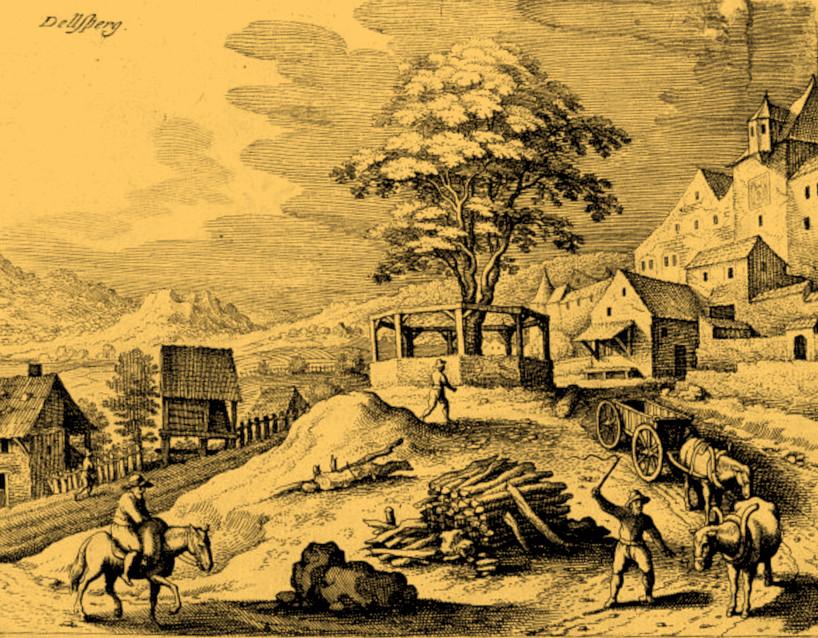
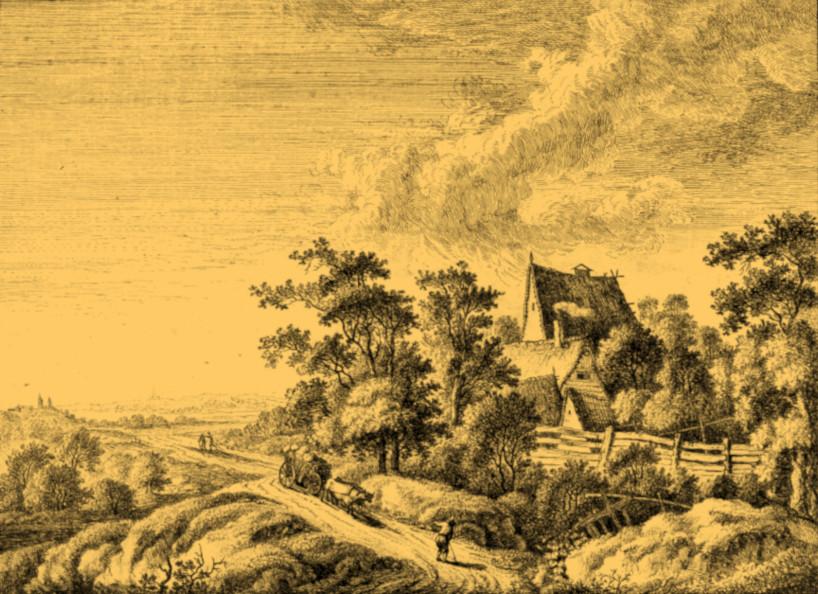
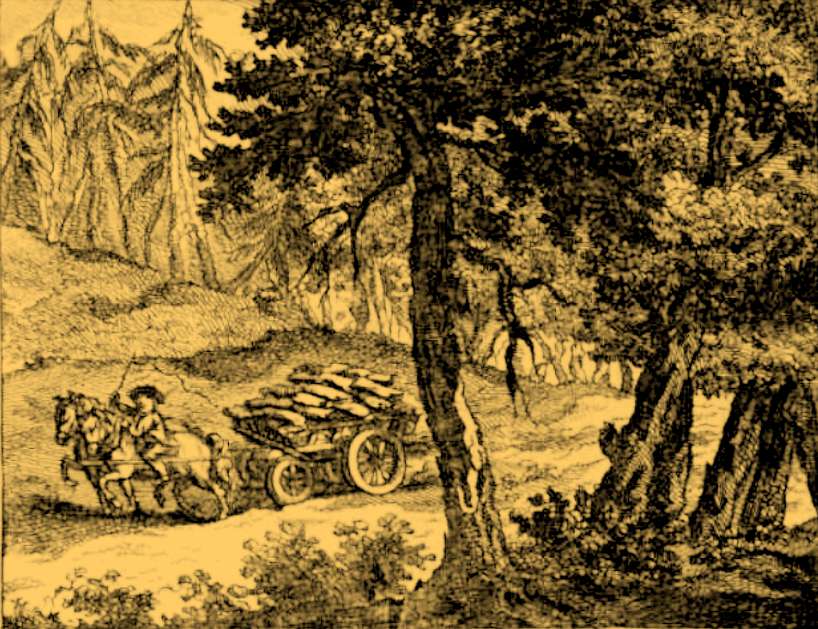
[11] Uncertain identity; possibly Johann Jacob Weibezahl, a contra-bassist with the royal ducal orchestra in Gotha in 1786 (Herzoglich-Sachsen-Gotha und Altenburgischer Hof- und Adress-Calender auf das Jahr 1786 [Gotha 1786] 56); or, albeit attested much later, Jacob Weibezahl, an outrider employed in the ducal stable in Gotha (Herzoglich-Sachsen-Gotha und Altenburgischer Hof- und Adress-Calender auf das Jahr 1819 [Gotha 1819], 22). Back.
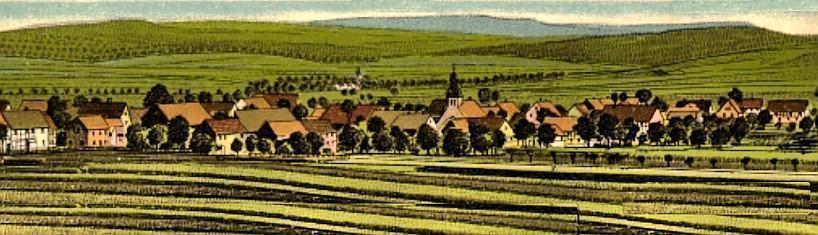
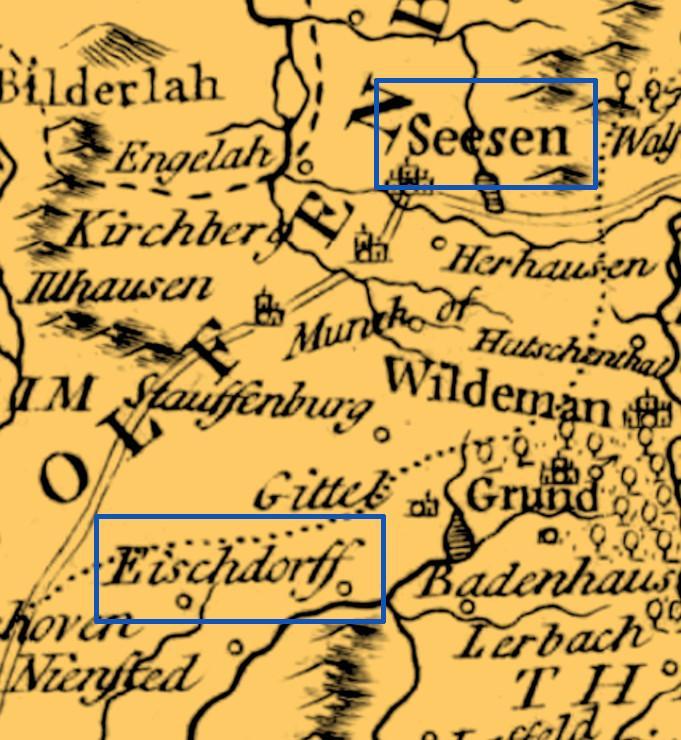
[12] Eisfeld (Eisdorf, Eischdorff), a tiny village situated on a broad plain approx. 12 km northeast of Katlenburg (R. Sayer and J. Bennett, The German Dominions of the King of Great Britain Comprised Under the Name of Electorate of Brunswick Luneburg [London 1778]; illustration: 1906 postcard):
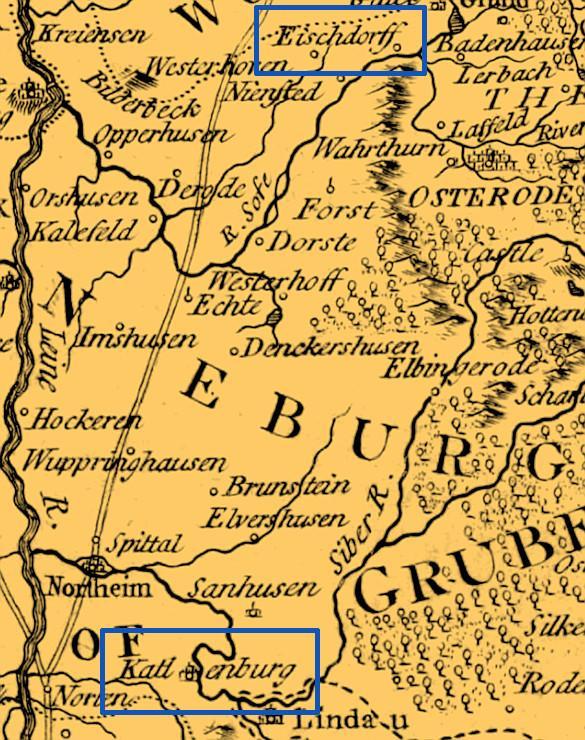
[13] I.e., the elder horse. “Cold brandy soup”: “A cooling summer concoction made from cold beer, though also from wine or milk, with various ingredients, such as bread or semmel, sugar, almonds, raisins” (Grimm, Deutsches Wörterbuch 11:90, 13). Back.
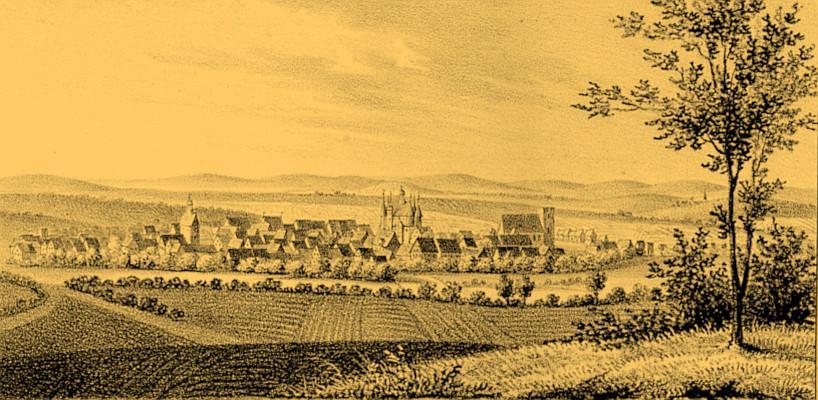
[14] Seesen, approx. 14 km north of Eisfeld (Eisdorf, Eischdorff) (R. Sayer and J. Bennett, The German Dominions of the King of Great Britain Comprised Under the Name of Electorate of Brunswick Luneburg [London 1778]; illustration: Season 1650, Herzog August Bibliothek; Museums./Signatur Top. App. 2:351):
[15] Unknown allusion. Back.
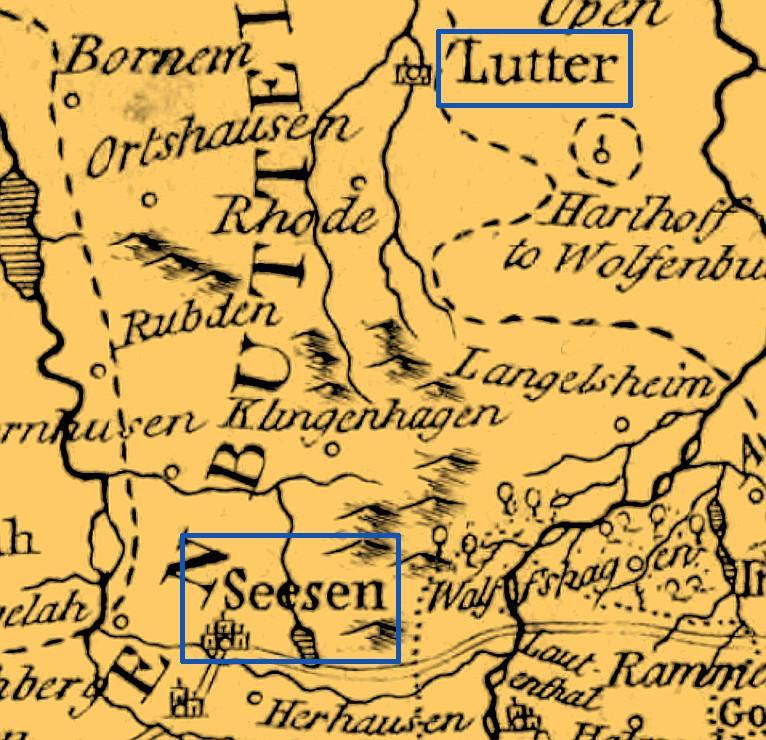
[16] Lutter, an extremely small village approx. 13 km northeast of Seesen (The German Dominions of the King of Great Britain Comprised Under the Name of Electorate of Brunswick Luneburg [London 1778]):
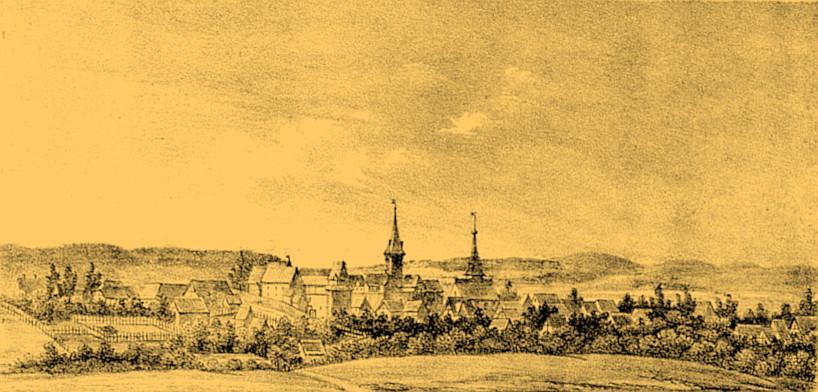
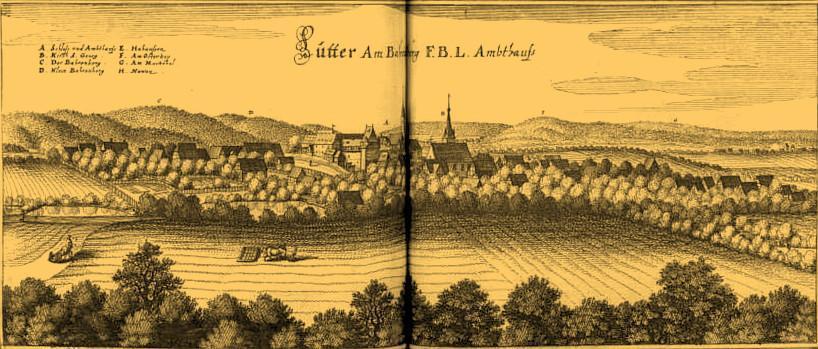
Here engravings from 1650 and 1654 (Vaterländische Geschichten und Denkwürdigkeiten der Vorzeit . . . Braunschweig und Hannover, ed. Wilhelm Görges [Braunschweig 1881], 2 [1844], plate following p. 302; Martin Zeiller, Topographia und Eigentliche Beschreibung Der Vornembsten Stäte, Schlösser auch anderer Plätze und Örter in denen Hertzogthümer[n] Braunschweig und Lüneburg, und denen dazu gehörende[n] Grafschafften Herrschafften und Landen [Franckfurt 1654], following p. 138):
[17] After Lotte Dieterich’s (née Michaelis) death in April 1793, Madam Michaelis kept her daughter until Lotte’s widower remarried. See Caroline’s letter to Friedrich Ludwig Wilhelm Meyer on 30 [–31] August, [17]94 (letter 147) with note 12. Back.
[18] Madam Michaelis and Luise Michaelis spent their final days in Göttingen in the home of the the Schlözer family before moving to Braunschweig; Madam Michaelis had already sold the family home. Back.
[19] The reference is to a beautiful and large block of silver-laced ore that George III had bequeathed to the Academic Museum in Göttingen from the library in Hannover in 1777. It was stolen during the night of 15–16 January 1783 and never recovered. See the review of Georg Otto Sigismund Lasius, Beobachtungen über die Harzgebirge, part 2 (Hannover 1789), in Revision der Literatur in den drey letzten Quinquennien des achtzehnten Jahrhunderts in Ergänzungsblättern zur Allgemeinen Literatur-Zeitung 4 (1804) vol. 1, no. 66, 521–24, here 522:
Sixteen mines are enumerated as being in operation at St. Andreasberg. Technical description of the shafts themselves. Here, too, there are occasional ore eruptions. At the Abendröthe [shaft], e.g., a huge 1/2 Lachter [1 Lachter = ca. 6.5 feet] ore spur was exposed in December 1786 with red-gilded and arsenical silver, in which a single centner ore contained 135 Mark of pure silver [1 Mark of silver contains approximately 16 Loths, 1 Loth being approx. 1/2 ounce]. Such examples also include [Lasius, Beobachtungen, 319] the silver-ore block formerly housed at the Academic Museum in Göttingen, which weighed one centner and was worth an estimated 1500 Reichsthaler.
The ore theft created a bit of a literary scandal when Johann Bernoulli, astronomer at the Berlin Academy of Science, insinuated in print that it was through the neglect of Johann Friedrich Blumenbach, as museum curator, that the theft of such a precious object was possible in the first place. For texts see supplementary appendix 149.1. Back.
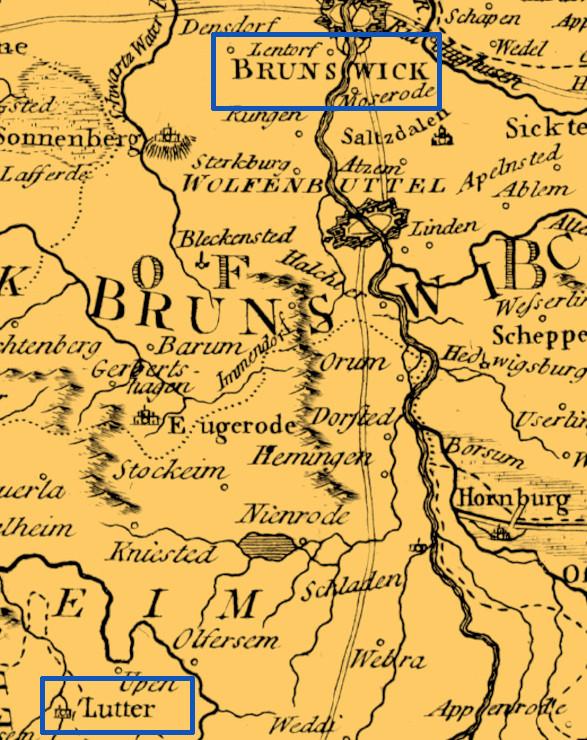
[19a] Lutter, finally, is located approx. 30–35 km southwest of Braunschweig itself (The German Dominions of the King of Great Britain Comprised Under the Name of Electorate of Brunswick Luneburg [London 1778]):
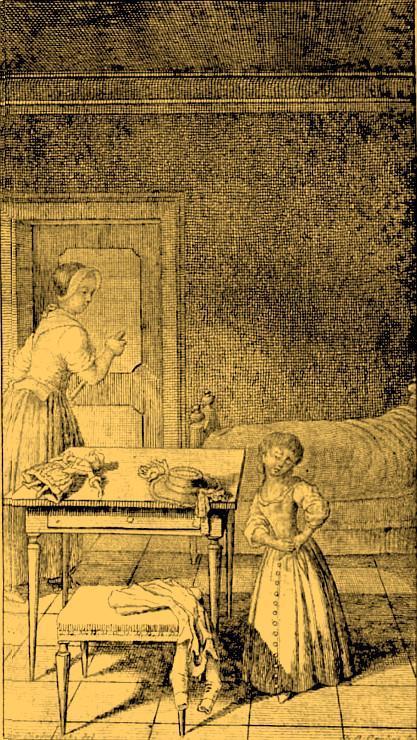
[20] Caroline’s remark that Auguste had “already” made a bit of a mess of the apartment might suggest they had been in Braunschweig but a few days, i.e., had indeed arrived on 14 April 1795 rather than earlier (Daniel Nikolaus Chodowiecki, Kupfer zu Herrn Professor Salzmanns Elementarwerk nach den Zeichnungen Herr Daniel Chodowiecki, nos. 1, 2 [Leipzig 1787], plate i, with the subtitle “Was für ein haeßliches Ding ist nicht die Unreinlichkeit,” “What an ugly thing uncleanliness is!”):
Caroline seems to have moved to Braunschweig concurrently with Luise Michaelis and their mother, the latter two having visited Caroline for a week in Gotha and then lived with the family of August Ludwig von Schlözer during their final period in Göttingen following the sale of the Michaelis house (see Luise’s Erinnerungen, 33–34, 40–41; Madam Michaelis lived in a small apartment after moving out of the family house). Luise, however, did not marry Christian Rudolf Wilhelm Wiedemann in Braunschweig until March 1796, and there is no documentation specifying where she, Caroline, and their mother lived upon moving to Braunschweig. Although Caroline speaks here and elsewhere about her apartment, nowhere does she identify its location.
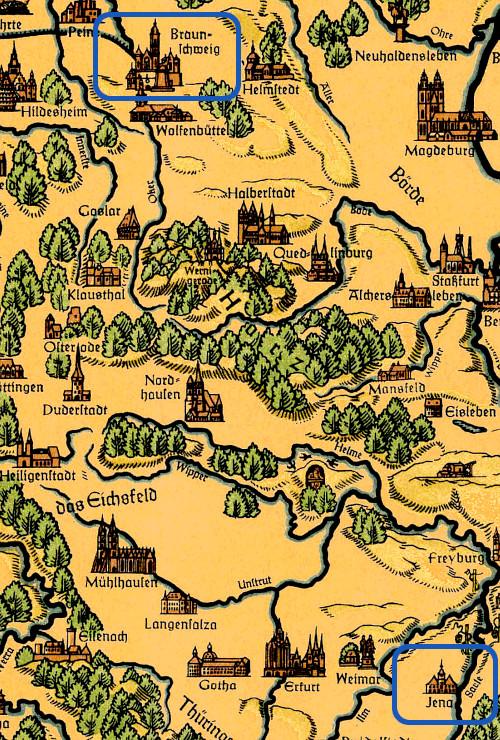
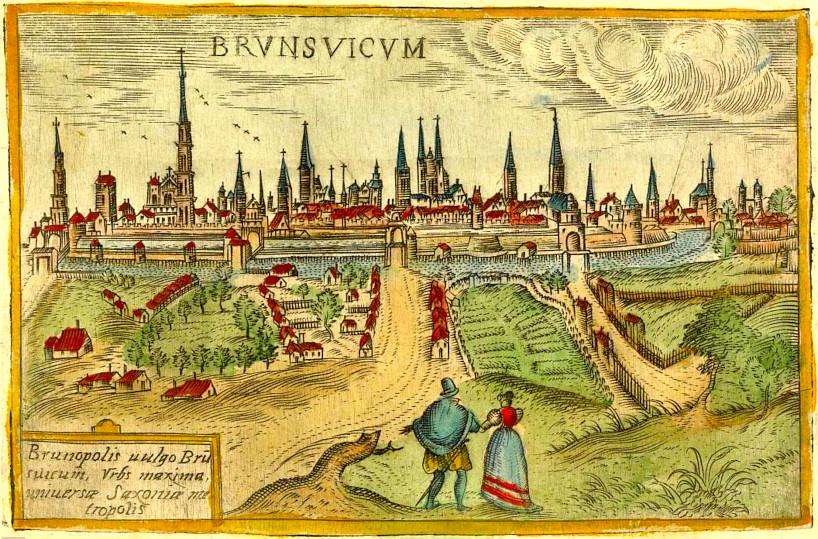
Here a map of Braunschweig’s location in relation to Caroline’s next residence, namely, Jena, and an overview of Braunschweig in 1640 ([1] Rudolf Koch and Fritz Kredel, Deutschland und angrenzende Gebiete [Leipzig 1937]; [2] frontispiece to Wilhelm Görges, Vaterländische Geschichten und Denkwürdigkeiten der Vorzeit . . . der Lande Braunschweig und Hannover 1 [Braunschweig 1843]; Francesco Valegio, Ansicht von Braunschweig (aus Westen) [1580–1620]; Herzog Anton Ulrich-Museum; Museums./Signatur Brunsvic. 4.I. 3.19):

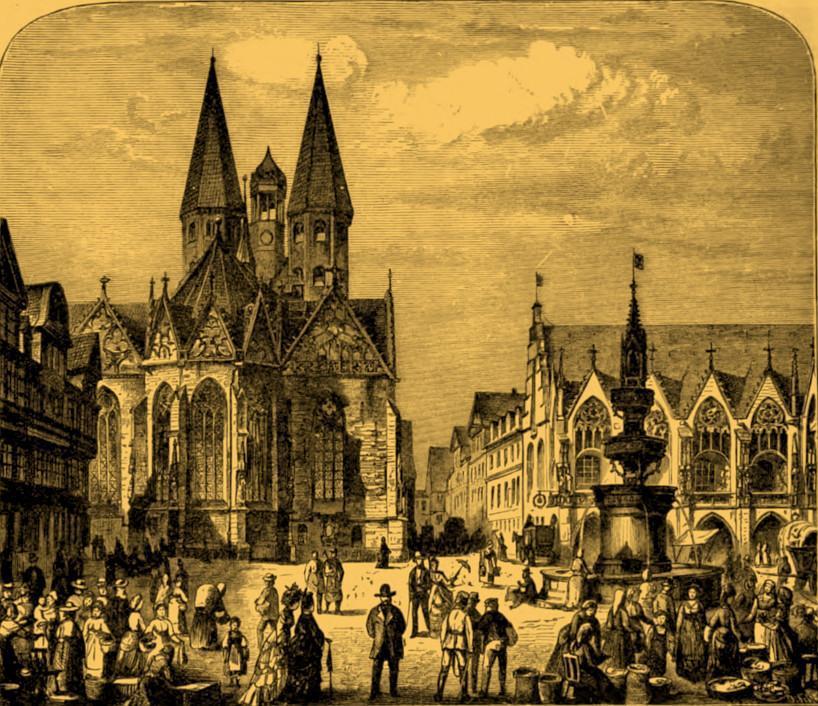
Here the old marketplace in Braunschweig (Samuel G. Green, Pictures from the German Fatherland: Drawn with Pen and Pencil rev. ed. [London 1893], 56):
[21] Peace as a result of the various stages of the Treaty of Basel between France, Prussia, Spain, and Hesse-Cassel beginning on 5 April 1795 (The New Illustrated Encyclopedia of World History, ed. William L. Langer, 2 vols. [New York 1975], 1:613):
Prussia, financially exhausted and at odds with Austria, withdrew from the war [of the First Coalition]. Saxony, Hanover, and Hesse-Cassel followed suit. France was to retain the left bank of the Rhine until peace should be concluded with the Empire, but was to evacuate the right bank. Northern Germany was to be neutralized. Secret articles: Prussia consented to the absolute cession of the left bank to France and was given assurance of compensation through secularization of ecclesiastical territory on the right bank. Back.
[22] Wednesday, 15 April 1795. Back.
[23] The Gotters’ nickname for Auguste (see also Caroline’s letter to Friedrich Ludwig Wilhelm Meyer on 30 August 1794 [letter 147]). Back.
[24] The Gotters’ three daughters, Cäcilie, Julie, and Pauline. Back.
[25] August Wilhelm Iffland, Allzu scharf macht schartig (Leipzig 1794). Back.
[26] Intriguing but uncertain allusion. Possibly a package forwarded to Caroline in Gotha from Mainz (?) or Leipzig (Lucka?) that arrived after her departure from Gotha and which Luise Gotter had then forwarded to her; regrettably, these letters from Therese Forster (now Therese Huber) seem no longer to be extant. Back.
Translation © 2011 Doug Stott