
• 150. Caroline to Luise Gotter in Gotha: Braunschweig, 20 May 1795
Braunschweig, 20 May [17]95
|357| Has it really been so long since I have written you that I have yet to report the arrival of the crates? Believe me, dear Louise, I simply must have been unable, otherwise it surely would have happened. My room was wallpapered and an adjoining cabinet chamber painted; amid all the cold I really had not even the tiniest space where I could go to write except the parlor, and, unlike your husband, I am not really able to bring forth my creations amid the conversation of aunts, nièces, and mothers. [1]
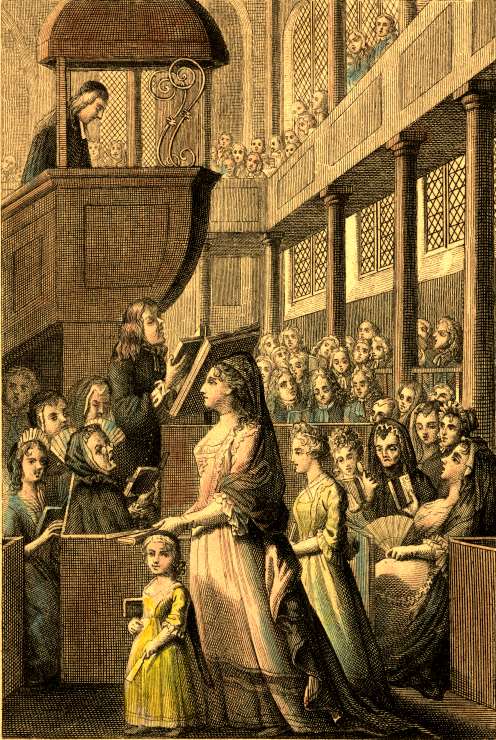
Moreover, I have not been well and in fact am still not. I would like to cough if I could do so without such pain — I coughed up a bit of blood, and as proof that it is indeed wretched I must tell you that today, when everyone else is attending the Repentance Day sermon of Abbot Bartels, I have remained here at home. That will not sit well with Madam Ebert; |358| she put her pew seats at our disposal and is quite perplexed that we do not make use of them each Sunday. [1a] Nor will anything keep me from doing so at the Whitsun celebration, since I have already read the second volume of Wilhelm Meister. [2]
At Madam Ebert’s house, where we recently spent an afternoon, there were all sorts of English, French, and German sermon books lying about, more than ever on Mamsell Lorchen’s writing desk. And yet it all still cannot quite bestow on her that full element of Christian gentleness that would animate my dear Lorchen even had she never read even a single sermon. [3]
Madam Ebert seemed quite depressed — her circumstances are probably characterized more by disarray than by stability and order. She is not keen on leaving the spacious building with its high-ceiling rooms, something I do not really comprehend, since my own spirit has always been satisfied with humble surroundings. The youngest Jerusalem girl composed a very nice poem or song commemorating Ebert’s death, and this particular month, which he was especially wont to celebrate himself, offered an appropriate occasion for doing so. [4] I may perhaps yet receive a copy of it from her personally. —
The lines you sent me and which I rather enjoyed relating further at least by passing them along I then found in the local Intelligenzblatt, [5] where Feronce must have entered them, though he certainly should have added Gotter’s name next to them. [6]
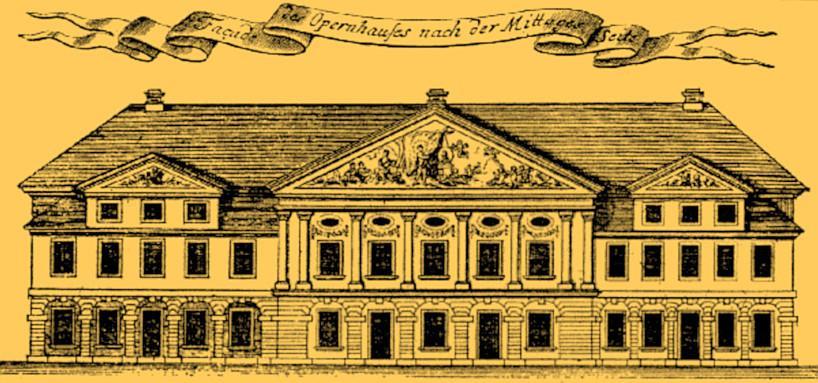
The theater here is not particularly inspiring; I saw an insignificant piece by Jünger and then also Scheinverdienst. [7] The wife of the Geheimrath [8] played her part from the very beginning such that no one need be surprised at her demise in the 5th act. The old Amicus carried the piece. [9] A few others were tolerable, and Heinrich did fairly well except that he was a bit too burly. [10] Almost no one ever applauds here, though behind where I was sitting I did hear someone whisper various words of praise regarding Ifland’s skill.
|359| The building is dark and colorful and poorly lit. Various Hubers, Müllers, Röggeles, and Nösselt provide the fonds for the company. They will now go to Wolfenbüttel and not return here again until the trade fair. All of you probably already know that Schröder has formally resigned and in the future intends to assemble preeminent persons on an estate in Holstein. [11]
Although my own social contacts will doubtless improve, there is as yet no sign that poor Fräulein Isabella will even remotely be able to replace her diminutive, unforgettable girlfriends. [12] Madam Eschenburg, who was quite cordial, has a little girl Auguste’s age who was, however, not at home when we recently visited them, and she assured me that her own little one was so incurably imbecilic that she would rather not put her up next to Gustel. [12a]
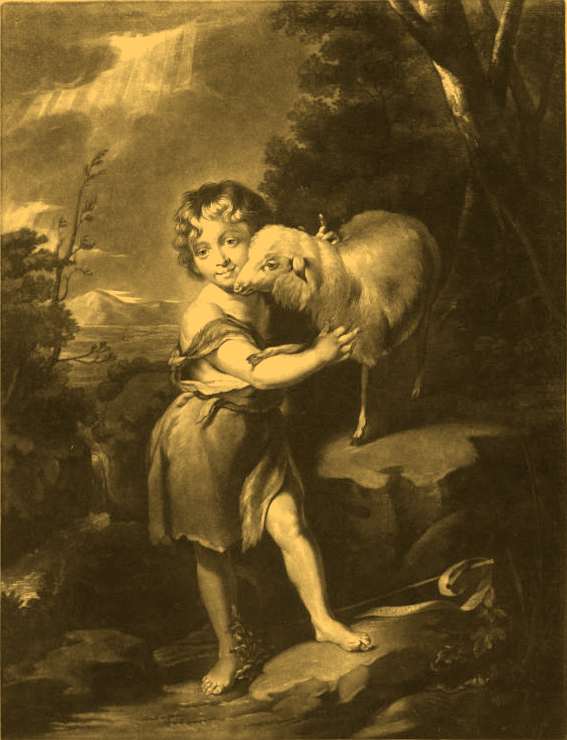
But then he said that he himself would like to bring her over sometime. [13] He was so pleased with Gustel that he compared her to an English copperplate engraving of a young St. John, and even went and fetched the engraving to convince me. [13a]
He is very good — he praises my child and sends me his entire library. Hence your husband is only half as good. His letter gladdened Eschenburg, as did the prospect of seeing something of his published soon. Will that soon be the case? Let me request my own copy here and now, and although you can rest assured I will not fold my embroidery silk and put it between the covers, I cannot guarantee that I will not pass it on to Eschenburg. —
Gustel is getting all her reading material from Campe himself; [14] you cannot imagine how delighted she was to be invited along to go over there, where we then had a quite charming souper. We often take walks over to the Campes’ garden. [15] . . .
She will now be quite occupied with the piano. She is receiving fairly serious instruction and has received a fine instrument as well, and I do not doubt for a moment that over time she will be able to sing the romance as well as “Know’st thou the land where the lemon-tree blows?” for me. [16]
|360| Know’st thou, too, the land? Has Gotter read it? [17] Let me wish him luck in pursuing this pleasure, for pleasure is precisely what the 2nd part will also provide for him, a part against which the world will doubtless rise up in protest even more vehemently than it did against the first, for now its suspicion is confirmed that our friend [18] is indeed keeping very ill company and is not really suitable for much better. Now the world will find it necessary to lower even further its initial expectations of the perfect new Goethean novel it had initially imagined in its soul.
But, then, who is able to fulfill its weighty ideals? Think of me, Louise, when you read — “It is the character of the Germans to bear heavily upon every thing, and that every thing should bear heavily upon them.” [19]
Will your husband be going to Weimar soon? Have I also already read our silent friend’s periodical, the Zeitarchiv? [20] The stories there are, I hope, not by him, though the articles on literature surely are. Let someone else judge them — I find merely that as daintily as his quill may well be sharpened, it still exhibits an undeniable ponderousness. I have not yet felt the inclination to determine whether, quite beyond that, at least toward me it might not also betray a certain burdened conscience. [21]
. . . Stay well, my dear.
Notes
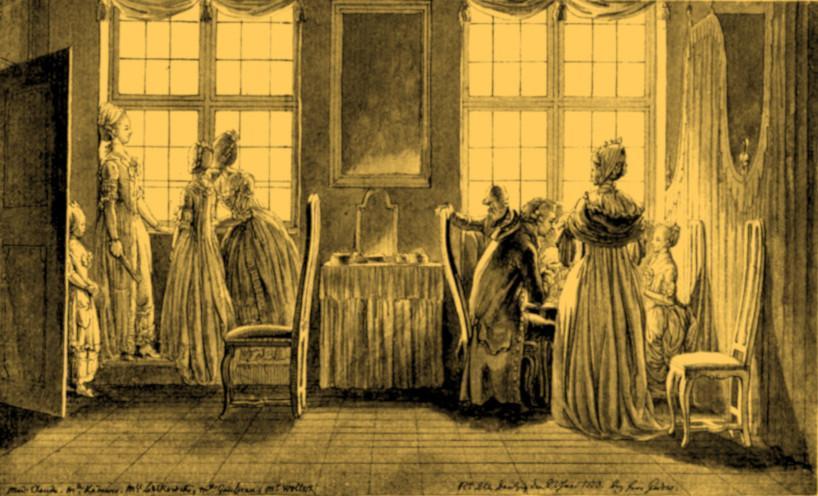
[1] Daniel Nikolaus Chodowiecki, “Eine Abendgesellschaft bei Herrn Gerdes,” Von Berlin nach Danzig: Eine Künstlerfahrt im jahre 1773, von Daniel Chodowiecki. 108 Lichtdrucke nach den originalen in der Staatl. akademie der künste in Berlin, mit erläuterndem text und einer einführung von Wolfgang von Oettingen (Leipzig 1923), plate 53:
[1a] Susanne Henry Der Sonntag von zwei Jahrhunderten (Kirchgang); Stiftung Stadtmuseum Berlin:
The Protestant Day of Repentance and Prayer, originally celebrated on two different feast days in the different states of the Holy Roman Empire of the German Nation, generally in the spring and autumn, is celebrated today in November on the Wednesday before the final Sunday of the liturgical year. Back.
[2] Goethe’s Wilhelm Meisters Lehrjahre. Ein Roman, 4 vols. (Berlin 1795–96). Volume 1 (books 1 and 2) had appeared during the first few days of 1795, volume 2 (books 3 and 4) in mid-May 1795, volume 3 (books 5 and 6) appeared in November 1795, and volume 4 (books 7 and 8) in October 1796. Because Caroline is presumably referring to volume 2 rather than the second book of volume 1, as emerges clearly later in the letter, she must have read the entire volume extremely quickly after its appearance. Back.
[3] Professor Johann Arnold Ebert had died on 19 March 1795. Johann Anton Leisewitz, Johann Anton Leisewitzens Briefe an seine Braut nach den Handschriften, ed. Heinrich Mack (Weimar 1906), 136–37, writes to his fiancée, Sophie Seyler, on 21 July 1781, concerning Ebert’s wife, Luise, née Gräfe:
Although the wife of Hofrath Ebert possesses understanding, knowledge, and especially musical and various other talents enough to make her a charming woman, she has discovered the secret of making herself consistently loathed among men, women, and children alike. She is the woman who knows everything, and everything better than everyone else. Accordingly she believes it to be her calling to instruct the entire world, and herself to be the apostle of all truth — just as, similarly, she is often the martyr of her opinions.
Among her sundry contradictions, I find it particularly ridiculous (1) that she often claims to know things better than the person with whom she is speaking even when these things intimately concern her conversation partner and even when the latter would necessarily, inevitably be better informed than she in any case, (2) that she often becomes extraordinarily perturbed and heated when asserting something in whose truth or falsehood, in fact, no one is the least bit interested. But you yourself will see how for her it is a matter of life and death, one whose veracity she is prepared to seal with her own blood, that Peter wore a green garment yesterday.
She is still quite vain with respect to her clothes and especially, as she puts it, her repas [Fr., meals], which are frequent and lavish. She is especially fond of table etiquette, e.g., that each dish be accompanied by the correct compot; and yet, even more than by these dishes themselves, her palate is titillated by the names of her dishes, with which, indeed, she tries to regale her company as much as with the dishes themselves. There is no need for me to tell you about her garrulousness and considerable imprudence, since such is attested by the above in any case. She is my and, in anticipatory fashion, also your great patroness.
A similar assessment is attested during Madam Ebert’s visit to Weimar in May 1800, during which she “came across insufferably with her parasitic lifestyle” (Charlotte von Schiller und ihre Freunde 1:260; Erich Schmidt [1913], 1:707, conflates Charlotte Schiller’s statements); Charlotte Schiller writes to Schiller on 29 May 1800 (Goettinger Taschen Calender vom Jahr 1790; Inhaltsverzeichnis deutscher Almanache, Theodor Springmann Stiftung):
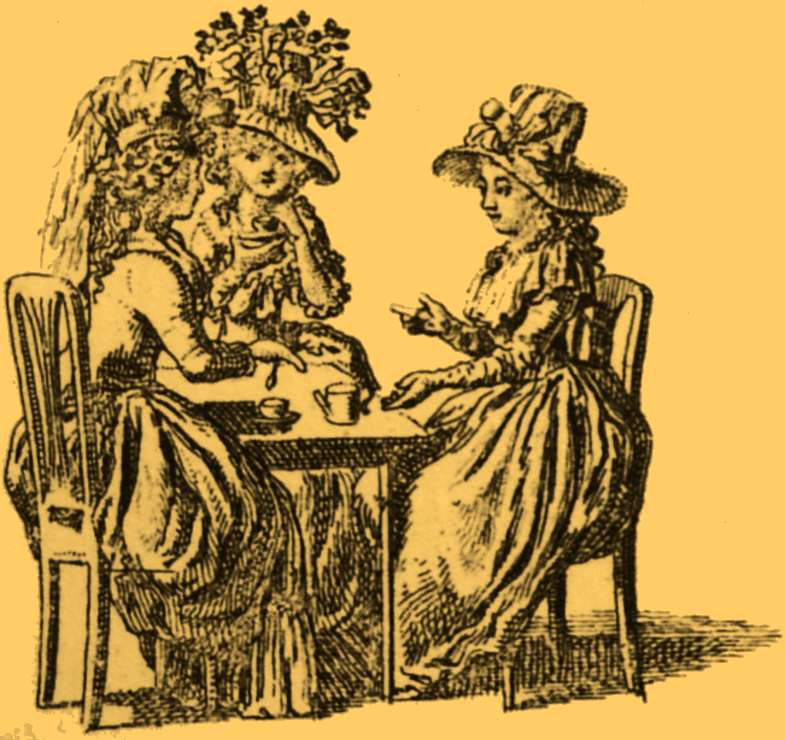
Imagine my misfortune: yesterday the door opened quite unannounced, and Madam Ebert from Braunschweig walked in. I received her rather coldly and dispatched her on to the Herders as soon as possible. She is continuing her parasitic lifestyle even after the death of her husband. . . .
Just imagine, the Ebert woman constantly asked about you, and when she heard that you were but an hour away, she asked me to accompany her on a walk there to see you; but I would not hear of it. I am locking myself in and letting no one enter; she is simply too insufferable.
Schiller responds on 30 May 1800 from Ettersburg (ibid. 261):
How utterly insufferable that that repugnant Ebert woman plagued you thus; if nothing else works, then you must use rudeness to get rid of her. Back.
[4] As noted above, Ebert, who was a friend of Friedrich Gottlob Klopstock during their youth and whom Klopstock also celebrated in poetry, had died on 19 March 1795. The poem by Friederike Jerusalem may perhaps be preserved in the Braunschweig municipal library as an anonymous, privately printed piece, Beileidversen vom Mai (not included here). Ebert was wont to celebrate 18 May in poems as the occasion of his wedding anniversary (1773). See in any case Johann Joachim Eschenburg’s lines to Madame Ebert in Johann Heinrich Voss’s Hamburg Musen-Almanach für das Jahr 1796, 144, “Der Frau Hofräthin Ebert. Am achtzehnten Mai 1795” (reprinted in the Deutsche Monatsschrift [1795] 3 [September–December], 47–48; approximate prose translation):
To Frau Hofräthin Ebert. On 18 May 1795.
Him at whose side you gently moved through life, that noble man
So inclined to weave garlands to you and to this month of May,
Has death now taken from your side.
Alas! the very day, his favorite, does even now approach once more,
The day toward which his delighted eye did gaze with
Selfsame intimation, selfsame yearning, selfsame clarity as Germany's peace.
And behold: this favorite of days, of joy and peace, has come
Toward which, peacefully as well, his heart did yearn,
Toward which his swan song did sound its welcome!
The flowers that Lent did strew at this celebration,
The blossoms that so delighted in your own hand,
Today breathe in vain the fragrance he found so sweet,
And sink down instead into his grave. Enveloped in that fragrance,
With melancholy yearning filled,
Do you, O grieving one, now gaze down where his dust does settle,
And entreat life's joy, of which so purely you did partake with him,
The most blessed pleasure, whose possession he to you gave,
Which no more your eye in blossoms does drink in, —
In vain do you that joy's return entreat. — — And yet behold:
To you does from the heaven of spring itself the transfigured one beckon
With serene gaze as in his last look,
Through which, dying, he poured comfort into your soul,
That gaze indeed is more serene still; and still relief, and peace,
Do stream into your breast. — "No," says he, "no lament,
O grieving one; may only love, bliss, gratitude
Envelope your soul on this the most beautiful of our days,
Just as before, in my arms it did envelope you!
For still, even now, do I yet hover about you, my spirit, intimate of yours,
Lingers yet, faithfully, loyally there with you as long as do you yourself;
And as long will love, stronger than death, unite us anew,
And then, indeed, will we celebrate Lent, and peace, eternally here!" Back.
[5] The Intelligenzblatt of German newspapers during this period (Intelligenz in the sense of “information, news”) resembled English counterparts in the sense of containing public or official advertisements and announcements, here ranging from official announcements of legal dates, meetings, bankruptcies, auctions, university promotions, business and private advertisements (for lease or sale), and family announcements (deaths, births, weddings), and even announcements of guests who registered at certain hotels in a town; Caroline, Wilhelm Schlegel, and Schelling are attested under the heading “Arriving Non-Residents” in the Hochfürstlich-Bambergisches Intelligenzblatt (1800) 56 (Tuesday, 22 July 1800), 258, as having arrived at the Bamberger Hof Hotel in Bamberg between 13–19 July 1800. These sections also, however, contained personal declarations, rejoinders, corrections, and so on of the sort that might easily degenerate into feuds. Such was certainly also the case, as attested in this correspondence, with the Allgemeine Literatur-Zeitung in Jena.

[6] Caroline is referring to “Ebert’s Tod,” Braunschweigisches Magazin 8 (1795) 14 (Saturday, 4 April 1795), 221–24. If this essay was written by Friedrich Wilhelm Gotter, then it must have been Braunschweig minister Jean Baptiste Féronce von Rotenkreutz who inserted expressions such as “our Braunschweig” after the fact:
Ebert’s Death
The passing of Herr Hofrath, Professor, and Canon Johann Arnold Ebert in the night of 18–19 March [1795] constitutes an extremely painful loss not only for his immediate family and friends, nor merely for Braunschweig or the scholarly world; it is rather the entirety of humanity that loses in him a man of whose spiritual dignity it had ample reason to be proud. For in him was united the rarest and most thorough scholarly erudition, which his perpetually active, serene intellect encompassed to an unusually high degree, with the most amiable, pleasing, philanthropic character, and with the noblest goodwill, goodwill fused through the highest sensibility for morality and religion into an increasingly rare state of perfection. Born on 8 February 1723 in Hamburg, he quite early exhibited the most exquisite intimations of his subtle, refined sense of taste, to whose cultivation for all of Germany he contributed not inconsiderably during his days as a student in Leipzig. For almost fifty years, he was engaged at the local Collegium Karolinum, first as a public tutor, then as a professor of English and Greek language and literature.
[Anton August Beck, Collegium Carolinum in Braunschweig (1746); Herzog Anton Ulrich-Museum; Museums./Signatur AABeck AB 3.34:]

This office, which he also had the good fortune to engage for the instruction of several princes and princesses of our royal house, indeed, even of His Highness the Duke, who currently reigns, he executed up to the very day his final illness commenced, doing so with the most praiseworthy faithfulness and widespread benefit for all. He was ardently concerned not only with instruction, however, but equally with sincerely preserving the well-being of this institution, and with preserving its centuries-old reputation, a reputation to whose establishment he himself had so long contributed.
Many are the distinguished men in public service in and outside Braunschweig who owe to him a large part of their own moral and intellectual cultivation. Among the many splendid personality traits attaching to his intellect and spirit, it is especially the vigorous capacity for an enjoyment of all that is good and beautiful that is perhaps most noticeable, a capacity through which he won the love, trust, and affection of everyone who knew him, and through which he himself took such an active, joyful, and encouraging interest in any and all progress in the development of cultural life and taste.
Whence also the universal grief at his loss, grief a beautiful demonstration of which — one doing honor not only to their deceased teacher, but also to their own character — the large number of current students at the Collegium Karolinum provided who followed behind his funeral procession with such visible expression of profound emotion. His loss is irreplaceable for his closest friends; most irreplaceable for his worthy spouse, who lived together with him in the happiest of unions into their twenty-third year, and who sweetened, eased, and doubtless lengthened this final part of his beautiful life through the most loyal and loving tenderness, and care. One of his younger friends, our own Herr Professor Roose, expressed his feeling on this occasion in the following beautiful lines, lines deserving a place not only here, but indeed also on Ebert’s gravestone:
Weep, yes, weep! but yearn not for his return
From the lofty goal toward which he strived
And so handsomely attained. The moment
Of death, indeed, was that for which he lived. Back.
[7] Presumably Johann Friedrich Jünger. — August Wilhelm Iffland, Scheinverdienst. Ein Schauspiel in fünf Aufzügen (n.p. 1794). The company was apparently that of Jean Tilly, who had, however, died in January 1795. His wife, Caroline Louise, née Geyer, seems to have directed the company after his death.
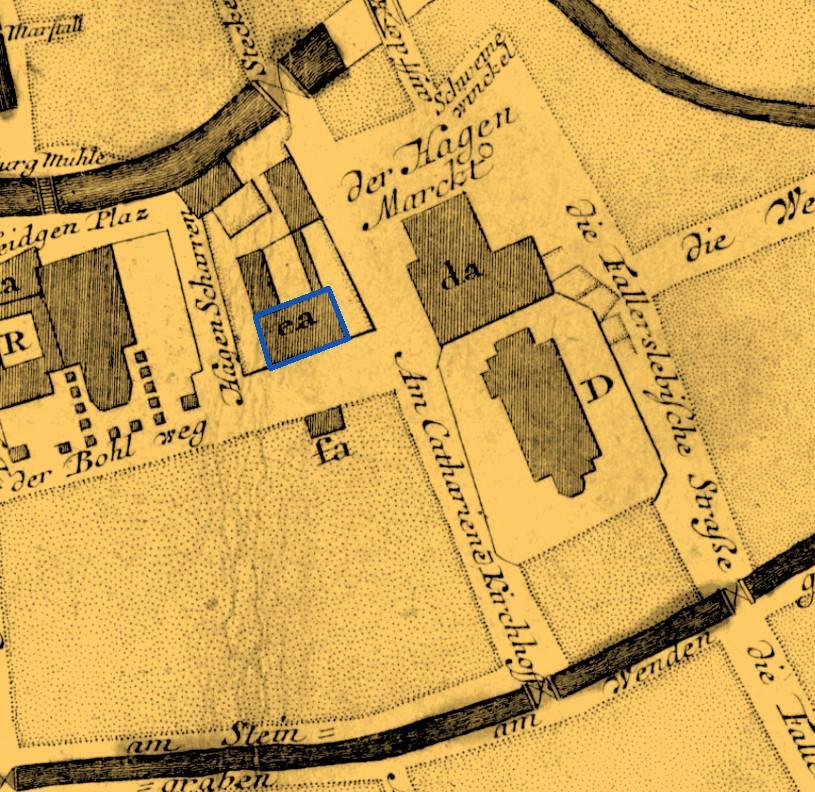
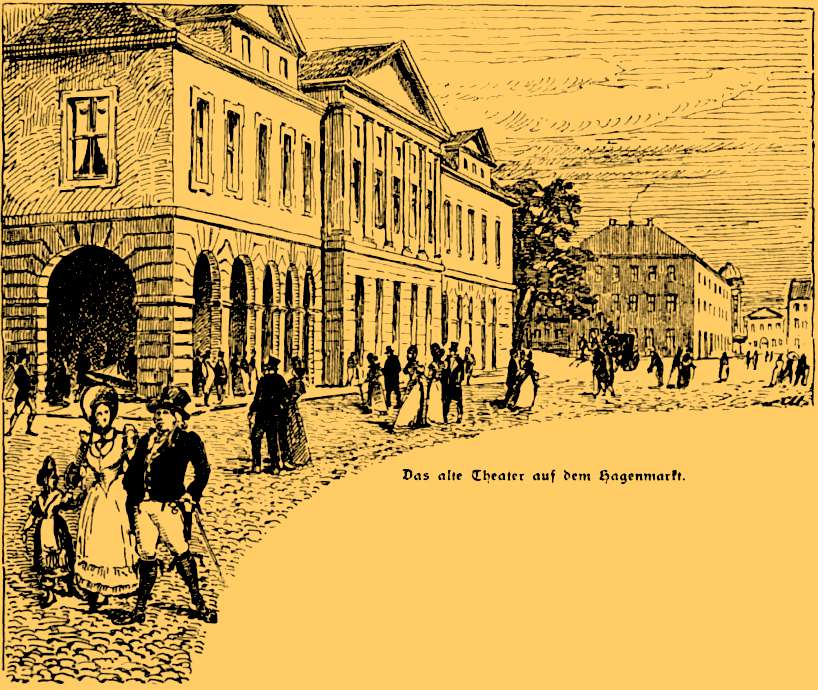
The theater in Braunschweig (labeled “ea” on the map below) that Caroline attended was located on the Hagen Market Square just opposite the Church of St. Catherine (labeled “D” on the map below) in which, significantly perhaps, Caroline and Wilhelm Schlegel would marry on 1 July 1796 (map: M. Counradi, Grundriss der Stadt Braunschweig [Augspurg 17??], Bibliothèque nationale de France; illustration: A. A. Beck, Façade des Opernhauses nach der MittagesSeite [1747]):
Concerning the status of the theater in Braunschweig during the period Caroline lived there, see Adolf Glaser, Geschichte des Theaters zu Braunschweig: Eine Kunstgeschichtliche Skizze (Braunschweig 1861), 75–76 (illustration: Festgabe: Braunschweig “Einst und Jetzt”: dargestellt in Wort und Bild [Braunschweig 1897], 23):
[The company of the previous director] Döbbelin was followed in 1792 by the company of Jean Tilly, which included several quite good players. The small royal theater was torn down at this time and the Italian opera dismissed forever. The Tilly company now performed in the grand Royal Theater on the Hagen Market Square, performing plays, operas, and ballets. Tilly introduced the performances with a word of greeting to the audience and concluded with a farewell speech. All festivals or deaths in the ducal family were celebrated by corresponding prologues or discourses. Wieland’s Oberon had been adapted as a singspiel at the time and set to music by Wranitzky. This operetta enjoyed unusual popularity, and most of its melodies quickly became familiar tunes among the public.
In the following years, up to 1796, Tilly’s company made regular appearances. Performances included a requiem for courageous Duke Ferdinand, the hero of the Seven Years War, and for the first time Don Giovanni by Mozart was performed on 10 March 1793, then Dittersdorf’s Doctor und Apotheker on 4 March 1794, and Mozart’s Magic Flute on 29 April 1794, the latter with great success. Several plays by Iffland and Kotzebue were performed in 1794 along with Dittersdorf’s opera Hieronymus Knicker and the first Viennese Zaubermärchen. Duke Karl Wilhelm Ferdinand’s participation in the military campaigns against France were celebrated by corresponding performances upon his return.
After Tilly died, his wife succeeded him until 1799. Back.
[8] In Iffland’s play Scheinverdienst, the wife of Geheimsecretär (privy secretary) Seefeld. Back.
[9] Latin, “friend” (not Amiens as in Erich Schmidt [1913], 1:358, and Waitz [1871], 2:157). In several scenes, the character of surgeon Rechtler addresses Geheimsecretär Seefeld as Amicus, or “(my) old Amicus. Caroline is assuming, of course, that Luise Gotter is sufficiently familiar with the play to recognize the allusion. Back.
[10] Heinrich, son of Geheimsecretär and Madam Seefeld in Scheinverdienst. Back.
[11] Friedrich Ulrich Schröder, Hamburg theater director (1771–80; 1786–96; 1811–13), did not withdraw from the theater to his estate in Relling outside Hamburg until 30 March 1798. Concerning Schröder’s home as a “gathering place for the very best minds, both foreign and native,” see Caroline’s letter to Friedrich Ludwig Wilhelm Meyer on 7 June 1794 (letter 145). Back.
[12] That is, the Gotter daughters in Gotha, Cäcilie, Julie, and Pauline. Back.
[12a] Christian Gotthilf Salzmann, Moralisches Elementarbuch, vol. 1 (Vienna 1794), plate 9:
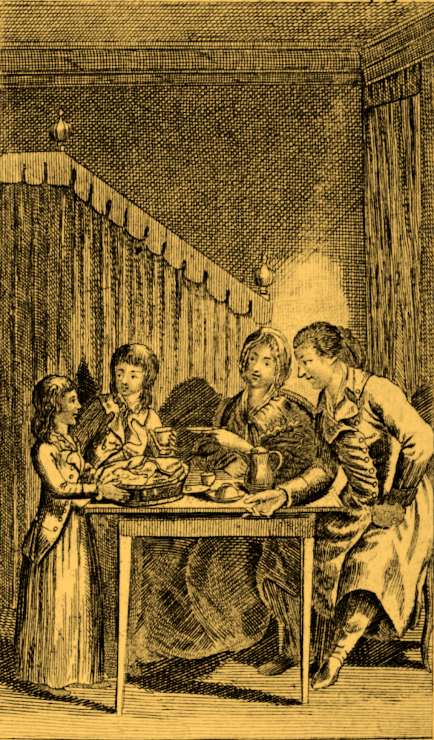
[13] Illustration from Daniel Nikolaus Chodowiecki, Kupfer zu Herrn Professor Salzmanns Elementarwerk nach den Zeichnungen Herr Daniel Chodowiecki, nos. 1, 2 (Leipzig 1787), plate xxx:
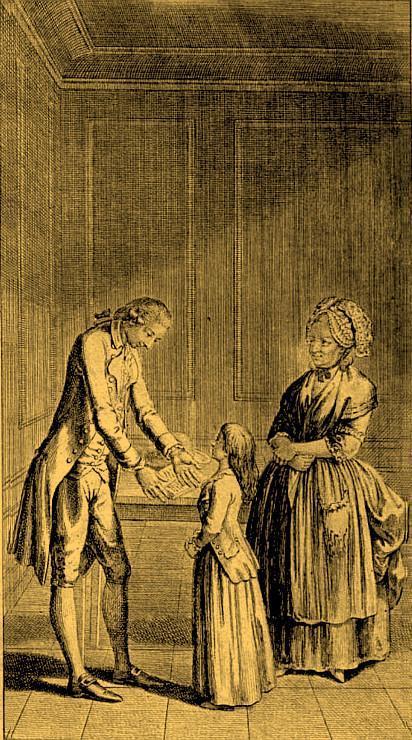
The Eschenburgs had the following other children besides Louise (the daughter referenced here): Wilhelm Arnold (1778–1861); Johanna Elisabeth (1780–81); a stillborn daughter (1781); Carl Hartwieg Friedrich (1784–1851); and Ferdandine (1790–1874) (Bernhard Koerner, ed., Genealogisches Handbuch Bürgerlicher Familien, ein Deutsches Geschlechterbuch, vol. 11 [Berlin 1904], 329–30). Back.
[13a] Samuel Richardson, Pamela, oder die belohnte Tugend, vol. 2 (Leipzig, Liegnitz 1772), following p. 424:
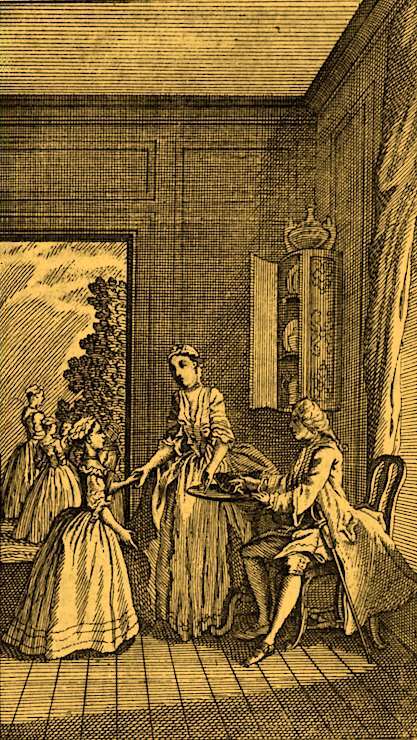
Quite apart from provenance (English school), although several engravings of John the Baptist and the evangelist John depict these men in their youth, Auguste was but ten years old at the time, i.e., neither a young woman yet nor still an infant.
The following mezzotint print (prior to 1768) from the English school by Valentine Green is possibly, even likely the very print that Johann Joachim Eschenburg showed to Caroline in Braunschweig. Many of Green’s original prints were part of the Düsseldorf Art Gallery’s collections, for which, while in Germany, he had obtained a privilege to provide eighty pieces in the style of “mezzo tinto” of works in that collection.
This print depicts a child close to Auguste’s age group and arguably also resembles her in appearance (e.g., eyes, mouth) based on her portrait by Tischbein five years later.
It is, moreover, owned by the Herzog Anton Ulrich-Museum in Braunschweig, which acquired the original prior to 1878, possibly (even likely, though not demonstrably) from the estate of Eschenburg himself, who died in Braunschweig in 1820 and is also buried there (Valentine Green [engraver] after Bartolomé Esteban Murillo [painter], St. John the Baptiste [London after 1759], English school; Herzog Anton Ulrich-Museum; Museums./Signatur Green AB2.57); at the bottom of the print (not shown here), one reads “From the Original in the Possession of the Honorable Thomas King Esq.” (see below):
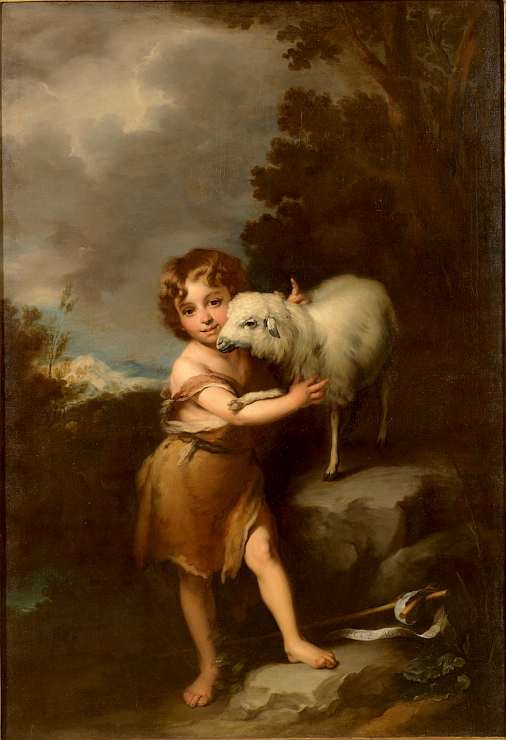
And here for comparison the original oil after Bartolomé Esteban Murillo,The Infant Saint John the Baptist with a Lamb, originally acquired by William King, 4th Lord King, Baron of Ockham, in 1734, and afterward in possession of his brother Thomas King, 5th Lord King, 1768, as also indicated at the bottom of Green’s print:
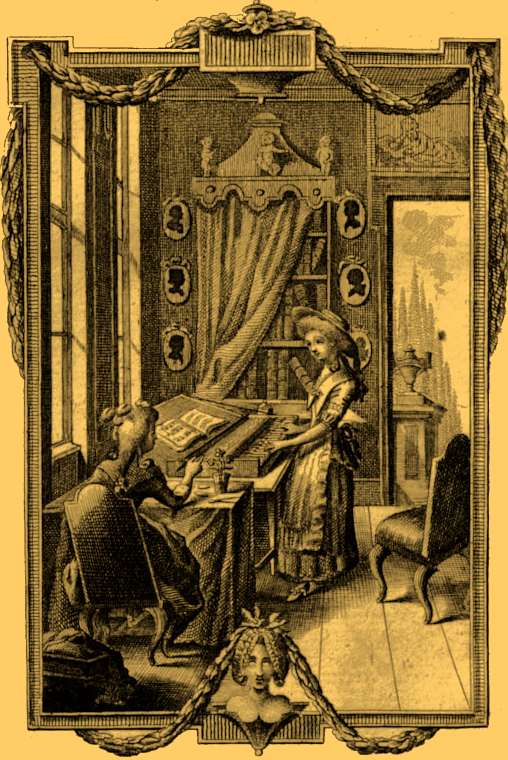
[14] What Caroline describes in these paragraphs is essentially the courses of instruction and training that bourgeois daughters ideally might receive and in which Auguste herself was now engaged (Das geöffnete Schreibepult zum Unterrichte und Vergnügen junger Personen 6 [no year]):
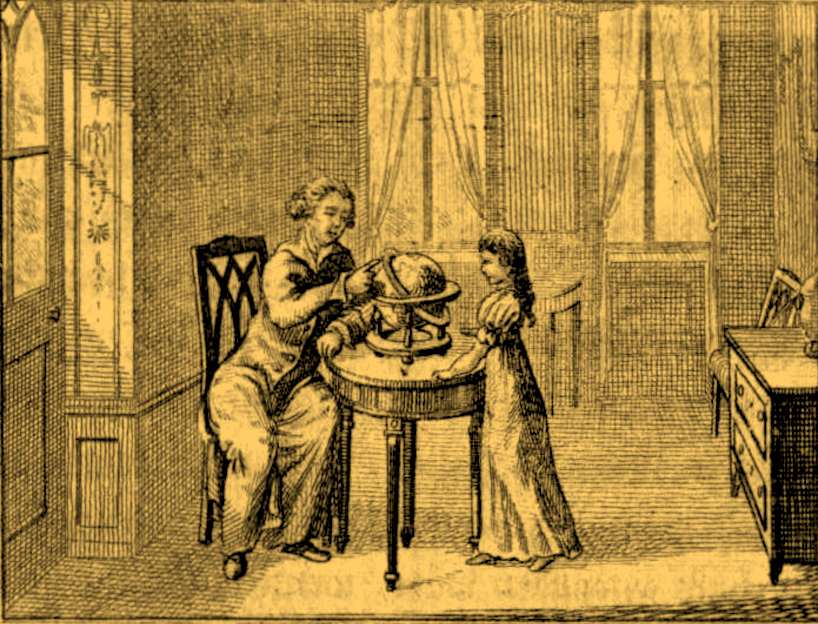
See esp. the frontispiece to Andreas Meyer, Wie soll ein junges Frauenzimmer sich würdig bilden? (Erlangen 1786), a treatise on “how a young lady might be suitably cultivated”:
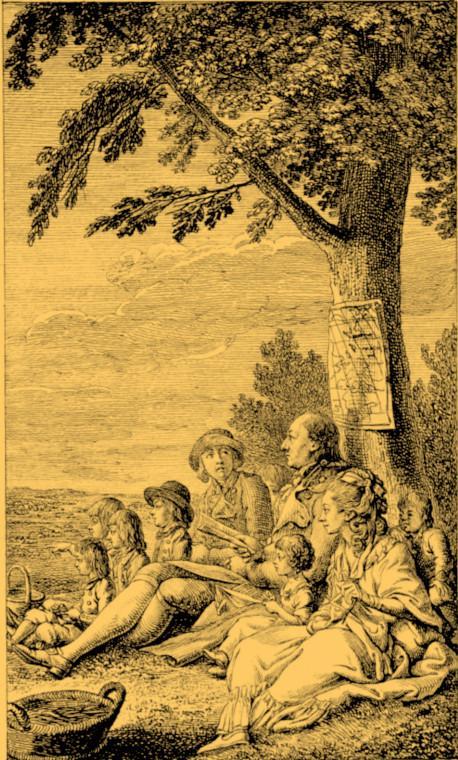
Johann Joachim Campe could contribute to her reading material his novel Robinson der Jüngere. Ein Lesebuch für Kinder, 2 vols., (Braunschweig 1779–80), which included children’s dialogues, as well as other materials. Here the frontispiece to vol. 1 (1779) by Daniel Nikolaus Chodowiecki; the author sits with his family (note the map on the tree; also repr. Herzog August Bibliothek; Museums./Signatur Chodowiecki Sammlung 3-165):
[15] Concerning the Campes’ lovely garden just outside Braunschweig, see Luise Wiedemann, née Michaelis’s account in her Erinnerungen, p. 42, esp. with note 74. Back.
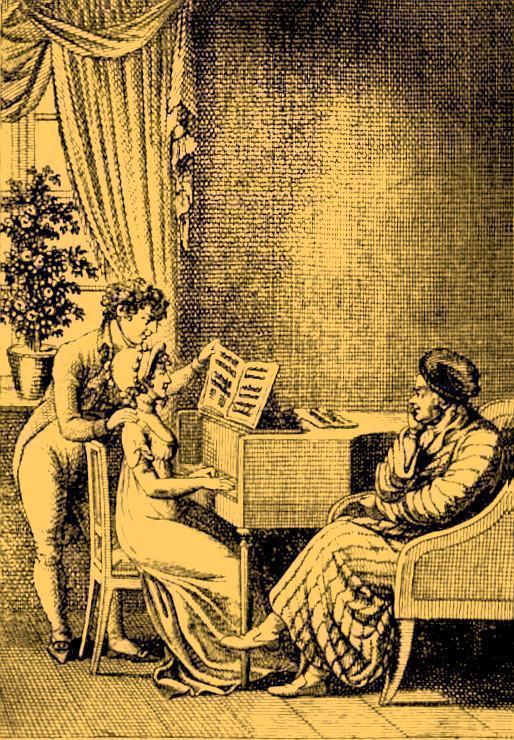
[16] The young wife in the following illustration similarly plays for other family members (Berlinischer Damen-Kalender auf das Jahr 1805; Inhaltsverzeichnis deutscher Almanache, Theodor Springmann Stiftung):
Concerning the piece: Caroline had recently — in the second instance: very recently — read the two volumes of Goethe’s novel in which these pieces appear (see note 2 above). The “romance” is the harpist’s song, “Was hör’ ich draussen vor dem Tor,” from Goethe’s Wilhelm Meisters Lehrjahre. Ein Roman, 4 vols. (Berlin 1795–96), book 2, chapter. The other song is known as “Mignon’s Song,” “Kennst du das Land, wo die Zitronen blühn”; it begins book 3, chapter 1 in Wilhelm Meisters Lehrjahre. Ein Roman.
Because these volumes had only just appeared, one can assume that Caroline is referring to the musical inserts included in this first edition of the novel (but not later) by Johann Friedrich Reichardt (see Terence Cave, Mignon’s Afterlives: Crossing Cultures from Goethe to the Twenty-First Century [Oxford 2011], chap. 6). That is, the lyrics to these songs had not previously been set to music, so instead of leaving it to the reader’s imagination, musical settings for the songs were included for the first edition as follows, all compositions by Reichardt:
- Book (vol.) 1, chaps. (books) 1/2 (1795): 3 musical inserts: “Was hör ich draussen vor dem Tor,” “Wer nie sein Brodt mit Thränen ass,” “Wer sich der Einsamkeit ergiebt”;
- Book (vol.) 2, chaps. (books) 3/4 (1795): 2 musical inserts: “Kennst du das Land?,” “Nur wer die Sehnsucht kennt”;
- Book (vol.) 3, chaps. (books) 5/6 (1795): 2 musical inserts: “Heiss mich nicht reden,” “Singet nicht in Trauertönen”;
- Book (vol.) 4, chaps. (books) 7/8 (1796): 1 musical insert: “So lasst mich scheinen.”
Although a composition of Mignon’s song was published the following year by Karl Friedrich Zelter in 12 Lieder am Clavier zu singen (Z.120) (Berlin and Leipzig, n.d. [1796]), no. 12, Caroline is doubtless thinking of having Auguste learn the melodies with which Caroline herself and presumably now Auguste as well had already become familiar from this first edition.
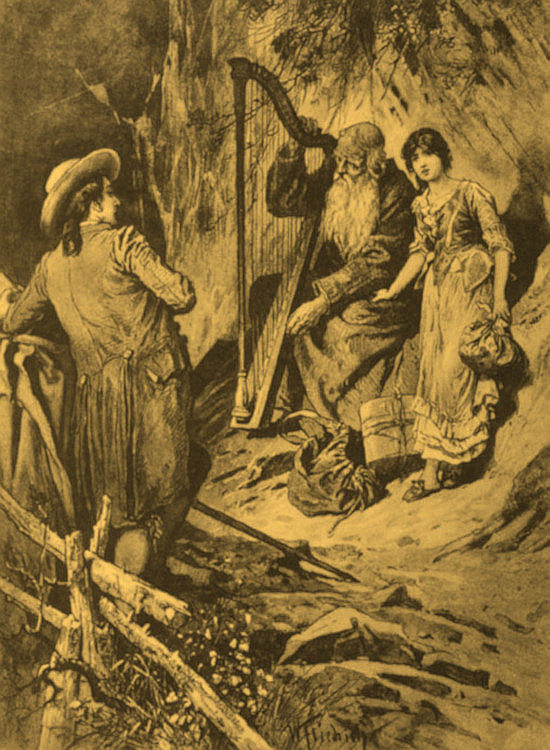
Here a portrayal of Wilhelm Meister encountering the harpist and Mignon in the novel (eary postcard):
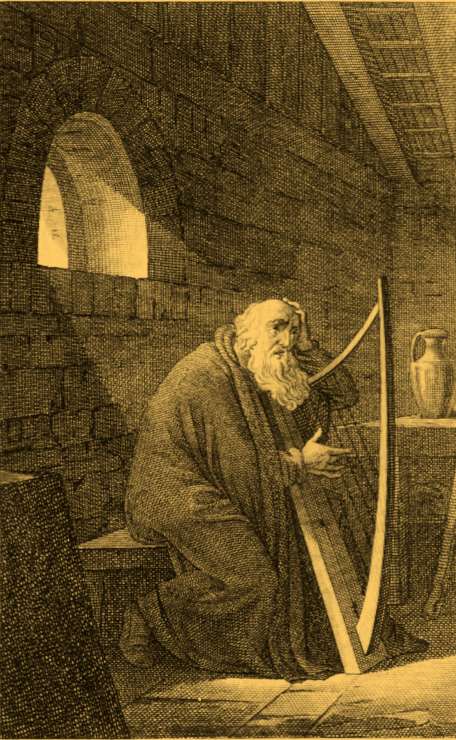
Here the harpist’s song, Wilhelm Meister’s Apprenticeship. A Novel from the German of Goethe, trans. R. Dillon Boylan (London 1867), 115–16 (illustration: Taschenbuch für 1799 [Berlin]; Inhaltsverzeichnis deutscher Almanache, Theodor Springmann Stiftung):
"What sounds are those which from the wall,
  And o'er the bridge I hear?
Those strains should echo through this hall,
  And greet a monarch's ear."
So spake the King — the page retires —
His answer brought, the King desires
  The Minstrel to appear.

Hail, Sire! and hail each gallant knight!
  Fair dames, I greet ye well!
Like Heaven, this hall with stars is bright,
  But who your names may tell?
What matchless glories round me shine!
But 'tis not now for eyes like mine
  On scenes like these to dwell.

The Minstrel raised his eyes inspired,
  And struck a thrilling strain,
Each hero's heart is quickly fired,
  Each fair one thrills with pain:
The King, enchanted with the Bard,
His magic talent to reward,
  Presents his golden chain.

O! deck me with no chain of gold,
  Such gift becomes the knight,
Before whose warrior eyes so bold,
  The rushing squadrons fight,
Or let the glittering bauble rest
Upon your Chancellor's honoured breast —
  He'll deem the burden light.

I sing but as the young bird sings,
  That carols in the tree,
The rapture of the music brings
  Its own reward to me.
Yet would I utter one request —
That of your wine — one cup — the best,
  Be given to-day by thee.

The cup is brought — the Minstrel quaffed;
  He thrills with joy divine —
Thrice happy home, where such a draught
  Is given — and none repine!
When fortune smiles, then think of me,
And thank kind Heaven, as I thank thee,
  For such a cup of wine.
Here the music from J. F. Reichardt, Goethe’s Lieder, Oden, Balladen und Romanzen mit Musik, part 2, Vermischte Gesänge und Declamationen (Leipzig n.d. [1809]), 52 (Reichardt has given the tune the title “Der Sänger”):
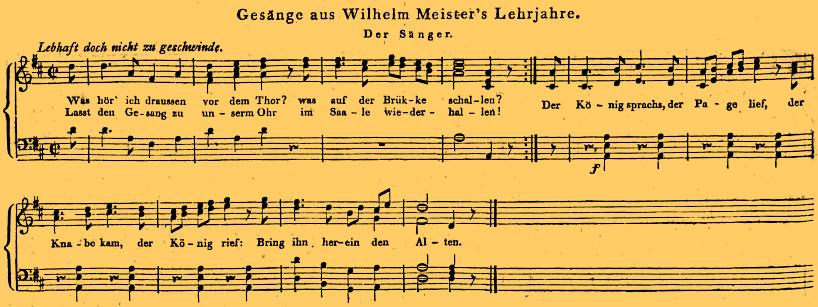
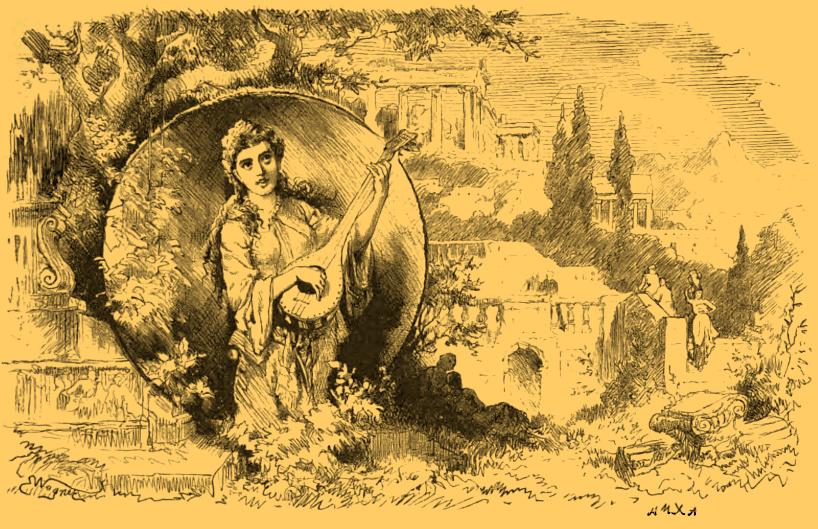
Here “Mignon’s Song,” “Kennst du das Land, wo die Zitronen blühn,” Wilhelm Meister’s Apprenticeship. A Novel from the German of Goethe, 130 (illustration: Goethe’s Works, ed. Hjalmar Jhorth Boyesen [Philadelphia 1885], vol. 4, plate following p. 143):
Know'st thou the land where the lemon tree blows —
Where deep in the bower the gold orange grows?
Where zephyrs from Heaven die softly away,
And the laurel and myrtle tree never decay?
Know'st thou it? Thither, oh! thither with thee,
My dearest, my fondest! with thee would I flee.

Know'st thou the hall with its pillared arcades,
Its chambers so vast and its long colonnades?
Where the statues of marble with features so mild
Ask, "Why have they used thee so harshly, my child?"
Know'st thou it? Thither, oh! thither with the,
My guide, my protector! with thee would I flee.

Know'st thou the Alp which the vapour enshrouds,
Where the bold muleteer seeks his way thro' the clouds!
In the cleft of the mountain the dragon abides,
And the rush of the stream tears the rock from its sides;
Know'st thou it? Thither, oh! thither with thee,
Leads our way, father — then come, let us flee.
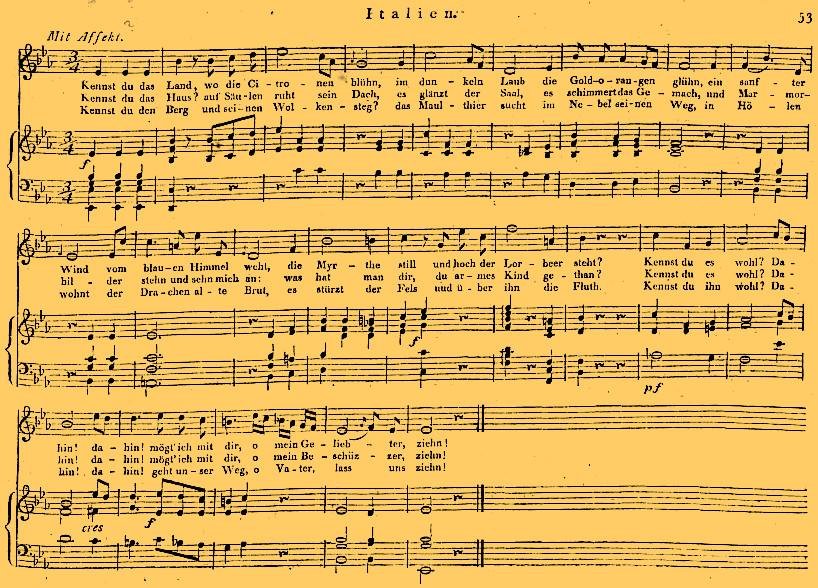
Here the music from J. F. Reichardt, Goethe’s Lieder, Oden, Balladen und Romanzen mit Musik, part 2, 53 (Reichardt has given the tune the title “Italien”; on the original musical insert in Wilhelm Meisters Lehrjahre, the lead part is written on the soprano clef):
Compare the initial lines of Byron’s “The Bride of Abydos”:
Know ye the land where cypress and myrtle
Are emblems of deeds that are done in their clime,
Where the rage of the vulture, the love of the turtle,
Now melt into sorrow, now madden to crime?
Know ye the land of the cedar and vine,
Where the flowers ever blossom, the beams ever shine;
Where the light wings of Zephyr, oppress'd with perfume,
Wax faint o'er the gardens of Gъl [the rose. ] in her bloom;
Where the citron and olive are fairest of fruit,
And the voice of the nightingale never is mute etc. Back.
[17] Namely, Wilhelm Meisters Lehrjahre. Ein Roman, volume 2, which had just appeared. Back.
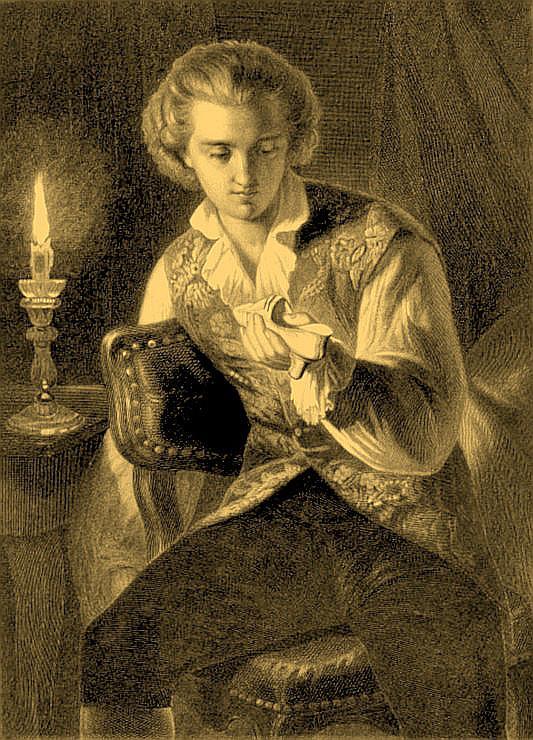
[18] The protagonist in Goethe’s novel Wilhelm Meisters Lehrjahre is frequently (indeed, according to Erich Schmidt [1913], 1:707, really too frequently) referred to as “our friend” (illustration from Goethe-Galerie. Charaktere aus Goethe’s Werken. Gezeichnet von Friedrich Pecht und Arthur von Ramberg [Leipzig 1864]):
[19] Wilhelm Meisters Lehrjahre, vol. 2, book 4, chapter 20, trans. from Wilhelm Meister’s Apprenticeship. A Novel from the German of Goethe, trans. R. Dillon Boylan (London 1867), 258; translation altered to read “of the Germans,” as in the original, rather than Boylan’s “of our nation.” Back.
[20] Beginning in 1795, Friedrich Ludwig Wilhelm Meyer (the “silent friend”) functioned as a managing editor of the Berlinisches Archiv der Zeit und ihres Geschmacks (Berlin 1795–1800) (ed. 1795–97 by Friedrich Ludwig Wilhelm Meyer and Friedrich Eberhard Rambach; July 1797–99 by Rambach alone, Meyer having retired to his estate outside Hamburg; and from 1799–1800 by Rambach and Ignatz Aurelius Fessler), contributing intelligent and well-written literary surveys, though also prompting Goethe’s manifest “Literarischer Sansculottismus,” Die Horen 2 (1795), no. 5, 50–56; see also Friedrich Schlegel’s letter to Caroline in late April 1799 [letter 236]). Back.
[21] Considering this piqued remark about Meyer (otherwise without parallel), perhaps it is no surprise that Caroline’s letter to Meyer from Gotha back on 30–31 August 1794 (letter 147) is the last extant letter to him in her correspondence. Back.
Translation © 2011 Doug Stott