
• 147. Caroline to Friedrich Ludwig Wilhelm Meyer in Berlin: Gotha, 30–31 August 1794
Gotha, 30 [–31] August, [17]94
|347| You did not insult me, I am not angry with you, and I did want to write you, but I remained silent that you might complete your mineral-springs cure in peace, since I initially did have a great many personal, pointed things to tell you and, frankly, was hoping my audacity would have annoyed you.
I then also wanted to be able to tell you something certain, the absolutely most recent, certain certainty, and not make you have to travel around continually from south to north etc. nor trouble yourself further in so excellently denigrating even more countries and republics such that one would not dare eat even a single bit of bread there. Not that I would not like reading such — you are indeed an infinitely ingenious, entertaining Smelfungus! [1]
Although America would have made great sport for you, France would have constituted your greatest triumph, for what wit would it have taken to rob the banks of the Garonne of their charm, [2] or to deny the beneficent influence on a delicate constitution of those regions where one does not languish from the heat, and where on New Year’s Eve a gentle rain rustles the leaves of the orange trees. And finally — I also remained silent in order to test you — it is, I believe, the first time you |348| have ever directed a second letter to me. The events that have happened to me in the meantime, however, cannot be subsumed under the rubric of such causes, since nothing can happen to me that might make me forget and neglect you.
Tomorrow morning, before this letter is on its way, I will know where I will be in 6 or 8 weeks — that is, whether I can already be in Dresden around that time. One problem is the initial sum of cash I will need to get established — and which my mother, who is being held off intolerably by the person who purchased my family’s house, was unable to pay out to me. [3] She is currently trying to secure it elsewhere, and I am hoping tomorrow’s mail will bring a favorable response.
That Holland might have become a French département, since the incomparable Mack has retired and the shameful Pichegru has implemented all his plans down to the last detail, [4] would admittedly have been enormously attractive to me except that I detest every possible form of fog. [5]
So after considering everything carefully, my plans are still focused on Dresden. Your virgin of Djinnistan, [6] whom I am wont to call the “bearded virgin,” along with her entourage, [7] were the only people who could oppose me there — in order for them not to do such, I need only ignore them — for I must confess that your knowledge of human nature, O thou so wise in the ways of the world, is too lofty for me to rely on or for me to believe that a woman is truly capable of good who, when she was almost 30 years old, accepts promises from someone who was but 19 or 20 years old and then, in her 40th year, becomes so hostile when those promises are broken. [8] Your information, your views are from yesterday — mine are from today. But fine — if it is better — then fine if I never learn any more about it than I know now.
By contrast, the sister has not demanded a revers [9] from me, |349| which, as you point out and as I also believe, I could easily provide. She did everything in her power — after receiving a letter from her brother telling her of my intentions, she first wrote to me and offered her services, and if I do not forget to do so, I will enclose the first page of her second letter here. [10]
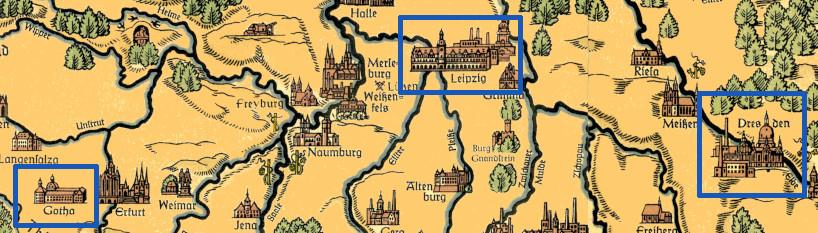
If I can plan on spending the winter there, I will begin with the town itself and not move out to the countryside until summer. [10a] But I doubt I will be able to travel before the end of October — that was the same time you were at the book fair last year. If you have not flattered me in vain, then we can still see each other, though likely in Dresden, since I am disinclined to linger in Leipzig — I am not certain enough of myself to be sure I would not be so foolish as to try to see my son, and doing so would betray me. I must hasten past there. You are in a better position than I to judge whether it might be possible to meet you in Leipzig, and whether you might then accompany me on to Dresden. Perhaps Gotter will take me as far as Leipzig. [10b] If anyone were to learn of it, then it would probably not be proper — but does anyone have to know?
I have resolved that in the future I will always ask you for advice when I intend to undertake anything that is not quite proper; I am familiar with the morality and laws of propriety of the virtuous — now I would like to investigate the pure morality of the godless as well. Your own seems strict enough — for as far as I can see, it has condemned me henceforth to the sacred fire — no — not that I might be incinerated therein, but that I might entertain it, of course. In any event, that is how I interpret at least one passage in your letter in which you mention hopes whose fate has already been irrevocably decided. And how could I contradict you?
But I would indeed like to hear your entire opinion concerning this part of my future. I hope I will soon be rationalizing about this as a grandmother |350| — for I am already no longer allowing you to embrace my daughter except through me — at the end of letters. She is an amiable, gracious, shy creature. When Gotter says to her, “Bring me a glass of water, Fräulein Isabelle,” she blushes with such a gentle glow, as if wrapped in a flowing pink veil. It is a shame she will be with me when we travel together to Dresden, since otherwise I could tell you much about her heavenly simplicity, her worldly wisdom, about everything she knows and does not know. She is certainly an extraordinarily interesting creature, and I believe she is receiving precisely the kind of cultured training this material needs.
I have seen a great many people again — my mother was here with Louise and Lotte’s child, who is an angel — she looks like both her father and her mother, not just like Lotte. [11] And she has heavenly eyes — a kind of dark blue. She is very lively, the little dear. Can she but keep from being ruined before she has a chance to become good. My mother is still keeping her for now. [12] —
It was only at my mother’s counsel that I took heart and accompanied them to Göttingen. [13] People received me there much better than I had expected. — The Böhmer family was very kind, even Philippine. [14] The two Meiners were infinitely cordial — as were all the others as well, the Schlözers, Feders etc. Meiners promised to commend me to Müller in Leipzig with regard to my stay in Saxony. I profited greatly from this trip — the Böhmers were able to see Gustel again, and I — also profit when one sees me. Now one can also no longer say that I am “estranged” from the Böhmers.
Here people remain basically the same — though I have been able to conquer this or that individual person anew, and perhaps when all is said and done there will be no one left with whom I have not spoken except — the |351| two sisters. [15] You might yet have found Amalie in Karlsbad; she is not yet back. And why have you not gone to the true healing spring? [15a]
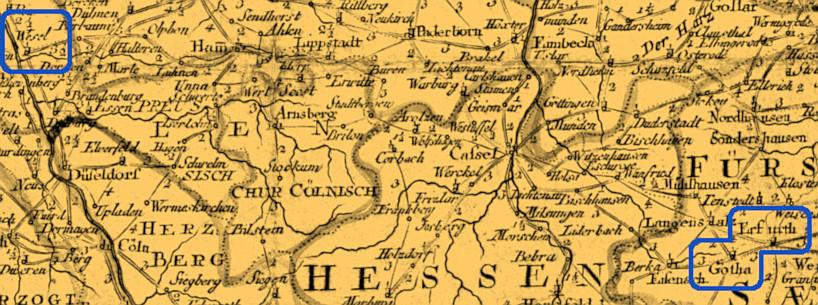
One more thing gave me inexpressible joy — my uncle, or my son’s great uncle, passed through here. [16] The remaining French hostages were taken from Wesel to Erfurt. [16a] I was able to see this excellent man again — you would worship him yourself if you knew him. I have never felt as tender toward his nephew as I did toward him. We spoke at Madam Schläger’s as we had arranged earlier — he stayed from that morning till the evening. Finally, a favorable bit of chance.
If I see you again, it will be a result of our reasonable will. See to it that it remains yours as well. I will wait until then to really laugh at you; and as a reward for your most politely allowing me such, I will then also relate much to you about which you in your own turn will laugh. But you do still laugh, do you not? Ah, but if you no longer could, how ashamed you would then be in the face of my insuperable levity, which is nothing more than my indefatigable goodness.
I recently had a souper at Minchen’s with the Library of the Fine Arts, Manso from Breslau at the head. I shall tell you more about it in person. You are right in what you told me about Sch[legel?] and G[öschen?] and which you have now presumably forgotten. We never received your Burg, [17] though we did read a certain Kunst der Liebe, of which we are firmly convinced you are the author [18] — whence all your previous secrecy, namely, that you are never where one suspects you will be and doubtless also never go to where you have announced you will be. I only want to see whether you will be journeying to see me! Good night.
|352|
31 August
I still know nothing for certain — I will relate it to you as soon as I myself know. Having to wait is trying the entire breadth of my patience. The Gotters send their regards and love.
Notes
[1] Smelfungus is a kind of itinerant professional fault-finder alongside Mundungus in Laurence Sterne’s A Sentimental Journey through France and Italy by Mr. Yorick, 2 vols. (London 1768), specifically in the chapter “In the Street. Calais.” The allusion is to Tobias George Smollett as the author of Travels through France and Italy. Containing observations on character, customs, religion, government, police, commerce, arts, and antiquities etc. (London 1766), in which Smollett engages in expansive, myopic, and indignant criticism at every step; see, e.g., Sentimental Journey, 1:86–88 (illustration: Laurence Sterne, A Sentimental Journey through France and Italy. With 100 illustrations by Tony Johannot [London 1857], 49):
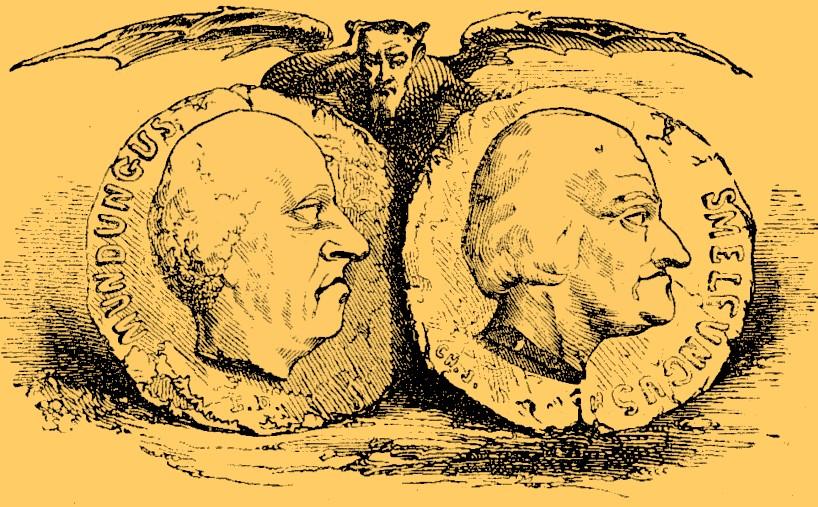
The learned Smelfungus traveled from Boulogne to Paris — from Paris to Rome — and so on — but he set out with the spleen and jaundice, and every object he pass’d by was discoloured or distorted — He wrote an account of them, but ’twas nothing but the account of his miserable feelings.
I met Smelfungus in the grand portico of the Pantheon [in Rome; see Smollett’s letter xxxi of 5 March 1765] — he was just coming out of it — ‘Tis nothing but a huge cock-pit, said he — I wish you had said nothing worse of the Venus of Medicis, replied I — for in passing through Florence, I had heard he had fallen foul upon the goddess and used her worse than a common strumpet, without the least provocation in nature. [See Smollett’s letter xxvii of 28 January 1765: “Others suppose, not without reason, that this statue is a representation of the famous Phryne, the courtezan of Athens, who, at the celebration of the Eleusinian games, exhibited herself coming out of the bath, naked, to the eyes of the whole Athenian people.”]
I popp’d upon Smelfungus again at Turin, in his return home; and a sad tale of sorrowful adventures had he to tell, “wherein he spoke of moving accidents by flood and field, and of the cannibals which each other et: the Anthropophagi” — he had been flea’d alive, and bedevil’d and used worse than St. Bartholomew, at every stage he had come at —
— I’ll tell it, cried Smelfungus, to the world. You had better tell it, said I, to your physician.
For a quite different take on Phryne, see Caroline’s letter to Friedrich von Hardenberg on 20 February 1799 (letter 222), note 11. Back.
[2] The “banks/shores of the Garonne [river]” in southwestern France near Bordeaux as a reference pars pro toto to France derives from Christoph Martin Wieland, Oberon, ein Gedicht in 14 Gesängen (Frankfurt, Leipzig 1780) (Der Teutsche Merkur [1780] 1. Vierteljahr, 155 unpaginated pages), cantos 1:20, 4:20, and 6:14 (La France commerçante [1791]; Bibliothèque nationale de France):
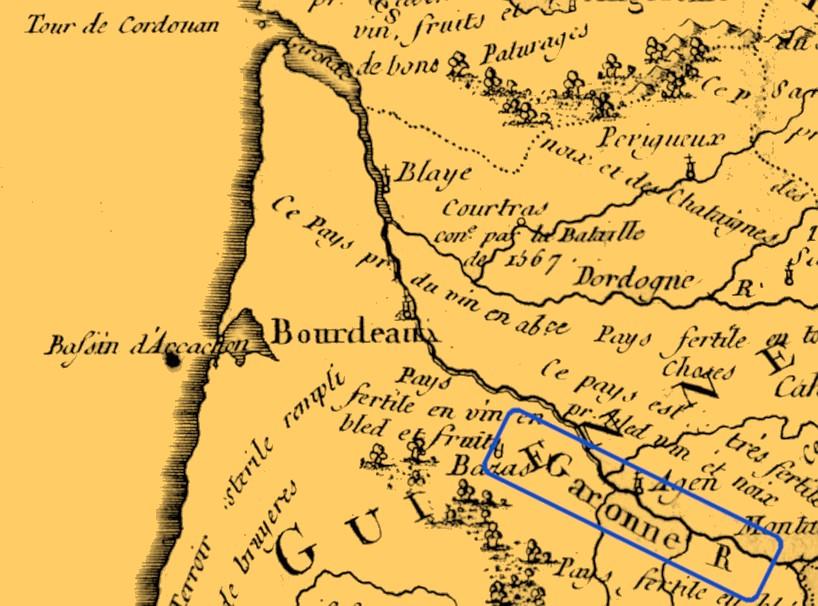
Translation here from Oberon. A Poem, trans. William Sotheby, 2 vols., 2nd ed. (London 1805), 1:11, 111, 186; Caroline’s expression added where the original translation merely paraphrases:
Canto 1:20
The knight, undaunted at his savage dress,
Club, and rough beard, and all that met his view,
In mother speech, no other speech he knew,
Begins the story of his sad distress.
"What hear I?" as his voice the woodman hears,
While down his hairy cheek stream joyful tears;
"Oh, mother tongue! oh, sweet melodious sound
[from the banks of the Garonne]!
Full sixteen years the sun has journey'd round,
Nor has thy note, till, now, e'er charm'd my longing ears."
Canto 4:20
While thus the knight, by many a danger won,
Clasps in his arms the visionary bride,
The old man from Euphrates' flowery side
Strays imperceptibly to [the banks of the] sweet Garonne.
He sees once more those lovely plains expand,
Where the first flow'ret lur'd his infant hand:
No where, he thinks, the sun so mildly gleams
As on the banks where first he drank its beams:
So green no other mead, so smiles no other land!
Canto 6:14
And as illimitable scenes expand,
And their enchanged eyes the waves pursue
Where the blue ocean melts in air from view,
Huon begins to praise his native land:
"How sweet her lovely scenes! her sons how gay!
From east to west th' all-seeing eye of day
That lights the vast creation, smiles on none
No spot so charming as his dear [banks of the] Garonne."
All this his liegeman swears, and echoes back the lay.
The expression also occurs in Schiller’s early poem to Rousseau (“Rousseau”), stanza 5 (Schillers sämmtliche Schriften, Historisch-kritische Ausgabe, vol. 1, Jugendversuche, ed. Karl Goedeke [Stuttgart 1867], 221; here freely rendered):
"New and singular — an errant sun
You stood on the banks of the Garonne
Meteorically for the French mind. Back.
[3] The purchaser of the house was Otto Justus Arnemann, from 1792 full professor of anatomy and surgery in Göttingen, who eventually incurred so much debt that he had to flee the town in 1802. Concerning the sale and the history of the house, see Caroline’s letter to Meyer on 10 May 1794 (letter 144) with note 7. Back.
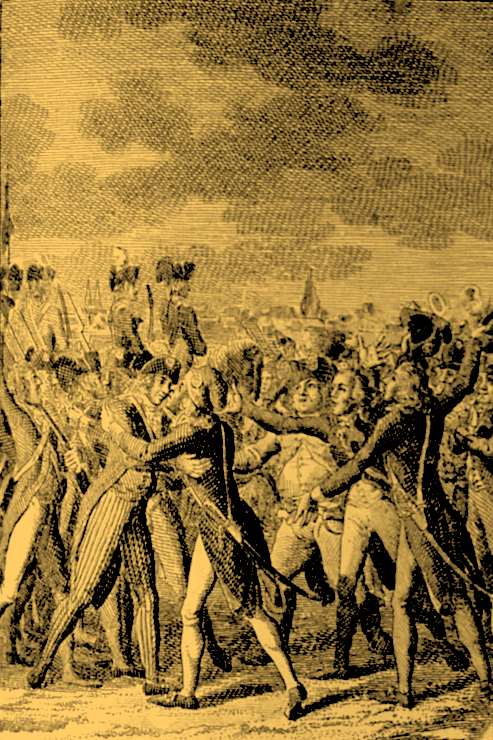
[4] Jean-Charles Pichegru had defeated the Austrian army at the Battle of Fleurus, southeast of Brussels, on 27 June 1794; the French victory in this overall battle prompted a full Allied withdrawal from Belgium and allowed French forces to push north into the Netherlands. Here the jubilant reception of the French army in Amsterdam by the local Republican party on 19 January 1795, an event Wilhelm would have experienced (Taschenbuch für die neuste Geschichte [1796]; Inhaltsverzeichnis deutscher Almanache, Theodor Springmann Stiftung):
Major General Karl Mack von Leiberich fell from favor after the Allied defeats in 1794 were in part attributed to his antiquated military strategy, whereas the French had engaged an observation balloon to considerable advantage at Fleurus (illustration: Le Beau and Thomas Naudet, Bataille de Fleurus gagnée par l’Armée Française le 8 Messidor de l’An 2, 1794; Smithsonian; text: Colonel N. M. Smyth, “The Air Service in the Time of Napoleon,” The Cavalry Journal (1913), no. 8 (January to October, 1913), 491–92, here 492):
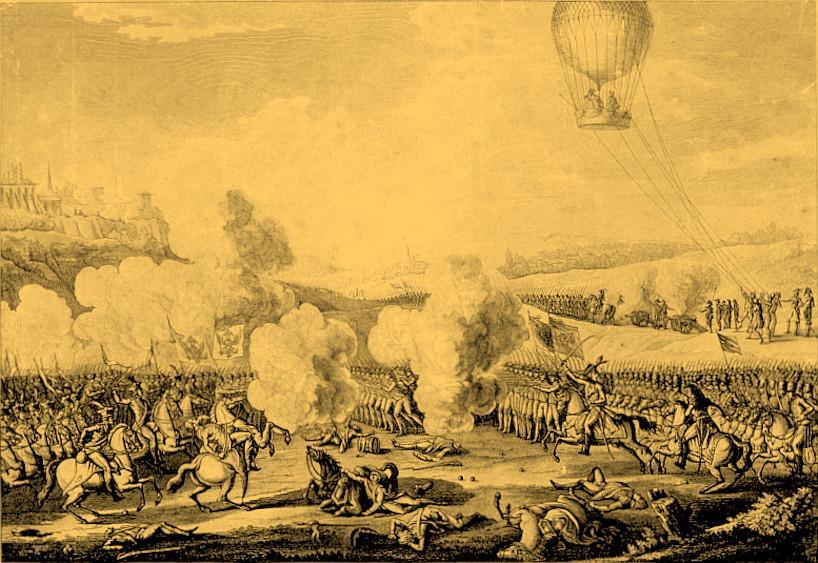
[Jean] Coutelle practised ascents, during which he remained from seven to ten hours in the air, and at the Battle of Fleurus, on June 26, 1794, he contributed to the success of the French arms. Taking as passenger Adjutant-General Morlot, he ascended to a height of nearly 1,000 feet, and by a system of visual signals was able to maintain constant communication with General Jourdan, transmitting information as to the strength, dispositions, and manoeuvres of the Austrian army. He repeatedly moved his position with the assistance of sixty-four soldiers manning the six guy-ropes, in spite of the strength of the wind, which blew in gusts at thirty miles an hour. One of the stays attaching the basket to the balloon was cut by bullets twice in succession, but the balloon remained for ten hours at work, even drifting over the hostile line of battle.
During the course of the campaign two ascents were made daily for purposes of reconnaissance in all weathers, and frequent extended expeditions were accomplished. Back.
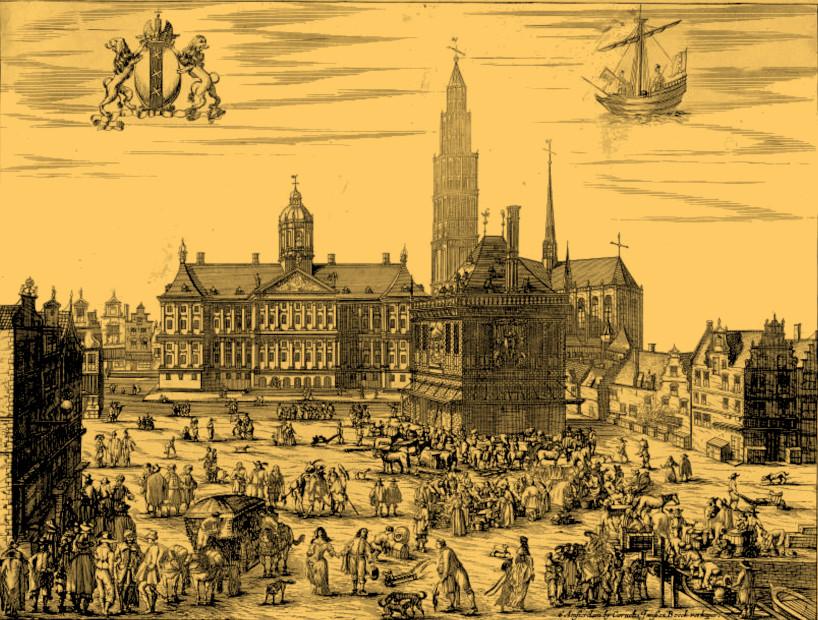
[5] Wilhelm Schlegel was still working in Amsterdam, here at the end of the seventeenth century (Johan Teyler, Ansicht des Dam in Amsterdam mit dem neuen Rathaus [1665–70]; Herzog Anton Ulrich-Museum; Museums./Signatur GValck Verlag AB 3.84):
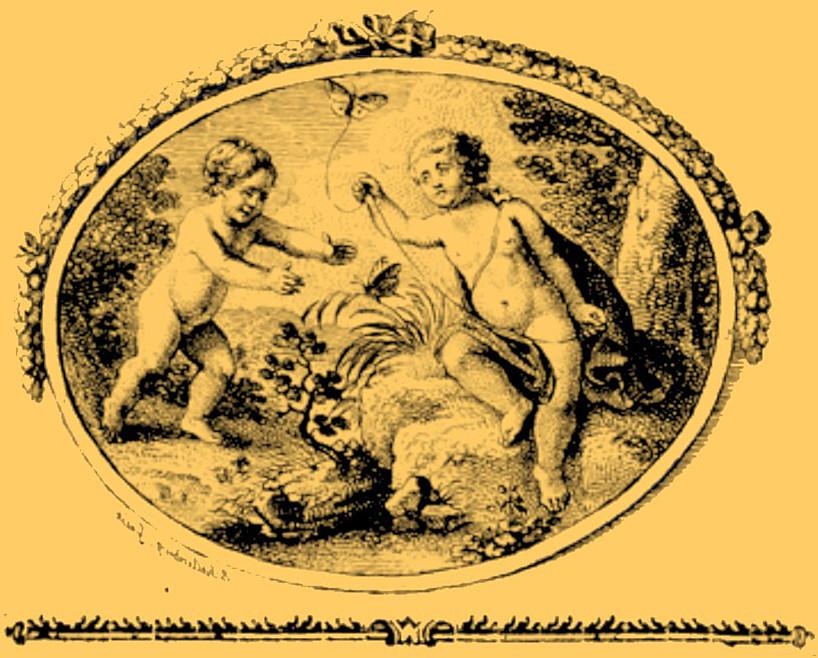
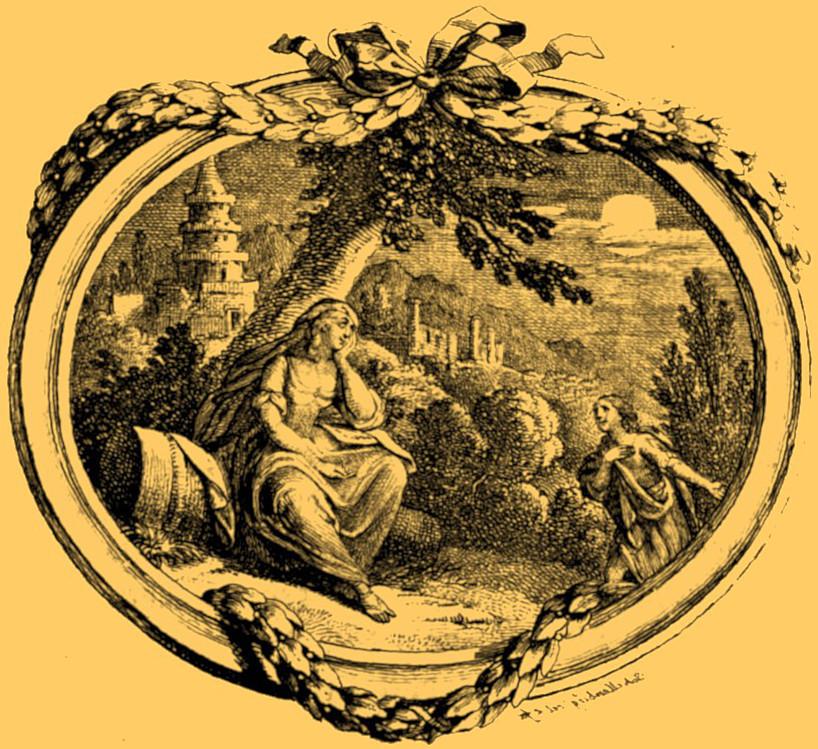
[6] Erich Schmidt (1913), 1:706, suggests the reference is to Dora Stock, and indeed, she was yet unmarried. In any event, the Djinnistan-allusion is to Christoph Martin Wieland, Dschinnistan; oder, Auserlesene Feen- und Geister-Mährchen, theils neu erfunden, theils neu übersezt und umgearbeitet (Winteruhr 1786–89), in which Dschinnistan itself represents an Arkadian, fairy-tale land. Caroline’s allusion may be to a maidservant character or to a virgin who plays a prominent role in vol. 2 in the story “Der Druide, oder die Salamandrin und die Bildsäule,” 2:61–145. Here the title vignette to vol. 1 and the vignette accompanying “Der Druide, oder die Salamandrin und die Bildsäule” in vol. 2:
[7] If the reference is indeed to Dora Stock, the “entourage” would include her sister, Minna Körner, the latter’s husband, Christian Gottfried Körner, and their acquaintances. Back.
[8] Waitz (1871), 1:152, suggests the reference may be to Dora Stock and her (broken) relationship (which seems to have had the nature of an engagement even if such was never formally the arrangement) with Ludwig Ferdinand Huber.
The dates, however, do not quite accord with Caroline’s statements here, since she was born in 1759, Huber in 1764; their engagement seems to have been broken off in 1792. On the other hand, the relationship seems to have begun when both were very young. In ca. 1779 Dora Stock, who was nineteen at the time, seems to have rejected a suitor because of a previous suitor who loved her and whom she loved, presumably Huber, who was but fifteen at the time (Heinrich Rudolf Brockhaus, Theodor Körner. Zum 23. September 1891 [Leipzig 1891], 152).
There was in any case extremely bad blood between Dora Stock and Minna Körner, on the one hand, and anyone even distantly associated with Huber, on the other, who had on 10 April 1794 — something Dora Stock doubtless knew — married Therese Forster (Goettinger Taschen Kalender vom Jahr 1785; Inhaltsverzeichnis deutscher Almanache, Theodor Springmann Stiftung):

Caroline, of course, may simply — and such seems likely — be referring in a broad fashion to the age difference. Back.
[9] Although it is not entirely clear who is to be identified as the “sister” here, it is likely Charlotte Ernst (see note 10 below). Revers: from Latin reversales, French lettres reversales, documents in which a person explicitly commits to or confirms an obligation, here: a financial countersurety. Back.
[10] Although Erich Schmidt (1913), 1:706, remarked that “Charlotte’s” letter was allegedly quite civil and obliging, the manuscript of which was preserved in Dresden (presumably the earlier form of the Sächsische Landes- Staats- und Universitätsbibliothek Dresden), he does not more closely identify “Charlotte.” This reference to the brother, along with Friedrich Schlegel’s letter to Wilhelm Schlegel in late July 1794 (letter 145a) with its mention of the excellent effect Wilhelm’s letter had had on Charlotte (as evidenced by her “reponse”), seems unequivocally to suggest Charlotte Ernst as the “sister” in this letter. Back.
[10a] Such was Friedrich Schlegel’s basic suggestion to Wilhelm Schlegel in a letter during late July 1794 (letter 145a). Back.
[10b] Rudolf Koch and Fritz Kredel, Deutschland und angrenzende Gebiete (Leipzig 1937):
[11] This passage documents a visit to Gotha by Caroline’s mother, her sister Luise, and her niece, the daughter of Lotte (who died on 2 April 1793; concerning the circumstances and the resulting scandal, see Georg Tatter’s letter to Luise Michaelis on 27 April 1793 with note 1) and Heinrich Dieterich (Post Karte Durch ganz Deutschland, ed. J. Walch [Augsburg 1795]):

[12] Lotte Michaelis’s widower, Heinrich Dieterich, would retrieve the child from the Michaelis family when he remarried, his second wife being Janette Fridheim (see Caroline’s letter to Meyer on 16 March 1794 [letter 143] with note 16, which includes a reference to Luise Michaelis’s recollection in her memoirs).
This was the first time Caroline had seen her mother and sister Louise since she had left Göttingen for Mainz during the spring of 1792, and the first time that she had ever seen her niece, Lotte Dieterich. Since her sister Lotte had died while Caroline was in custody after trying to flee Mainz, this reunion with her mother and sister and visit with Lotte’s daughter was almost surely an emotional one. Back.
[13] The only other documentation of this visit to Göttingen seems to be the short diary entry of Georg Christoph Lichtenberg on 16 July 1794 (see the Rescript of the Hannoverian University Board of Trustees [letter/document 146] with note 1). Back.
[14] Either Sophie Dorothea Philippine Böhmer, Caroline’s sister-in-law, or Henriette Philippine Elisabeth Böhmer, her mother-in-law (to whom Caroline would, however, likely not refer by her first name). Back.
[15] “The two sisters Gelbke and Grabstich,” who seem to have ostracized Caroline publicly and are also mentioned in Caroline’s letters to Meyer on 16 March and 10 May 1794 (letters 143, 144) and in her letter to Franz Oberthür on 21 September 1794 (letter 148) (Leipziger Taschenbuch für Frauenzimmer zum Nutzen und Vergnügen auf das Jahr 1798; Inhaltsverzeichnis deutscher Almanache, Theodor Springmann Stiftung):

[15a] Uncertain allusion. Caroline’s remark about Amalie Reichard may in any case suggest that Meyer went to Karlsbad rather than to Töplitz. Back.
[16] General François Ignace Ervoil d’Oyré had since the siege of Mainz (where he arrived on 9 November 1792) been kept as a hostage to guarantee the correct implementation of the terms of capitulation. Back.
[16a] Wesel is located considerably north on the Rhine River (Post Karte Durch ganz Deutschland, ed. J. Walch [Augsburg 1795]):
It may be remembered that Caroline’s brother-in-law Georg Wilhelm Böhmer had similarly been transferred from Ehrenbreitstein to Erfurt. Back.
[17] Meyer’s translation of Horace Walpole’s seminal Gothic novel The Castle of Otranto, A Story. Translated by William Marshal (London 1764) (the adjective “Gothic” was not added until the second edition) as Die Burg von Otranto: Eine gotische Geschichte: Mit vier Kupfern (Berlin: Christian Friedrich Himburg, 1794). Here the frontispiece to Jeffery’s Edition of the Castle of Otranto: A Gothic Story, trans. William Marshal, new ed. (London 1796; 1800):
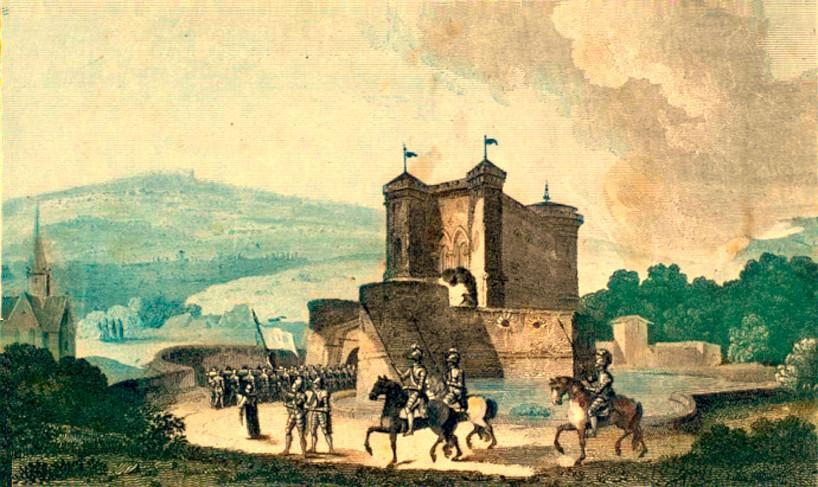
In mid-December 1798, Goethe requested and received a copy from Wilhelm Schlegel (Körner-Wieneke 78–81, nos. 62, 63, 66) and had already discussed it earlier with Schiller.
In a letter to Wilhelm from Berlin on 5 February 1799 (Walzel, 417; KFSA 24:263, which dates the letter to April 1799), Friedrich Schlegel calls it “infinitely insipid”:
Moreover, you called Walpole ingenious [in Athenaeum (1799) 196, in Wilhelm’s essay “Ueber Zeichnungen zu Gedichten und John Flaxman’s Umrisse,” where Wilhelm uses the German word geistvoll rather than, as Friedrich would have it, geistreich, though the two terms were largely synomymous]? My good friend! Consider what you are doing, and how economical severe critics must be with such praise. We — for I read the entire essay together with Tieck — think this person is an entirely inappropriate subject, and, indeed, I cannot comprehend how someone who has written something in every respect as infinitely insipid as the Castel [KFSA reads Castle] of Otranto could ever say anything ingenious. If he is ingenious, then Jenisch is doubtless a genius. — Tieck opined that “Walpole” already says too much, and that one would do better just to call him “Pole.”
Meyer wrote a self-effacing letter from Berlin to Johann Gottfried Herder on 10 May 1794 (Von und an Herder. Ungedruckte Briefe aus Herders Nachlass, ed. Heinrich Düntzer and Ferdinand Gottfried von Herder, 3 vols. [Leipzig 1861–62], 2:262) about his Burg von Otranto, which he had already translated two years earlier:
p.s., . . . You will be receiving my Burg von Otranto direct from the publisher, a novelle I translated two years ago but which is only being published now because of the appended engraving. You are already familiar with the original. I have done little to merit praise with respect to that original.
In an undated note to Meyer, Caroline wrote (illustrations: [1] frontispiece to Carl von Eckartshausen, Sammlung der merkwürdigsten Visionen, Erscheinungen, Geister- und Gespenstergeschichten, nebst einer Anweisung dergleichen Vorfälle vernünftig zu untersuchen, und zu beurtheilen [Munich 1792]; [2] frontispiece to Samuel Christoph Wagener, Die Gespenster: Kurze Erzählungen aus dem Reiche der Wahrheit, 2nd ed., vol. 1 [Berlin 1798]; (3) title vignette to Ann Ward Radcliffe, Adolphos Geheimniße: Aus den Englischen Von d. Verfaßer der Adeline, vols. 1–2 [Vienna, Prague 1798]):
Neither the Castle of Otranto nor Ettinger has arrived. You sent me the Castle of Otranto when I was in the Harz — do you still remember? — before my first or second childbed, and were vehemently reproached for having sent something as frightening as this Burg to a woman in my condition.
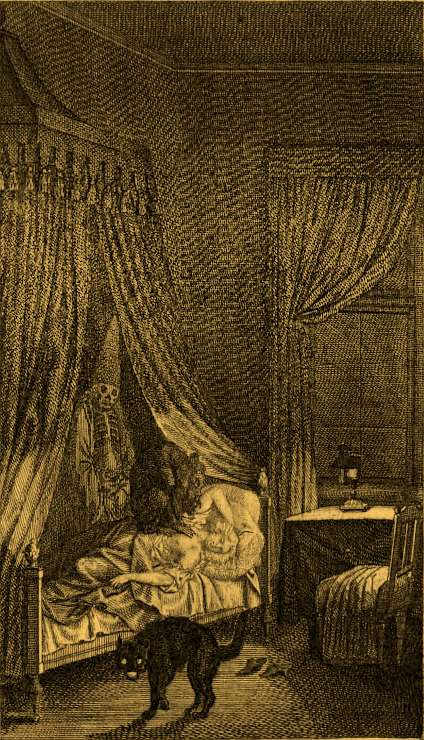
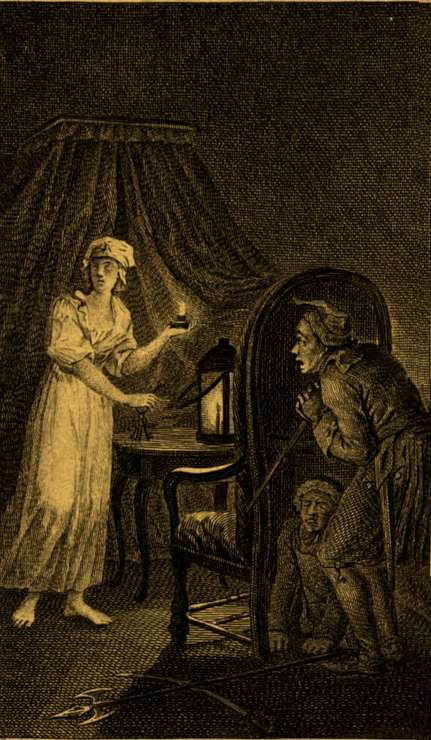
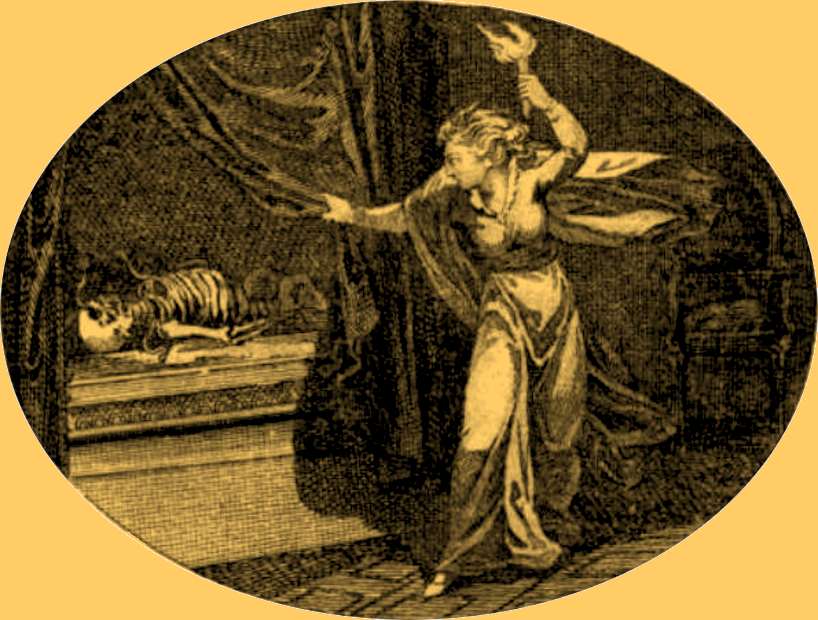
It may be noted that because the novel had not yet been translated into German, Meyer presumably sent Caroline an edition of the English original. With respect to Caroline’s reproach here, see this synopsis from Charles Dudley Warner (ed.), Library of the World’s Best Literature Ancient and Modern, 46 vols. (New York 1902), 44:32:
Conrad, son of Manfred, Prince of Otranto, about to marry Isabella, daughter of the Marquis of Vicenza, is found in the castle court, dashed to pieces under an enormous helmet.
Now deprived of an heir, Manfred declares to Isabella his intention of marrying her himself; when, to his horror, his grandfather’s portrait descends from the wall, and signs to Manfred to follow him. Isabella meanwhile, by the assistance of a peasant, Theodore, escapes to Friar Jerome.
For this intervention, Manfred, now returned from his tête-à-tête with his grandfather’s phantom, leads the youth into the court to be executed, when he is found to be Jerome’s son, and is spared. At this moment a herald appears demanding of Manfred, in the name of Prince Frederick, his daughter Isabella, and the resignation of the principality of Otranto usurped from Frederick; who follows the proclamation, is admitted to the castle and informed of Manfred’s desire to marry Isabella, when word comes that she has escaped from Jerome’s protection.
A series of ludicrous portents hastens the denouement: drops of blood flow from the nose of the statue of Alphonso, the prince from whose heirs the dukedom has been wrested; unrelated arms and legs appear in various parts of the castle; and finally, in the midst of the rocking of earth, and the rattling of “more than mortal armor,” the walls of the castle are thrown down, the inmates having presumably escaped.
From the ruins the statue of Alphonso, raised to gigantic proportions, cries, “Behold in Theodore the true heir of Alphonso.” Isabella, having been rescued at the critical moment, is of course married to Theodore.
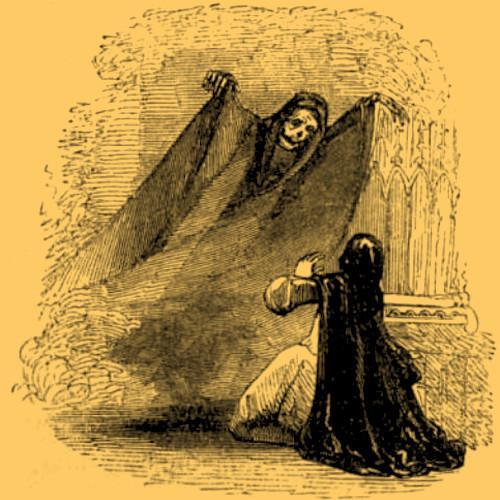
To open a gallery of the four engravings in the 1794 German edition (an English edition of 1794 had these same vignettes and the same German publisher: The Castle of Otranto, a Gothic Story. Last Edition Adorned with Cuts [Berlin: Christ. Fred. Himbourg, 1794]) along with the seven color illustrations in Jeffrey’s edition of 1800 mentioned above, click on the image below (illustration from The Castle of Otranto: A Gothic Story [London 1840]):
To open a gallery of both exterior and interior views of Walpole’s own estate, Strawberry Hill, click on the image below:

Walpole’s novel and the subsequent popularity of ghost stories in general exerted considerable influence on German literature for the rest of the eighteenth and into the nineteenth centuries, not least in that part of Romanticism inclined toward the darker, unknown, inexplicable side of life ([1] frontispiece to Samuel Christoph Wagener, Die Gespenster: Kurze Erzählungen aus dem Reiche der Wahrheit, vol. 2 [Berlin 1799]; [2] title vignette to Joseph Alois Gleich, Udo der Stählerne oder die Ruinen von Drudenstein: Eine niedersächsische Volkssage [Vienna 1799]):
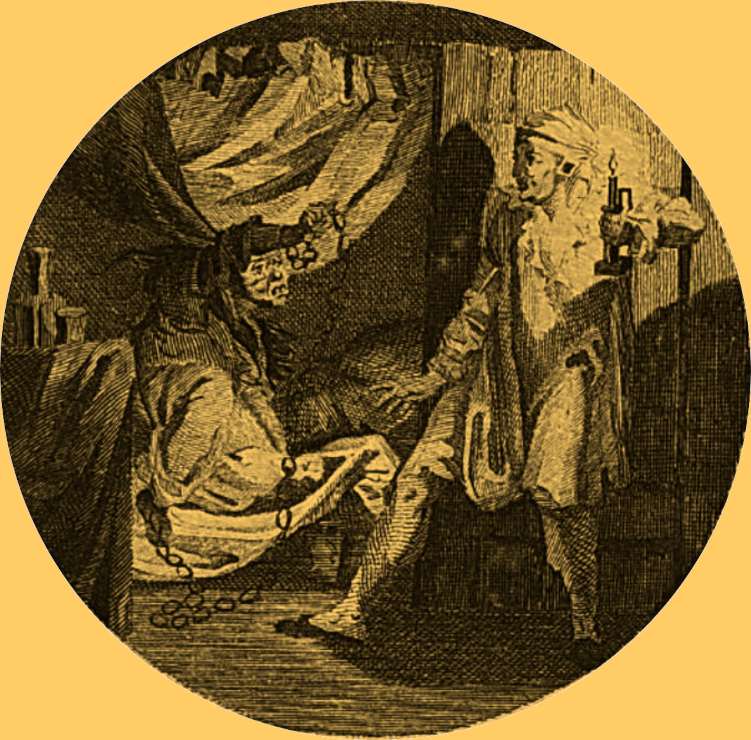
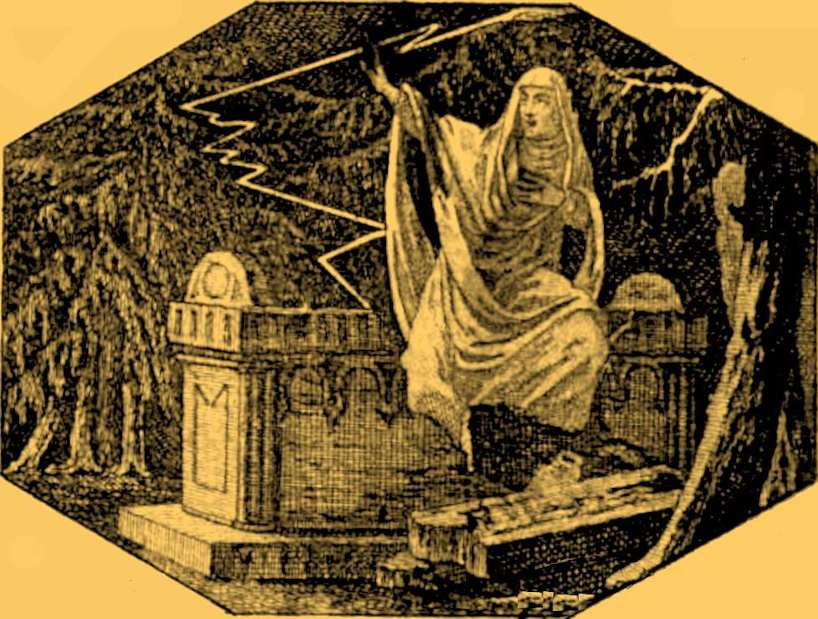
The following vignettes typify this literary fascination with ghosts of the sort found in Walpole’s book and its successors.
Sources, in order: Friedrich August Wilhelm Schmidt, Almanach Romantisch-Ländlicher Gemälde für MDCCIIC; Inhaltsverzeichnis deutscher Almanache, Theodor Springmann Stiftung, plates accompanying “Graf Königsmark und sein Verwalter” and “Kunz von Drachenfels”; Daniel Nikolaus Chodowiecki, Das Gespenst, accompanying Christian Fürchtegott Gellert, Gellerts Fabeln, Sammlung der besten deutschen prosaischen Schriftsteller und Dichter 1 (Carlsruhe 1774), in Genealogischer Calender für West-Preussen auf das Jahr 1776 zu Berlin (Berlin), Herzog August Bibliothek, Museumsnr./Signatur Uh 4° 47 (111); Gottlieb Böttger d.Ä., Kennen Sie mich?, Herzog August Bibliothek, Museumsnr./Signatur Graph. A1: 276:
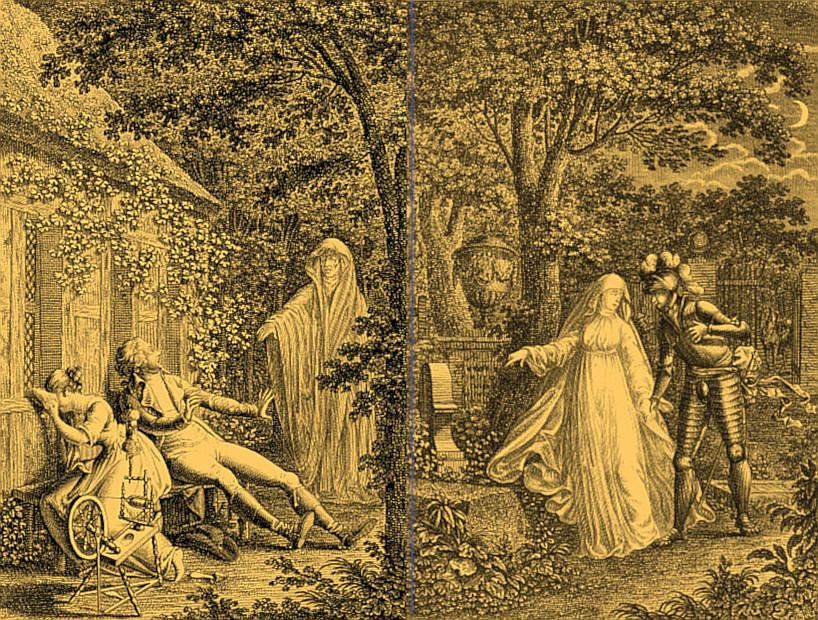
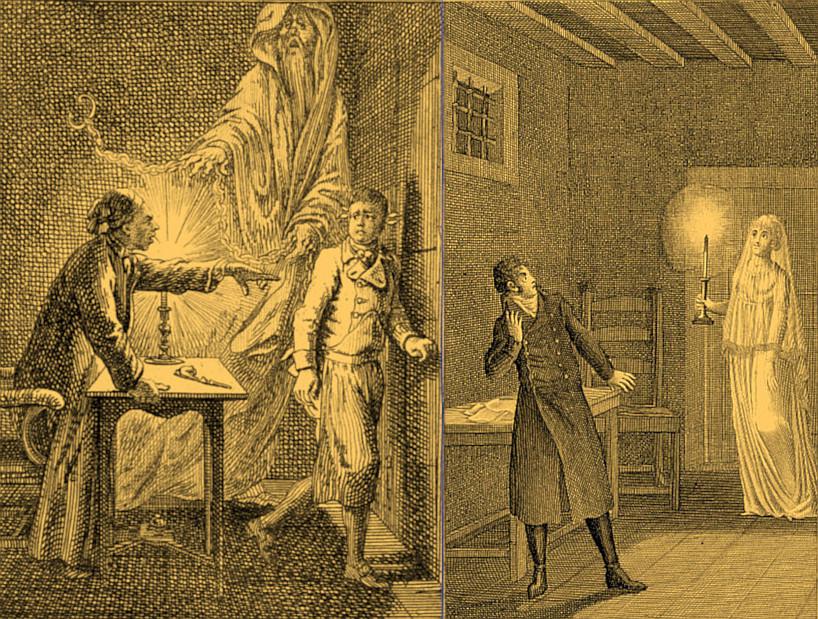
[18] It is only in jest that Caroline is attributing to Meyer the grand poem on the “art of loving,” Die Kunst zu lieben. Ein Lehrgedicht in drey Büchern (Berlin 1794), by Johann Kaspar Friedrich Manso mentioned above; here the title page and vignette:

Goethe and Schiller later dedicate to Manso, a classical philologist and educator in Breslau, three merciless Xenien, epigrams in the forms of a classical distich published in Schiller’s Musenalmanach für das Jahr 1797 (197–302):
35. The Art of Love.
You even need art in order to love? Unhappy Manso,
that nature otherwise did nothing, absolutely nothing for you!

36. The Breslau Schoolmaster.
In boring verses and fatuous thoughts
a preceptor teaches us here how to please and how to seduce.

37. Amor as Teaching Colleague.
The most terrifying of all terrifying things?
A pedant itching to be loose and easy.
Even Manso’s friend Friedrich Jacobs defended him only with qualification (Personalien [Leipzig 1840], 256–57):
The acknowledged virtues he [Manso] did possess assured him the respect of the public, which recognized his merits despite the extraordinarily hostile attacks on him as a poet. Had there been even a shred of dissimulation and deceit, it would have receded in the face of the cruel and poisonous derision heaped on him by the Xenien and various artistic disciples who might not have fancied themselves quite on the pinnacle of art and taste had they not genuinely believed in the oracles proclaimed by those distichs and indeed had not themselves proclaimed that faith through their own derisive laughter.
Far be it from me to condone the fact that Manso chose a subject that in fact could not be successfully treated without a certain element of frivolity; but that was not the charge laid at his feet or which his opponents found offensive. Some who had perhaps never even read Die Kunst zu lieben [Die Kunst der Liebe] trustingly joined in the Xenien chorus, ridiculing the “unhappy” man who — though no one would hold such against either ancient Ovid or the gentil Bernard — “even needs art in order to love”; and more than one person who, as a matter of fact, could never have taken his own career as far as even to become a pedant, no matter how much effort he may have expended, took it upon himself to mock the “pedant” Manso, who was allegedly “itching to be loose and easy.” Back.
Translation © 2011 Doug Stott