
• 23. Caroline to Julie von Studnitz in Gotha: Göttingen, 14 June 1781 (Fr.)
Göttingen, 14 June 1781
|40| So, now I have finally seen our amiable bishop! [1] And he is indeed so amiable, dear Julie, that my quill can hardly describe him. Such goodness |41| of soul, combined with so much proportional beauty, a frankness one can see in his eyes, his majesty, and his modesty — it is all quite inexpressible. One simply has to see him to love him as he merits, though unquestionably, one cannot see him without loving him as well.
He arrived on the ninth of June and stayed in Wehnde, a village five or ten minutes from town, where there is an extremely beautiful house that is normally the bailiff’s residence, though the king of England himself stays there when he comes. [2] Representatives of the town, the university, the military, and who knows who else were waiting there for him to pay their respects.
I do not believe all this amused him very much, for he does not understand German well and detests French, though he did speak English with my father and with those of our Englishmen who had gone to his reception, one of whom he already knew personally. My father returned quite pleased with him, and as for me, well, I did not sleep, so impatient was I to see him.
The next day he arrived in town at eleven o’clock to go to the library, where the professors were introduced to him. [3] He came by our house, his carriage was carried along by the crowd, and he greeted us several times in the most gracious fashion imaginable. At the library he was a bit embarrassed, as if they were in fact paying him too much respect. He returned to Wehnde for dinner, where there was a grand company, including my father. [3a]
Then he came back here to see various curiosities as well and then the riding academy, where he arrived accompanied by the equerry who had dined with him, by his entire entourage, and by eight gentlemen in exquisite uniforms who had come by horse to take him. [3b] The gentlemen entertained him greatly with a carrousel, a kind of tournier, an ancient remnant of the age of knights errant, which they performed to absolute perfection |42| and which made the most beautiful impression imaginable [4]. The equerry himself put on an equestrian show. The bishop beheld the most beautiful horses, and one could see he was quite pleased. That was when I saw him up close.
The carrouselistes then accompanied him all the way to Wehnde, where they remained for the ball. Before the bishop’s arrival, the bailiff had received a mounted courier alerting him that the bishop wished to give a ball and charging him with arranging it. Hence, in the name of His Royal Highness, he invited Göttingen’s elite and, naturally, my dear friend, us as well.
So the ball was held — but — I was not there. I chose to decline the pleasure of seeing him up so close, of speaking with him, and of dancing with him, and of being able to tell myself one day that I had danced with my king, which he will indeed likely become, the Prince of Wales being valetudinarian. I renounced all that — would you have believed that of your friend? — out of considerations of prudence, and I am certainly far from regretting it even though it was inexpressibly difficult for me, and though I regard the sacrifice as the greatest I have made in my life.
But I knew in advance that people would talk a great deal about this ball, would lie about it, speak ill of it as much as might be possible, and that every little detail would be reported in Hannover and naturally also augmented not inconsiderably in the process. I did not fear the attention, but I did fear the calumny. Since people had already talked so much about it beforehand, what will they not be saying about it later, and what sorts of things, indeed, do they not say afterward?
In any case, I am too insouciant for it to bother me, and my mother was not feeling well enough to be my chaperone. Although my father did offer to accompany me, a father’s eye is never as attentive as a mother’s. [4a] The prince is known for being gallant toward the ladies. People would have |43| accused them of having tried to please him, and I do not want my name to be mentioned in such a context.
Hence I did not attend, and resisted quite insistent invitations; it is true that I did hesitate for a moment out of regard for the bishop, but non obstante I held firm. [5] I thought the memory of having won such a great victory over myself would someday be as sweet to me as the idea of having danced with my king. Is not the most intense pleasure born from contentment with oneself?
I congratulated myself on avoiding the danger, which I was indeed able to foresee and to which I ran as much risk of falling prey as the others, and even the most rigorous among them did in fact fall prey to it. —
The company was not particularly large; there were only nine ladies who actually danced. Upon arriving, they were led to the garden, where the bishop followed and where they were introduced to him. They dined outdoors in the garden. The gentlemen all kept their hats on, and the bishop spoke very little with the two ladies sitting next to him, since they did not speak English, though he did act as gracious as an angel.
After dinner, there was an illumination during which he took his host’s daughter, who was married in Hannover, for a walk in the garden; [6] she was a quite lovely and amiable young lady, and he even opened the ball with her, though they were always only the second couple. The crowd of spectators in the garden, just as at the riding academy, was extraordinarily large, surely more than eight thousand people. Everyone strained to see the son of our king and of that admirable queen whom the entire universe adores. —
At the end of the ball, which lasted until four o’clock, they danced the Grosvater, [7] with all the rounds possible, traversing the courtyard, the garden, all the apartments in the house, and finally he cried out in joy and repeated a thousand times that this was the most beautiful dance he had ever experienced.
The next |44| morning, he went hunting, then that evening came here to attend the theater. I know not if I told you that we currently have a company of actors directed by Monsieur Abt; it is not all that bad, and there are even certain actors, e.g., Monsieur and Madame Abt, who perform quite exquisitely. They gave a marvelous performance of Grosmann’s Sechs Schüsseln. [8] Madame de Schmerling, the chamberlain, old Reinhard, his children [9] — every role was executed as perfectly as possible.
On this particular day they were performing La Chasse. [10] Excepting that Madame Koch sang much better and was more beautiful, our own Röschen, a certain Madame Hulsner, did not yield to her in anything. [11] The bishop laughed several times with all his being; he had almost everything explained to him. That evening he had wanted to dance yet again, but I know not why he did not; it was also too late, for the theater performance was not finished until 10:00.
When he left Tuesday morning, he took everyone’s heart along with him, declaring that during his entire stay in the territory of Hannover he had never enjoyed himself has much as here.
You realize, my very dear friend, that I was prepared to admire him, indeed that I even admired him in advance, and yet he surpassed even the ideal my active imagination had conjured of him. Heaven itself can be seen in his eyes, both innocence and candor permeate his entire being, one can see that his soul knows no ill, and his gaze is that of an angel. One would like to prostrate oneself before him and entreat him to wish us well.
With all that however, he really does not know himself, does not suspect that it is he himself whom people adore. He is man as man came from the hand of God. Woe to those who would destroy such innocence and such happy disposition. Nevertheless, people are saying that precisely such is the |45| case, and that he is in ill hands. The idea that he could be corrupted fills my soul with great sadness, a sentiment that becomes even stronger than my admiration for him. Indeed, I would give my very life to save his soul. —
The reason they sent him to Hannover is that he is in love with one of the queen’s ladies, beautiful and virtuous, whom he could even marry were the king to make her a duchess. However, they wanted to divert him from her through absence, but in vain, since so far he has remained constant even though his seducers have set countless traps for him, even giving him the most beautiful girls in Hannover for his service, to make the beds, etc.; yet he does not even look at them.
Naturally, his parents know nothing of this. Perhaps that love, and the ardent love he has for his worthy mother, keeps him from evil. But as young as he is, without experience, open to every impression — will he always be able to resist? The more excellent his character is, the easier it is to seduce him, especially at so young an age, when a person is not yet anything but can still become everything (at least men) and with so much vivacity.
Recently he took a carriage ride with the grand equerry Busch. They came upon a heavily laden peasant who was initially unable to get out of their way. Busch got down from the carriage and beat him like a madman. Is that an example for a prince who will one day likely be the father of his people? All that does is teach him cruelty. Especially for an Englishman, who is born, so to speak, with a sense of his own freedom, the spectacle must have been even more striking, and what idea must he now have of a land where one can abuse a poor peasant with impunity? Those who ridicule everything beneath them and him infuse him with arrogance.
As for him, he detests |46| etiquette and enjoyed himself here more than in their company, which breathes nothing but ceremony and knows no other pleasure than the feeling of being superior to us. The young men in his entourage teach him to slander and ridicule everything, be there reason for ridicule or not. Such are the worthy lessons for a grand lord. As for him, he is still far from suspecting anything.
Some time ago, while out walking, he saw a man in great distress because his cow had just fallen into a hole from which he was unable to pull him out alone. The bishop sent his companion there to see what was going on; the man returned, related to him what had happened, and proposed going to fetch someone who might help the man. But the prince, fearing that would take too long, went himself to help the man. — At a narrow point of a road, he encountered a merchant carrying his merchandise on his back who was unable to get by without falling; he got down off his horse and fell himself while allowing the other man to pass, and the other man was quite terrified by it all. People relate a thousand anecdotes about him; not all are well founded, but I do know these to be quite true. —
I would be unable to console myself were I to see such a soul debased; my tears would flow for both him and his parents. Could you but already have seen him, my dear Julie! Only then could you share my ardent prayers for his well-being. You have no need to speak to him, just by seeing him you know him, for he wears his soul in his eyes. —
Having been around so many young men, I have seen a great many handsome members of the opposite sex, but that particular, enchanting physiognomy, that divine gaze, I have never seen. It is not my own enthusiasm that makes me talk this way, but rather the enthusiasm he inspires in all around him, even in the most insensitive hearts. |47| In fact I have said little in comparison with others, but I still find that people are going too far, deifying him. One great flaw I find with him is that he has little about him of a bishop, so little in fact that it even vexes me a bit to call him such; he is neither big nor fat, and he loves neither wine nor women.
When you have seen him, my dear Julie, you will forgive me for writing so much about him to you, but it is indeed necessary that he first learn a bit more German. Here everyone speaks so much English, even several of our ladies, that he was able to get along without it. When he does not speak English, he comes up with the most comical combinations, mixing English with French, German, and Low German, the latter of which most nearly resembles English, which is why he learned it so easily. . . .
Notes
[1] Concerning reactions to the Göttingen visits of George III’s second son, Frederick, Duke of York, see letter 22, note 5. Back.
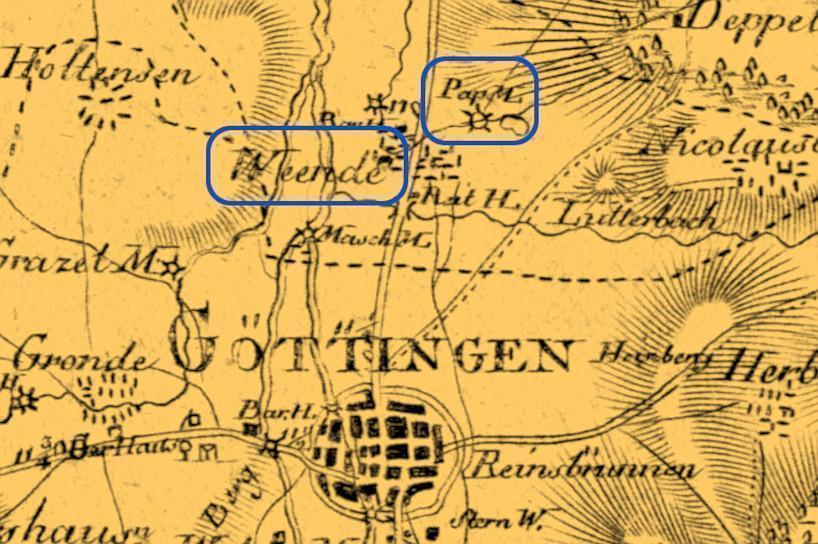
[2] Weende (Caroline spells it phonetically) (here also indicating the location of the popular paper mill, which will recur in this correspondence and in Luise Wiedemann’s Erinnerungen; J. F. Saltzenberg and H. F. Irsengarth, Carte der Gegend um Göttingen auf 2. und 3. Meilen [between 1803 and 1816]; illustration: Herzog August Bibliothek, Museumsnr./Signatur Top. App. 2:413):

Here the mill ca. 1810 (anonymous colorized engraving):

[3] Concerning the library and the bishop’s itinerary, several items of which Caroline mentions below, see Caroline’s letter to Minchen Bertuch on 2 March 1781 (letter 22), note 4. Caroline’s house was just across the street from the library, here ca. 1800 (painting by Johann Christian Eberlein, and the grand reading room ca. 1820, attributed to Friedrich Besemann):


[3a] Social gathering from 1782, title vignette to Johann Jacob Nathanael Neumann, Visiten (Berlin, Leipzig 1782):

[3b] Here Daniel Nikolaus Chodowiecki’s tongue-in-cheek engraving of activity in such a riding academy, Preparation pour l’Université [1773]; Herzog August Bibliothek; Museums./Signatur Museumsnr. Uh 4° 47 [198], part of several engravings illustrating the life of a dissolute young fellow but reflecting the presence of such riding academies at universities nonetheless:

[4] Caroussel, Fr., “jousting, tilting-match, military tournament,” though beginning in late-sixteenth-century France an equestrian spectacle at which horseman executed dance-like figures to music, also called a ballet équestre or ballet à cheval, essentially an event of advanced dressage; became especially fashionable during the eighteenth century (anonymous engraving, Der Zwinger in Dresden, Blick auf ein Damen Reitturnier (Ringelreiten) [1709]):

Here just such a caroussel at the Göttingen university itself in honor of King George I in 1748 (Georg Daniel Heumann, “Ritterspiel das in Sr. Königlichen Majestät Georg I. Gegenwart auf der Göttingenschen Universität den 1. August 1748 gehalten worden ist):

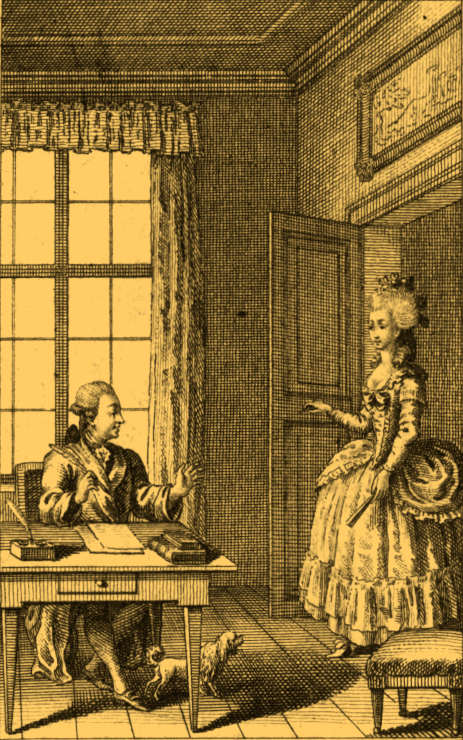
[4a] Frontispiece to Der Sachwalter des Schönen Geschlechtes, ed. P. M. Schmid (Vienna 1782):
[5] Latin, “that notwithstanding.”
Caroline’s arguably tedious remonstrations and reasoning do in any case attest the social and moral pressures under which young middle-class women found themselves not least with respect to even merely perceived social missteps and the resulting gossip (frontispiece to Johann Christian Siede, Raritäten von Berlin und merkwürdige Geschichten einiger Berlinischen Freudenmädchen, vol. 1 [Berlin 1792]):

[6] References to “taking a walk” or “going for a ride (by horse or carriage)” recur countless times in this correspondence (Deutsches Leben der Vergangenheit in Bildern, vol. 2 [Jena 1908], no. 1533):

Insofar as the reference is to a leisure activity, a distinction is made between (1) taking a walk on foot or (2) a ride on a horse or (3) in a carriage. The Germ. root behind spazieren refers to all three depending on the context; Spaziergang, taking a walk; Spazierritt, taking a ride on horseback; and Spazierfahrt, taking a ride in a carriage.
Here Daniel Nikolaus Chodowiecki depicts all three modes in a single engraving (Kupfersammlung zu J[ohann] B[ernhard] Basedows Elementarwerke für die Jugend und ihre Freunde: Erste Lieferung in 53 Tafeln. Zweyte Lieferung in 47 Tafeln von L bis XCVI [Leipzig, Dessau, Berlin 1774]); at far right and far left: taking a walk; center left: taking a horseback ride; center right: taking a carriage ride:

Here a similar illustration depicting all three forms at once in a public park (Joseph Richter, Bildergalerie weltlicher Misbräuche: Ein Gegenstück zur Bildergalerie katholischer und klösterlicher Misbräuche [Frankfurt, Leipzig 1785], illustration preceding p. 215):

Here an illustration portraying the two forms of taking a walk (left) and taking a carriage ride (right); the second depicts a couple and their driver pausing during a leisure carriage ride ([1] Johannes Esaias Nilson, L’Ocupation, La promenade [ca. 1741–88]; Herzog Anton Ulrich-Museum; Museums./Signatur JENilson AB 3.116; [2] frontispiece to Johann Timotheus Hermes, Geschiedenis van den heer Leopold Kerker, of Moeder, zoogster en kind [Haarlem 1810]):


Chodowiecki did a series of vignettes in 1780 with the title Occupations des dames, occupation in the sense of “pasttimes”; one of those pasttimes is la promenade, “walking, taking a walk,” which occurs with particular frequency in these letters. The first vignette features couples walking in a garden or wooded area from the series Occupations des dames, the second a family (in order: [1780], Herzog Anton Ulrich Museum, Museumsnr./Signatur Uh 4° 47 [162]; [1779] Göttingen Taschenkalender [1799]):

Women frequently adhered to attire suggested by fashion for taking walks (“Promenade”) as illustrated in the Toiletten Kalender für Damen 1805, similarly also for recreational rides on horseback ([1] Inhaltsverzeichnis deutscher Almanache, Theodor Springmann Stiftung; [2] frontispiece to Fanny Burney, Georgina: Eine wahre Geschichte, vol. 3 [Tübingen 1791]):


Here additional renderings by Chodowiecki of this popular activity (in order: [1778], Herzog Anton Ulrich Museum, Museumsnr./Signatur Uh 4° 47 [140]; [1783], Herzog Anton Ulrich Museum, Museumsnr./Signatur Uh 4° 47 [225]; Sophie auf der Promenade [1777–80]; Herzog Anton Ulrich-Museum; Museums./Signatur DChodowiecki-Kopie St AB 3.17; Alexander blickt aus dem Fenster [1778–81]; Herzog August Bibliothek; Museums./Signatur Chodowiecki Sammlung [4-221]):


[7] “Grandfather Dance,” a seventeenth-century German dance in polonaise style deriving its name from the beginning of the first song, “Und als der Grossvater die Grossmutter nahm, / Da war der Grossvater ein Bräutigam” (“And when Grandfather took Grandmother, Grandfather was her betrothed”), referring to a grandfather’s wooing. It begins with a slow, polonaise-like tour in 3/8 time (andante), followed by brisk music in 2/4 (allegro), then an additional, similarly brisk theme in 2/4 (allegro).
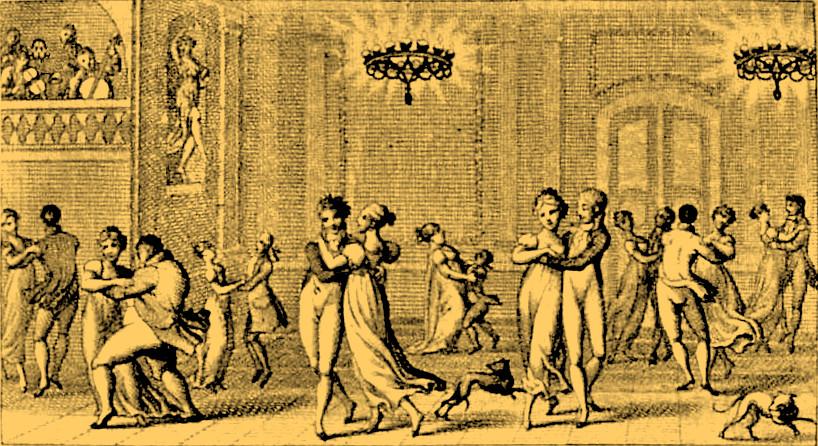
It was danced especially at weddings and later used as the final dance at balls to encourage people to leave a party or dance, therefore called the Kehraus, “sweep-out, clear-out.” As little as the increasingly brisk tempo might be called “grandfatherly,” it did generally draw in both young and old at the end of an evening or event, and Caroline is presumably referring to the multiple verses (“rounds”; in the example below: seven) that were sang at the event here described (here representative dances at such an event, albeit not the “Grandfather’s Dance” (Taschenbuch für das Jahr 1814: Der Liebe und Freundschaft gewidmet 1814; Inhaltsverzeichnis deutscher Almanache, Theodor Springmann Stiftung):

The first two verses read approximately:
When grandfather married grandmother,
No one knew anything about "Mamsell" and "Madam."
The virtuous maiden, the domestic woman
Were genuinely German in both body and soul."

When grandfather married grandmother,
The order of the day was still demure modesty,
One behaved honorably and did not consider it good form
To walk about the street in Greek nakedness.
See Volksthümliche Lider der Deutschen im 18. und 19. Jahrhundert, ed. Franz Magnus Böhmer (Leipzig 1895), 536; first printed in Wilhelm Gottlieb Becker’s Taschenbuch zum geselligen Vergnügen (1813), 332–33:

Here a version with the change in time signature from Characteristic Songs and Dances of All Nations, ed. James Duff Brown, arranged by Alfred Moffat (Glasgow 1901), 98:

A famous theatrical example is found in the first act of Tchaikovsky’s The Nutcracker (1892). Back.
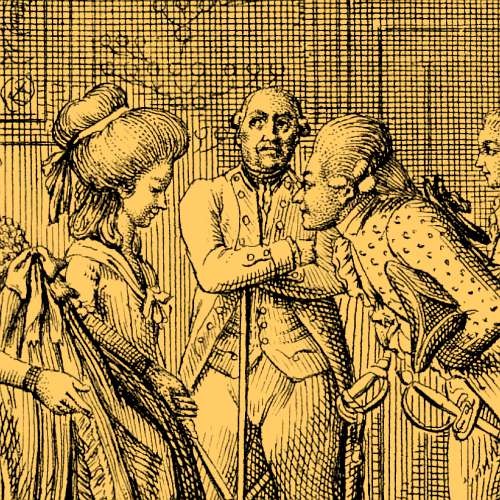
[8] Gustav Friedrich Wilhelm Grossmann, Nicht mehr als sechs Schüsseln. Familiengemälde in fünf Aufzügen (premiered 6 April 1779; published Bonn 1780), a popular middle-class play about resistance to social pressure, in this case the pressure to serve at least eighteen courses (Schüsseln, “dishes”) at a meal (frontispiece to Iohann Heinrich Voss, Luise: Ein Lændliches Gedicht in Drei Idyllen [Kónigsberg 1795]):

Goethe virulently despised the play (see supplementary appendix 23.1). Here the title page to the edition of 1780, the title vignette to the edition of 1781, and the title vignette to the edition of 1780 by Daniel Nikolaus Chodowiecki (“Oh, my! Only six courses!”) to the edition of 1785 (both published in Leipzig):


Click on the illustration below to open a gallery of Daniel Nikolaus Chodowiecki’s illustrations to the play:
[9] Characters in the play: the protagonist, Hofrath Reinhard; Madame de Schmerling, his sister; the chamberlain, von Wilsdorf; and Reinhard’s children, Wilhelmine and Fritz. Back.
[10] Caroline presents the title in French; the reference is to Christian Felix Weisse’s singspiel, Die Jagd. Komische Oper in drei Aufzügen (Leipzig 1770), freely adapted after Charles Collé (1709–83), La partie de chasse de Henri IV. Comédie en trois actes et en prose (Paris 1766), the latter a piece about — doubtless not by accident in this case — a king who falls in unrecognized among the common folk (see below). Here two secnes from the French version ([1] Digital Collections and Archives, Tufts University, id mc87q109g; [2] act 3, scene 10, Félix Massard, Jean-Baptiste Blaise Simonet La Partie de chasse de Henri IV [1790]; Archives et bibliothèques Pau Béarn, Bibliothèque nationale de France):

[11] Here the handsome Franziska Romana Koch in performance in the role of a milkmaid (Theater-Kalender auf das Jahr 1778; Inhaltsverzeichnis deutscher Almanache, Theodor Springmann Stiftung):

Röschen (Röse), the daughter of Michel, a village judge in Weisse’s singspiel Die Jagd, loves Töffel but is not allowed to marry until the disappearance Hännchen, the fiancée of her brother, Christel, has been explained. Hännchen, who has been abducted by Count Schmetterling, escapes.
The king, separated from his hunting party, seeks refuge with Michel and his wife, Marthe, though they do not know who he is. The king does, however, learn of the family’s loyalty to him. Hännchen recognizes Schmetterling when he is brought in as a poacher, the king reveals himself, banishes Schmetterling, and rewards the two couples. Röschen begins the play with the following song (Johann Adam Hiller, Die Jagd, eine comische Oper in drey Acten, in die Musik gesetzt von Johann Adam Hiller (piano score), 2nd ed. [Leipzig 1772]):

Concerning “Hulsner” (correct: Hülsner; Caroline omits the umlaut because she is writing in French and spelling according to the French pronunciation), see Erich Schmidt, (1913), 1:677: “The name Hulsner is unclear, though theater history maintains that Karl Friedrich Abt formed a new company from part of the Hulsner company and that Madame Hulsner performed the roles of lively female love interests.” On Hulsner, his wife, Abt, and the circumstances of this engagement in Göttingen and the split, see Joseph Wolter, Gustav Friedrich Wilhelm Grossmann. Ein Beitrag zur deutschen Literatur- und Theatergeschichte des 18. Jahrhunderts (Köln 1901), xv, appendix 6, the alphabetical index of members of the company of Gustav Friedrich Wilhelm Grossmann; this entry also explains how the Hülsners came to be in Göttingen in 1781:
71. Hülsner performed the roles of the love interest and servants, debuted on 23 January 1782 as “Michel” (in Die Kolonie) and was well received. From 1777 he led his own company, which performed for three years in Düsseldorf and in the summer of 1781 in Aachen. In January 1781 he went with Abt to Hannover and Göttingen after he had received from the king the honor of “Royal British Court Actor” along with 1000 Reichsthaler. In part because of the intrigues of his colleague [Abt], and in part because of his wife’s perpetual illness, Hülsner was compelled to cede his company to Abt, who took it to Bremen and Lübeck. Hülsner himself went to Jena to live with his mother and to wait out his wife’s illness. She recovered, and Hülsner accepted an engagement with Grossmann, with whom he had long corresponded and with whom he had become acquainted on many occasions as an “upright man.”
72. Madam Hülsner, after recovering from her illness, performed the roles of the female love interest and young farmers’ daughters, debuting as “Julie” (in Julie) on 27 January 1782. The married couple Hülsner was, however, released in the autumn of 1784. Back.
Translation © 2011 Doug Stott