
• 22. Caroline to Wilhelmine Bertuch in Gotha: Göttingen, 2 March 1781
Göttingen, 2 March 1781
|39| . . . This week the Duke of Württemberg and the Countess of Hohenheim — who is traveling with him — honored our city. [1] He visited all the lectures, saw and heard exhibits in the natural-history collection, the library, disputations, societies, everything one could think of, was extremely polite, extremely gracious, regaled the professors, etc.
She went along, then spent the rest of the time at the inn being bored. [2] Everyone who has seen her offers the most charming description; she is allegedly not beautiful but is extremely pleasant, learned, and endowed with ample good sense and understanding. He has become so taken with erudition as a hobby that he makes a fool of himself and has become a pedant.
He is ugly, and she is probably not really in love with him even though she left her husband for his sake. And though his subjects would indeed like for him to marry her, he himself does not trust his own constancy enough to do so. Every other word he speaks is “virtue” or “religion,” |40| he who oppresses feminine virtue, who shatters the peace of so many families, who denies his own religion when the real issue is to live according to religion itself, then dares abuse these sacred names.
Oh, how I despise him! If you want to know what he looks like, then imagine a large man, not slender, with a reddish face, a big nose along with small ditos [3] on it, large, protruding eyes, a short brown jacket, a sulfur-yellow vest so long that one could hardly see the black-satin leggings over which his gray stockings were wrapped in the old-fashioned style, for his vest and stockings overlapped, and finally boots that had been stiffened with whalebone, and who walks with the gait of an old man. Indeed, would you, at such a price, even want to be — let us not even consider “Countess of Hohenheim,” but rather straightaway — the legitimate “Duchess of Württemberg“? [4]
I would instead prefer to praise our dear Bishop of Osnabrück. [5] Were I a pagan, I would make him my god; and were I a Catholic, my saint. And, indeed, he is idolized, people would worship him even were he merely the son of our good king and of our dear queen; but since he is also good, extremely pleasant, handsome, and who knows what else, there is simply no end to the praise. You are to have a copy of his silhouette; Madam Reinbold [6] is sending me several exemplars from Hannover. You already see it everywhere here. All who pique themselves on being fashionable are carrying the bishop in their bag, on their watch, in a ring, on their hat, as a pin, and woe to him who does not know that the bishop has blond hair! . . .
Notes
[1] Johann Stephan Pütter, Gelehrten-Geschichte, 2:16, refers the reader to the Göttingische Anzeigen von gelehrten Sachen (1781) no. 32 (15 March 1781), 248–49; no. 33 (17 March 1781), 259, for information concerning the visit of Karl Eugen and Countess Franziska, a visit also celebrated by a banquet given by the German Society under Abraham Kästner:
From among the princely personages who have spent several days here [in Göttingen] in order to become better acquainted with the university, unforgettable memories include how . . . in February 1781 the reigning Duke of Württemberg(*) not only took in the local sites and honored several academic festivities with his presence, but also attended various classes given by local professors. [(*) Göttingische Anzeigen von gelehrten Sachen (1781), 248, 259]
The Göttingische Anzeigen von gelehrten Sachen (1781) no. 32 (15 March 1781), 248–49; no. 33 [17 March 1781], 259, contain merely a marginal note about a missed dedication to the duke in a book published at the time of his visit):
The assembly of the Royal Society of Science on 24 February was prompted by an extraordinary occasion insofar as Your Highness the Reigning Duke of Württemberg deigned to honor our town of Göttingen with Your Illustrious Presence for several days, visiting our library as well as other academic institutions.
[Here the library exterior ca. 1800, illustration by Johann Christian Eberlein, and the grand reading room ca. 1820, attributed to Friedrich Besemann:]


Indeed, Your Highness spent an entire afternoon at the library, remaining even until darkness. It has truly been a long time since any visitor to our town, even among those devoted solely to higher learning, has examined everything, in every discipline, with so much literary learning, so much investigative élan, and such indefatigable attentiveness.
On the other days, Your Highness deigned to visit the majority of teachers in their lecture halls and otherwise to demonstrate to those teachers as a whole extreme graciousness. The conclusion was a lecture in the German Society given by a citizen of Württemberg studying here, Herr Tasinger, prior to which Herr Hofrath Abraham Kästner delivered an address to which, on the spot, Your Ducal Highness responded with a few but brilliant remarks.
To return to the assembly itself, let us remark that Herr Hofrath Christian Gottlob Heyne read a short essay, De Hercule Musaget nominisque caussis. . . .” Back.
[2] (1) Frontispiece to Johann Gottlieb Fridrich, Tornschild im Gasthof: ein komischer Roman (Copenhagen, Leipzig 1791); (2) title vignette to anonymous, Zeitverkürzende Winterlustbarkeiten für junge Leute in Gesellschaften Aus Gesundheiten, Scherz- und Pfänderspielen, Räthseln, Kartenkünsten, auch andern lustigen und leichten Kunststücken bestehend (Quedlinburg 1773):


[3] Ital. “fingers,” here used figuratively. Back.
[4] Karl Eugen of Württemberg did not marry the mistress whom he had met in 1771, Franziska Freifrau Leutrum von Ertingen, née von Bernerdin, until 1785, after her elevation to the status of Reichsgräfin (imperial countess) von Hohenheim (1785) and her divorce (1772) and the death (1780), moreover, of his first wife, Princess Elisabeth Friederike Sophie von Brandenburg-Bayreuth (the niece of Friedrich II of Prussia), whom he had met in 1741, married in 1748, and who had left him in 1756 and returned to her parental home in Bayreuth.
That is, Caroline is implying that not even the status of legitimate Duchess of Württemberg would be worth putting up with such a husband, much less that of the ambiguous status of Countess von Hohenheim, i.e., the mistress and for all practial purposes current but certainly illegitimate Duchess of Württemberg. Back.
[5] George III’s second son, Duke Frederick of York, in Hannover since 1781, was the same age as Caroline; here the portrait of the ten-year-old that appeared in the Königlich Großbritannischer und Churfürstlicher Genealogischer Kalender auf das 1773. Iahr (Inhaltsverzeichnis deutscher Almanache, Theodor Springmann Stiftung):
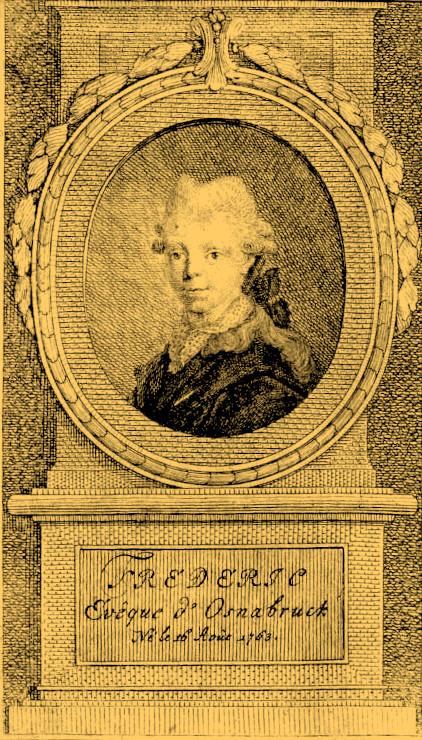
Georg Christoph Lichtenberg (Lichtenberg, Briefe, 1:366) writes to the Hannoverian official Johann Andreas Schernhagen (1722–85) on 16 November 1780 from Göttingen: “So, now it seems you [in Hannover] will likely soon be seeing the bishop; he is, it seems to me, a crafty bird, and much more reserved than the Prince of Valais. I know him very well.” Pütter, Gelehrten-Geschichte, 2:16 recounts:
The university was first honored by a visit from His Royal Highness Prince Frederick, Bishop of Osnabrück and current Duke of York, on 10 June 1781, a visit also rendered unforgettable by his having signed his name with his own hand (Göttingische Anzeigen von gelehrten Sachen [1781] issue 83 [9 July 1781], 657–58). The university had this good fortune a second time in October 1786.” At that second visit, Gottfried August Bürger composed an ode as a greeting to the Bishop of Osnabrück from the students.
On the visit of the Bishop of Osnabrück, see Göttingische Anzeigen von gelehrten Sachen (1781) issue 83 (9 July 1781), 657–58 (illustration: frontispiece to the Magazin für die neue Historie und Geographie 19 [1785]):
On 10 June our university was graced by the most sublime presence of Your Royal Highness the Prince Bishop of Osnabrück. Reverential joy at having a branch of the royal house, a promising prince within our city walls was coupled with the most profound respect for the favor and grace His Royal Highness demonstrated toward our university and to which it owed this joyous bit of good fortune.
Your Royal Highness arrived from Wehnde [Weende] that morning, visited the library, there deigning to allow the introduction of teachers, dukes from among the students here, and others who were present, and graciously to accept their most humble demonstrations of deference, thereafter to have an attentive look at the library and become acquainted with various of its noteworthy aspects, and also, in his own hand, to sign his Highness’s Name to the university students’ registry.
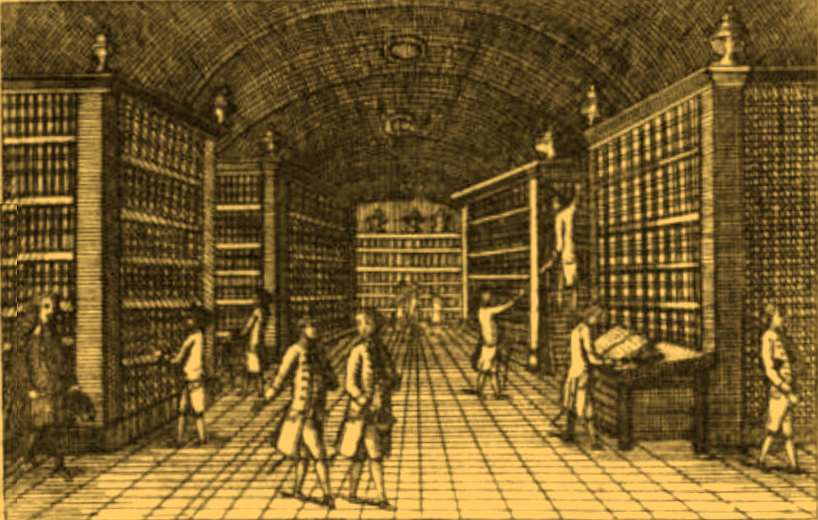
In the academic museum, Your Royal Highness similarly had various curiosities presented and explained. Afterward His Excellency deigned to visit the observatory, the fencing hall, and botanical garden, and to honor a carrousel [Fr., “jousting, tilting-match, military tournament”] on the riding course with Your Highness’s lofty approval. Various teachers were graciously favored by being invited both to the midday meal and to the souper and ball. This amiable, gracious comportment amid such magnificent characteristics of both mind and heart won the hearts of everyone here for Your Royal Highness. Back.
[6] Otherwise unidentified; Caroline’s maternal grandmother’s maiden name, however, was Reinbold(t). Back.
Translation © 2011 Doug Stott