
• 44. Caroline to Luise Gotter and Wilhelmine Bertuch in Gotha: Clausthal, 9 July 1784
Clausthal, 9 Jul[y 17]84
|92| Here I sit in a rural bower in my new garden and am completely with you, my dears. [1] May the solitude of these few hours — virtually the first in so long a time — be dedicated to both of you. If only I had you both here with me, and instead of this boring writing, in which so infinitely much gets lost, I could instead relate everything to you in person! For I simply know not how I can guide you through 4 such weeks with my quill alone.
At least do not ask me to relate the story of my own emotions; what they were you can easily enough guess from all that has happened, and how — well, that I cannot describe in any case. What a frenzy of love, friendship, and happiness I have lived through, and with what sweet melancholy — perpetually at the edge where pain and joy meet — and with what gratitude did I enjoy it.
It would be unnatural for a young wife not to begin with the wedding day itself. [2] My own was quite beautiful. Böhmer breakfasted with me, and these morning hours were characterized by the |93| most joyous serenity, by a sense of peace that could arise only from the complete conviction of both bringing happiness and being happy oneself. No wedding-day fear — souls alone were exchanged in the encounter.
My brother came. We stayed together until 11, and when we parted he conferred his blessing on us amid tears. After the midday meal I then had my hair done, while Friederike and Lotte made up the bridal wreath from natural myrtles. [2a] Then I spoke with my father and got dressed.
In the meantime, dear Madam Meiners sent me beautiful, homemade garters along with a billet; several of my friends wrote to me, and finally I received the silhouette of Lotte Nieper and Friederike, painted in full figure on glass, binding the wreath. Once I had finished putting on my outfit, I was a quite pretty bride. My mother had arranged the hall most charmingly with her own hands.
After 4 o’clock, Böhmer arrived with the wedding group, which consisted of 38 persons. Thank heaven there were no old uncles and aunts there, so the group was considerably more bearable than is usually the case at such occasions. [3] I stood there surrounded by my girlfriends, and what I thought about most vividly was what a state I would be in if I did not love the man before me.
My father, who was still a long way from having completely recuperated, led me to the pastor, and at this moment I now saw myself next to Böhmer, for the rest of my life, and yet did not tremble! nor did I weep during the ceremony! but once it was over and Böhmer embraced me so powerfully, and with the most powerful love, and my parents, sisters, brothers, friends greeted me with all their good wishes, blessings, and love in a way surely no bride has ever been greeted, and my brother beside himself, so moved with joy was he — then my heart did indeed melt and overflow with bliss. [4]
|94| The rest of the day hardly even resembled a wedding, so free and easy was it all. Hofrath Feder’s participation landed him in a condition not unlike intoxication lasting at least a week thence. Schlözer, who really is my friend in a way he probably is to very few others, looked like joy itself, and then my Lesses, Niepers, and others as well — you can hardly imagine the friendship amid which they all celebrated our day with us. There was absolutely no thought of any silly ceremonies, not even with the garter.
The next morning [5] I was awakened by a song outside my door, whereupon I immediately found myself surrounded by the entire host of sisters. [6] We had company until midday, and at 4:00 both families went over to Madam Less’s, who along with Madam Meiners wanted to throw a small party for us.
After coffee, Herr Less led me out into the garden, where I was so delightfully surprised that I can still feel it even now. Madam Less was standing at the entrance with her son, who was dressed like Hymenaeus, [7] a basket of flowers in his arms which he scattered out in front of us while leading us to the opposite arbor, in which a throne of moss and flowers and with high steps, a canopy, triumphal arch, and — who knows what else had been set up. A harpist and singer were standing behind a small stand of shrubbery and began singing once we sat down:
The love that does ignite this couple etc.
— — — — —
Upon a throne of flowers do they find
Perpetually the art of being happy etc. [8]
God only knows the feelings with which I then sank into Böhmer’s arms! The love displayed by these excellent people imposed a new, sacred obligation on me to be good.
It was a wonderful afternoon, and my heart was so exhausted at the end that I was quite glad to spend the evening at an inconsequential social gathering at Osann’s. [9] |95| Madam Meiners and Madam Less were the ones responsible for staging this beautiful performance. Less gave his blessing to Böhmer and me — Herr Meiners was moved to the point of weeping.
Were I to tell you, my dears, all the ways these very best of souls celebrated our union, how everyone took part, how they came from all quarters to demonstrate their good will, you would think it was just too much, just as I myself did. Böhmer is extremely well-liked here — I for my part was of interest to many — the family joy was such a joyfully attractive sight, and thus did we almost sweep up the entire town into our happiness.
On Thursday [10] my brother gave a great dejeunée for 40–50 persons in my uncle’s garden. [11] The Heynes and Blumenbachs [12] attended. And again, extraordinary good wishes from everyone. The Heyne family has taken such a genuine interest in me, even the elder Heyne came by expressly to wish me luck. Blumenbach took Böhmer aside and told him all sorts of things in praise of me and was so moved — a kind of dizziness had absolutely seized everyone, and you know how infectious something like that is. We danced. My brother played the host as no other, spreading the pleasure with overflowing hands.
We had a souper at the Böhmers. Two tables with guests. What a divine evening! [12a] You should see the old, magnificent Böhmer. Under the pretense that it was too warm inside, I was ushered out into the garden as far as the professor’s retreat, where a small illumination was lit, spelling out the proverb: “Happy the man who possesses a virtuous wife: his life is doubled.” [13] A charming idea indeed from the retreat’s resident hermit.
When we returned, the punch was served, and between the punch and the rejoicing we spent half the night in the most beautiful intoxication. What a sight, a family so good and full of love to the very last person, |96| and to be received into such a family as if the bride of each and every one! I also experienced a couple of scenes with my brother and Böhmer that exhausted my soul.
On Friday morning, [14] we — we last three mentioned above — acted as godparents to my second uncle’s newborn son. [15] With a so lovingly conceived set of godparents, he cannot help but become a fine young man. He was named Friedrich Willhelm Theodor. They chose the latter name from mine, Dorothea, since the eldest son is already called Carl. Apropos, most people, including the Heynes, Spittler etc. call me “Frau” or “Madam” Caroline. [15a]
That afternoon we traveled about paying visits. The evening at the Gräzels. Herr Gräzel brought the prince a goblet with which to drink to our health, and at that very moment the music started. The prince led me up to his étage [floor, story], everyone followed, and we danced until after one o’clock. Then he had us serenaded. [15b]
On Saturday [16] yet another dejeunee. That evening a ball at Herr Schlözer’s, who came to meet me at the garden gate, pronouncing solemnly: “You are the queen!” And, indeed, I was, and luckily my sense of reason withdraws like a snail into its shell amid such flattering of my vanity.
On Sunday morning, [17] we received visitors, that afternoon I myself paid some visits, spending 3 hours alone with Therese until going on to the Feders, where we dined.
Monday morning was spent taking leave from everyone — for my mother, I had my silhouette done on a tableau along with Böhmer and Fritz. [18] That afternoon we departed, accompanied by both families, separating finally in Nörthen, [19] and for the first time I genuinely felt that I was married, since now I had to follow my husband and was leaving everything behind. We spent the night in Osterode, [20] where Louise Nieper [21] lives, and the next afternoon [22] at 6:00 I was here.
|97| . . . I will not yet speak about my happiness. Who would not attribute such an account simply to the first 6 weeks of married life? And yet I do believe it will endure, for it is not exaggerated. Böhmer will doubtless be a good husband for as long as I love him, and my own affection for him does not have the character of smoldering emotions. [23]
Notes
[1] Caroline and Franz Wilhelm Böhmer moved into the first floor of the service residence reserved for the town physician on the east side of the market place (“A”), near the town hall (“D”), and behind the Church of the Holy Spirit (“C”) (today: An der Markt 5; the house burned in 1844). They later moved into the apartment upstairs, with which Caroline was better pleased. In the following illustration, Caroline’s bower — if such be her reference — can possibly be seen as the fenced-in area at the side of the house (Adam Illing, Der Marktplatz von Clausthal im Jahre 1661, repr. in the Allgemeiner Harz-Berg-Kalender für das Schaltjahr 1928 [Clausthal 1928], 43)

Here an excerpt of the house itself:

The Church of the Holy Spirit is visible at center right in the following illustration (from Wilhelm Blumenhagen, Der Harz, Das malerische und romantische Deutschland 4, 2nd ed. [Leipzig 1847], plate following p. 232]):

The bower or arbor (see also below), esp. in a bucolic or pastoral setting, was a popular motif incorporated into literary scenes and other illustrations and frequently into attached gardens (Abraham Wolfgang Küfer, Theophron [1793]; Herzog August Bibliothek; Museums./Signatur Graph. A!: 1424):

[2] The wedding took place on Tuesday, 15 June 1784. The week’s events Caroline relates in this letter can be followed on this calendar for June 1784 (Neuer Passauerischer Schreibkalender auf das Jahr 1784 [Passau 1784]):

[2a] The following illlustration portrays a woman having her hair styled just two years after Caroline is here writing (Allmanach auf das Jahr nach der gnadenreichen Geburt Jesu Christi 1786; Inhaltsverzeichnis deutscher Almanache, Theodor Springmann Stiftung):

The following illustrations portray women having their hair styled ca. 1800 (anonymous book illustration), 1779 (Daniel Nikolaus Chodowiecki, Herzog Anton Ulrich-Museum; Museums./Signatur DChodowiecki AB 3.321), and 1802 (Almanach der Musen und Grazien, ed. F. W. A. Schmidt [1802], Inhaltsverzeichnis deutscher Almanache, Theodor Springmann Stiftung):


Here two woman at their dressing tables alone (Gottfried Stein, Dame bei der Toilette [ca. 1700–25]; Herzog Anton Ulrich-Museum; Museums./Signatur GStein AB 3.9; Johann Jakob Haid, Die Verliebte [ca. 1725–67]; Herzog Anton Ulrich-Museum; Museums./Signatur JJHaid AB 3.74):


Bridal wreath illustrations: (1) 3rd frontispiece engraving by M. Voigt after Esperstedt, Der Brautkranz, in the Volkskalender für 1843, ed. Karl Steffens (Frankfurt 1843); (2) Taschenbuch für das Jahr 1817: Der Liebe und Freundschaft gewidmet; Inhaltsverzeichnis deutscher Almanache, Theodor Springmann Stiftung:


[3] Similar arrival of guests in a publication from 1784 (Johann Jacob Nathanael Neumann, Julie von Rosenfeld: Eine Familiengeschichte in lauter kleinen Kapitelchen [Berlin 1784]):

Concerning Caroline’s understanding of “old uncles and aunts,” see her letter to Luise Gotter on 12 January 1781 (letter 21). Back.
[4] Caroline’s “brothers” included not only her half-brother Fritz, but also her younger brother, Gottfried Philipp Michaelis.
Although Caroline nowhere goes into more detail about the wedding ceremony itself, her note that her mother arranged the hall indicates it took place in the Michaelis’ home at Prinzenstrasse 21 (Michaelis house at right; anonymous engraving, late 18th century):

In 1785, a year after Caroline’s wedding here, Daniel Nikolaus Chodowiecki did an illustration for Tobias George Smollett´s The Adventures of Peregrine Pickle (1751) of the bride’s entry at her wedding (Potz Velten, was für eine prächtige Galeere! [1785]; Herzog August Bibliothek; Museums./Signatur Chodowiecki Sammlung [5-322]):

Here a wedding ceremony in a home setting much as Caroline here describes (Taschenbuch für das Jahr 1813: Der Liebe und Freundschaft gewidmet [Frankfurt], Inhaltsverzeichnis deutscher Almanache, Theodor Springmann Stiftung):
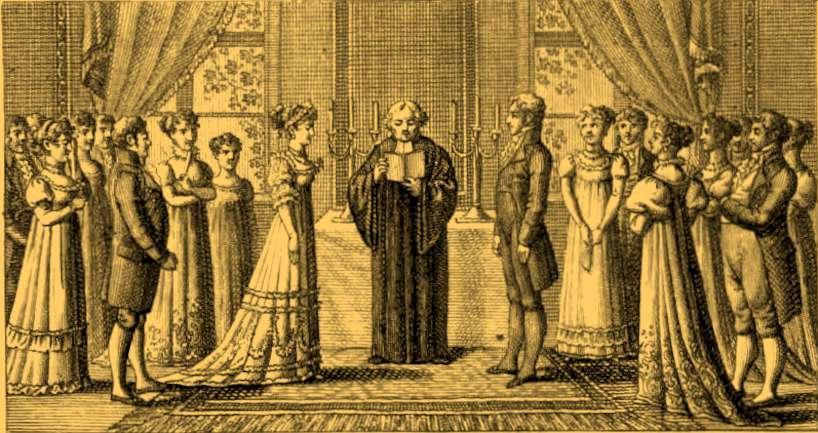
In 1774 Chodowiecki also did an affectionately satirical portrayal of such a ceremony with the title “The Commencement of Domestic Bliss” that does provide an illustration of the typical backdrop of such ceremonies at the time (Anfang der häuslichen Glückseeligkeit [1774]; Herzog August Bibliothek; Museums./Signatur DChodowiecki AB 3.85):

Of course, traditional weddings were performed in churches as well (Taschenbuch auf das Jahr 1805 für edle Weiber und Mädchen; second illustration: Berlinischer Damen Kalender auf das Jahr 1809; both illustrations: Inhaltsverzeichnis deutscher Almanache, Theodor Springmann Stiftung):

Chodowiecki also did a stylized but more serious illustration of the romantic embrace of the sort Caroline here mentions that characterizes this “second period of life” upon which she was embarking, and an illustration evoking Caroline’s reference to “parents, sisters, brothers, friends greeted me with all their good wishes, blessings” ([1] Der Lebenslauff. II te Periode [1793]; Herzog Anton Ulrich-Museum; Museums./Signatur DChodowiecki AB 3.942; [2] Es lebe unser Graff und unsre Gräfinn [1786], Herzog Anton Ulrich-Museum; Museums./Signatur DChodowiecki AB 3.710):

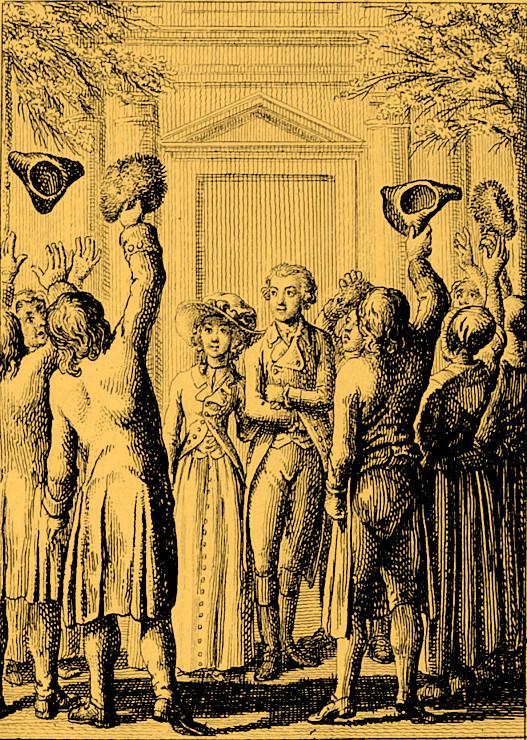
[5] Wednesday, 16 June 1784, the morning after the bridal night; see the following illustrations (Taschenbuch für das Jahr 1813: Der Liebe und Freundschaft gewidmet [Frankfurt]; Inhaltsverzeichnis deutscher Almanache, Theodor Springmann Stiftung; Daniel Nikolaus Chodowiecki, Peter Marks und seine Frau nach der Hochzeitsnacht [Peter Marks and his wife the after the bridal night] [1779]; Herzog August Bibliothek Museumsnr. / Signatur Chodowiecki Sammlung [2-121]):


[6] Presumably the Michaelis sisters (Lotte and Luise) with the Böhmer sisters. Back.
[7] Hymenaeus or Hymen, originally associated with Greek weddings in the bridal song (hymeneal) or some version of the customary outcry Υμεναι ω or ω Υμην Υμεναι, but of an unknown origin; it eventually was taken as the invocation of a being by this name and various stories invented about its association with weddings (a handsome, happily married young man or youth, etc.) (Oxford Classical Dictionary [1973], 534 s.v. Hymenaeus; Wörterbuch der Antike, 7th ed. [Stuttgart 1976], 257 s.v. Hymenaios). Hymenaeus has generally been represented as a young man wearing a garland of flowers and holding a burning bridal torch (Václav Hollar, Hymenaeus and Cupid; University of Toronto, Wenceslaus Hollar Digital Collection):

References to him appear in five of Shakespeare’s plays; see Aristophanes, Peace, lines ca. 1315–59 (The Complete Greek Drama, ed. Whitney J. Oates and Eugene O’Neill, Jr., 2 vols. [New York 1938], 2:720–21):
Trygaeus (coming out of the house): Silence! Keep silence! Here is the bride about to appear! Take nuptial torches and let all rejoice and join in our songs. Then, when we have danced, clinked our cups and thrown Hyperbolus through the doorway we will carry back all our farming tools to the fields and shall pray the gods to give wealth to the Greeks and to cause us all to gather in an abundant barley harvest, enjoy a noble vintage, to grant that we may choke with good figs, that our wives may prove fruitful, that in fact we may recover all our lost blessings, and that the sparkling fire may be restored to the hearth. (Opora comes out of the house, followed by torch-bearing slaves.) Come, wife, to the fields and seek, my beauty, to brighten and enliven my nights. Oh! Hymen! oh! Hymenaeus!
Leader of the chorus (singing): Oh! thrice happy man, who so well deserve your good fortune! Oh! Hymen! oh! Hymenaeus!
Chorus (singing): Oh! Hymen! oh! Hymenaeus!
Trygaeus (singing): What shall we do to her?
Chorus (singing): What shall we do to her?
Trygaeus (singing): We will gather her kisses.
Chorus (singing): We will gather her kisses.
Leader of the chorus (singing): But come, comrades, we who are in the first row, let us pick up the bridegroom and carry him in triumph. Oh! Hymen! oh! Hymenaeus! Oh! Hymen! oh! Hymenaeus!
Trygaeus (singing): You shall have a fine house, no cares and the finest of figs. Oh! Hymen! oh! Hymenaeus! Oh! Hymen! oh! Hymenaeus!
Leader of the chorus (singing): The bridegroom’s fig is great and thick; the bride’s very soft and tender.
Trygaeus (singing): While eating and drinking deep draughts of wine, continue to repeat: Oh! Hymen! oh! Hymenaeus! Oh! Hymen! oh! Hymenaeus! Hail, hail, my friends. All who come with me shall have cakes galore.
The Lesses’ son mentioned here (name unknown) died at a very young age, shortly after his mother’s death in 1791, so that Gottfried Less lost not only his stepdaughter, but also his wife and son; only his daughter outlived him (Nekrolog auf das Jahr 1797, Achter Jahrgang, Zweyter Band, ed. Friedrich Schlichtegroll [Gotha 1801], 234–35). Back.
[8] The studied bucolic, pastoral setting of Caroline’s reception, not least under the influence of Rousseau, accords with the popular motif of natural gardens and arbors (see also above) ([1] title vignette to Ferdinand und Luise: Eine wahre Geschichte, Neue Original-Romane der Deutschen 16 [Leipzig 1785]; [2] Taschenbuch zum geselligen Vergnügen für 1793; Inhaltsverzeichnis deutscher Almanache, Theodor Springmann Stiftung):


One might broadly imagine the “throne of moss and flowers and with high steps” of which Caroline speaks set up in one of the illustrations below (in order: [1] Daniel Nikolaus Chodowiecki, Quand tout à coup je te vis pâlir [1782]; Herzog Anton Ulrich-Museum; Museums./Signatur DChodowiecki AB 3.474; [2] Beleidigung des Herrn von Säugling [1775]; Herzog Anton Ulrich-Museum; Museums./Signatur DChodowiecki AB 3.109; [3] Non — ce n´est pas ainsi que nous devons nous séparer [1787]; Herzog Anton Ulrich-Museum; Museums./Signatur DChodowiecki AB 3.758):


Three period illustrations of harpists in similarly pastoral or bucolic settings; the second depicts a remarkably similar wedding reception in a garden setting ([1] Toiletten Kalender für Frauenzimmer [Vienna 1792]; [2] Frauenzimmer Almanach zum Nutzen u. Vergnügen für das Jahr 1806; both: Inhaltsverzeichnis deutscher Almanache, Theodor Springmann Stiftung; [3] frontispiece to Carl Gottlob Cramer, Das Harfen-Mädchen [Rudolstadt 1800]):


The bucoloic setting continues insofar as the lines Caroline cites come from the initial verse of the final musical round in the singspiel by Christian Felix Weisse, Die Liebe auf dem Lande: eine komische Oper in drey Aufzügen (Love in the country: a comic opera in three acts) (Frankfurt, Leipzig 1778), 202; also in Weisse’s Komische Opern von C. F. Weisse, part 1 (Carlsruhe 1778), 186 (the character of the count sings; bucolic title vignette from the musical score itself [see below]):

The love that does ignite this couple
Was the wish of the two of them alone:
Upon a throne of flowers do they find
That happiness of contentment.
     [Caroline: Perpetually the art of being happy]
Both at false honor do laugh:
Their happiness is innocence, love, and faithfulness!
     [Final lines not cited by Caroline:]
Ah, but unfelt every joy if our heart be not present,
If our heart be not present,
If our heart be not present.
Here the music and (German) subsequent verses by Johann Adam Hiller, Die Liebe auf dem Lande, eine komische Oper in drey Acten, in die Musik Gesetz von Johann Adam Hiller, 2nd ed. (Leipzig 1770), 84–85:

[9] Uncertain reference. Erich Schmidt (1913), 1:682, remarks that “Waitz [(1871), 1:318] read this name as ‘Osten,’ [though it is] probably the theologian Johann Bernhard Gottfried Osann.” Therese Huber Briefe, 1:817, however, lists a certain Göttingen physician and private lecturer Samuel Christian Gotthold Osann (1743–84). Back.
[10] 17 June 1784. Back.
[11] Déjeuner, here: breakfast; below: souper, here: evening dinner.
Otherwise uncertain reference. The breakfast possibly took place at the home of Caroline’s mother’s brother, Johann Friedrich Schroeder (Schröder), who seems to have succeeded his mother, Anna Klara Schröder, as the Göttingen postmaster, who in her own turn succeeded his father and her husband when the latter died in 1761 (Protokolle über die Sitzungen des Vereins für die Geschichte Göttingens im sechsten Vereinsjahre 1897–98, vol. 2, no. 1, ed. August Tecklenburg [Göttingen 1898], 132). Back.
[12] Johann Friedrich Blumenbach’s wife, Louise Amalie, née Brandes, was Georgine Heyne’s sister. Back.
[12a] Here such a dinner for a wedding company “Hochzeitsgesellschaft,” vignette for the month of September, Taschenbuch für das Jahr 1813 (Frankfurt), Inhaltsverzeichnis deutscher Almanache, Theodor Springmann Stiftung:

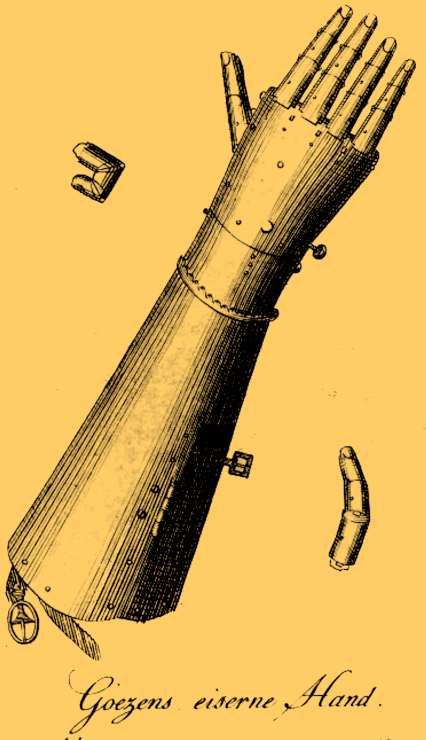
[13] From Goethe’s play Götz von Berlichingen (1771; published 1773), act 1, scene 2, here Goetz von Berlichingen with the Iron Hand: A Drama, trans. Sir Walter Scott, in The Works of Goethe, vol. 2 (New York 1902), 243. The historical Götz von Berlichingen lost his right hand in battle in 1504. It is no accident that Caroline and her friends cite lines from this popular play from memory.
Illustrations: (1) Johann Gottfried Brückner (1730–86) as the title character in the Gotha theater (Theater-Kalender auf das Jahr 1779); (2) undated engraving of the historical Götz’s second, mechanically more sophisticated prosthesis, or iron hand (Herzog August Bibliothek; Museums./Signatur Graph. A1: 1468b); (3) scene from Goethe’s Works, vol. 3, trans. George Barrie (New York 1885), 11:


Brother Martin: When you, Sir Knight, return to your castle, with the consciousness of your courage and strength, which no fatigue can overcome: when you, for the first time, after a long absence, stretch yourself unarmed upon your bed, secure from the attack of enemies, and resign yourself to a sleep sweeter than the draught after a long thirst, — then can you speak of happiness.
Goetz: And accordingly it comes but seldom!
Martin (with growing ardour): But, when it does come, it is a foretaste of paradise. When you return home laden with the spoils of your enemies, and remember, “Such a one I struck from his horse ere he could discharge his piece — such another I overthrew, horse and man,” then you ride to your castle, and —
Goetz: And what?
Martin: And your wife — (Fills a glass.) To her health! (He wipes his eyes.) You have one?
Goetz: A virtuous, noble wife!
Martin: Happy the man who possesses a virtuous wife: his life is doubled. This blessing was denied me, yet was woman the glory or crown of creation. Back.
[14] 18 June 1784. Back.
[15] Uncertain references. Back.
[15a] Frau oder Madam in original; concerning the use of these two titles at the time and in this project, see the initial paragraph of the supplementary appendix on honorific titles. — Caroline’s remark here is noteworthy and even prescient insofar as she would later become known in German literary history largely simply as “Caroline.” Back.
[15b] Here the Grätzel house on the left, just across the Leine Canal from the Michaelis house on the right (anonymous late eighteenth-century illustration):
[16] 19 June 1784. Back.
[17] 20 June 1784. Back.
[18] 21 June 1784, from which one can see that the altered timetable Franz Wilhelm Böhmer discusses in his letter to Caroline on 5 June 1784 (letter 43) was indeed the one they followed.
Here illustrations of how silhouettes — an extremely popular art form at the time — were produced ([1] Johann Eleazar Schenau [Zeissig], L´origine de la peinture ou les portraits à la mode [1645–1784]; Herzog August Bibliothek; Museums./Signatur Graph. A2:149; [2] Eugen Diederichs, ed. Deutsches Leben der Vergangenheit in Bildern, 2 vols. [Jena 1908], 2:541):


[19] Here the new bride, with her husband, touchingly takes leave of her parents (father in the background) and childhood home (frontispiece to Sigismund Sintenis, Mütterlicher Rath an meine Tochter, wie sie die glücklichste Gattinn, Mutter und Hausfrau werden könne!, 2nd rev. ed. [Halle 1794]):

Here several newlywed departure rituals in period illustrations (Taschenbuch für das Jahr 1813: Der Liebe und Freundschaft gewidmet [Frankfurt]; Inhaltsverzeichnis deutscher Almanache, Theodor Springmann Stiftung):


Nörten (today Nörten-Hardenberg), 10 km north of Göttingen, then Osterode (mentioned below) and Clausthal (Ignaz Heymann, PostKarte von Deutschland und den angrenzenden Laendern, 2nd ed. [Triest 1806]; Bibliothèque nationale de France, département Cartes et plans):

[20] Osterode am Harz, a town on the southwestern edge of the Harz Mountains; here two illustrations ca. 1845, colorized steel-plate engraving, Riegel/Hornemann, and Wilhelm Blumenhagen, Der Harz, Das malerische und romantische Deutschland: In zehn Sektionen 4, 2nd ed. (Leipzig 1847), plate following p. 152:


[21] Erich Schmidt, (1913), 708 (index s.v.), conjectures that Louise Nieper may also appear at the end of letter 54. Back.
[22] Tuesday, 22 June 1784. Back.
[23] Yet another telling, even ominous remark about the nature of her relationship with her husband and her expectations with respect to her marriage; see Caroline’s letter to Luise Gotter and Wilhelmine Bertuch on 28 May 1784 (letter 41), note 14.
Entry into marital status in the small mining town of Clausthal was a difficult and persistently awkward transition for this professor’s daughter from Göttingen (Daniel Nikolaus Chodowiecki, Szenen aus dem Alltagsleben [late 18th century]; Herzog August Bibliothek; Museums./Signatur Graph. A1: 161):

Translation © 2011 Doug Stott