
• 39. Caroline to Julie von Studnitz in Gotha: Göttingen, 17 February 1784 (Fr.) [*]
Göttingen, 17 Febr[uary] 1784
|76| How could I describe to my friend the state of my soul? And need I even do such? A simple narration will suffice to give your own soul the correct impression.
My brother has arrived safely in London. Because for so long I knew him to be in a different world, I now feel sufficiently close to him to feel that we are no longer truly separated. He is in the most agreeable situation there and will be returning in the month of April to assist in my nuptials.
Yes, my Julie, my destiny has been decided, and in such a fashion that I myself entreat you to congratulate me on it. I am, however, aware with every word I speak that I cannot tell you everything, so please be so kind as to make do with this little bit until I am tranquil enough to write, and master of my own time.
|77| My brother will be giving me to the man to whom he destined me from my childhood, namely, his best friend, who has loved me ever since. [1] Through this marriage I will be fulfilling the wishes of my family, my friends, and his friends; moreover, my own heart has long been in accordance with them. Guided by all these powerful motives, I made my choice — and it was literally that same choice. [1a] I am marrying a kind man, moreover a man who is himself loved, with a character of the sort one does not often encounter; the friend of a dear brother, and the brother of the best girlfriend I have here; [2] I am entering into a charming family who will welcome me with open arms; all of them are one in my heart, and I am the bond between them.
But you would doubtless like to know his name. He is the son of privy Justizrath Böhmer. [3] He is a physician in Clausthal in the Harz Mountains. [4] The proximity of Göttingen has vanquished the sadness of a separation whose bitterness I know only too well.
I will introduce you to Böhmer through my brother’s letters. You will see what sort of man it is with whom I will be uniting myself, and you will have the goodness of honoring him with your friendship by continuing your friendship for me.
The courier is waiting, and I cannot let him depart without these lines, imperfect though they may well be. They will persuade you at least that in the midst of inexpressible happiness, the memory of my friend never leaves me for even a single moment.
Caroline Michaelis
Notes
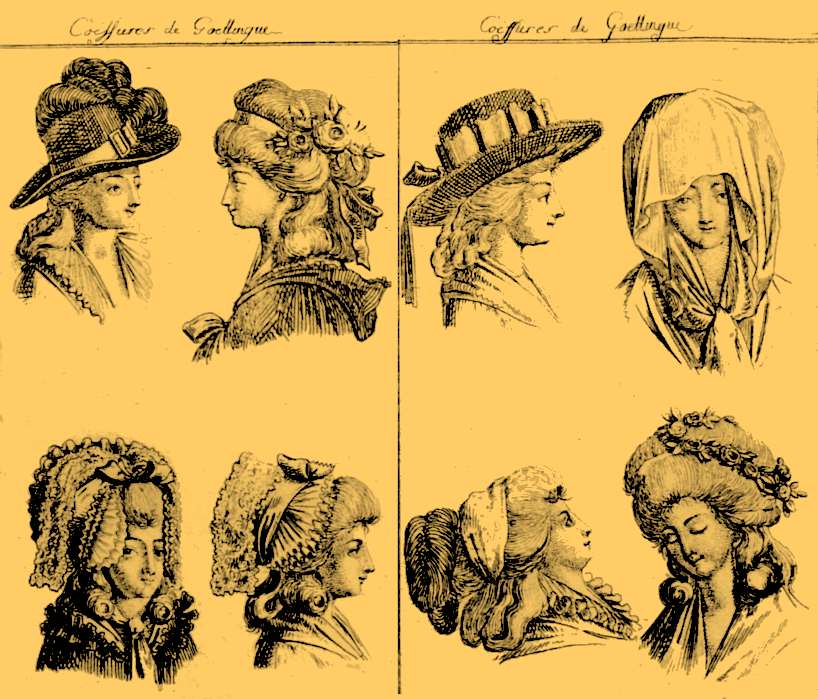
[*] Caroline is now a young woman twenty years old; it may be of interest to note hair and head-covering styles for young women specifically in Göttingen during 1784 (Goettinger Taschen Calender vom Jahr 1784; Inhaltsverzeichnis deutscher Almanache, Theodor Springmann Stiftung):
Caroline announces here for the first time, moreover, her engagement to be married: “My destiny has been decided” (Franz Ludwig Catel, Die Verlobung — Urania. [ca. 1776–99]; Herzog August Bibliothek; Museums./Signatur Graph. A1: 1394f):
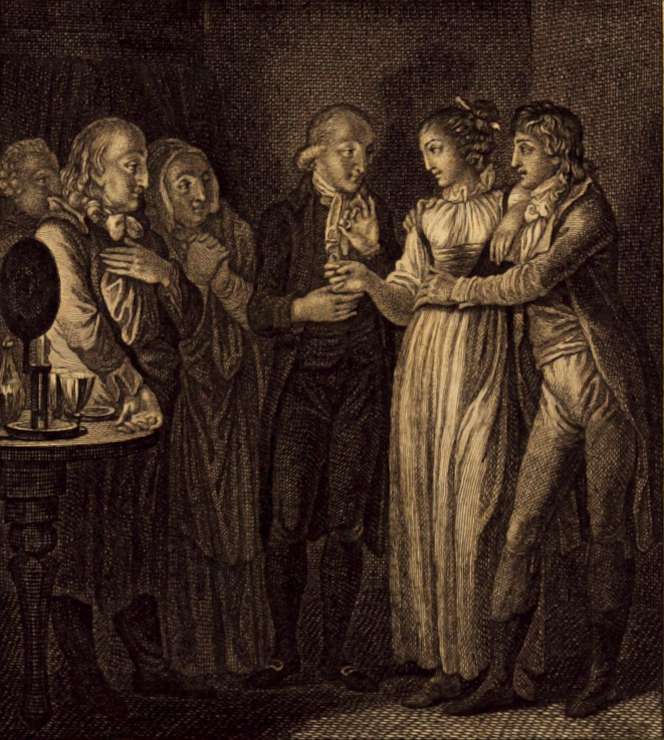
[1] Taschenbuch auf das Jahr 1800 der Liebe und Freundschaft gewidmet; Inhaltsverzeichnis deutscher Almanache, Theodor Springmann Stiftung:
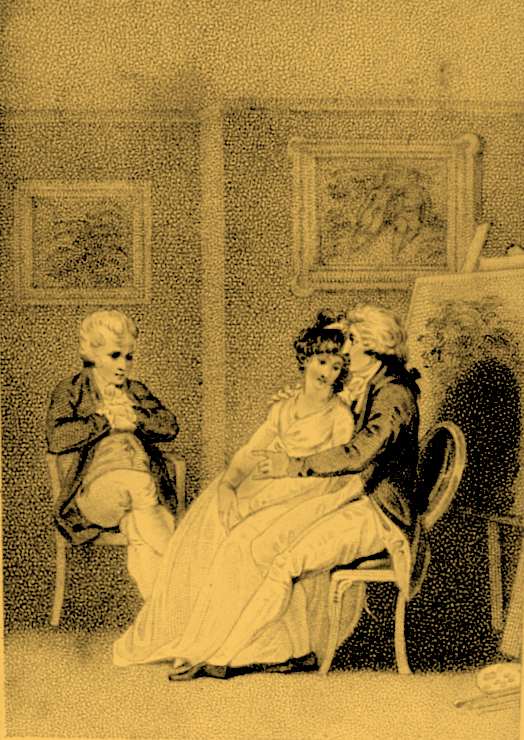
[1] A remarkably but understandably disingenuous statement, since women at the time rarely had the last word in choosing a marital partner and were often enough married off through (1) “coercion” or (2) “persuasion” rather than from (3) “inclination,” as portrayed in these three illustrations by Daniel Nikolaus Chodowiecki (in order: Heyrath durch Zwang. [1788], Herzog Anton Ulrich Museum, Museumsnr./Signatur DChodowiecki AB 3.775; Heyrath durch Überredung [1788], Herzog Anton Ulrich Museum, Museumsnr./Signatur DChodowiecki AB 3.769; Heyrath durch Zuneigung [1788], Herzog Anton Ulrich Museum, Museumsnr./SignaturDChodowiecki AB 3.765):
Coercion:
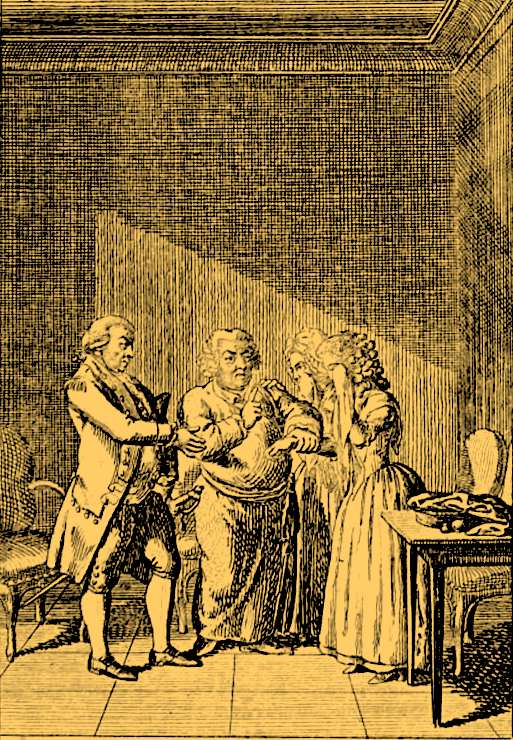
Persuasion:

Inclination:
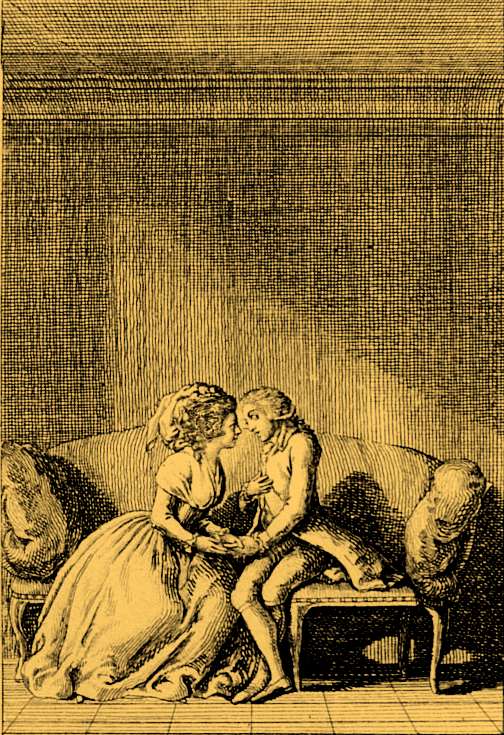
In contemporary literary portrayals, marriages of coercion or persuasion are frequently accompanied by the woman’s declaration of loyalty to the man whom she prefers by inclination (title vignette to Friedrich J. von Günderode, Die weibliche Beständigkeit: Ein Schauspiel in fünf Aufzügen, [Frankfurt, Leipzig 1781]):
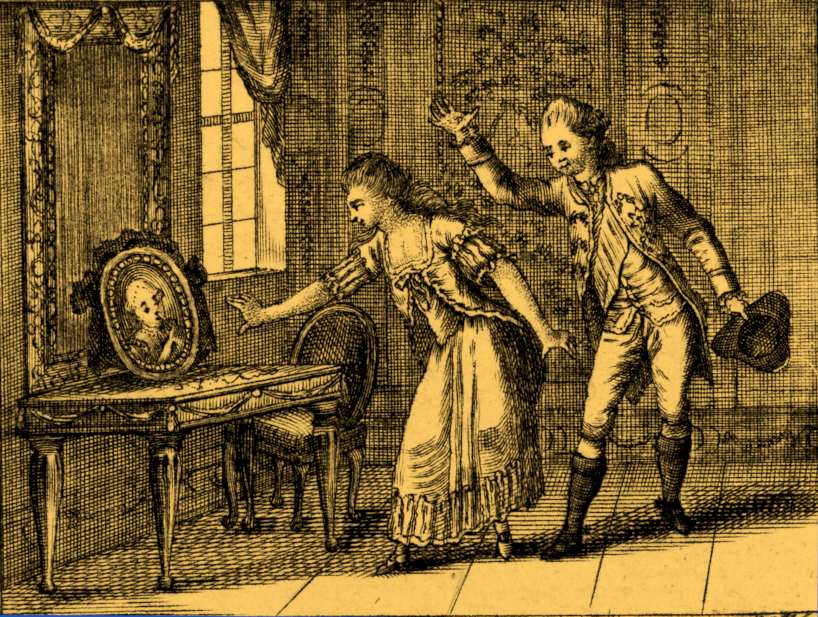
In any case Caroline’s father would have had to grant permission despite her rhapsodic enumeration of all the persons she, Caroline, would be pleasing by this alliance, notably herself in final position, and despite the allegation that her brother had already “destined” her for a particular man.
Generally, of course, the suitor personally asked for the hand of the daughter and was then subjected to careful “scrutiny” by the family and especially the father; presumably Franz Böhmer also made this gesture even though Caroline makes no mention of it ([1] Taschenbuch für das Jahr 1813: Der Liebe und Freundschaft gewidmet [Frankfurt]; Inhaltsverzeichnis deutscher Almanache, Theodor Springmann Stiftung; [2] and [3] (Österreichischer Taschenkalender für das Jahr 1801):):

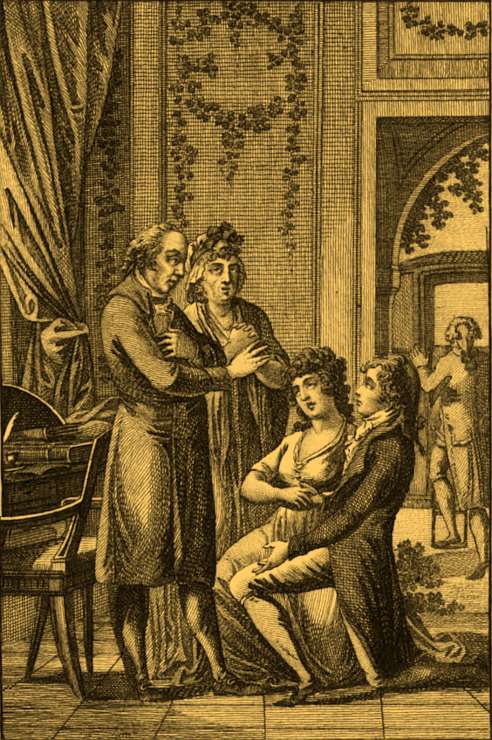
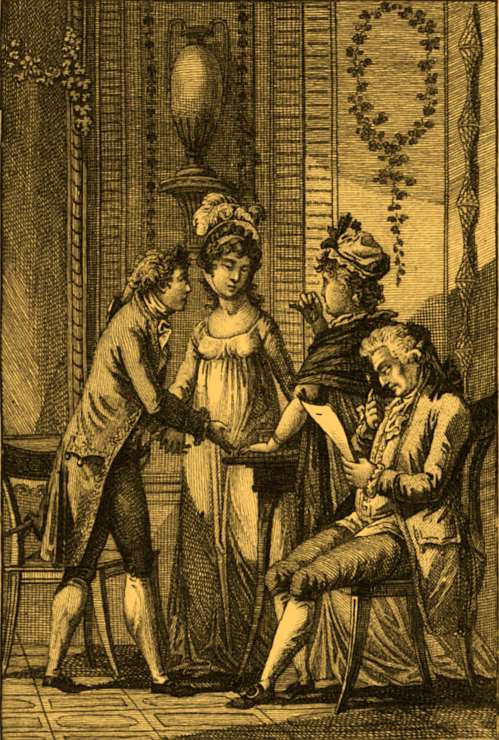
Here two engravings by Daniel Nikolaus Chodowiecki depicting a couple receiving the woman’s father’s permission and blessing (from Fragment einer Heirathsgeschichte [1794]; Herzog Anton Ulrich Museum; Museumsnr./Signatur DChodowiecki AB 3.988; Da nimm sie hin [ca. 1781–83]; Herzog Anton Ulrich Museum; Museumsnr./Signatur JARossmaesler WB 3.22):

[2] Although Caroline herself nowhere specifies exactly which of the Böhmer daughters she considered her best friend, her sister Luise Michaelis, in her memoirs (Erinnerungen,) p. 6, mentions that Emmi [Friederike] was “especially friends with Caroline and Lotte.” She goes on to remark that “Louise was later Lotte’s girlfriend, and I [Luise Michaelis] had contact and daily dealings with her at the time as well as with Philippine. Back.
[3] The elderly Geheimrath Georg Ludwig Böhmer had twelve children with his wife, among whom we are able to follow the lives of four sons and three daughters. Theirs was an extremely sociable household. Piter Poel’s Erinnerungen eines Greises (1835–37, not published separately, but rather anonymously in installments in the Altonar Merkur) quite charmingly describes Böhmer’s “pandect enthusiasm,” his ponderous self-awareness coupled with considerable kindness, his solemn didactic tone, and his expansive bluntness. These passages were then reprinted in Piter Poel, Bilder aus vergangener Zeit, 1:249–53, with an extensive family portrait and intimations that not all of Caroline’s fiancé’s friends (the elderly Böhmer’s second son, Johann Franz Wilhelm Böhmer) approved of his betrothal to Caroline (text see supplementary appendix 39.1). Karl August Varnhagen von Ense also published excerpts in his Denkwürdigkeiten und vermischte Schriften, 2nd ed., 9 vols. (Leipzig 1843–59), vol. 5 (1843), 487–90). Back.
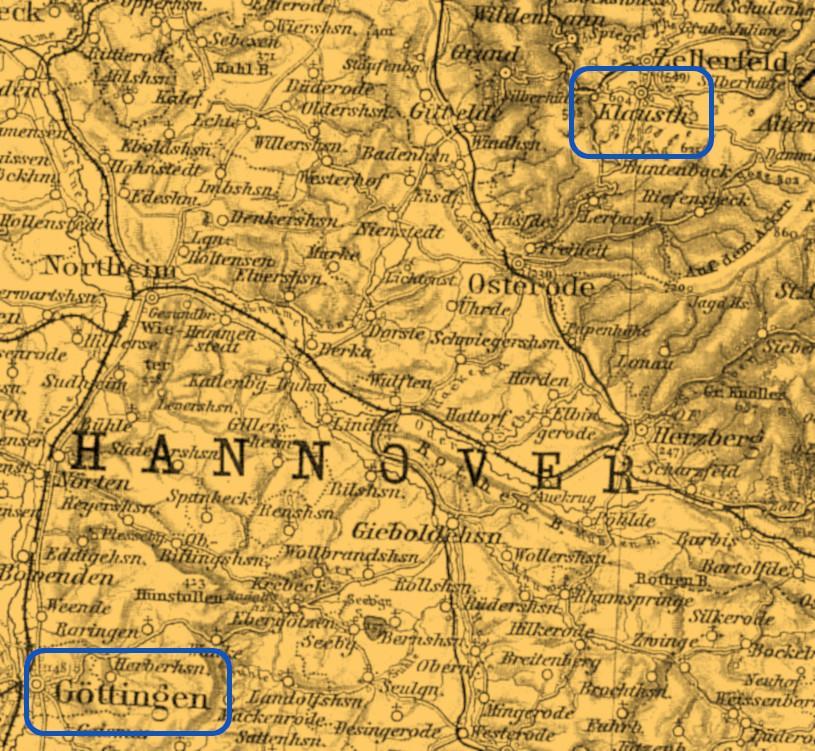
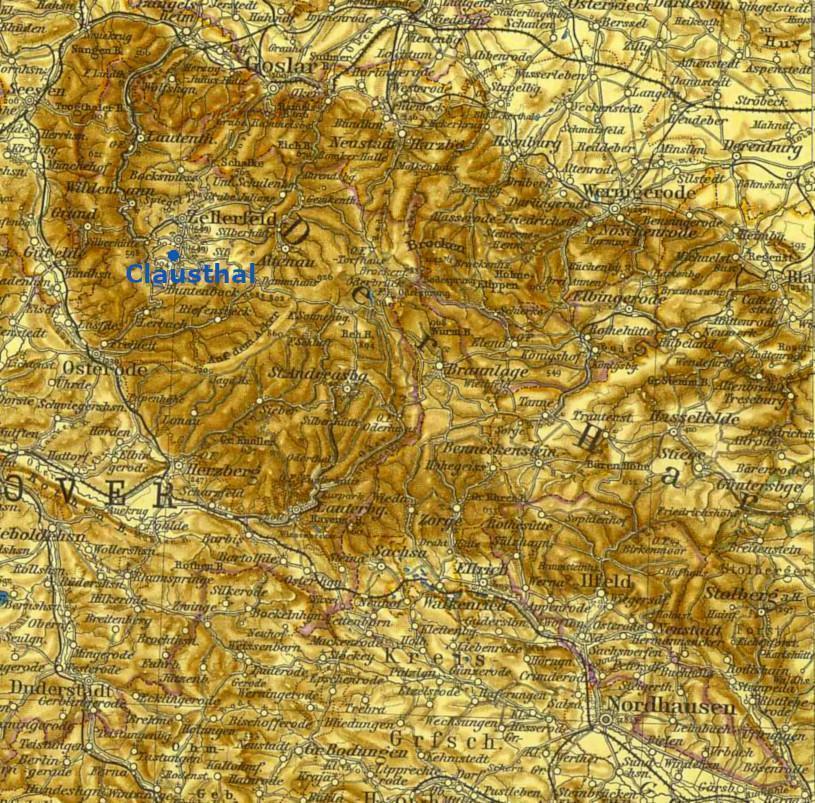
[4] Clausthal is located just over 40 km northeast of Göttingen, in the territory of Hannover nestled in the Harz Mountains (both maps: Karte des deutschen Reichs, ed. C. Vogel [Gotha 1907], no. 13; Rudolf Koch and Fritz Kredel, Deutschland und angrenzende Gebiete [Leipzig 1937]; illustration from Wilhelm Blumenhagen, Der Harz, Das malerische und romantische Deutschland 4, 2nd ed. [Leipzig 1847], plate following p. 232]):


See Caroline’s letter to Luise Gotter on 3 April 1784 (letter 40), for more illustrations of the dramatic landscapes in the Harz Mountains. Back.
Translation © 2011 Doug Stott