
• 204. Caroline to Friedrich Schlegel in Berlin: Jena, 14–15 October 1798 [*]
Jena, 14 October [17]98
|455| Today I can tell you all sorts of things you have been wanting to know.
Wilhelm remained back in Weimar [1] to speak with Göthe, who was indeed quite disposed to such conversation and in the best of moods with regard to Athenaeum, [2] and also in a quite appropriate mood with regard to your “Wilhelm Meister,” having comprehended not merely the seriousness, but also the commended irony in it; he is in fact quite satisfied with it and is already most cordially looking forward to the continuation. [3]
First he said that it was quite good, quite charmant, and after talking about the “weather” in this, his customary fashion, he also ardently approved of the way you dealt with it by consistently focusing on the structure of the whole instead of lingering amid a pathological “dissection” of individual characters. He then betrayed that he had read it quite closely by repeating many of the expressions you used, especially the ones involving irony. You have every reason now to finish your work from this side; hence do so with dispatch. [4]
He loaded Wilhelm down with greetings for you and asked several times to be excused for not having written, something that really can be explained by the bustling activity of the past three months, on which more later. He already dictated an entire, finished letter to Wilhelm and yet did not send it off. He also spoke about your Griechische Poesie; [5] he mentioned that he would have liked to have some passages discussed and elucidated in person |456| that he might view them perhaps from a somewhat longer and broader perspective. He also genuinely read it, nor can one ever accuse him otherwise.
He was uncommonly interested in the fragments; [6] his opinion was that you two have put yourself on war footing, yet he did not raise a single objection even to that; he only thought it an excessively large number [addendum from W. Schlegel: the pivot of his general assessment was that there really was too much waste] and that it should have been subdivided. Wilhelm responded by saying that it admittedly could not be read in one sitting, whereupon he murmured something about not being able to put it down after all, so attractive did he find it.
A great many people in Weimar are reading Athenaeum. A certain Friedrich von Oertel defended Jean Paul against you, his article is appearing in the Merkur [addendum from W. Schlegel: in the October issue], though we have not yet seen it. [7] Böttiger told Wilhelm in this regard that though he himself did not want to include it, Wieland maintained that since it was, after all, modestly written, they really had no grounds for declining it. [8]
We knew nothing yet about Carl Nicolai’s mischief, [9] but we will be able to get it here, as well as what Hirt writes, [10] and Wilhelm for his part is hoping the number will quickly increase exponentially. Tiek’s note will be taken care of; but did he not let himself go on too long in it? [11]
We spoke to a young man in Dessau [12] who had just come from Vienna, where he had seen a letter from Böttiger to Hammer (who can occasionally be found in the Merkur), which in his recollection contained the words: “those two divinely impish rogues, as Wieland calls them” — the rest was some sort of account which he has since forgotten regarding what you two had done or where you were currently residing. The only real issue is whether he put the emphasis more on “divine” or “impish.”
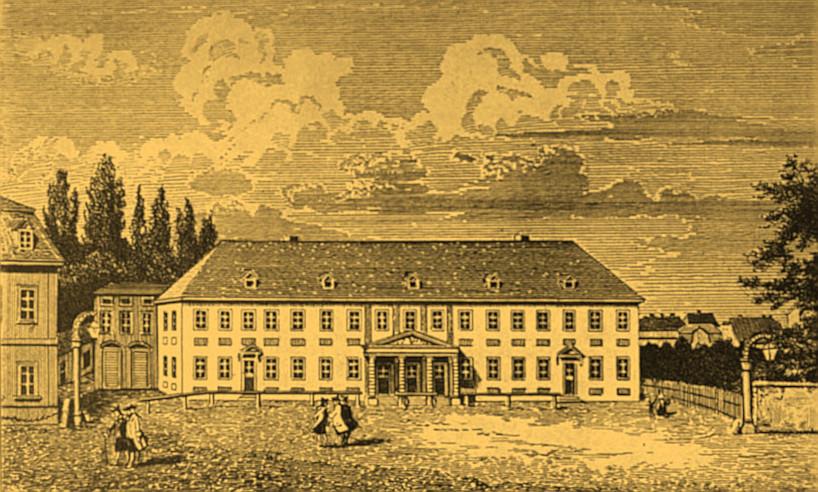
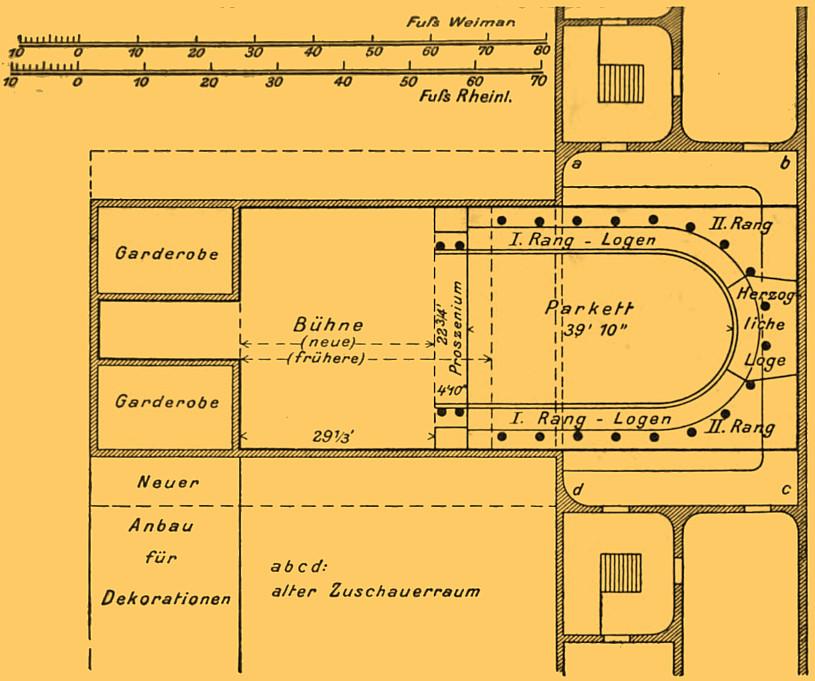
Now, concerning Göthe’s bustling activity. He has completely remodeled the |457| Weimar theater on the inside and turned it into an inviting, sparkling fairy palace. [13] I was astonishingly well pleased with it. An architect and decorator from Studtgart was engaged for the task, and within 13 weeks columns, galleries, balconies, and curtains were constructed and all sorts of things adorned, painted, and gilded, but genuinely with taste. The illumination is extremely nice, coming from a broad garland of English lamps hovering in a small cupola through which the building’s haze also escapes.
Göthe was like an excited child during this whole process; he spent the entire day there before the theater’s grand opening, [14] from morning till late in the evening, eating and drinking there and even pitching in and working with his own hands. He had to put up with some extremely rude billets and complaints concerning various furnishings that were changed and concerning a price increase, but he took it all with a cheerful disposition for the sake of getting things finished, all of which are being funded by the theater box office.
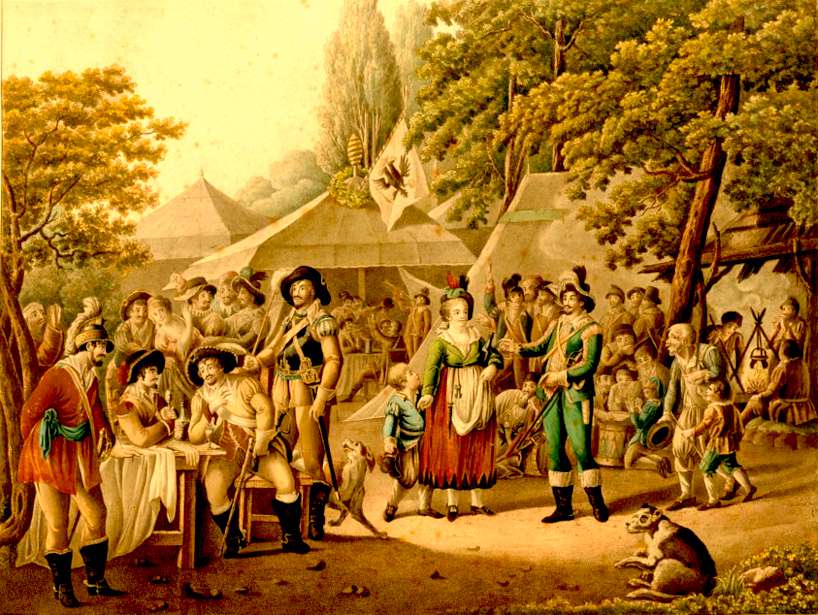
Then the actors also had to be oriented so they could properly perform the prologue, in which they found everything strange and unprecedented. It depicts Wallenstein’s camp, as you know, and is composed in rhymes in the style of Hans Sachs, [15] full of life, energy, the spirit of the age, and imaginative ideas. But it has taken Schiller years to produce what Göthe (not counting the background studies) might perhaps have written in a single afternoon, and that, as always, says a lot. Basically (I have this from Wilhelm), in order to remain a realist and to keep from falling into sentimentality, Schiller sold himself to the devil.
But enough, it is good; he derives all the honor from it and the others considerable plaisir. Nor were Göthe’s efforts in vain; the company performed excellently, it was the most consummate ensemble, not a trace or disorganization amid the tumult. Visually, as well, |458| it came across most superbly. As you might imagine, the costumes were carefully assembled and in their own turn contrasted quite nicely with one another. [15a] For the prologue, a new and quite beautiful set had been prepared. —
The renovation of the building included removing Schiller’s cage such that now he had to present himself on the open balcony, initially alongside Göthe, then next to the ducal loge. We were seated in the parquet, which costs the same as the balcony, where we also could have gone except that we preferred to choose the familiar seats. — Kotzebue’s Korsen was performed first. [16]
During the prologue, people laughed and applauded more. This actor unquestionably prompts completely different, more animated and concrete enthusiasm than does the poet himself, though in this instance the generally cooler attitude toward the latter and even toward his very presence may have played a role as well, quite apart from the fact that people necessarily found the thing rather strange, and on top of that allegedly also found it excessively long.
The Piccolomini will probably be performed in December, [17] similarly, as it were, on a trial basis, making do with our actors. Göthe believes the elder Piccolomini (for both father and son appear in the play) would be a good role for Iffland. People are already counting on Schröder. [18] —
Göthe arrived here again today to continue his assessment of the earlier effect of the prologue and to consider the future effect of the Piccolomini. All the better for us. —
Schelling rode back that night with me in Schlegel’s stead. Gustel did not come along, we had come together with Gries [19] and Mayer. [20] It was simply too expensive, 1 Thaler for each billet. But she will eventually see it, and I related everything to her. After the performance, Fichte forced 4 glasses of champagne on me; let me not forget to report that to you. [20a]
Schelling will allegedly wall himself in from now on, as he puts it, but |459| will doubtless not see it through. He is someone who sooner breaks through walls. Believe me, friend, as a person he is more interesting than you are admitting, a real primal being, viewed as a mineral: pure granite.
Tiek has as little need to become scandalized over Göthe’s silence as do you, since he is also asking him for forbearance. And I can also relate to you his assessment of the 1st part of Sternbald; you can pass it along to Tiek. One might, Goethe thinks, actually be more inclined to call it “musical wanderings,” since there are so many musical perceptions and stimuli (my own choice of words, by the way), and since it contains everything except the painter. If it was supposed to be an artist’s novel, it really should have spoken quite differently about art, but as it is, he, Göthe, failed to find the proper content, and the artistic element emerged instead as a false tendency.
But he did read it, indeed, twice, and does give it considerable praise. It contains many quite beautiful sunrises, as he put it [addendum from W. Schlegel: from which one can, Goethe thinks, see that the poet’s eye was in a strict sense genuinely delighting in colors, it is simply that they recurred too frequently]. [21]
Would you now like to hear my judgment on the second part? Only this much concerning the first: I am still doubtful whether the love of art should not intentionally have been portrayed as a false tendency in Sternbald and then ultimately not turn out well, as in Wilhelm Meister, but then a different inadequacy obviously emerges — for then it contains too little of the human side.
The second part still has provided no light for me. How is it possible that you prefer it to the first and even in a general sense give it so much more attention? [22] It suffers from precisely this indeterminate element, and lacks any really penetrating power — the reader is always hoping for something decisive to happen, to see Franz make genuine progress at some point. But does he do that?
A great many charming |460| sunrises and springtimes are again offered; day and night diligently alternate, the sun, moon and stars all rise as they ought, the little birds sing; it is all quite nice, but — empty, and the trivial change of moods and feelings in Sternbald himself is given a trivial portrayal. There are almost too many verses, which weave as loosely in and out of one another as do the attached stories and events, which, I might add, exhibit quite a few quiet traces of imitation of various sorts.
Am I being too severe, or am I simply wrong? Wilhelm is going to read it aloud to me, I want to see how we end up judging it together.
15 October
I have almost as little artistic sensibility as Tiek’s dear Amalie, for yesterday I fell asleep while reading it, which does not, however, mean anything. [23] But I do own that, awake, we agree in the above. It does not sweep you away, nor does it keep your attention despite various individual elements that are indeed pleasing enough, such as Florestan’s manner during the song competition, which pleased Wilhelm. [24]
The reader tends to linger most readily in the more lively scenes, but even then, who can keep from thinking that this is Wilhelm Meister, and too much Wilhelm Meister? For the rest, the old melancholy rears its head again. A fantasy that constantly flutters and flaps its wings and yet never quite gets off the ground. I really am sorry it does not strike me any other way. But please relate Göthe’s judgment to him openly.
Meyer was here this morning. He came with apologies as well, allegedly did not know your address but is extremely grateful and has studiously read you. Quite without being prompted, he began talking about Wilhelm’s fragments on art, which he says pleased him greatly and in which a great deal is allegedly to be found, and in short, he |461| was wholly satisfied with them. [25] What do you think he will have to say about “Die Gemählde”? [26]
Fernow in Rome has written a strong treatise contra Hirt’s “Laokoön.” It has not been published yet. [27]
The Allgemeiner Literaturanzeiger allegedly contains a coarse invective against you, including in the matter of Jean Paul. [28] How crazy that one did immediately think of you in this matter. Oertel also mentions you; he filled up a couple of insipid pages based on the same misunderstanding of your ironic treatment of Göthean emptiness that led Jean Paul astray, who will be residing in Weimar in the future. I will certainly be curious to see how he behaves toward us.
Hardenberg did not travel over here. — Charlotte’s child is getting better. [29] — Schleusner is dead.
. . . In closing now let me ask you in all honesty whether the project with Henriette yielded all the gifts for which you conjured and entreated the shadows — the same spirit and love. To that end, nothing had to be fetched from the depths. I took absolutely all of it away from the surface such that I have absolutely nothing against this plan in any respect and believe it is perfectly doable if you otherwise believe that all our personalities fit together, as seems to be your conviction. [30]
Earthly considerations will certainly present no obstacle to me. Henriette can live with us without it costing us so much more that such might become an issue. She can cover her private expenses herself, just as she is probably also doing now, and otherwise it will be like having one of my sisters staying with me. [31] —
Nor is my soul burdened by a more spiritual earthly consideration, namely, concerning the innocent attraction between her and Wilhelm. [32] And so I like the idea very much indeed, and if nothing about it bothers Henriette herself, I would think it might |462| quite easily be implemented this summer when we come to Berlin and could take Henriette with us. [33] I am speaking solely for myself, since Wilhelm has left it completely up to me.
But now tell me in confidence about the other projects for your relatives. Is there nothing for me among them? It must, however, be so easy for everyone.
Adieu, Friedrich.
Please tell Unger that the index of errata was not included with the copies of Shakespeare, also Reichardt’s compositions for Twelfth-Night; or, What You Will. [34] What might the status of those things be?
Will Woltmann not oust you, slander you, and wholly unseat you with Madam Unzelmann? [35] Can she even stand him? How does he act toward you? I would really think you two ought to properly reconcile, and since I must write to Madam Unzelmann soon and have absolutely no idea what to say, I will charge her with helping in that regard. [36]
Is Schleiermacher happy, tout à fait? that he, too, — is permitted to kiss feet?
Notes
[*] Reprinted in KFSA 24:176–81, which points out (24:410) that the location of the manuscript to this letter is unknown, it in any case not being extant in the Sächsische Landesbibliothek in Dresden. Back.
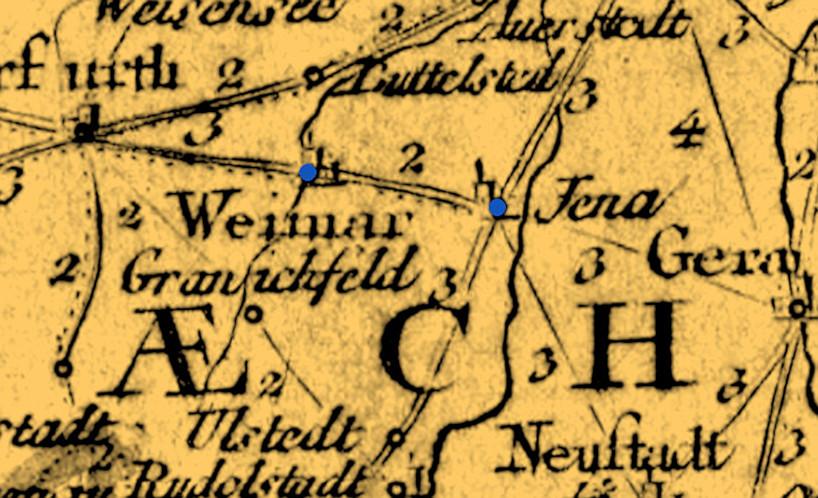
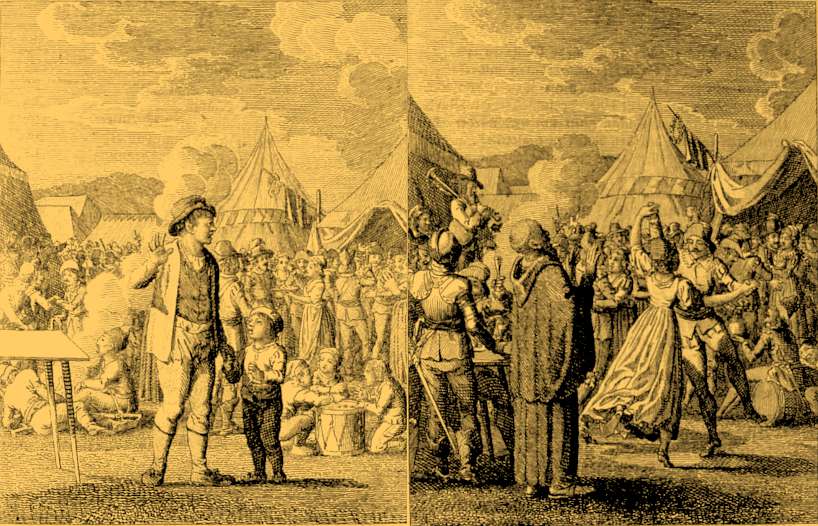
[1] That is, Wilhelm remained in Weimar after the premiere of the first part of Schiller’s Wallenstein trilogy, Wallensteins Lager (Wallenstein’s camp; with prologue) in the Weimar theater on 12 October 1798, which Caroline, Wilhelm, and Schelling attended (map: Post Karte Durch ganz Deutschland, ed. J. Walch [Augsburg 1795]; text: Dramatic Works of Friedrich Schiller: Wallenstein and Wilhelm Tell, trans. James Churchill [London 1908], 3; illustrations: [1] Schiller’s Works, ed. J. G. Fischer, vol. 2 [Philadelphia 1883], 115; [2] and [3]: Taschenbuch für Frauenzimmer von Bildung auf das Jahr 1800; Inhaltsverzeichnis deutscher Almanache, Theodor Springmann Stiftung):
Scene I.
Sutlers’ tents — in front, a Slop-shop. — Soldiers of all colours and uniforms thronging about. — Tables all filled. — Croats and Hulans cooking at a fire. — Sutler-woman serving out wine. — Soldier-boys throwing dice on a drum-head — Singing heard from the tent.

[2] The second issue of Athenaeum (1798) had appeared in July 1798.
Goethe’s reception was quite different than that of Schiller, who rejected Athenaeum outright and especially its “Fragments” and the “Litterarischer Reichsanzeiger” and who later also found Wilhelm Schlegel and Ludwig Tieck’s Musen-Almanach für das Jahr 1802 “utterly repugnant” (to Goethe on 23, 27 July 1798; 16 August 1799; 28 October 1801).
Goethe, on the other hand, defended the “wasps’ nest” of the “Fragments,” even the “impiety” toward Christoph Martin Wieland, which in his opinion would have been better left out entirely (to Schiller on 27 July 1798; 17 August 1799), even though he could not discern any stable internal center in the two brothers. For the texts of this correspondence, see supplementary appendix 204.1. Back.
[3] Friedrich’s essay “Über Goethe’s Meister,” Athenaeum (1798) 323–54; Jugendschriften 2:165–82; KFSA 2:126–46. Friedrich writes to Schleiermacher on 3 July 1798 (Aus Schleiermacher’s Leben 3:75; KFSA 24:140–41):
I have not yet heard anything of significance here concerning my Übermeister . . . for Caroline the first piece was too short to give her an unequivocal impression. Although she does in the meantime admit that Goethe is not really a complete person, she will not, however, concede that, as I maintain, he is in part a god and in part a marble statue. Thus it stands with her, and her intention is also still the same.
Friedrich goes on to say that “the old gentleman,” advising merely fair and just moderation in the matter,” did praise Athenaeum, much to Wilhelm’s delight. “Caroline said that he would not notice the irony in my essay. That says a lot.” Back.
[4] Friedrich never wrote the anticipated continuation of his essay. Back.
[5] Friedrich Schlegel, “Ueber das Studium der Griechischen Poesie,” Griechen und Römer, 1–250; Jugendschriften 1:85–178; excerpted in Deutschland (1796) 6, no. 8, 393–415. Back.
[6] The “Fragmente,” conceived as a seditious piece positioned before Friedrich’s article on Wilhelm Meister in this second issue of Athenaeum (1798) 179–322 (Jugendschriften 2:203–88); composed by Friedrich with contributions from Wilhelm and Schleiermacher. Back.
[7] Friedrich von Oertel’s insignificant (thus Erich Schmidt) essay, “Ueber Jean Paul Richter. Herrn Friedrich Schlegel gewidmet,” in Der Neue Teutsche Merkur (1798) 3, no. 10 (October), 174–78, contra Friedrich’s invective against Jean Paul in the “Fragmente” (Athenaeum [1798] 307–9; for the text of the fragment from Athenaeum, see Friedrich’s letter to Wilhelm Schlegel and Auguste Böhmer on 18 December 1797 [letter 194] with note 4). Back.
[8] Wieland seems to have deleted a note Karl August Böttiger wrote as an accompaniment to the article. In correspondence, Wieland speaks about the “conscious literary hyberbolus” and insists it took him some time before he overcame the “cargo load of sneezing powder with which you were intent on regaling the German reading public at my cost on the occasion of Richter, Lafontaine, and the Schlegel brothers.” Back.
[9] Out of a sense of rancor, Karl August Nicolai had published a list of Ludwig Tieck’s “collected works” in the advertiser of the Berlinisches Archiv der Zeit und ihres Geschmacks (1798) October, pp. 31f.) as an “announcement for friends of fine literature” and then, despite Tieck’s protests, published an edition.
Koberstein recounts the basic sequence of this quarrel between Tieck and Nicolai in vol. 4, Vom zweiten Viertel des achtzehnten Jahrhunderts bis zu Goethes Tod, 5th ed. (Leipzig 1873) 586–87 (summary):
Apparently Nicolai included not only Tieck’s version of the Tempest (Der Sturm), but also the anonymous novel William Lovell 3 vols. (Berlin, Leipzig 1795–96), the Volksmährchen, “ed. P. Leb(e)recht,” 3 vols. (Berlin 1797), the anonymous novel Abdallah (Berlin, Leipzig 1795), and Peter Leb(e)recht (pseudonym), Eine Geschichte ohne Abenteuerlichkeiten, 2 vols. (Berlin 1795–96), as well as alleged translations of the English novels Der Demokrat, Kloster Netley, and Schloss Montford, which in fact had been translated by others. Despite Tieck’s protests, Nicolai did indeed publish these works in twelve volumes simply by adding a common title page to all of them, namely, Ludwig Tieck’s sämmtliche Werke (Berlin, Leipzig: Nicolai, 1799) (not Schriften, as Tieck writes in his protest; see below).
Tieck published several counterstatements and refutations: See the Berlinisches Archiv der Zeit; see also Tieck’s “Contra the Bookseller Karl August Nicolai,” Intelligenzblatt of the Allgemeine Literatur-Zeitung (1798) 161 (Wednesday, 7 November 1798) 1335–36. See finally also the Anzeiger of the Berlinisches Archiv der Zeit (1798) November, pp. 46ff., and Tieck’s Schriften, vol. 11 (Berlin 1828), beginning on p. viii. Back.
[10] Concerning the dispute between Wilhelm Schlegel and Hirt, see the supplementary appendix on the Laocoön dispute with Alois Hirt. Back.
[11] The reference is to Tieck’s lengthy letter to the editors of the Allgemeine Literatur-Zeitung, “Contra the Bookseller Karl August Nicolai,” Intelligenzblatt of the Allgemeine Literatur-Zeitung (1798) 161 (Wednesday, 7 November 1798) 1335–36 (see note 6 above). Tieck apparently sent this letter — dated 3 October 1798 — to Caroline and Wilhelm to pass along to the editors in Jena. The letter occupies almost two entire columns of the in any case large format Intelligenzblatt of the Allgemeine Literatur-Zeitung, and Tieck himself, sensing the perhaps inappropriate length, concluded his letter as follows:
I am, by the way, quite sorry for having to waste so many words because of this man, but I felt compelled to do so because Herr Nicolai has publicly alleged untruths concerning me and has otherwise violated his obligations toward me. Back.
[12] I.e., when Caroline, Wilhelm, and Auguste were visiting the Tischbein family on their way back to Jena from Dresden. Concerning visits to the Tischbein family during this period, see supplementary appendix 181c.1. Back.
[13] Here the exterior of the theater in Weimar after the renovation of 1798 and the 1798 blueprint for the renovation of the theater within the earlier structure; note the stage (Bühne to the left, the ducal loge (Herzogliche Loge) to the right, and the first and second balconies of loges (I. Rang, II. Rang) (Adolph Döbler, Lauchstädt und Weimar: Eine theaterbaugeschichtliche Studie [Berlin 1908], illustrations [in order] following pp. 64 and 56):
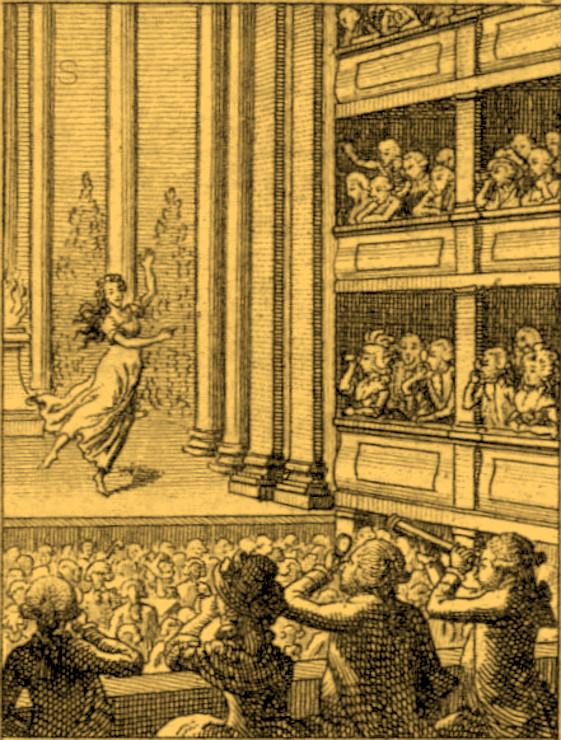
Here illustrations of similar theater spectator arrangements with loges and parterre ([1] Der neuesten Moden Almanach auf das Jahr 1795; Inhaltsverzeichnis deutscher Almanache, Theodor Springmann Stiftung; [2] Joseph Richter, Bildergalerie weltlicher Misbräuche: Ein Gegenstück zur Bildergalerie katholischer und klösterlicher Misbräuche [Frankfurt, Leipzig 1785], illustration following p. 248):

The Weimar theater location (“G”) is indicated at bottom center on the following map, Market Square (Markt) at center right, and the residence castle (Schloss) at the top (Hand-Atlas der Erde und des Himmels in 70 Blättern, ed. Heinrich Kiepert, C. und A. Gräf, C. Bruhns [Weimar 1855])

[14] On 12 October 1798. Back.
[15] Using rhymes “in the style of Hans Sachs” refers to the use of sixteenth-century Knittelverse with four stresses over an irregular number of unstressed syllables, usually in rhyming pairs. Here an example from Hans Sachs, Das Schlaraffenland (metrical schema imposed in verses 3 and 4 against the natural accentuation of the words):
Ain gégent haíst Schlauráffen lánd
Den faúlen leúten wól bekánt.
Das lígt drey méyl hindér Weyhnáchten.
Vnd wélcher dárein wólle tráchten etc.
Because key semantic elements did not always fall on a stressed syllable, the meter was often perceived as rather ponderously awkward and tended to live on only in folk poetry. That said, the iteration that appeared during the late-eighteenth century did not precisely follow the original in any case. See esp. Wallenstein: Wallensteins Lager. Die Piccolomini: With Introduction, English Notes, and an Appendix, ed. Karl Breul (Cambridge 1894), xxxiv,
The verses of Wallensteins Lager are called in German Knittelverse. The English term “doggerels” is the nearest though scarcely an exact equivalent of Knittelvers. Schiller’s spirited verses are, however, infinitely superior to the crude and pedantic Knittelverse of the writers of the 16th and 17th centuries in whose poems the natural and the metrical accent of the words are very frequently at variance. In the earlier part of the 18th century such verses were as a rule only used for low comical productions.
Goethe was the first to use this loose riming metre again for poems of a more dignified character also (e.g. Hans Sachsens poetische Sendung, the early part of Faust, etc.) and handled it with consummate skill. He called the lines “verses after the manner of Hans Sachs,” but in fact his lines and Schiller’s resemble much more the Middle High German verses of four accents or the free metre of the Middle Low German popular epic Reinke de Vos than those of the old Nürnberg master singer.
The lines of Hans Sachs are much more regular, as they always have a fixed number of syllables (8–9), while in old German poetry the treatment of the unaccented syllables was much less strictly fixed. But Schiller’s Knittelvers is even freer than the M.H.G. and M.L.G. riming couplets on account of the much greater freedom which he allows himself in the arrangement of the rimes. Back.
[15a] Here another rendering of the scene (Museum Weißenfels – Schloss Neu-Augustusburg Gemälde und Grafiken [V 1444 K2]; © Museum Weißenfels; Licence: CC BY-NC-SA):
[16] August von Kotzebue, Die Corsen (Leipzig 1799); that is, both this and Schiller’s play were performed at the theater opening on 12 October 1798. Back.
[17] Die Piccolomini, the second part of the Wallenstein trilogy, premiered in Weimar on 30 January 1799. Back.
[18] The actor Friedrich Ludwig Schröder was expected from Hamburg, something to which Schiller’s prologue (Caroline later calls it the “prelude”) to Wallensteins Lager also alludes (to further complicate things, Wallensteins Lager is similarly frequently called the “prologue” to the trilogy); see the opening lines of the prologue (The Dramatic Works of Friedrich Schiller. Wallenstein and Wilhelm Tell, trans. S. T. Coleridge, J. Churchill, and T. Martin [London 1914]; prologue trans. Edw. Bell):
The drama of the gay or serious mask
To which you oft have lent a willing ear
And eye, and given up the yielding soul,
Unites us once again within this Hall.
And look! it is rejuvenated; Art
Has re-adorn'd it as a brilliant fane,
And, all in harmony a lofty spirit
Speaks to us from this noble column-rank
And prompts the mind to joyous sentiments.

And yet this is the old arena still,
The cradle of many youthful energies,
The training place of many a budding wit.
We still are they of old who in your sight,
With zeal and impulse hot, fulfill'd our growth.
A noble master [Friedrich Ludwig Schröder] stood upon this stage
By his creative genius witching you
Up to the shining summits of his Art.
O! May this chamber's new-found worthiness
Draw to our midst those who are worthiest [e.g., also Iffland],
And may a hope which we have cherish'd long
Disclose itself in brilliant fulfilment.
A great example stirs up rivalry,
And gives to criticism higher laws.
Then let this auditorium, this new stage
Be witnesses of genius perfected etc. Back.
[19] Concerning the acquaintance with Johann Diederich Gries, with whom Caroline and Auguste had traveled to Dresden back in early May and then also socialized in Dresden, and concerning Gries’s own stay in Dresden and his acquaintance with Schelling, see See Aus dem Leben J. D. Gries, 27–30:
His [Gries’s] social contacts [in Dresden] were restricted almost exclusively to the Schlegel family, Professor Morgenstern, who lived in the same house as Gries, and mistress of the Neumann household, where he often made music with the mother and daughter . . .
Schelling arrived in Dresden in mid-August . . . Gries made his acquaintance for the first time in the gallery, the two seemed to develop an immediate fondness for each other and were thereafter constantly together, including during excursions to the beautiful areas around Dresden itself [ed. note: see Schelling’s letter to his father on 20 September 1798 with note 2] and during visits to the various art collections . . . But let us hear Gries’s own words concerning Schelling [Gries writes in a letter]:
Schelling is one of the few people whose personal acquaintance enhances the already positive impression of their writings. He was twenty-four years old at the time, and his external appearance, without really being handsome, was nonetheless as powerful and energetic as his intellect. The grandeur of his ideas often enraptured me; indeed I felt elevated by him. We generally concurred in our political opinions. The thrust of his intellect and spirit was extremely poetic even though he was not really what one calls a poet.
Schelling had just received an appointment in Jena, which encouraged Gries himself even more to spend the winter there. They arranged to travel back to Jena together [from Dresden], though Schelling ended up having to stay in Dresden a bit longer than he wanted, whereas Gries was unwilling to miss the annual performance of the great Requiem in the Catholic church on 1 October, [Johann Adolph] Hasse’s [1699—1783] immortal masterpiece.
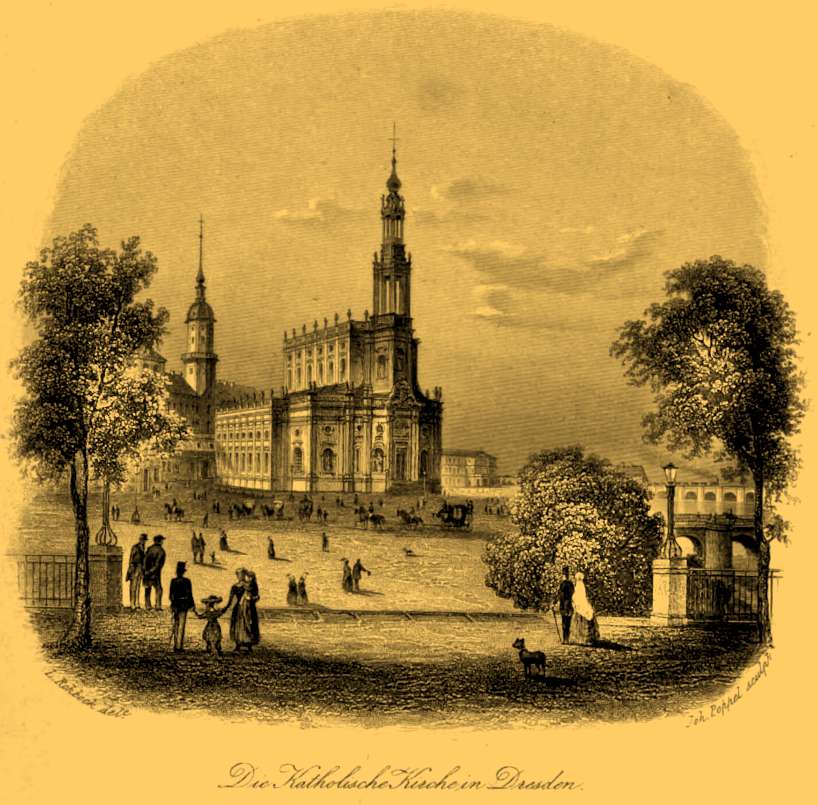
[Catholic Church in Dresden: frontispiece to Ludwig Lange, Ernst Rauch, Georg Lange, Original-Ansichten der historisch merkwürdigsten Städte in Deutschland, vol. 13 [Darmstadt 1841]:]
Shortly before their departure, Fichte joined them, who here utterly lost his earlier reserve from Jena, whereby the former wall of separation fell that had always kept Gries at a respectful distance from this extraordinary man. With him and Schelling, Gries spent the final and what was doubtless the most enjoyable evening in Dresden. . . .
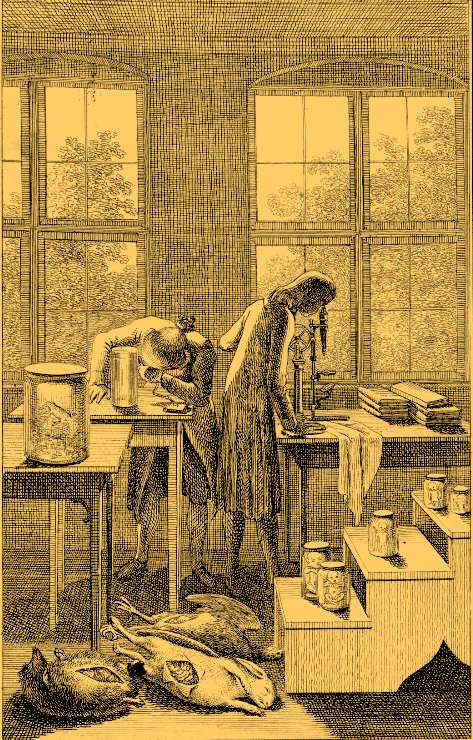
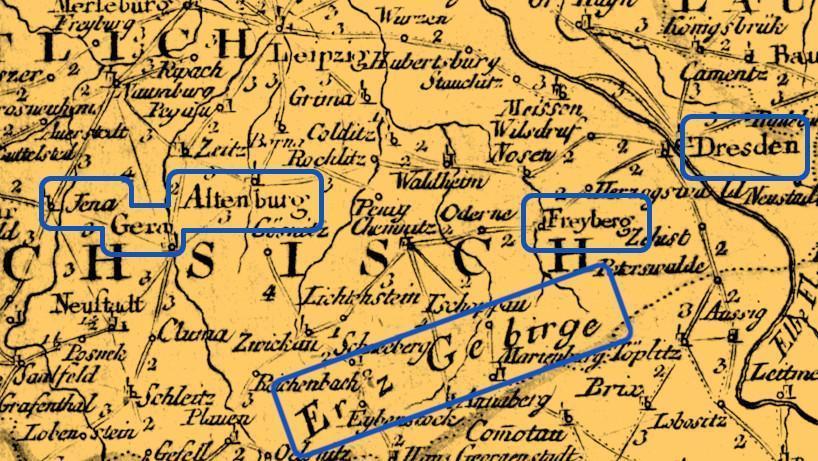
On 1 October 1798 Gries departed Dresden in Schelling’s company . . . The journey itself, apart from the delightful opportunity to spend time with Schelling, offered little else in the way of pleasantries, since both the weather and the roads were dreadful. They travelled by way of Freiberg and part of the Erzgebirge [Ore Mountains]; in the former, they found August Herder present but, much to their dismay, Hardenberg away. Herder arranged for them to tour a mine, from which Gries emerged back into daylight before Schelling, finding it rather unnerving below ground; Lampadius then showed them the laboratory and chemistry equipment. — (Daniel Nikolaus Chodowiecki, title vignette to Johann Friedrich Blumenbach, Naturgeschichte [1787]; from the collection of Johann Caspar Lavater; Österreichische Nationalbibliothek Signatur/Inv-Nr. LAV 469/16249 POR MAG):
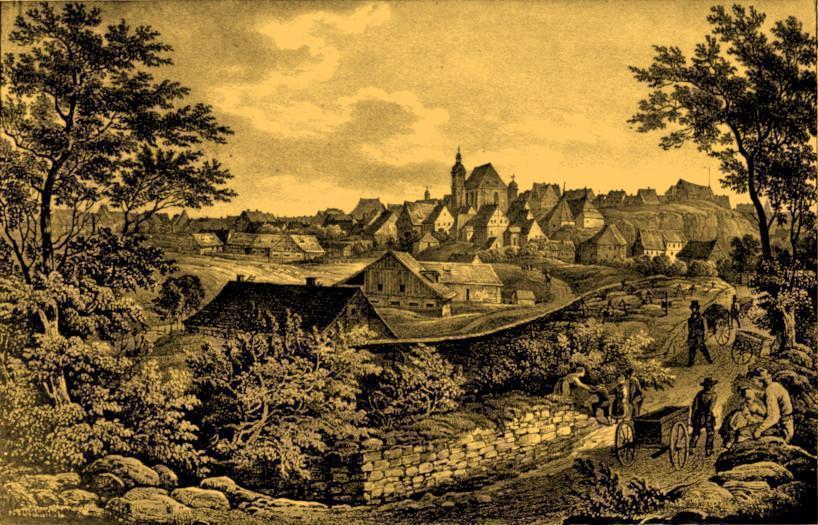
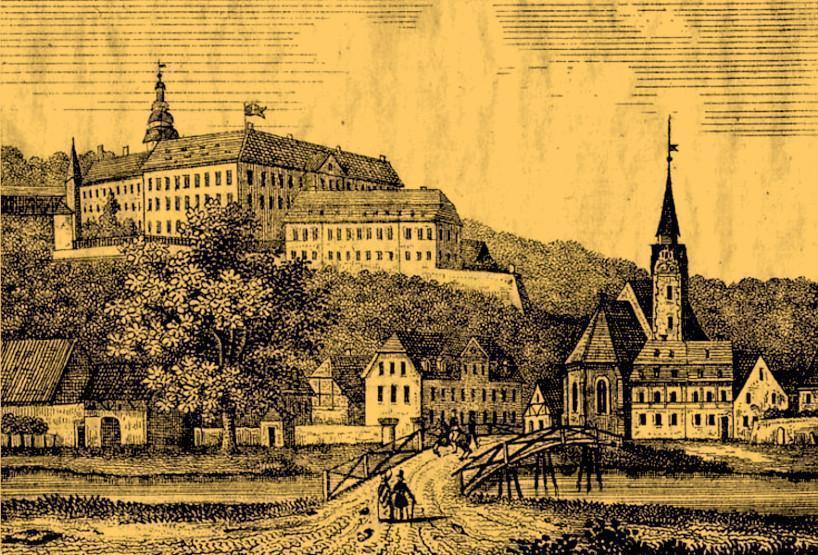
The next day they continued on to Altenburg and Gera. (Post Karte Durch ganz Deutschland, ed. J. Walch [Augsburg 1795]; illustration of Altenburg from Saxonia, Museum für Sächsische Vaterlandskunde 4 [Dresden 1839], plate preceding p. 85; illustration of Schloss Osterstein in Gera by F. E. Müller, early 19th century:)
Altenburg:
Gera:
Not far from Jena itself they met Hofrath Ullrich [possibly Johann August Heinrich Ulrich], and Gries was delighted to introduce him to his new companion, though Schelling preferred to remain incognito in his travelling suit.
But now the hills surrounding Jena itself increasingly came into view, and soon Gries saw his beloved town in the pleasant valley, and amid mixed emotion he [and Schelling] arrived at the home of his choice and his heart on the evening of 5 October. (Jena from the northwest, ca. 1840, by Eduard Lobe; Bildrechte/-herkunft: Sammlung Jenaer Stadtansichten [Stadtmuseum Jena 13011:)

[20] Probably Friedrich Majer in Jena and Oberweimar (A. W. Ludwig, Charte über den grosten Theil des Fürstenthums Weimar in 8 Sectionen nach einem Originale von Wibekind copiert durch A.W. Ludwig [1789]; Bibliothèque nationale de France, département Cartes et plans):

Majer, whom Caroline mentions often later, frequently published in romantic and other periodicals on Indic and Eddic materials; Goethe mentions his Nordic legends, and Majer himself later introduced the philosopher Arthur Schopenhauer (1788–1860) to Sanskrit. Back.
[20a] A charming and revealing anecdote; it may be recalled that Fichte was but a year older than Caroline (frontispiece to Christiane Benedicte Eugenie Naubert, Marie Fürst oder das Alpenmädchen [Leipzig 1792]):
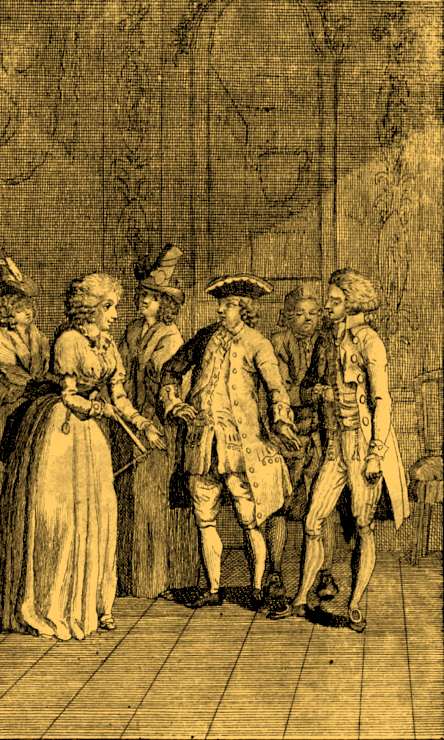
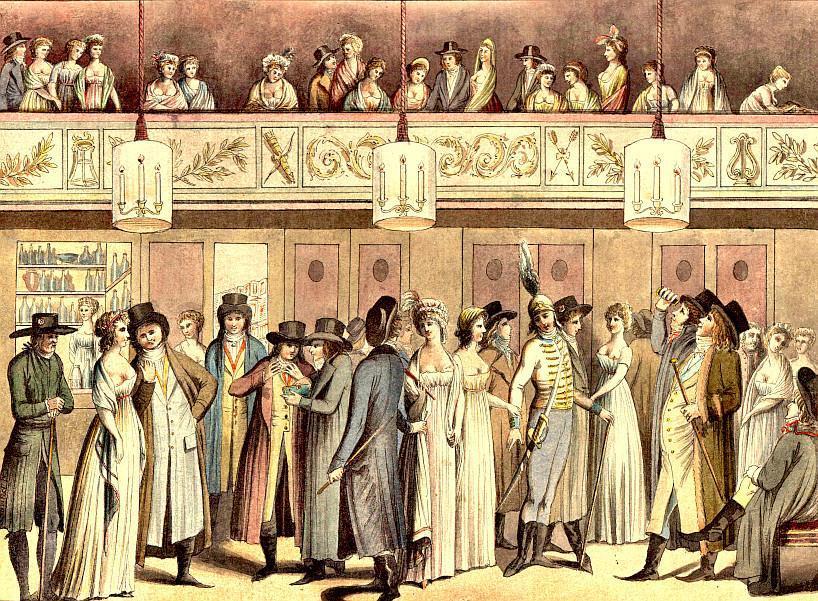
Here a more specific illustration of a French theater foyer (Théâtre Montansier, later Théâtre du Palais-Royal) from the same year, 1798, in which spectators could mingle before and after a performance as well as during the intermission, in the case of the Théâtre Montansier at the time also for more overt social connections (Edme Bovinet and Louis Binet, Foyer du Théâtre Montansier [1798], Bibliothèque nationale de France, département Estampes et photographie; repr. in Arthur Pougin, Dictionnaire historique et pittoresque du théâtre et des arts qui s’y rattachent: Poétique, musique, danse, pantomime, décor, costume, machinerie, acrobatisme [Paris 1885], 391):
Concerning the reference to champagne in 1798, see Johann Samuel Halle, “Über das Vaterland, Natur, Handel, Verfeinerung, Verfälschung und den Genuss der Weine,” Vorgesetzte Magie, oder, die Zauberkräfte der Natur, so auf den Nutzen und die Belustigung angewandt worden, vol. 12 [Berlin 1801], 18–125, here 61–63 (illustration: frontispiece to the volume, specified as accompanying this present article):

Among foreign countries, France doubtless enjoys the most enviable blessing of wines. Vineyards are vigorously cultivated in almost every province of this country. . . . The most superior among the various types are Burgundy and Champagne.
Champagne enjoys healthy sales not only in France itself, but even more so in England, Holland, and in the northern countries, competing for preeminence with Burgundy, though both attract their own partisans.
Young men and women prefer Champagne, whereas more mature Frenchmen prefer Burgundy. Englishmen, who otherwise enjoy light, smooth drinks, consider Champagne the most excellent among all French wines. The Dutch and those from the northern countries value Burgundy because they enjoy wines that are simultaneously strong and tasty, which is certainly the case with Burgundy, whereas drinkers in Britain already enjoy sufficient native drinks and beers that are both stout and piquant as intoxicants. . . .
The impression of this drink [Burgundy] is gentler and more moderate, its effects less swift, and also more enduring that those of champagne. Champagne animates and raises the spirits, offers a piquant flavor — both pleasing and fetching in its own way — dispels melancholy and gloomy thoughts, loosens the tongue into flowing eloquence, and inspires by imparting a serene and a cheerful disposition. Its effects are quick and yet pleasant, but they also abate quickly and extinguish before one knows it. Back.
[21] Tieck’s novel Franz Sternbalds Wanderungen, 2 vols. (Berlin: Unger, 1798), was intended as a Bildungsroman on the life of a young Nürnberg painter after the model of Wilhelm Meister. See Friedrich to Wilhelm in April 1799 (Walzel, 414; KFSA 24:260): “a divine book . . . the first novel since Cervantes that is romantic, and in that regard also far above Meister.”
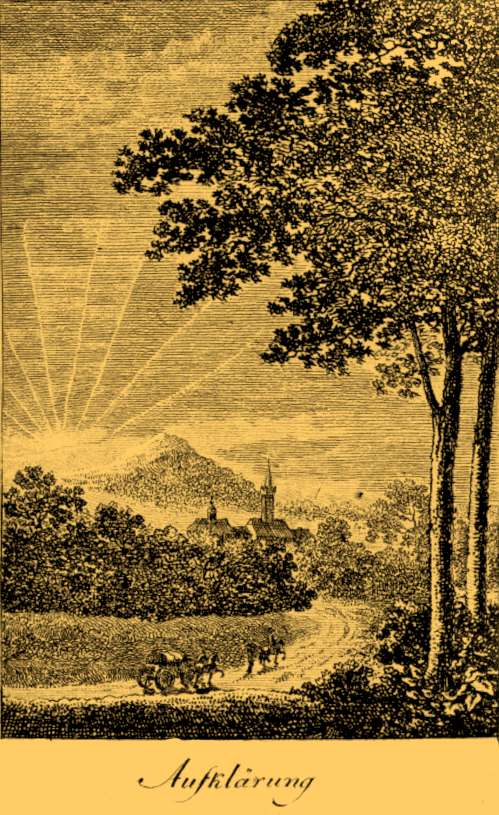
Concerning “sunrises”: Goethe had intended to review Sternbald — and Tieck’s and Wilhelm Wackenroder’s Herzensergiessungen eines kunstliebenden Klosterbruders (Berlin 1797) — in his periodical Propyläen (see Weimarer Ausgabe 47:282, 362; also Caroline’s review of the latter piece); his notes begin with the remark: “Too much morning sun.”
The motif was in any case popular at the time, though N.B. also as a metaphor for the Enlightenment as in the following illustration by Daniel Nikolaus Chodowiecki (Aufklärung [“Enlightenment”] [1791]; Herzog August Bibliothek; Museums./Signatur Chodowiecki Sammlung [6-500]):
Goethe, however, (thus Erich Schmidt) always despised what for him was the sooner reactionary inclination to “Sternbaldize.” Back.
[22] See Friedrich’s remarks to Auguste in early autumn 1798 (letter 203c). Back.
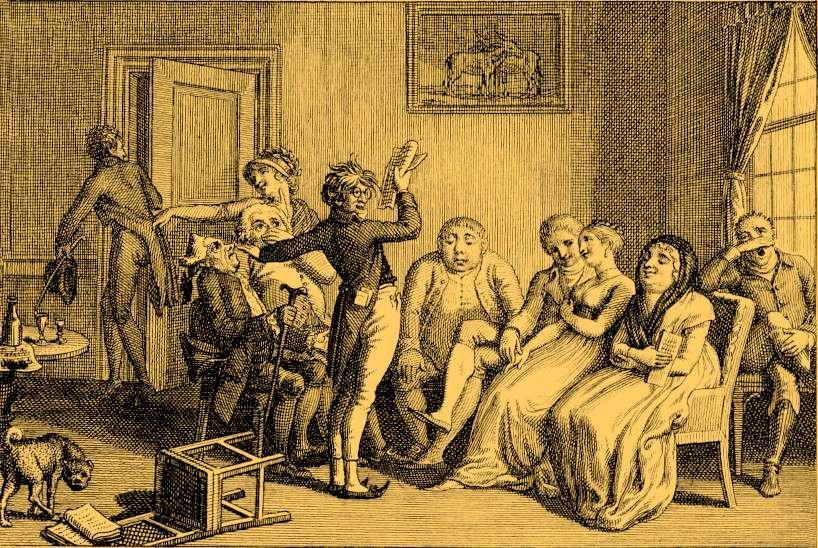
[23] Concerning Amalie Tieck’s alleged lack of understanding for art, see Friedrich’s letter to Auguste in October 1798 (letter 203e): “Tieck is very happily married except for complaining that his dear Amalie does not have much sense for art. She always falls asleep when he reads his things aloud to her” (“Ein Leseconvent,” Taschenbuch auf das Jahr 1803: Dem Edeln und Schönen der frohen Laune und der Philosophie des Lebens gewidmet [1804], plate 4):
[24] Rudolf Florestan, a character in the novel of a decidedly more animated temperament than Franz Sternbald himself, the latter of whom becomes less meditative and more sensual under his influence. Back.
[25] Heinrich Meyer, Goethe’s friend in the arts and housemate, referred to as “Mephistopheles” in later letters. Wilhelm’s fragments on art appeared in the “Fragmente” in Athenaeum (1798) beginning on 180 Back.
[26] “Die Gemählde. Ein Gespräch von W.,” in the next issue of Athenaeum (1799) 39–151, which incorporates Caroline’s descriptions of paintings in the Dresden gallery. See the remarks in this project’s introduction to Caroline’s literary reviews. Back.
[27] Nothing by Karl Ludwig Fernow, who at the time was in Rome, appeared in Der Neue Teutsche Merkur contra Alois Hirt in 1798/99. — Concerning the lengthy dispute between Wilhelm Schlegel and Hirt, see the supplementary appendix on the Laocoön dispute with Alois Hirt. Back.
[28] Paul Emil Thieriot came out publicly in defense of his friend Jean Paul in the Leipzig periodical Der Allgemeine litterarische Anzeiger 151 (24 September 1798), an otherwise (thus Erich Schmidt) colorless Intelligenzblatt (see Eduard Berend, Jean Pauls Ästhetik, Forschungen zur neueren Literaturgeschichte 26 [Berlin 1904], 23); later, in 191 (3 December 1798), he issued invectives against the “chubby-cheeked” journal Athenaeum and the Schlegel brothers. Back.
[29] Friedrich had mentioned Auguste Ernst’s illness in a letter to Auguste in early autumn 1798 (letter 203d). Back.
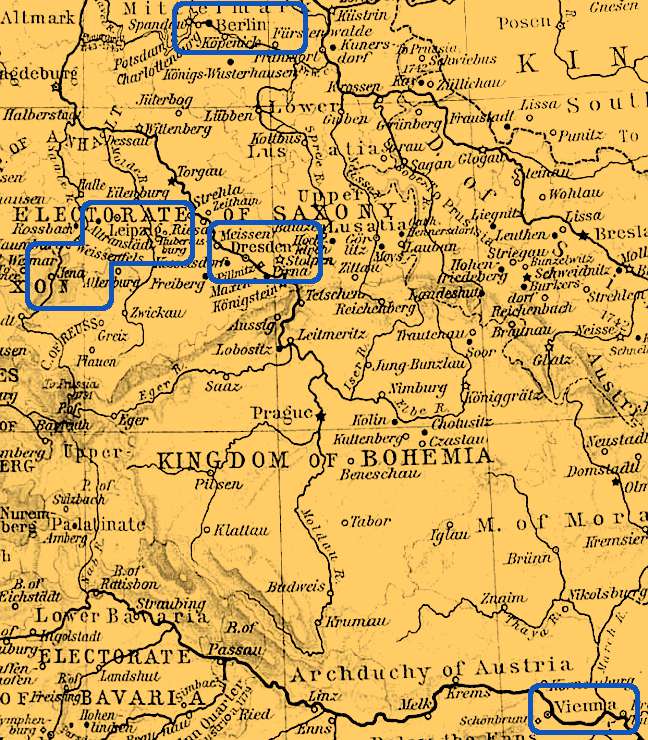
[30] Dorothea Veit’s younger sister, Henriette Mendelssohn, Moses Mendelssohn’s third daughter. Later letters speak about her visit with the Schlegels in Jena, though that visit did not come about as soon as anticipated and even then, because of travel difficulties, seems to have lasted but a single day (16 April 1799). Dorothea writes to Karl Gustav Brinckmann on 2 February 1799 about her own divorce and, among other things, her new, financially precarious life (Franz Deibel, Dorothea Schlegel als Schrifstellerin im Zusammenhang mit der romantischen Schule, Palaestra XL [Berlin 1905], 162–63; KFSA 24:225):
You probably have already heard from Jette herself that she will be going to Vienna to try out her independence on herself and her pedagogical proficiency on the children of others — I would not have so calmly permitted her to remove so far from me did I not think that, all things considered, it cannot really hurt her to test her own powers, since she will, after all, be in such good hands — and also considering that she can return to me as soon as she likes, and that it will then, of course, be more advantageous for both of us if she then has learned how to undertake something serious and see it through to the end — I myself will, after all, have to think of some way or other to enhance my own income, and that is something we can then do better together than individually.
Berlin is over 500 km from Vienna (W. R. Shepherd, Historical Map of Central Europe about 1786 [1926]):
[31] Of Caroline’s two sisters, only Luise was still alive; Lotte had died in 1793. Back.
[32] Caroline was clearly already aware of Wilhelm’s flirtations with Henriette Mendelssohn.
Some extremely cordial letters from Henriette to Wilhelm Schlegel were published in Holtei, Dreihundert Briefe 2:165–72, here 169–72. From Berlin, 16 August 1798 (letter 202f above); 18 December 1798 (letter 212c); and 2 March 1799 (letter 224a), in the latter also a reference to Wilhelm’s “charming wife,” “whom I have not yet even thanked for a letter full of beautiful truths and amiable cordiality, a letter I read ever anew with pleasure. . . . A thousand regards to Auguste as well,” whom she elsewhere refers to as her “little sister.”
Wilhelm in any case, and as Caroline well knew, rarely hesitated in responding to the attention of women (Göttinger Taschen Calender Für das Iahr 1796; Inhaltsverzeichnis deutscher Almanache, Theodor Springmann Stiftung):

And as referenced earlier, Caroline later remarks in a letter to Julie Gotter on 18 February 1803 (letter 375) that her and Wilhelm’s marriage was “an alliance that the two of us otherwise never viewed as being anything but completely free.” See on the other hand the supplementary appendix on Caroline’s Rival: Elisa van Nuys. Back.
[33] There would be no trip to Berlin in the winter of 1798 or the spring or summer of 1799. Back.
[34] Twelfth-Night; or, What You Will (Was ihr wollt) had appeared in October 1797 along with Julius Caesar (Julius Cäsar) in vol. 2 of Wilhelm’s translation. Back.
[35] Karl Ludwig von Woltmann was apparently enamored of the Berlin actress Friederike Unzelmann and easily roused to jealousy at the prospect of rivals; see Friedrich’s letter to Caroline in November 1798 (letter 209) and esp. Caroline’s letter to Wilhelm Schlegel on 22 June 1801 (letter 322).
Friedrich was at odds with Woltmann for other reasons, being at least partly responsible for Woltmann having resigned his professorship in Jena and moved to Berlin. In a review of Die Horen (1796) in the journal Deutschland 4 (1797) 12, no. viii (Jugendschriften 2:33–35), Friedrich had subjected Woltmann to extremely harsh treatement for an essay Woltmann had published in Die Horen, “Theoderich, König der Ostgothen” (Die Horen [1796] 7, no. 7, 90–105; no. 8, 1–20; it is the latter piece that Friedrich addresses in his review; see Wilhelm and Caroline’s letter to Schiller on 1 June 1797 [letter 182], and the pertinent section in supplementary appendix 181g.1). Woltmann published a vehement response in the Intelligenzblatt of the Allgemeine Literatur-Zeitung (1797) 65 (Saturday, 20 May 1797) 544, and Friedrich identified himself in a caustic rejoinder in Allgemeine Literatur-Zeitung (1797) 76 (Saturday, 17 June 1797) 631–32.
Friedrich writes to Wilhelm in April 1799 concerning how Friederike Unger essentially tyrannized her husband, the publisher Johann Friedrich Unger, even in business matters (Walzel, 413; KFSA 24:260):
For the rest, Unger is actually a charming person, though utterly an instrument of his wife. In matters of business as well, she completely controls him, and it is no doubt her doing that he did not want to publish your poems. And that he puts so much stock in the praxis, in soldiers, Geheimräthe, and Brandenburg. None of which is actually natural to him, since by nature he is an artist.
She, however, is still keenly aware of having noble blood in her veins, though that particular inoculation is already rather old. This weakness is also the reason Woltmann is able to impress him so much. He no doubt thinks all of us are nothing but insignificant people compared to this pathetic windbag. And do not believe that anything might be done to remedy this, since Madam [Unger] now has found realized in Woltmann everything she originally wanted from me, and because Woltmann also props up and supports the fundamentally pathetic Jahrbücher [der preussischen Monarchie, ed. F. C. Rambach (Berlin: Unger 1798–1801)]. It is truly an abomination that such a scoundrel can sell himself as a representative of the discipline of history.
Friedrich had written to Karl August Böttiger from Jena on 11 May 1797 (Erich Schmidt, Jakob Minor, “Briefe von Friedrich Schlegel,” Archiv für Litteraturgeschichte 15 [1887] 422; KFSA 23:365):
I will soon be giving the Intelligenzblatt of the Allgemeine Literatur-Zeitung something to make it earn its keep. Young Woltmann will be receiving a serious chastisement from me. Namely, concerning something said in the twelfth issue of Deutschland about his “Theoderich,” which was stolen from Gibbon. What bothers me, though, is the collision this involves with Die Horen, since although I do indeed consider myself both obligated and have a right to justify what is said there concerning Woltmann’s “Theoderich” but by no means either can or want to acknowledge responsibility for the entire review. Back.
[36] Regrettably, no correspondence between Caroline and Friederike Unzelmann seems to be extant. Back.
Translation © 2012 Doug Stott