
242c. Henrik Steffens to Wilhelm Schlegel in Jena: Freiberg, 26 July 1799 [*]
Freyberg, 26 July 1799
Greetings be to you, my dear Herr Professor. I almost know not whether I ought to apologize for daring to bore you so soon or because I am doing it so late. I often imagined the former and then followed the principle of positive non-writing, or of negative writing; but then I imagined the latter with equal frequency, and accepted the principles of positive writing or negative non-writing. The product of these two, equally strong, mutually opposing principles has hitherto been — since the good spirit and the last-mentioned principles maintained the upper hand — a zero.
I was delighted in Berlin by my acquaintance with your bright and intelligent brother, with whom I was often together and who made my stay there quite pleasant, notwithstanding I admittedly do not always agree with him. [1] N.B. Has his small book on Fichtean atheism not yet appeared? [2] I am extremely curious — and even if I but know the title (if he has published it anonymously), I would soon seek it out among the enormous number of writings on this subject. When you write him, please do give him my regards.
I was also delighted by my acquaintance with Tieck, whom I would be inclined to call the aesthetician of my soul. What makes me sorry are all the things I would like to have discussed with him but did not. Give him my regards as well. [2a] —
Furthermore, I was delighted by my acquaintance with the bright and intelligent Madam Veit, and with good Schleiermacher, whose Reden are probably not out yet, or are they? [3]
I was aggravated by the Piccolominis, because I saw them too often and found them a bit more boring each successive time, primarily because so much is said by the persons in the play that would be much more appropriately said by persons in the parterre and by an aesthetic critic; [4] and because Iffland performed Octavio so boringly and Mattausch Max so poorly, [5] and because Fleck as Wallenstein was usually blind drunk. [6] I was also aggravated by Berlin in general, by the oh-so-royal marionettes, by extinguished nature, and by the revue. [7]
Most of all, however, I was aggravated that the government, in order to punish me for my theoretical transgressions, which are admittedly considerable, has condemned me to forced labor on the mining galleys here, thereby fettering me — capital criminal that I surely am — with frightfully heavy iron chains on my arms, legs, and neck.
And yet, as is often the case, even my chains have come to seem half pleasant to me. Since, as you probably already know, “true men are never to each other known; such knowledge is reserv’d for galley-slaves, chain’d to a narrow plank, who gasp for breath.” [8] — I can indeed claim that I know my colleagues here and am thus perfectly allowed to assess them, which I herewith do as follows:
Pathetic apes
Haggling and gaping,
Digging and pounding,
Smelting and boiling —
See how they run —
The crowd of beasts! —
Their entire plunder I would not take
And were it given to me! —
Could I but get beyond them! [9]
You can see from the enclosed letter to your wife that I was in Dresden. [10] And now — but no more about me; but please, my good Schlegel, do have pity on me, and write to me as soon as possible how things look in Jena, what people are talking about, what — — — is saying, and — — — and — — — You understand what I am asking. You cannot imagine how Jena interests me; truly, more than any other place in the world. One senses one’s happiness most strongly, appreciates it most appropriately, when one has lost it — a trivial but for all that no less correct observation. Please do write me soon, my good Schlegel, even though, as I well feel, I do not deserve it.
Your friend
Steffens
Please remind Professor Stahl that he is supposed to send me a crate of minerals over by post. He did not respond to one of my letters, and as a result I have gotten into a rather embarrassing situation.
Notes
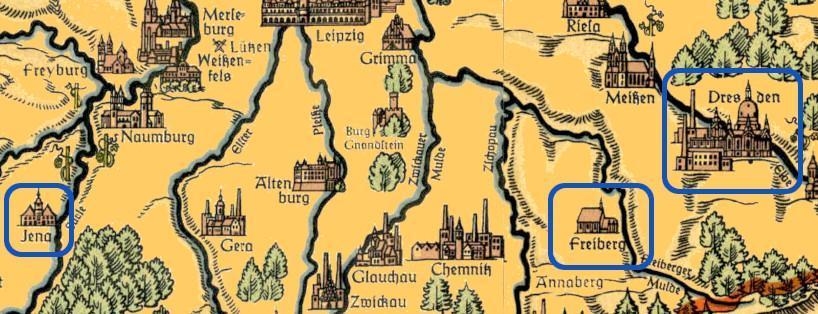
[*] Source: Körner (1930) 1:95–97. — After spending four weeks in Berlin, Steffens had gone to Freiberg (he spells it Freyberg) to begin a month-long professional praxis in geology and mining. Freiberg is located ca. 125 km east of Jena, 30 km southwest of Dresden (map: Post Karte Durch ganz Deutschland, ed. J. Walch [Augsburg 1795]; illustrations [in order]: Ansicht von Freiberg in Sachsen; Deutsche Fotothek obj 30139841; Saxonia. Museum für Sächsische Vaterlandskunde, vol. 4 [Dresden 1839], plate following p. 48); note the mining students in the foreground of the first illustration:


The native Norwegian is still struggling with the German language in this letter, though such is not rendered in the English translation. Back.
[1] Concerning Steffens stay in Berlin and his acquaintance with Friedrich, see Friedrich to Wilhelm and Caroline in May 1799 (letter 237), with note 3; similarly Wilhelm to Johann Diederich Gries on 10 May 1799 (letter 236c), where Wilhelm mentions only that “Steffens must probably be in Berlin; I’m anxious to hear something about his acquaintance with Fr. Schlegel and Schleiermacher”).
Concerning Steffens’s faulty recollection of his stay in Berlin as recounted in his memoirs, Was ich erlebte, 4:182–202, see the above and Rudolf Haym, Die romantische Schule, 626: “To a certain extent, Steffens memory left him in the lurch in the account of this stay in Berlin (Was ich erlebte, vol. 4). Friedrich Schlegel had by no means left Berlin, nor is it correct that Steffens did not seek out Schleiermacher.”
Haym then cites passages from this present letter attesting Steffens’s acquaintance with both. Concerning Steffens’s impression of Friedrich, see supplementary appendix 242c.1.
Steffens spoke in less flattering terms about Friedrich in a letter to Schelling on this same day (Plitt 1:264; Fuhrmans 2:176–77; illustration: Daniel Nikolaus Chodowiecki, Und ich zur ewigen Glückseeligkeit bestimmt werde herzlich lachen, wenn Ihr verdammt werdet [1781]; Herzog August Bibliothek; Museums./Signatur Uh 4° 47 [232]):
I made Schlegel’s acquaintance in Berlin, a person who can maintain that people ought not be rigorously consistent, who lives solely from ideas, and, as he himself puts it, from immediate perceptions, and who accuses Jacobi of always returning to the same point because he — as I am convinced — never had such a point himself from which he might depart and return. I spoke with him often because I met Tieck at his place. He embarrassed me a bit by his authentically Schlegelian inclination to badger me into telling him my humble opinion about — Lucinde.

[2] Friedrich’s anticipated piece, “Für Fichte. An die Deutschen,” was never written. See Dorothea’s letter to Caroline on 20 April 1799 (letter 234), note 2. Concerning Fichte’s atheism dispute, see supplementary appendix 215a.1. Back.
[2a] Tieck had been in Jena with the Schlegels since 17 July 1799. Back.
[3] Schleiermacher’s Über die Religion: Reden an die Gebildeten unter ihren Verächtern appeared at the end of June 1799. Back.
[4] Schiller’s play Die Piccolomini, the second part of his Wallenstein, premiered in Berlin on 18 February 1799 (C. Schäffer and C. Hartmann, Die Königlichen Theater in Berlin: Statistischer Rückblick auf die künstlerische Thätigkeit und die Personal-Verhältnisse während des Zeitraums vom 5. December 1786 bis 31. December 1885 [Berlin 1886], 68). Wilhelm Schlegel, Caroline, and Auguste attended the second performance in Weimar on 2 February 1799, whereas Steffens was in Jena and attended the premiere in Weimar on 30 January 1799.
For Caroline’s assessment, see the letter to Friedrich von Hardenberg of 4 February 1799 (letter 219). Concerning Wilhelm’s anticipation of the Berlin performance, see his letter to Goethe on 4 February 1799 (letter 219a). Concerning Steffens’s recollection of the events leading up to the premiere in Weimar (which Caroline, again, did not attend), the performance itself — Steffens sat in Schiller’s loge — and the ensuing discussion that evening at the Schlegels’ in Jena, see Caroline’s letter to Luise Gotter in early 1799 (letter 215), note 1. Back.
[5] The roles of Octavio Piccolomini and his son, Max. Back.
[6] The role of Wallenstein was considered to be Johann Friedrich Ferdinand Fleck’s preeminent role. For Wilhelm’s anticipated assessment of Fleck’s and Iffland’s probable renderings of the roles, see his previously mentioned letter to Goethe on 4 February 1799 (letter 219a), in which he remarks that “I do at least trust that Fleck, to the extent I am acquainted with him, will generously and fully render the idea of Wallenstein, and Iffland, as father Piccolomini, will doubtless leave nothing to be desired.” Back.
[7] Presumably the same military revue or similar maneuvers in Potsdam about which Dorothea had written Caroline on 26 March 1799 (letter 225a). Back.
[8] Citation from Goethe’s play Torquato Tasso, Goethe’s Schriften, vol. 6 (Leipzig 1790), 1–222, here 214–15 (Weimarer Ausgabe 5:5:3338ff.), act 5, scene 5 (here from Goethe’s Works, trans. Hjalmar Hjorth Boyesen [Philadelphia 1885], 152); Tasso is speaking to Antonio in the play’s final scene (illustration: Goethe’s Works, trans. George Barrie, vol. 1 [Philadelphia 1885], 149):

But we so willingly deceive ourselves,
We honor reprobates, who honor us.
True men are never to each other known;
Such knowledge is reserv'd for galley-slaves,
Chain'd to a narrow plank, who gasp for breath,
Where none hath aught to ask, nor aught to lose,
Where for a rascal each avows himself,
and holds his neighbor for a rascal too, —
Such men as these perchance may know each other.
But for the rest, we courteously misjudge them,
Hoping they may misjudge us in return.
Steffens, as may be recalled, was able to cite lengthy passages from Goethe’s works from memory. Back.
[9] These verses parody a passage from Goethe’s “Jahrmarktsfest zu Plundersweilern,” in Goethe’s Schriften, vol. 8 (Leipzig 1789), 7–66, here 19 (Weimarer Ausgabe 1:16:7–40, here 15–16 [lines 145–53]), altering it to apply to the mining environment in Freiberg; Goethe’s original passage intends to reflect the helter-skelter hubbub of the marketplace:
Open-mouthed fops
Haggling and gaping,
Gaping and buying,
Crowds of beasts!
Children and grotesques,
Apes and cats!
Nothing of any of it would I take
And were it given to me!
Could I but get beyond them!
Concerning the later (ballad) version of the same theme, Goethe’s “Das Neueste von Plundersweilern” (1781), and for a reproduction of the allegorical-satirical painting of the market scene by Georg Melchior Kraus, see Caroline’s letter to Julie von Studnitz on 2 March 1782 (letter 30), note 10. Back.
[10] Steffens’s letter to Caroline (letter 242d) (Rudolf Koch and Fritz Kredel, Deutschland und angrenzende Gebiete [Leipzig 1937]):
Translation © 2013 Doug Stott