
242d. Henrik Steffens to Caroline: Freiberg, 26 July 1799 [*]
Freiberg, 26 July 1799
Madame!
Let me first fulfill my obligation by sending a profound compliment and then be so presumptuous as to assume you will not hold it against me for only doing so now. Let me then inquire about how you are doing, whether your eyes have improved, whether you have frequently been in Dornburg, [1] etc., and how the dear little one is doing (to whom, however, I have the audacity to put the very same question).
Then, as is proper and fitting, I will adduce the reasons that have emboldened me to turn to you directly. Such include (and I am being quite serious): first, the hope that you may delight me with a couple of lines from your own hand (something which, as I shall strictly demonstrate later, you more or less owe me); second, the wonderful mood I enjoy when I am able to speak at length with you, Madame, insofar as such evokes for me all the happy hours I spent in Jena in your company, hours the likes of which I have not enjoyed again since that time and will likely not so easily find in the future either (unless I come to Jena in the autumn), and which are yet so vivid for me, and the recollection of which, like a gentle, gracious genius, serves up to me the blossoms of the past that have not yet withered; and third, because I have a very serious objection to lay at your feet and am quite curious to see how you defend yourself.
Before I move on to the actual matter at hand, I must first tell you the reason I am writing so late. The real reason is that I wanted to write a beautiful, witty, and profound letter so that you yourself, and everyone to whom you show the letter, might be excessively amazed and delighted at so wondrously beautiful a letter. But even after tormenting myself with this task over the course of many, many nights, I still could not get it right. But now another postal day has come round, and I realize I must write either a quite ordinary letter or none at all, whence my decision to renounce all the admiration my wit and acumen might have elicited. —
And now to the matter at hand.
You claimed I would feel nothing upon first beholding the paintings in Dresden, that I would find the sacred language of the artists utterly incomprehensible because, as you probably believed, I would not even understand the letters, and that I would end up having to traverse the boring path of the pupil, occupying myself first with a simple art primer so that, after traversing a long and slow and boring path of spelling things out, I might come up with a tolerable opinion of such things.
But you erred, Madame! and erred considerably. Nor did I find it at all particularly pleasant that you erred in this particular way.
A thousand times I imagined how I would stand before the paintings of Raphael, oppressed by my own horrific stupidity, gaping at these masterpieces “like a dried-out bucket,” with not the slightest spark of emotion and feeling. “A human being is capable of depicting something this marvelous, something a thousand other people recognize, but something you somehow cannot even feel” — such were my thoughts.
I was able to entertain such a low opinion of myself for being thus and for probably having to be thus because you, Madame, had declared me thus and because I trust your judgment more than I do my own. I could, like Franz Sternbald, have felt a profound sympathy for myself had I been as weak as he. I solemnly swear to you, Madame, such were my feelings. I unnecessarily tormented and tortured myself, and did so in the most wretched fashion — and it is your fault. [2] —
But only listen to what I experienced when I finally did see the paintings in Dresden, and defend yourself — if you are able.
First, I do confess that the grand, titanic figures of Rubens, his grinning fauns and satyrs and his foolish Ganymede (whom, after reading Goethe’s poem, I admittedly imagined as exhibiting a completely different disposition), did not move me at all; [3] that the petty diligence of the Dutch masters and the medusa-like brush of van der Werft, who immediately transformed everything he produced into dainty little stone dolls [4] — that all this actually annoyed me, and that I was outright horrified by the dreadful naturalness of Deuder [5] and Seybold. [6]
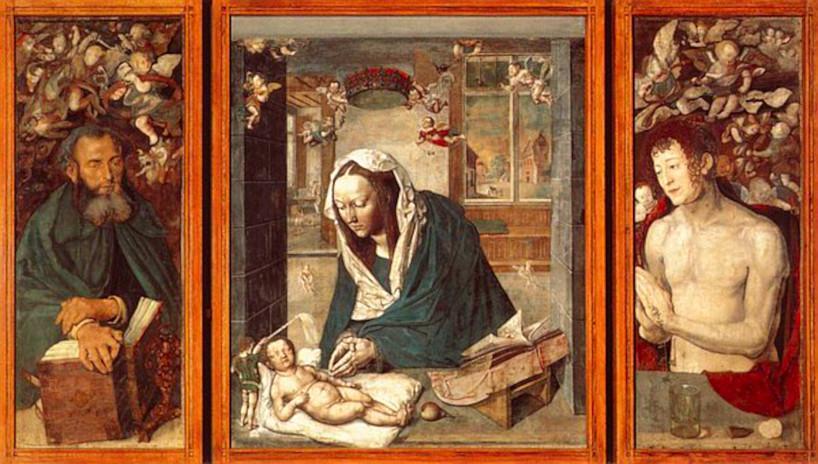
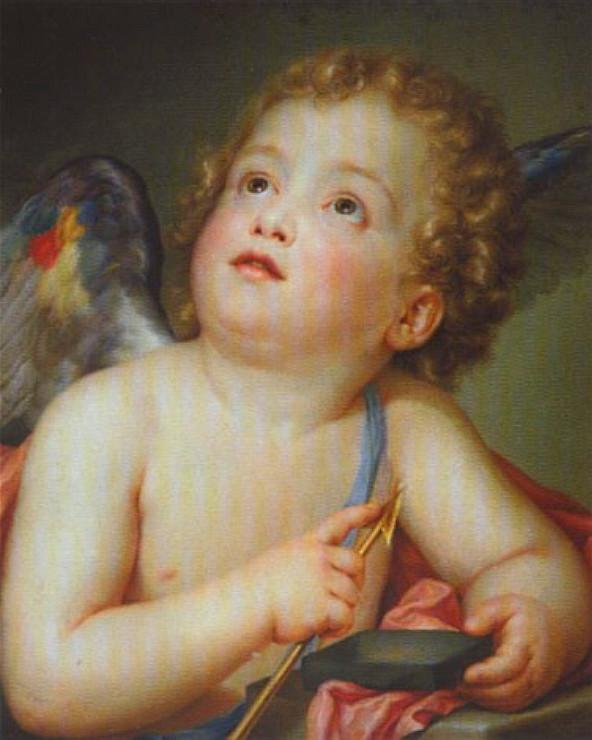
But it was different with the Madonnas of Lucas van Leyden, [7] Albert Dürer, [8] and Holbein, [9] and with the Amor and the upward-glancing angel of Mengs. [10] —
The simple sensibility of the first, the melancholic [?] fear of God of the second, the bold and yet modest imagination of the third, and the grand, cheeky imagination of the fourth simply swept me wondrously off my feet, putting me into a disposition I had hitherto never experienced and opening up for me a joyous view into a new, infinite world.
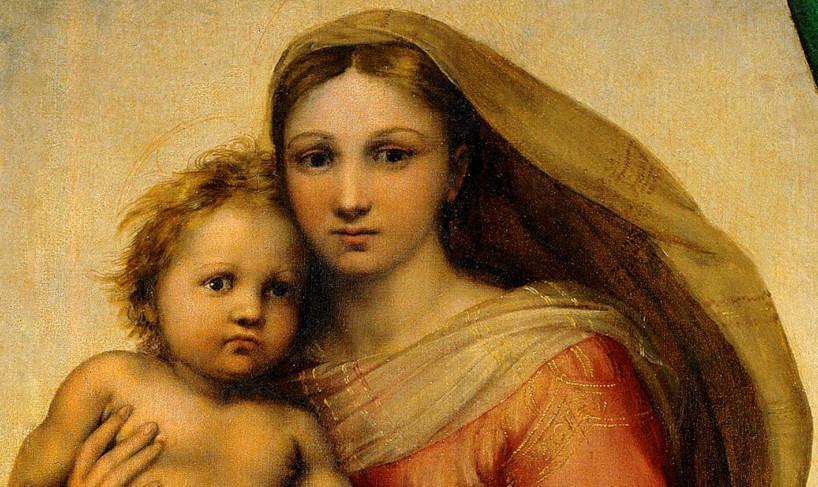
In the Italian collection I saw only the Madonna [11] — by God! nothing but the Madonna, which the inspector, because I stood looking at Holbein’s for so long, soon showed me. Never has a painting affected me that way. They gazed at me, are still gazing at me, are still right here in front of me — the large, bright, blue eyes reflecting an infinitude. [12] Everything I had ever felt and intimated, all the vague images that, cloaked in a hazy mist, had ever hovered before my soul, the entire, colorful, teeming mass of my inner life now radiated back at me, glorified, from within these eyes.
What I felt I call devotion, true religious devotion, adoration, because I know of no other word. — But then what is devotion? I will readily, indeed quite readily grant that the concept of God is nothing but that which is absolutely infinite, of which we can form neither an image nor a representation that we might worship it.
But how did the idea of a merely ideal and yet simultaneously corporeal world ever arise? I would say it arose because we were restricted on all sides by necessity. [13] Weary of our eternal efforts to struggle through raw matter, to summon forth from the chaos and to create for ourselves a new world, we tried to find a different path on which we might hasten to the infinite, toward which we could but slowly move as long as we were burdened by raw matter.
We returned into ourselves and created another world, a world in which ethereal, hovering, quickly emerging and quickly disappearing beings showed us the traces of the path, traces past which we hastened in flight. And thus high poesy arose insofar as one used a different language, at once capable of expressing infinitely much; thus arose art, in general that which is romantic.
But what is it other than the yearning for the infinite, perpetually driving us forward and yet immediately tearing down again every self-erected barrier? And the feeling that seizes us when we behold a painting whose sublime, profound meaning is attained almost solely through infinite approximation, what is that feeling if not religious sensibility, devotion?
And thus does the genuinely sacred being always hover before me:
It lures me forward in a seraph's shape,
I see it near, I see it nearer floating,
It draws, it pulls me with a god-like power —
I have no power within me not to move. [14]
I am, as you can see from my letter to your husband, condemned to spend a year here; yet I have very little social contact apart from the Charpentier family. My only consolation is my scholarly otium, [15] which I well know how to employ, and that Dresden is nearby, which I will visit almost every two weeks.
I will never find Jena again in any other place, that much I can sense, and I am not infrequently befallen by a yearning that I am inclined to called homesickness; for, truly, I was never at home anywhere the way I was in Jena. Nor do I need to point out that I owe everything to the time I spent in your house and to Schelling’s friendship; I think my stay there expressed that with sufficient clarity. —
Please accept my warmest gratitude — I owe you so much — for even my present situation is made more bearable by my recollection of a better one.
Your Steffens
I will probably be coming to Jena in the autumn for a short time. Please give my regards to the wife of the Justizrath as well as, at your own risk, Hannchen Loder.
Notes
[*] Sources: Not in Erich Schmidt, (1913). Text from Plitt 1:267–71; Waitz (1882), 69–72; Plitt (267) adds the footnote: “The addition of this letter is justified insofar as it throws light on Schelling’s life in Jena and on the regnant opinions and views in his surroundings at the time.”
Dating: Plitt dates the letter 26 July 1799; Waitz (1882) 17 July 1799 without explaining his deviation from Plitt. Because Steffens mentions this letter in his letter to Wilhelm Schlegel of the same day (letter 242c), the two were likely sent together (he similarly mentions his letter to Wilhelm toward the end of this letter). Back.
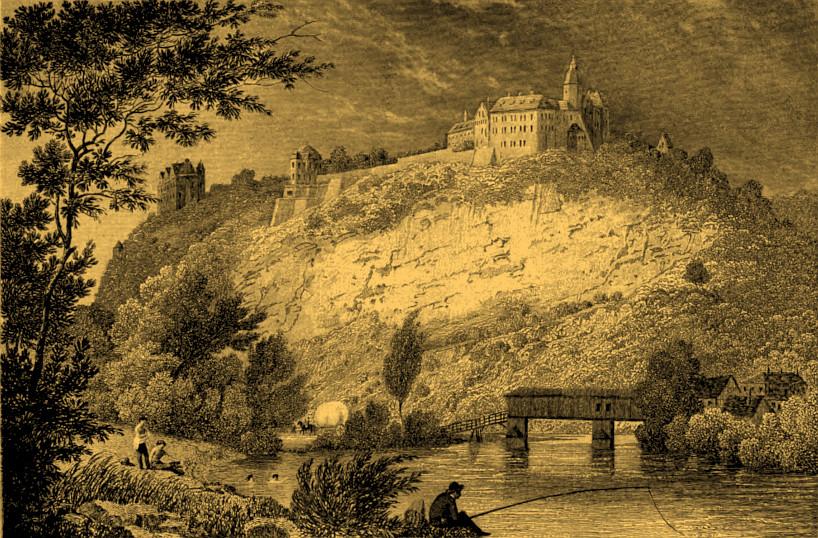
[1] See Caroline’s letter to Johann Diederich Gries on 9 June 1799 (letter 240), with note 16. Dornburg is located 10 km northeast of Jena, past Kunitz, on the Saale River (Karl Baedeker, Northern Germany as far as the Bavarian and Austrian Frontiers: Handbook for Travellers, 15th rev. ed. [Leipzig 1910], 269):

The town is also well known because of its castles situated on the edge of the cliffs overlooking the Salle River, here in an illustration from the 1840s (Ludwig Bechstein, Thüringen, Das malerische und romantische Deutschland: In zehn Sektionen 3, 2nd ed. [Leipzig 1847], plate following p. 102):
Caroline relates in her letter to Wilhelm Schlegel on 29 June 1801 (letter 323) that she and her housemates — Luise and Emma Wiedemann and Julie Gotter — visited Dornburg on 28 June 1801. See esp. Julie Gotter’s account of the visit in her letter to her mother, Luise Gotter, on 29 June 1801 (letter 322b), with additional illustrations. Dornburg perennially represented a popular excursion destination for Jena residents. Back.
[2] Wiener Damenkalender zum Nutzen u. Vergnügen auf das Jahr 1801 (Inhaltsverzeichnis deutscher Almanache, Theodor Springmann Stiftung):
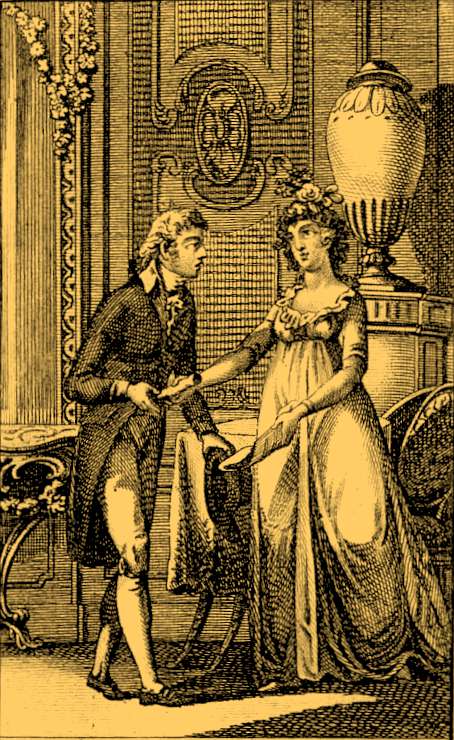
Franz Sternbald: the protagonist in Ludwig Tieck’s eponymous novel Franz Sternbalds Wanderungen, 2 vols. (Berlin 1798). See Caroline’s assessment in her letter to Friedrich Schlegel on 4–15 October 1798 (letter 204). Back.
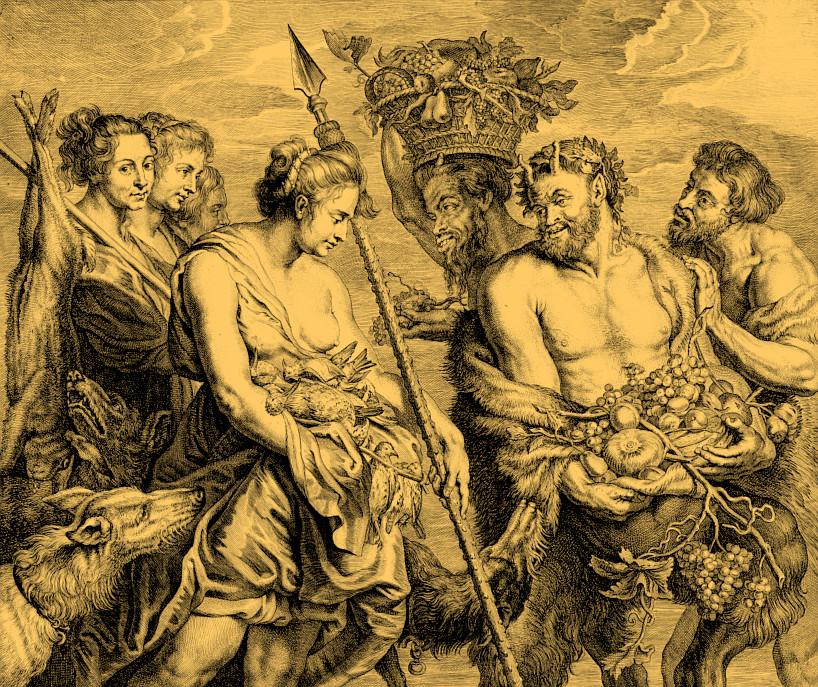
[3] A representative example of Rubens’s many grinning satyrs and fauns (Peter Paul Rubens, Sic vobis lassae sint proemia fausta puellae: Conueniunt epulis poma feraeque bene [Diana und ihre Nymphen kommen von der Jagd wieder; Diana and her nymphs returning from the chase] [1606–59]; Herzog Anton Ulrich-Museum; Museums./Signatur SBolswert AB 3.42):
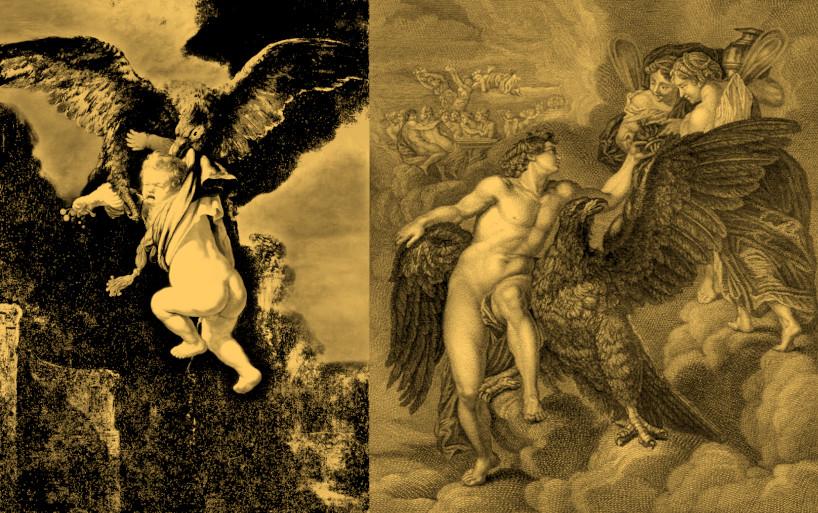
Ganymede, a beautiful Trojan youth in whom Zeus fell in love; Zeus, in the form of an eagle, carried him off to Olympus, where Ganymede became his cup-bearer.
A later catalogue, namely, Julius Hübner, Catalogue of the Royal Picture Gallery in Dresden, trans. J. Pond (Dresden 1876), lists no “Ganymede” by Rubens in Dresden. Rubens’s “The Abduction of Ganymede” (ca. 1612) is owned by the Schwarzenberg Palace in Vienna. Hübner (281) does list Rembrandt’s “Ganymede borne to Olympus by the eagle of Jupiter” (1635), which was acquired in 1751. Here the two side-by-side, first Rembrandt, then Rubens:
See Goethe, “Ganymed,” in Goethe’s Schriften, vol. 8 (Leipzig 1789), 210–11; here “Ganymede,” trans. George Barrie, Goethe’s Works, vol. 1 (Philadelphia 1885), 135–36:
How in the light of morning
Round me thou glowest,
Spring, thou beloved one!
With thousand-varying loving bliss
The sacred emotions
Born of thy warmth eternal
Press 'gainst my bosom,
Thou endlessly fair one!

Could I but hold thee clasp'd
Within mine arms!

Ah! upon thy bosom lay I pining,
And then thy flowers, thy grass,
Were pressing against my heart.
Thou coolest the burning
Thirst of my bosom,
Beauteous morning breeze!
The nightingale then calls me
Sweetly from out of the misty vale.

I come, I come!
Whither? Ah, wither?

Up, up, lies my course.
While downward the clouds
Are hovering, the clouds
Are bending to meet yearning love.
For me
Within thine arms
Upwards!
Embrac'd and embracing!
Upwards into they bosom,
O Father all-loving! Back.
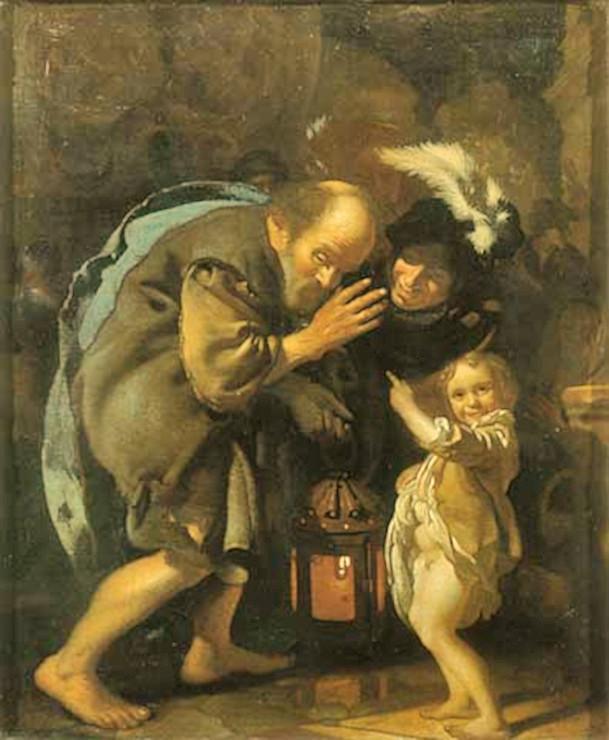
[4] Hübner, Catalogue of the Royal Picture Gallery in Dresden, 349–51, lists twelve pieces by van der Werff in Dresden (either Steffens or Gustav Plitt misspelled or misread the name): “A pastoral scene,” “a portrait of the Artist with his family,” “Lot and his daughters,” “Venus and Cupid,” “A hermit before his cell,” “Magdalen,” “The Judgment of Paris,” “The Infant Jesus caressing the little John,” “The annunciation to the Virgin,” “Diogenes with his lantern, looking for honest men,” “The expulsion of Hagar by Abraham,” and “A gentleman and a lady, sitting at a table, playing chess.”
Steffens’s remark is admittedly curious and difficult to assess or document; perhaps he is thinking of a painting such as Werff’s “Diogenes with his lantern, looking for honest men”:
[5] Steffens seems to be referring to Balthasar Denner rather than an otherwise unknown artist named “Deuder”; either he or Plitt may have committed an orthographical error in reading or transcribing.
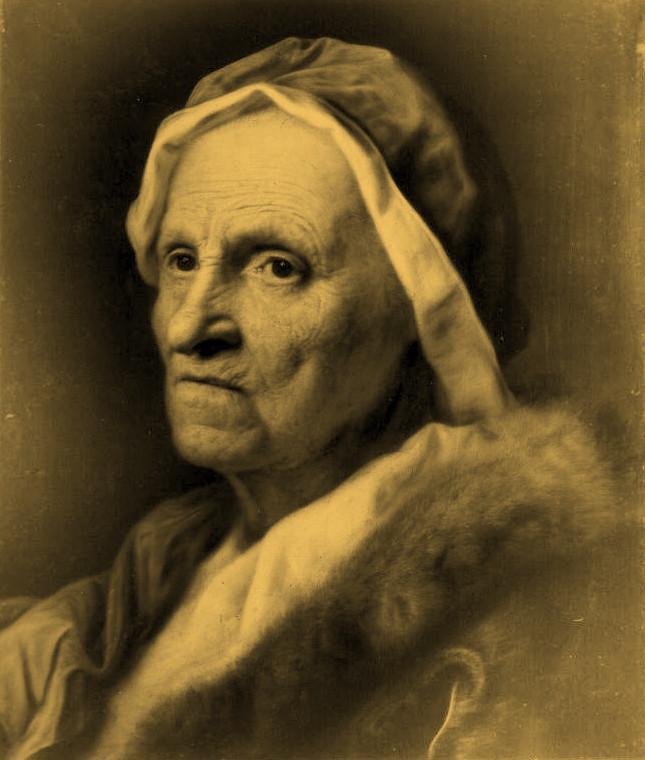
Denner is represented by nine pieces in Dresden in Julius Hübner, Catalogue of the Royal Picture Gallery in Dresden, 393–94 (no “Deuder” is listed): “St. Jerome,” “Portrait of an old man, almost in profile, in light-brown clothes,” “Half-length portrait of an old woman with violet drapery over her head,” “Half-length portrait of an elderly woman with white drapery over her head,” “Head of a girl with an orange blossom in her hair,” “Half-length portrait of an elderly man,” “Half-length portrait of a man with long gray hair and small mustaches,” “Portrait of an elderly woman, enveloped in a gray cloth, with a white cap,” and “Half-length portrait of a woman with a green cap.”
Steffens does, however, react predicably to Denner’s style. See the remarks in Sadakichi Hartmann, “The Tend Leading Styles of Portraiture: III: The German Method,” Portrait 1 (1913) 5 (May 1913), 2–5, here: 3:
In his portraits every wrinkle, every fold of the skin is carefully drawn, every hair of the head, every gleam of the plush cap is conscientiously noted, and the texture is so smooth that nothing can be seen of the brushwork. Denner, in a way, was the first portrait painter of the middle classes of people that had hitherto had not indulged in such luxury.
Here a representative portrait, “Bildnis einer alten Frau im Pelz,” from the Alte Pinakothek in Munich (repr. ibid.):
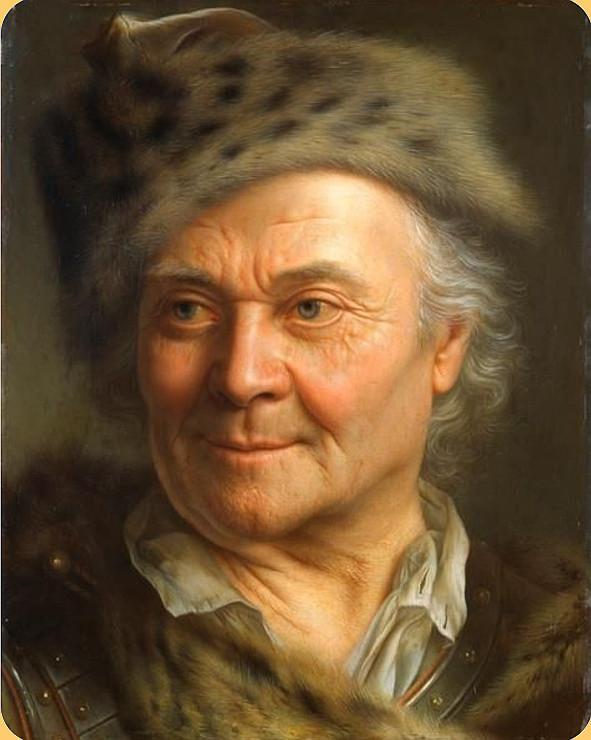
[6] Christian Seybold (Seibold) is represented by five pieces in Dresden in Julius Hübner, Catalogue of the Royal Picture Gallery in Dresden, 396–97: “Half-length portrait of a boy with a gray hat and ostrich feathers,” “Portrait of a girl with a white veil,” “Half-length portrait of a man with a spotted fur-cap,” Portrait of an elderly woman,” and “The Artist’s own portrait; a brush and palette in his left hand.” Here his “Half-length portrait of a man with a spotted fur-cap”:
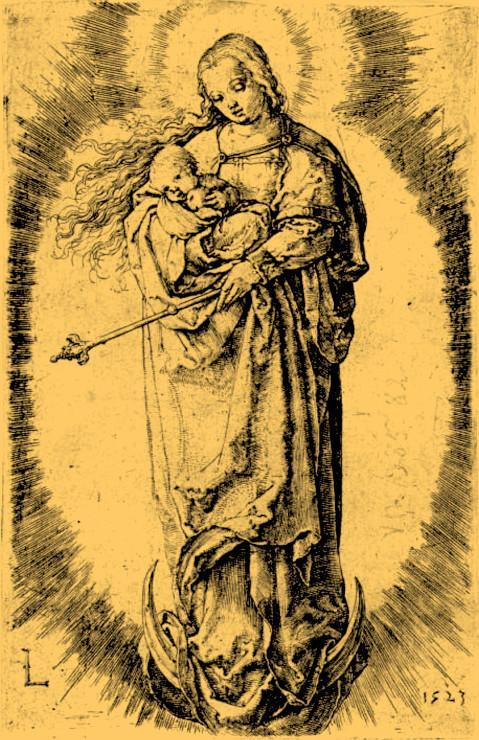
[7] Uncertain; although Julius Hübner, Catalogue of the Royal Picture Gallery in Dresden, lists no Madonna by van Leyden, here in any case a representative example of his several madonnas (Lucas van Leyden, [Mondsichelmadonna; The Virgin with Child on the Crescent] [1523]; Herzog Anton Ulrich-Museum; Museums./Signatur LvLeyden AB 3.57):
[8] First name as in Steffens’s spelling. — Presumably the “Dresden Altarpiece,” also “Virgin with the sleeping Child; above him, two angels hold a crown. Centre picture by an unknown master of the Early German school [!]. On the right, St. Sebastian; on the left, St. Anthony, surrounded by angels. Both wing pictures by Albrecht Dürer” (Julius Hübner, Catalogue of the Royal Picture Gallery in Dresden, 366–67). The center piece has in the meantime been attributed more specifically to a Dutch painter, though Karl Woermann, Catalogue of the Pictures in the Royal Gallery at Dresden, 7th ed. (Dresden 1908), 198, updates the information as follows: “In Hübner’s catalogue, the centre picture was erroneously denied to be the work of Dürer. Subsequent doubt . . . has led to its genuineness being admitted. It is certainly in a very poor state of preservation.”
[9] The strange story behind Hans Holbein the Younger’s “Madonna” (1528) involves distinguishing between the original and a later copy sold to Marie de Medici in Paris. That copy was eventually purchased by the Count of Saxony and exhibited in the Dresden gallery, while the original — “Madonna with Basel Mayer Jakob Meyer and His Family” — was eventually purchased by Prince Wilhelm of Prussia for his wife and is now owned privately. The two paintings, however, are not identical, something determined in 1871 when art historians had the opportunity to compare the two and determine which was original. In any event, Steffens viewed the copy in Dresden. Below is the original (left) and the Dresden copy (right):
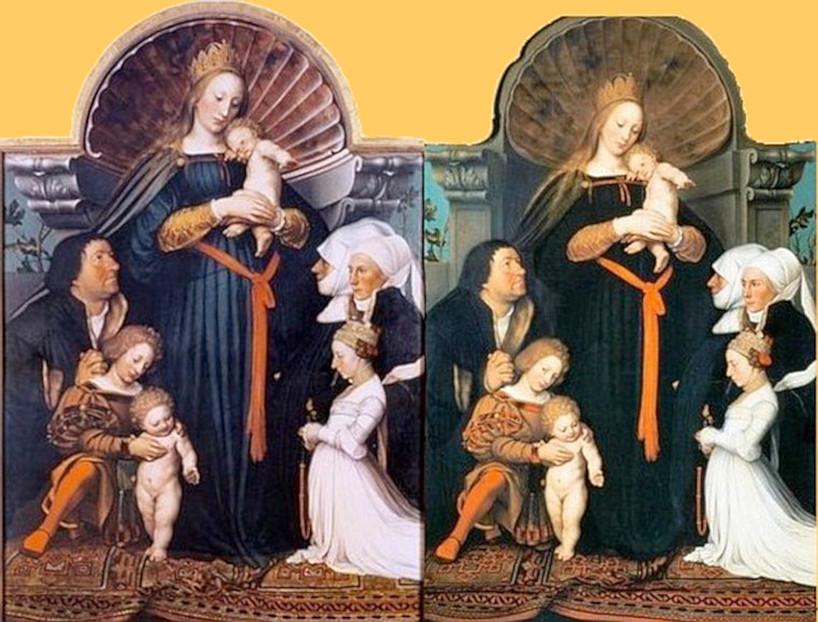
Oddly, Julius Hübner, Catalogue of the Royal Picture Gallery in Dresden, 378, while providing the date of purchase (4 September 1743) of the painting (“Jacob Meyer, Burgomaster of Basle, kneeling in adoration, with his family before the Virgin Mary, who holds the Child in her arms”), does not identify the piece as the copy it was determined to be in 1871.
In any event, Wilhelm and Caroline discuss this painting in their essay “Die Gemählde. Ein Gespräch von W.,” in Athenaeum (1799) 39–151, here 69–75. Back.
[10] Steffens seems to be referring to but a single piece by Mengs in Dresden, namely “Cupid, sharpening a golden dart”:
[11] Although Steffens does not mention the artist, he is presumably referring to Raphael’s Sistine Madonna, about which Wilhelm and Caroline wrote in “Die Gemählde. Ein Gespräch von W.”; indeed, that essay culminates in a discussion of this piece (beginning on 124). See Margaret Stoljar’s chapter “Approaches to the Plastic Arts,” in Athenaeum: A Critical Commentary, Australian and New Zealand Studies in German Language and Literature 4 (Bern, Frankfurt/M. 1973), 53–76, here esp. 68–76. Back.
[13] In what follows, Steffens seems to take his point of departure broadly from the philosophy of Fichte, then moves through its limitations toward the position explicated in Athenaeum regarding the progressive and approximative disposition of art. Back.
[14] From Schiller’s play Die Piccolomini, act 3, scene 9, a scene, however, utterly at odds with Steffens’s evocation here (significantly, he omits one line in the sequence: “And lo! the abyss — and thither am I moving”). He could, of course, be sure Caroline would recognize both the line and its provenance.
In the scene, Thekla is speaking alone (The Piccolomini, trans. S. T. Coleridge, in The Works of Frederick Schiller: Historical and Dramatic, [London 1887], 252; illustration depicting this scene: Minerva für das Jahr 1811; Inhaltsverzeichnis deutscher Almanache, Theodor Springmann Stiftung):

There's a dark spirit walking in our house,
And swiftly will the Destiny close on us.
It drove me hither from my calm asylum,
It mocks my soul with charming witchery,
It lures me forward in a seraph's shape,
I see it near, I see it nearer floating,
It draws, it pulls me with a god-like power —
And lo! the abyss — and thither am I moving —
I have no power within me not to move!
[The music from the banquet-room becomes louder]
O when a house is doom'd in fire to perish,
Many and dark Heaven drives his clouds together,
Yea, shoots his lightnings down from sunny heights,
Flames burst from out the subterraneous chasms,
And fiends and angels, mingling in their fury,
Sling fire-brands at the burning edifice. Back.
[15] Latin, “leisure, ease.” Back.
Translation © 2013 Doug Stott