
• 240. Caroline to Johann Diederich Gries in Göttingen: Jena, 9 June 1799 [*]
Jena, 9 June [17]99
|547| Surely you will forgive and forget that I am answering you late for the sake of my present enclosure. Here is something for your more lonely hours, though at just this moment you are admittedly probably not lonely at all, since I suspect you are in Kassel. [1] And if you are not there — pends toi, brave Crillon! [2]
Enough, the letter has been secured for you. [3] Schelling did nothing toward that end except that he, too, wanted you to have it. Fichte’s famulus copied it out, and I just paid exactly a half Laubthaler for it. [4] Too bad I did not think to have it copied onto green paper as well that it might correspond more to the original and lose nothing of its magic. But enough will be left over to complete your enchantment that Steffens began with his fragments of the fragment. I am waiting to hear from you whether you found everything you were expecting; I certainly cannot prophesy anything |548| in that regard.
I found the letter infinitely charming and interesting, albeit not because of what it revealed — none of which concerns me really, since I already know what I know. It does not seem to me that the gap is filled except by the leap, with which you are already familiar and which Jacobi himself calls the salto mortale [5] — and thus did Sappho leap from the Leucadian cliff, unable to live without love. [6] And indeed — it is an ocean into which Jacobi leaps, where at first the waves flatter his heated disposition and where the end is near — but I do hope the gods take him up before he finds death in that abyss. [7]
Jacobi’s words, “I am not, and do not wish to be if God is not!” and “the good — What is it? — I have no answer if there is no God,” — are the words where I cannot feel with him and which even my modest intellect recognizes as dangerous. There is nothing more repugnant to my innermost faith than that the good be based on a condition — to that extent, the good is my God about whom I have immediate knowledge. For myself, I do not now ask further about a “personality” — but neither do I push it away from me, but am glad simply to allow it to appear to me, especially when I am happy. It has never occurred to me in times of distress to direct my thoughts to that personality. —
That particular inclination to make morality dependent on conviction one simply cannot provide for oneself and which even a consecrated initiate has only in consecrated hours — I have always considered that inclination to be eternally pernicious. I certainly do not condemn Jacobi on that account, but I do believe that without his own immediate love of the good it leads to degradation and servitude. And that particular support that Jacobi rejects in Woldemar, namely, “do not trust your heart” — the heart alone is able to keep a person of such disposition upright. [7a]
|549| You realize that I am speaking about these things without any familiarity at all with the philosophical or metaphysical use of these words, indeed without really being familiar at all with many of the needs of the speculative mind, and I am certainly content with the fact that not all people are as self-contented concerning the science of the infinite and of the limited as am I.
Hence you can imagine how little sensibility I have for Fichte’s system, which I have only managed to piece together a bit through these latest quarrels. Good for the sake of good, that much I can comprehend in his thinking, that elevates my soul, and I also admire the sublimity of the human spirit in him and am interested in the defender of the freedom of thought — quite apart from his personal uprightness.
The really excellent thing about Jacobi, and that which at least for me is the only truly inspiring element in the letter, is that he so ardently admires in Fichte precisely that against which he himself feels the strongest disinclination. What is also remarkably fine and high-spirited and what I find enormously plausible is his parable of the knitted stocking. [8]
Fichte will probably be leaving Jena as soon as this month, but only he alone, since his wife must stay here with the little boy, who has been sickly for 10 weeks now and needs constant care. . . . I do not yet know where Fichte will be going. [9] But he is in good spirits. His legal response has appeared, [10] I will ask your brother whether he wants to enclose it for you. It is composed much more for the sake of eliciting a response than was the Appellation, [11] being more biting and not treating the matter so ceremoniously.
One very pleasant guest we have had here was Herr von Dohm (who — by the way — made a fine declaration in favor of Fichte). [12] Huber had already written me that if the abominations in Rastatt came to light |550| and influenced other courts, it would be thanks to Dohm’s eternally praiseworthy efforts in having implemented the immediate measures with genuine courage. [13] We spoke with him here personally about all this, since he paid us a visit. A truly admirable person who has powdered his hair in the affairs of state without forfeiting his bourgeois sensibility. He strongly contrasts with Goethe and Schiller, who speak about the matter like émigrés. “It makes no difference who did it, it is just good that it happened, for the abominable must happen.” [14]
For Goethe it is a kind of despair over the fact that the peace and quiet he so loves remains at such an increasingly far remove.
What do you mean by saying that a poet needs faith in God? — he does not even need faith in human beings. The religion of the poet is in its own turn something quite different, not faith, good works. Which of your faiths does Goethe have? And he will attain eternal glory despite that. Whatever is excellent already contains the divine, and should it yet need to be purified such can certainly be quickly done.
We are sticking close together in these bad times. Only imagine, not just Schelling, but Paulus, too, is now eating with us, and I also just got Hufland and Loder. [15] Were you yourself only here! We see your brother hardly at all; yesterday we invited him, but he was in Dornburg; [16] Heise came.
Steffens was recently still in Berlin, [17] he was not planning to write us until he was in Freyberg. Hardenberg is in Weissenfels and sent us his sister as an emissary; business is keeping him there, though he will probably be here soon. [18]
Schelling has woken up and is even starting to be a bit more flexible.
|551| Schlegel is thinking up new malicious deviltries. [19] Auguste is practicing her Lucianity toward Schelling. [20]
Stay well, take care of the enclosure. We will probably be hearing from you again soon.
Caroline Schlegel
Notes
[*] The manuscript of this letter is part of the Campe autograph collection in the Stadtbibliothek Hamburg. Max Grunwald, “Miszellen,” Archiv für Geschichte der Philosophie 9 (Berlin 1896), 445–57, here 454, published a couple of extracts from this present letter (albeit with incorrect dating, namely, 9 June 1794; Caroline was not in Jena at the time). He similarly published an extract from Caroline’s letter to Gries on 27 December 1799 (letter 258) in “Briefe von Karl von Holtei, aus dem Goethekreis, von Jac. Grimm, den Humboldts, Schlegels, Chr. F. Krause, Baggesen, Overbeck u. a.,” Nord und Süd 84 (1898), 99–113, here 106. The Campe collection also contains what Erich Schmidt, (1913), 1:740, calls an “insignificant, undated note.” Back.
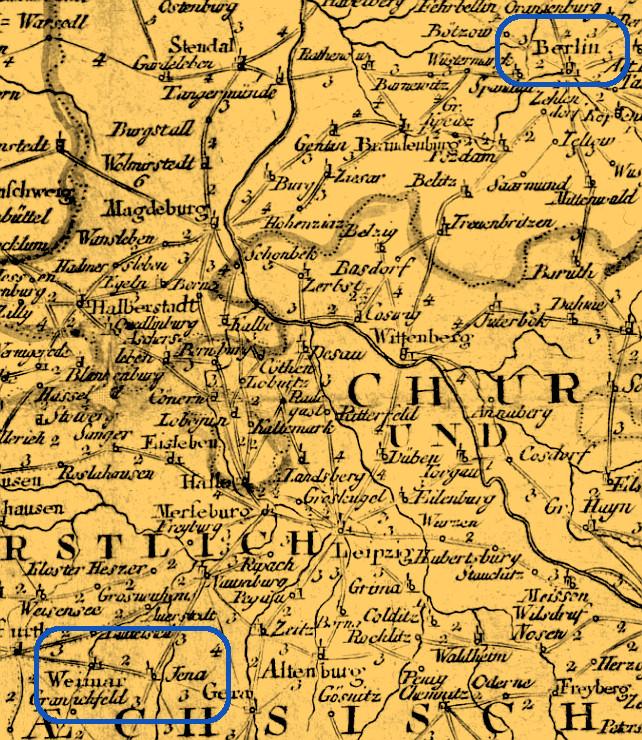
[1] Friedrich Wilhelm III and his popular wife, Queen Luise of Prussia, were traveling through Germany at the time, their stops after departing Berlin included Kassel on 8 June 1799, where they stayed for five days, then Hildburghausen, Erlangen, Fürth (outside Nürnberg), Ansbach, Hanau, and on to Frankfurt, where the king had meetings on 25 June 1799; map below includes Göttingen and Jena (Post Karte Durch ganz Deutschland, ed. J. Walch [Augsburg 1795]):
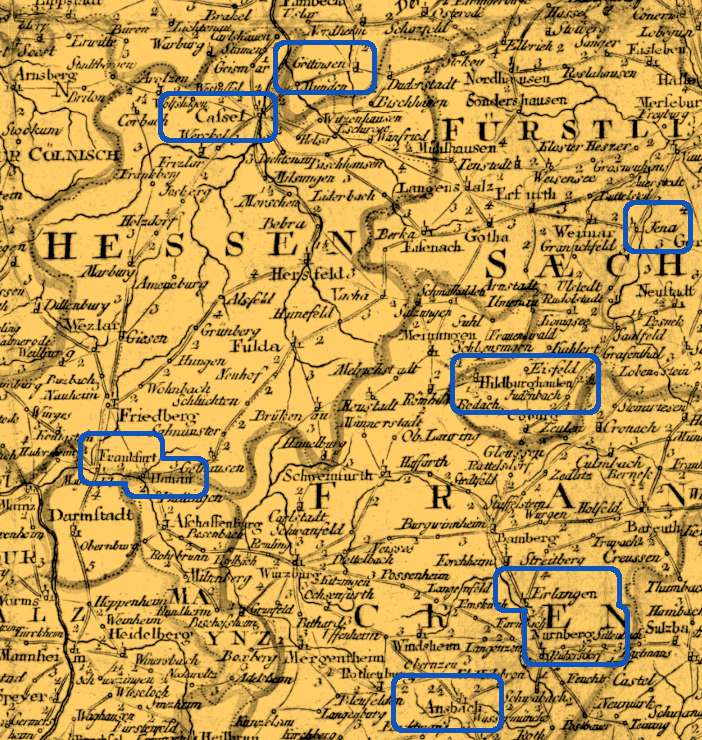
Their stay in Kassel — including military maneuvers on 10 June and illuminations (fireworks) — drew a great many visitors to the town to see the royal couple. Here the fireworks celebration on a similar occasion in Würzburg, viz., the entry of Emperor Leopold I into Brussels (Romeyn de Hooghe, Feierlichkeiten in Belgien zu Ehren Kaiser Leopold’s [ca. 1683–86]; Herzog Anton Ulrich-Museum; Museums./Signatur RdHooghe AB 2.87):

Gries and two of his friends visited Kassel then as well (Aus dem Leben J. D. Gries 36):
The second excursion [after Gotha] was to Kassel, where the presence of the King of Prussia had already drawn a whole throng of visitors from near and far, including our Gries along with Schildener and the Swiss Wyttenbach. One unexpected and extremely gratifying encounter for Gries was that with the families Loder, Hufeland, and Bertuch, and he almost felt the need to follow his friends back to Jena — though his compass pointed toward Göttingen [where Gries was trying to finish his law degree after neglecting his studies in Jena]. Back.
[2] Here Caroline underscores what a loss it would be for Gries were he not in Kassel for the king’s visit.
Voltaire relates in a note to La Henriade, 1:97 (London [Paris] 1730), that France’s Henry IV, “the Great” (1553–1610), wrote the following jesting words after a victory at Arques in Normandy attained in the absence of the glorious duke Louis Des Balbes de Berton de Crillon (1543–1615): “Pends-toi, brave Crillon, nous avons vaincu à Arques et tu n’y étais pas . . . Adieu, brave Crillon, je vous aime à tort et à travers,” “Hang thyself, brave Crillon, we have fought at Arques, and thou wert absent . . . Adieu, brave Crillon, I love you through all” (19th-century illustration by unknown artist):
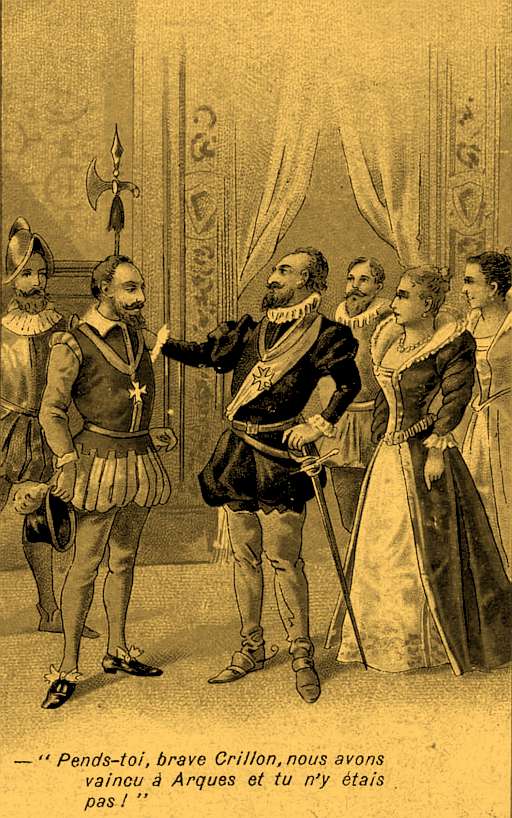
See Shakespeare Henry V, act 4 scene 3: “And gentlemen in England now a-bed / shall think themselves accurs’d they were not here etc.” Back.
[3] Already mentioned in Wilhelm Schlegel’s letter to Gries on 10 May 1799 (letter 236c).
The reference is to Friedrich Heinrich Jacobi’s letter to Fichte from Eutin on 3 March 1799, sent privately and circulated in manuscript form before being published during the autumn of 1799 by Perthes in Hamburg with Fichte’s concurrence (it begins with an introduction on pp. i-xi, followed by 105 [!] pages of text). Translated into English by Diana I. Behler as “Open Letter to Fichte,” in Philosophy of German Idealism, ed. Ernst Behler (New York 1987), 119–41; also Friedrich Heinrich Jacobi, The Main Philosophical Writings and the Novel Allwill, trans. George di Giovanni (Montréal, Buffalo 1994), 497–536.
Prior to publication, it circulated as what was known as the “green letter,” so named because Jacobi used such paper because of his sensitive eyes; see Henrik Steffens, Was ich erlebte, 4:134-36:
Fichte, who had already been teaching in Jena for several years, seemed to be the object both of the most vehement attacks and of the most intense admiration. During this winter, the letter from Jacobi (which was to become so famous later) made quite a stir. It contained that remarkable mixture of admiration and resistance so thoroughly characterizing Jacobi whenever the issue was genuine speculation.
The letter itself was characterized by that peculiar opinion that one should be familiar with and respect speculation, indeed that it might even be useful in bestowing an element of elegance and brilliance to certain assertions, but that one must nonetheless avoid giving in to it excessively and especially avoid subjecting it to any consistently rigorous development. The famous passage in which Jacobi invoked the right of moral individuals over against the formalism of the moral law made a profound impression at the time.
Because in its own way it is a classic passage, I will cite it here [trans. here from Friedrich Heinrich Jacobi, The Main Philosophical Writings and the Novel Allwill, trans. George di Giovanni (Montréal, Buffalo 1994), 515–16, the first paragraph here not included in Steffens]:
I therefore admit that I do not know the good in itself, but that I have only a distant intimation of it. I declare that I become furious whenever they want to impose on me the will that wills nothing in its stead, this hollow shell of self-subsistence and freedom in the absolute indeterminate, and accuse me of atheism, of true and genuine Godlessness, if I resist accepting it in exchange.
Yea, I am the atheist and the Godless one, who, against the will that wills nothing, will tell lies, just as Desdemona did when she lay dying; the one that will lie and defraud, just as Pylades did when he passed himself off for Orestes; will murder, as Timoleon did; or break law and oath, like Epaminondas, or John de Witt; commit suicide like Otho, perpetrate sacrilege likd David — yea, I would pluck ears of wheat on the sabbath just because I have hunger, and the law is made for man, not man for the law.
I am this godless man, and I scoff at the philosophy that calls me godless on this account. I scoff at it and at its highest Being, for I know, with the most sacred certainty that I have in me, that the privilegium aggratiandi [right of pardon] for such crimes against the pure letter of the absolutely universal law of reason is man’s true right of majesty, the seal of his worth, of his divine nature.
This letter, written on green paper because of the author’s poor eyesight, circulated and was read by us in the same spirit in which it had been written. It was both praised and harshly criticized, though the time had not yet come when Jacobi himself — who from his one-sided perspective was inclined to be rubbed the wrong way by everything significant that appeared in philosophy, and who was unable to forget that for a long time he himself, as a singular example, stood juxtaposed alongside the normal philosopher, directing or at least trying to direct opinion through witty remarks — the time had not yet come when Jacobi himself was to become the object of vehement attacks.
Goethe, in a letter to Jacobi on 2 January 1800, assesses the printed version as being more “rounded out” (Weimarer Ausgabe 4:15:4):
Although I had already seen the letter to Fichte in the manuscript version, I found the printed version — enhanced as its content is — almost new; the addenda especially contribute to rounding it out.
The sight of a naturally noble nature, someone who because he believes in himself must thus also believe in the best of which human beings as such are capable at their highest level, is always beneficent, and is especially delightful when we sense in it both friendship and love toward ourselves along with its other virtues. Back.
[4] Approximately 1 2/3 Rheinish Thaler (or currency) (Schmidt, [1913], 1:740). Back.
[5] Italian, “deadly jump; full somersault; dangerous or crucial undertaking”; here: leap of faith. Back.
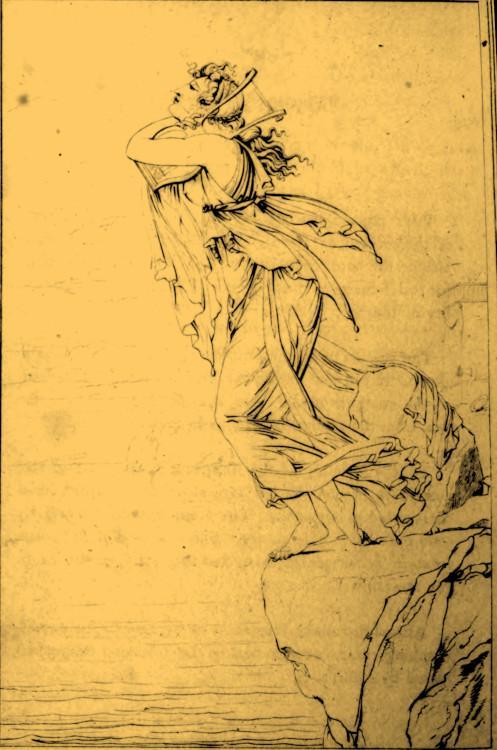
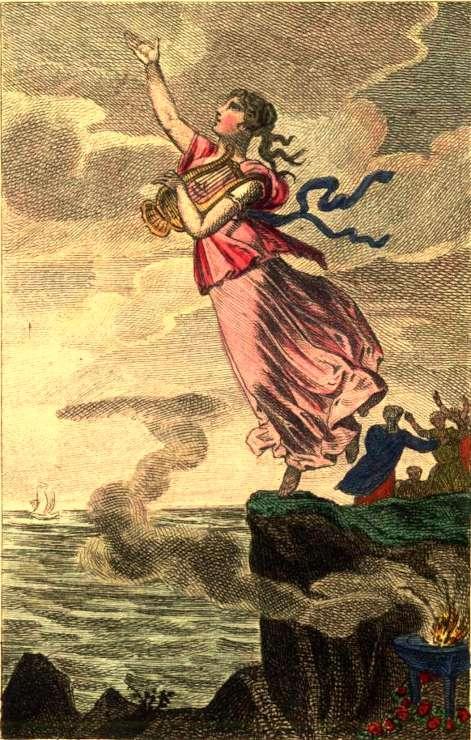
[6] The anecdote that Sappho threw herself off a cliff out of love for the boatman Phaon (Ovid, Epistulae Sapphus, passim, itself a doubtful attribution to Ovid) seems to be an invention. In any event, Sappho allegedly fell in love with Phaon, who had had his youth and beauty restored by Aphrodite. He, however, tired of her, and she in desperation threw herself off the Leucadian cliffs into the sea hoping either to be cured of her love or drown (Ovid, trans. Dryden, Pope, Congreve, Addison and others, 2 vols. [New York 1836), 2:193]):
If not from Phaon I must hope for ease,
Ah let me seek it from the raging seas:
From thee to those, unpitied I'll remove,
And either cease to live, or cease to love!
Illustrations (1) “Sappho at Leucas” from The Historic Gallery of Portraits and Paintings; or, Biographical review: containing a brief account of the lives of the most celebrated men, in every age and country; and graphic imitations of the finest specimens of the arts; ancient and modern. With remarks, critical and explanatory, 14 vols. (London 1807–19), vol. 6 (unpaginated plate); (2) Das Veilchen: Ein Taschenbuch guten Menschen geweiht (1821); Inhaltsverzeichnis deutscher Almanache, Theodor Springmann Stiftung:
[7] In 1796, in his review of Jacobi’s novel Woldemar: eine Seltenheit aus der Naturgeschichte (Flensburg 1779) (originally published in Deutschland, vol. 3 [1796], no. 8, IX: “Neue deutsche Werke,” 185–213; reprinted in Jugendschriften 2:72–91, here 90–91), Friedrich Schlegel had mocked Jacobi’s “leap into faith” that had become famous through his Spinoza dialogue with Lessing:
The striving to partake of the infinite invariably had to generate an inclination for solitary introspection capable of being easily amplified through the soullessness of the surrounding people.
Lost in himself, the person thirsting for eternity could not help but soon acquire a consciousness of a divine capacity, a selfless drive, a pure love within himself, then dissolve his feelings of that capacity into concepts and expand those same concepts into the infinite commensurate with his original inclination toward immoderation, which was constantly seeking “everything in one reality.”
Whence the doctrine of the legislative power of the moral genius, of the license granted high poesy that heroes might allow themselves contrary to the grammar of virtue. Dangerous indifference against all formative impulses. Mysticism hostile to the law. . . .
The hope of unconditional union. Apotheosis of femininity on account of the pure morality of the female drives and the inclination toward limitless surrender . . .
Return to solitariness and love of God. The general tone of the whole, lending it its unifying color, is overwrought tension, an expansion of every individual object of love or desire beyond all limitations of truth, of justice, and appropriateness into limitless emptiness. —
The striving for the infinite is, on this view, allegedly the regnant driving force in a healthy, active soul. . . . what reigns in [all of Jacobi’s writings] is not merely a fortuitous, meaningless preference for the terminology of the sublime mysticism of a few affected Christians, but the same, serious inclination toward unconditional surrender to God’s grace.
Woldemar is thus actually an invitation to become acquainted with God, and this theological work of art ends the same way as do all moral debaucheries, namely, with a salto mortale into the abyss of divine compassion. Back.
[7a] Concerning this alleged statement in Woldemar, see Caroline’s letter to Schelling in March 1801 (letter 295). Back.
[8] See Jacobi’s “Open Letter to Fichte,” trans. Diana I. Behler, in Philosophy of German Idealism, ed. Ernst Behler (New York 1987), 128–130:
In a mischievous moment last winter in Hamburg, I conveyed the result of Fichtean idealism into an image. I chose a knitted stocking.
In order to form an idea other than the usual empirical one of the origin and composition of a knitted stocking, one need only untie the end of the fabric and allow it to unravel on this thread of the identity of this object-subject. One then clearly sees how this individual thing reached actuality by means of a mere weaving back and forth of the thread, that is, through a constant limitation of its movement and prevention that it follow its striving out into the infinite — without an empirical touch or any other admixture or garnishing.
Let me give this, my stocking, stripes, flowers, sun, moon, and stars, all possible figures, and perceive how all of this is nothing but a product of this productive power of the imagination of the fingers suspended between the Ego of the thread and the Non-Ego of the strands. All these figures, together with the stocking essence, viewed from the standpoint of truth, are the single naked thread. Nothing has flowed into it, neither out of the strands nor out of the fingers. It is solely and purely that Everything, and there is in that Everything Nothing outside of it. It is completely, solely — with its movements of reflection on the strands which he has continuously held on to and thereby become this specific individual.
I should like to hear how one would deny this stocking that with all its infinite multiplicities it is still certainly and truly only one thread; and deny the thread that it Alone is this infinite multiplicity. The latter, as I have already said, need only return to its original identity by displaying the series of its reflections in order to make it evident that the former infinite multiplicity and manifold infinity was nothing but an empty weaving of its weaving, and the only reality was merely itself with its action out of, in and upon itself. It also wants this return, namely, liberation from the bonds of the Non-Ego adhering to it; and there is no one who wouldn’t know and had experienced it just as: All stockings have the tendency to abolish their boundaries in order to fill up infinity — highly inprudent [imprudent]! since they can probably know that it is impossible to be Everything and, at the same time, One and Something.
Should this image be so inappropriate that it obviously betray a gross misunderstanding on the part of its inventor, then I would therefore not know how the new philosophy could truly be a new and not merely an altered enunciation of the old philosophy based on one or the other dualism; it would not then be a truly and honestly immanent philosophy, a philosophy all of a piece. What in the old had been called perception would in the new necessarily be called imagining, but mean basically exactly the same. Should it in any way mean only the same, then empiricism ultimately still remains at the top, relating to science as the living limbs to their artificial organs. Therefore, in the human intellect a higher site than the site of scientific knowledge must be assumed, and it is looked down from the former upon the latter: “the highest standpoint of speculation is” not then “the standpoint of truth.”
I therefore don’t fear that reproach. I can much sooner imagine that the new philosophy might like my image and use it to its advantage.
“Just think, it might say to me. Repent! What are all stockings, and what is all wearing of stockings in heaven and on earth compared with the insight into its origin, compared with the observation of the mechanism through which they are produced at all, compared with the reinvention in general and ever more general of its art: a reinvention through which art itself is first created as essential art.” . . .
What would it [the stocking] be without the relationship to and purpose for the human leg, by which means alone reason enters its essence? Back.
[9] Fichte would leave for Berlin at the end of June (Post Karte Durch ganz Deutschland, ed. J. Walch [Augsburg 1795]):
[10] Der Herausgeber des philosophischen Journals gerichtliche Verantwortungsschriften gegen die Anklage des Atheismus, ed. J. G. Fichte (Jena 1799); for an overview of the sequence of events involved in Fichte’s atheism dispute, see supplementary appendix 215a.1. Back.
[11] J. G. Fichtes des phil. Doktors und ordentlichen Professors zu Jena Appellation an das Publikum über die durch ein kurf. sächs. Konfiskationsreskript ihm beigemessenen atheistischen Äusserungen (Jena, Leipzig, Tübingen 1799). Back.
[12] Dohm visited the Schlegels on 6 June 1799; Caroline mentions this visit in her letter to Luise Gotter on 6 June 1799. Back.
[13] Ludwig Ferdinand Huber’s letter to Caroline seems no longer to be extant. — Concerning the Rastatt murders, see Wilhelm Schlegel’s letter to Johann Diederich Gries on 10 May 1799 (letter 236c), note 25.
Dohm’s report on the events was published as Authentischer Bericht von dem an der Französischen Friedensgesandtschaft bei ihrer Rückreise von dem Congress in der Nähe von Rastadt verübten Meuchelmord. Nebst einigen weiteren Actenstüken und Zusätzen des Herausgebers (n.p. 1799). Back.
[14] Goethe writes to Heinrich Meyer from Jena on 9 May 1799 (Weimarer Ausgabe 4:14:83): “The Rastatt affair is one of the craziest ever offered up by world history.” On 7 June 1799 Schiller wrote a rather neutral letter to Goethe from Jena concerning the events; Christian Wilhelm von Dohm had visited him the previous day (Correspondence between Schiller and Goethe 2:221):
Dohm has left me his authentic account of the affair at Rastadt which has led me to make many an observation. Among other things you must have remarked that most strange contradiction which occurs in it respecting the death of Robertjot, where two entirely opposite reports are founded upon the statement of the same valet. When solemnly declared to be an accurate account, such an error is indeed strange, and I do not, in fact, know how to explain it. Back.
[15] Interestingly, the families of both Gottlieb Hufeland and Justus Christian Loder were also in Kassel at this time. See note 1 above. — The friendship with the Paulus family would not last; see supplementary appendix 239.1. Back.
[16] See W. H. Bruford, Culture and Society in Classical Weimar 1775–1806 (Cambridge 1975), 57:
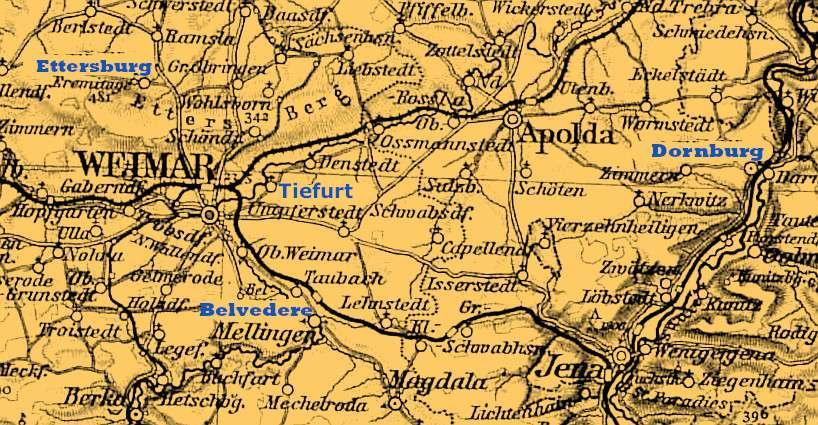
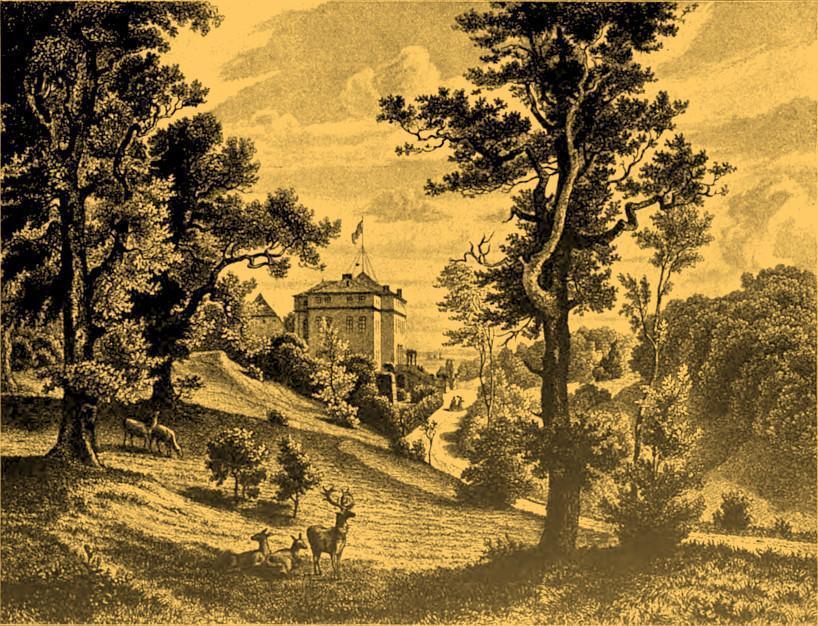
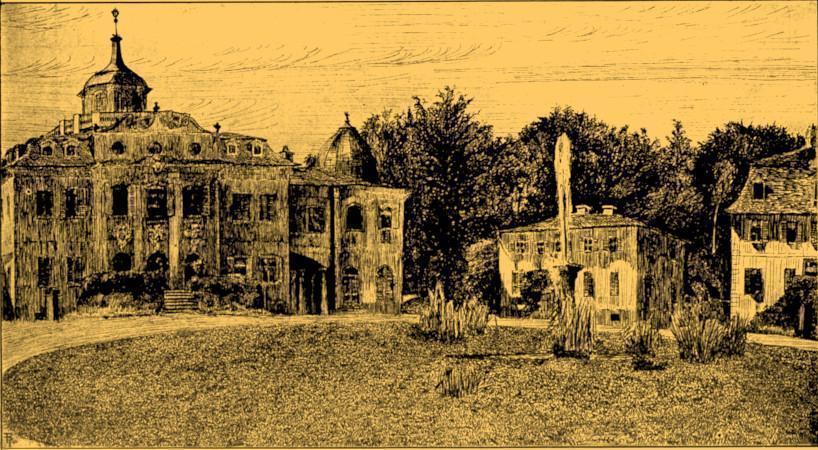
Within walking distance of the town [Weimar] were three country residences [of the royal family] of varying size, Ettersburg to the north, Belvedere to the south, and the modest but charming Tiefurt to the east, and further away a few hunting-lodges, like Goethe’s beloved Dornburg.
See Karte des deutschen Reichs, ed. C. Vogel (Gotha 1907), no. 19:
Here Ettersburg in an illustration by Robert Bauer, in Wilhelm Bode, Damals in Weimar (Weimar 1912), 28:
Belvedere in an illustration by Fritz Reichenbecher, in Wilhelm Bode, Damals in Weimar, 32:
Tiefurt in an illustration by K. Westermeyer, in Wilhelm Bode, Damals in Weimar, 31:

Dornburg is then situated approx. 10 km northeast of Jena, here here in an illustration from the 1840s (Ludwig Bechstein, Thüringen, Das malerische und romantische Deutschland: In zehn Sektionen 3, 2nd ed. [Leipzig 1847], plate following p. 102):
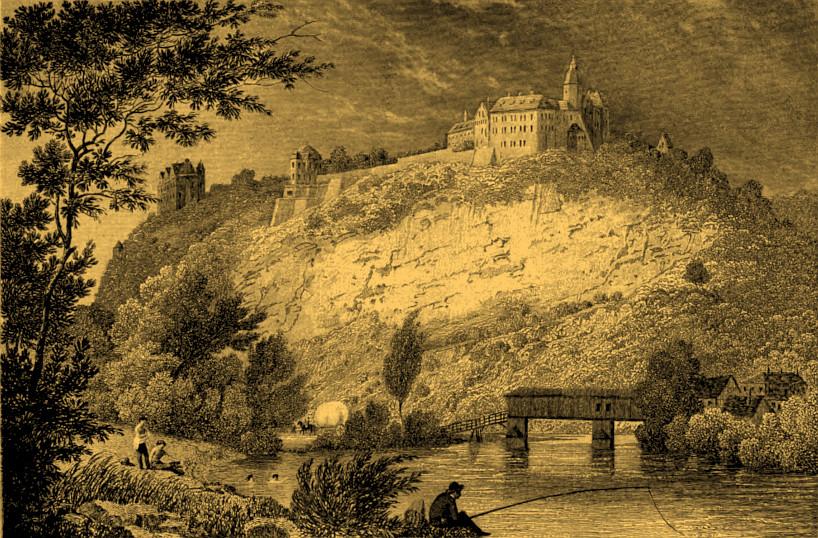
[17] Concerning Henrik Steffens in Berlin, see Friedrich’s letter to Wilhelm and Caroline in May 1799 (letter 237). Back.
[18] Hardenberg would arrive in Jena on 17 July. Back.
[19] That is, literary barbs for inclusion in Athenaeum. Back.
[20] “Lucianity”: the behavior characterizing the pert teenage girl (who, like Auguste, has grown up without a father) portrayed in the table scene between half-grown Lucie and the unknown officer in Goethe’s play Stella (originally Berlin 1776) (act 1); see similarly the expression “aloof half-mamsell” in Caroline’s letter to Auguste on 30 September 1799 (letter 245). For the text to this scene, see supplementary appendix 240.1. Back.
Translation © 2013 Doug Stott