
• 241. Friedrich Schlegel to Caroline in Jena: Berlin, July 1799 [*]
[Berlin, July 1799]
|551| I really would like to be there with you along with the two slender youths, would like to see how they are and how you like them. [1] Please severely reproach the first-born for not writing at all. — And tell me a great deal about him.
I am herewith sending you yet more evidence of human limitedness! — They initially did not want to let the “litterarischer Reichsanzeiger” by the censor, but we managed to get it through. [2]
Fichte has not said anything in opposition to our leaving, but he is not particularly pleased with it either. [3] He intends to have Schelling ask you whether it might not be possible for you two to spend the winter here. I neither can nor intend to oppose this query in any way. As far as I know and can determine, it is not possible, though I do not really know why. [4]
If you were not to come it would be quite sad, including with regard to the journey itself. Dorothea was looking forward to seeing you so soon and then to traveling with you.
You should not let yourself be swayed by such trivialities. [5] Frankly, it is enough to make a person angry. It is good and praiseworthy of Tieck to try and open your eyes, as it were, concerning a predictable Iffland. [6]
Eschen’s room would be sufficient for me if need be if |552| none better is available. [7] If the Tiecks are living very close to you, I would be glad to have lodging with them. [8] Or perhaps something could be done to improve a room such as that of Eschen (e.g., whitewashing, painting the windows and doors). Cleanliness is the main thing.
Dorothea has now also rented her logis out for the winter so that she will only be losing 6 1/2 rh. [9]
All other plans for the journey are still too far off and too dependent on other plans for me to be able to discuss them properly now.
Give my warmest regards to Schelling and think about traveling or not traveling with him that he in his own turn may also be open. After all, we all belong to the same family of magnificent exiles.
Please pardon Dorothea for not writing to you today. Her eldest son is sick, and I myself am extremely distracted. [10]
I am delighted that you are reading a bit in Schleiermacher’s book. Continue to do so. [11]
Auguste does not write. Auguste does not send her regards to me. Auguste is odious.
Malitta or the Indic Fairy Tale is still coming into blossom. [12]
Warm regards to Tieck from me and from his sister. [13] If he has not already done so, he should write and say for sure whether he will be spending the winter in Jena. [14]
The one thing that is of some comfort to me as far as Fichte is concerned is that if he does remain here for the winter, he will then surely be here for more than a year.
Please do write soon again and forgive the flat and stale indifference of my own missive. [15] We have not heard anything from Henriette from some time now. [16]
Friedr.
Notes
[*] Also in KFSA 24:297–98. Back.
[1] Friedrich von Hardenberg and his brother Karl von Hardenberg. Back.
[2] The “Litterarischer Reichsanzeiger oder Archiv der Zeit und ihres Geschmacks” concluded the second issue of Athenaeum (1799), which was to appear in August. It was a collection of harsh, even caustic and cruel literary barbs — “deviltries” — directed at both lesser contemporary writers such as Daniel Jenisch, booksellers such as Friedrich Nicolai, and luminaries or otherwise popular writers such as Christoph Martin Wieland and August von Kotzebue.

Indeed, Caroline was so anxious about the repercussions that she could not even bear to see the volume lying around the house once published; see Wilhelm Schlegel’s letter to Ludwig Tieck on 16 August 1799 (letter 243b) (illustration: Toiletten Kalender für Frauenzimmer 1796; Inhaltsverzeichnis deutscher Almanache, Theodor Springmann Stiftung):
Caroline is plagued by such anxiety concerning the consequences that she has not yet dared even to look at it, and wherever she sees it lying around, even from afar, she immediately covers her head with her hands.

[3] Friedrich and Dorothea Veit had decided to leave Berlin and move to Jena. Fichte, by contrast, had left Jena at the end of June after losing his teaching position (see supplementary appendix 215a.1) and had moved to Berlin, albeit temporarily without his wife and son, whom he would return to Jena to pick up in early 1800. Fichte, of course, had few acquaintances in Berlin and was already taking his meals at Dorothea’s. Back.
[4] For this correspondence between Fichte and Schelling, see supplementary appendix 241.1. Back.
[5] Unclear allusion to Caroline’s (lost) letter to Friedrich; seems to have involved remarks made by Ludwig Tieck concerning August Wilhelm Iffland. Back.
[6] Concerning the increasingly troubled relationship between the Schlegels and August Wilhelm Iffland with respect to the Berlin premiere of Hamlet, see Ella Horn’s essay on the background to the premiere of Hamlet in Berlin. Back.
[7] Friedrich August Eschen, who arrived in Jena at Easter 1796, had left for a position as a private house tutor in Switzerland in May 1798. Back.
[8] Concerning the Tieck’s living situation after arriving in Jena in October 1799, see supplementary appendix 241.1, note 10. Back.
[9] Dorothea moved out of the initial residence she had taken on Ziegelstrasse following her separation from Simon Veit and into a more spacious one; unfortunately, its location seems to be unknown. See Friedrich’s letter to Caroline in late March 1799 (letter 225) with note 12. Back.
[10] Jonas Veit had the measles; Philipp came down with them as well. Back.
[11] Schleiermacher’s Über die Religion: Reden an die Gebildeten unter ihren Verächtern was not yet available in bookstores. Friedrich writes to Schleiermacher on 20 September 1799 (Aus Schleiermacher’s Leben 3:121; KFSA 25:5):
Caroline could not read your Reden until yesterday because the house has hitherto been full of people, and she is an extremely conscientious hostess. She did, however, read it in a single sitting and with great interest and finds it to be a powerful book indeed. She is certainly pleased enough with religion and the universe, probably also with the notion of mediation; but she will hear nothing about any communication of religion, and from that point on she takes a retrograde position in it all. Back.
[12] Unknown reference, though in his letters during April 1801, Friedrich mentions an Indic verse fairy tale with the title Pandaram. He writes from Jena to Wilhelm in Berlin on 17 April 1801 (Walzel 476–77; KFSA 25:261): “I can also promise you with absolute certainly the Indic fairy tale, the Pandaram, or The Singer of Shiva. — It will be composed completely in verse. . . . You will definitely receive the Pandaram.” Further on 27 April 1801 (Walzel, 479 KFSA 25:266): “The fairy tale would already be finished except for Plato! Plato!” And finally on 1 June 1801 (Walzel, 484; KFSA 25:274):
Surely you will forgive me for not writing until now and for still not including either the fairy tale or the copy of the poem when I tell you that Dorothea has been seriously ill for three weeks now, and although she has gotten better is still confined to the bed.
See also Wilhelm Schlegel’s letter from Jena to Sophie Bernhardi in Berlin on 21 August 1801 (Dreihundert Briefe 2:3:67; here letter 327f); Wilhelm is discussing current literary projects:
Neither has Friedrich gotten the Indic fairy tale onto paper yet; he does not want to get to work on it seriously until he knows whether it might yet be published in the Almanach this year, something that might not be possible. Back.
[13] Ludwig Tieck was currently in Jena staying with the Schlegels. Back.
[14] Tieck would arrive in Jena with his family on 17 October 1799 and remain into the summer of 1800. Back.
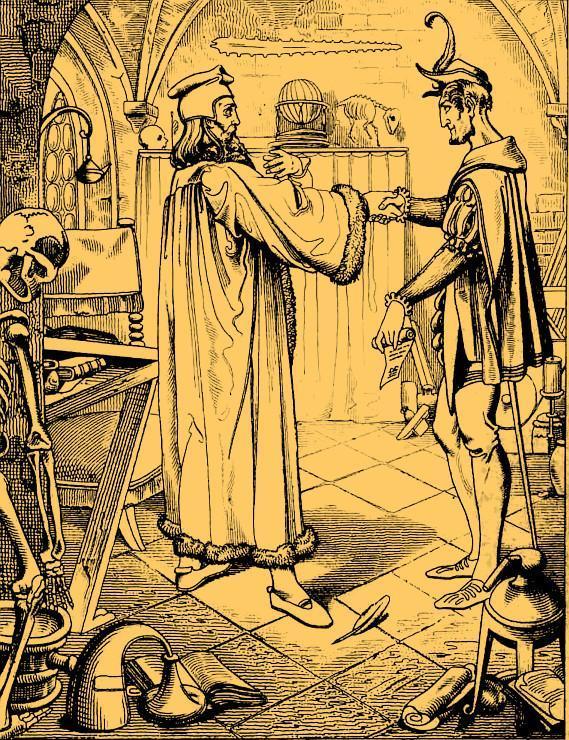
[15] The expression “flat and stale indifference” (flache Unbedeutendheit) alludes to Goethe’s Faust. Ein Fragment, in Goethe’s Schriften, vol. 7 (Leipzig 1790), 24–25, the version with which Friedrich and Wilhelm would have been familiar (illustration of Faust and Mephistopheles concluding their pact: Göthe-Gallerie: Stahlstiche zu Göthe’s Meisterwerken / nach Zeichnungen von Julius Nisle [Stuttgart 1840–41], issue 3, Faust: Erster Theil):
In the scene where Faust exits his study because he does not wish to see a student who has arrived, Mephistopheles disguises himself as Faust, and before the student enters — before whom he mocks university study and scholarship in general and various disciplines in particular — recites the following monologue (trans. Faust. A Tragedy, trans. Bayard Taylor [Boston, New York 1870], 74–75, act 1, scene 4; the monologue was not altered between this and the later version of Faust; illustration from Faust, tragédie de M. de Goethe, trans. Albert Stapfer, 3rd ed. [Paris 1828], plate following p. 50):
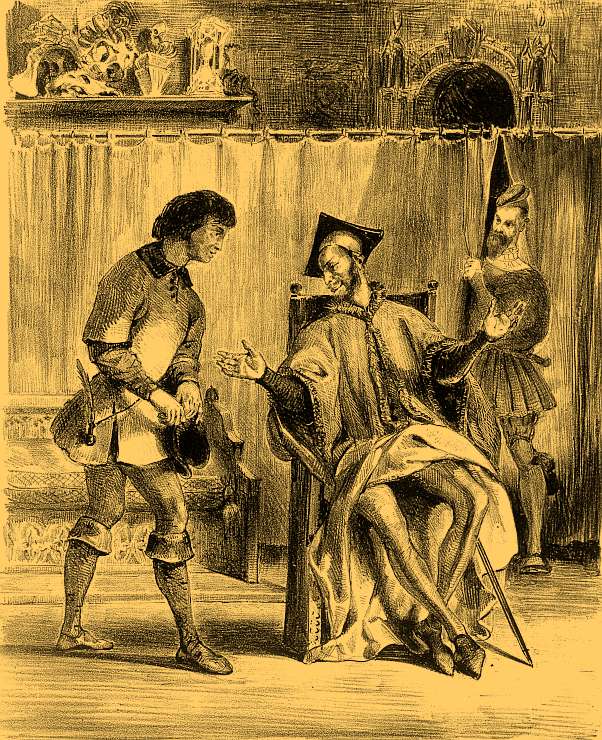
[Mephistopheles (in Faust's long mantle.]
Reason and Knowledge only thou despise,
The highest strength in man that lies!
Let but the Lying Spirit bind thee
With magic works and shows that blind thee.
And I shall have thee fast and sure ! —
Fate such a bold, untrammelled spirit gave him,
As forwards, onwards, ever must endure;
Whose over-hasty impulse drave him
Past earthly joys he might secure.
Dragged through the wildest life, will I enslave him,
Through flat and stale indifference;
With struggling, chilling, checking, so deprave him
That, to his hot, insatiate sense,
The dream of drink shall mock, but never lave him:
Refreshment shall his lips in vain implore —
Had he not made himself the Devil's, naught could save him,
Still were he lost forevermore! Back.
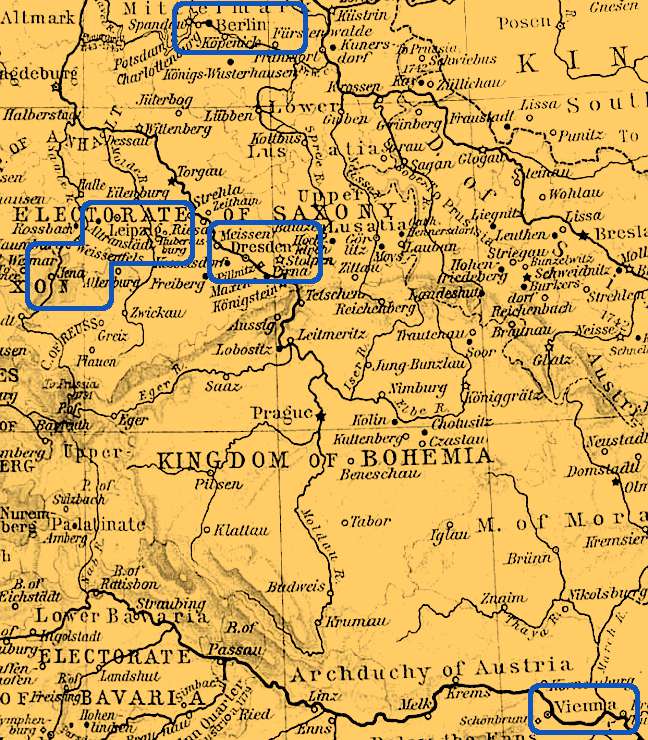
[16] Henriette Mendelssohn was in Vienna working as a governess, though she would soon return to Berlin; concerning the uncertain chronology, see her letters to Dorothea on 16, 18, 19 April 1799 (letters 230c,d,e); letters immediately following these also mention her journey (W. R. Shepherd, Historical Map of Central Europe about 1786 [1926]):
Translation © 2013 Doug Stott