
• 219. Caroline to Friedrich von Hardenberg in Freiberg: Jena, 4 February 1799 [*]
[Jena] 4 February 1799
|495| Notwithstanding you immediately angered me with your dithyrambs on mercantile genius, which we lack and which you, too, do not possess, you have nonetheless been better than I. At least you send us news about yourself, whereas I, on the other hand, have depended entirely |496| on your Christmas conversation with Madam Ernst [1] with regard to the necessary information and have thought of you more than I have written. Finally, the two can merge.
I do not want to get too anxious concerning what you relate about your sickliness, [2] since considerable good spirits invariably shine through as well and because, given your irritability, you must anticipate having periods during which you simply feel you are not much good for anything.
The words of comfort you mention, however, interest me much more personally. Love. [3] Which? Where? In heaven or on earth? And what do you have to tell me in person that is wonderful and new? Please only go ahead and tell me now if it is nothing too involved and is something specific. There is no love about which you could not speak where, as you know, there dwells nothing but love for you. Indeed — may I read into the conclusion of your letter the entire meaning it seems to be relating? I will simply remain silent until you yourself tell me.
All your other bustling intellectual activity, however, makes my poor head overheat. You cannot believe how little I comprehend what all of you are about, how little I really understand what you are doing. I myself basically know about nothing but moral humanity and the poetic arts. I enjoy reading everything you relate from time to time, and I doubt not that the moment will someday come when the details will also coalesce into some semblance of order for me as well, and when everything you say will please me not merely because it is you who are speaking.
What all of you are engaged in together there seems like a proper magic cauldron to me. For the time being, let me ask merely that you confide in me whether your ultimate result will be a published work, or whether nature, which you also manage to construe so magnificently and artfully and simply, is to perish for this earth together with your own magnificent and artistic nature. Please understand that it is difficult to predict |497| exactly from your own statements [4] whether, when you begin a piece of work, it is to become a book, or, when you love, whether it is the harmony of the spheres or a Harmonika. [5]
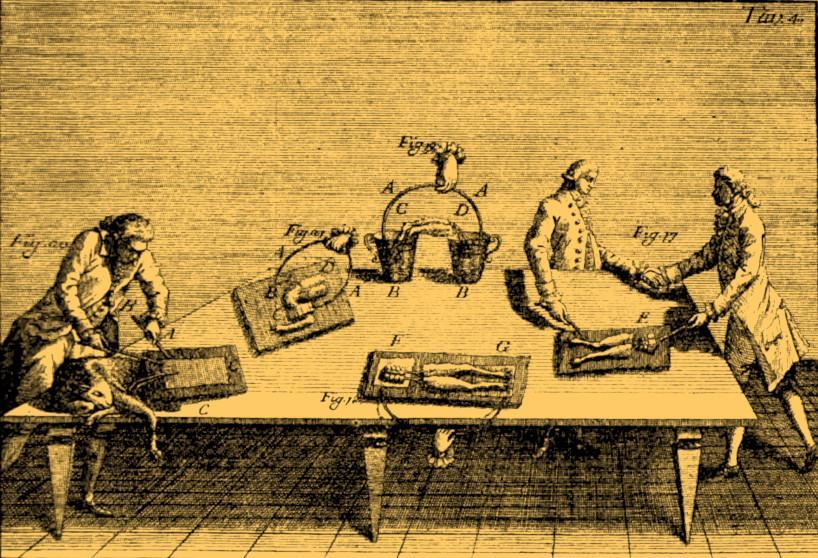
What can I relate to you about Ritter? He is living in Belvedere and is always sending frogs over here, of which there is a surplus there and a lack here. [6] He occasionally accompanies them himself, though I have not yet seen him, and the others have assured me that he would neither be able nor want to speak three words with me. He has but one sense, as far as I can tell. It is allegedly eminent enough, but is probably not really the highest one can have with regard to his science — the highest consists of many. Schelling says you ought simply to write to Ritter yourself if you have something to say to him. It makes no difference, he says, that Ritter himself might not write at all. You will be seeing him the spring in any case.
As far as Schelling is concerned, there has never been a more brittle outer covering. And yet even though I cannot spend six minutes with him without getting into an argument, he is nonetheless far and wide the most interesting thing around, and I wish we could see him more often and more privately. Then the arguing would also come to an end. He is constantly on guard against me and against the irony in the Schlegel family; because he is wholly lacking in cheerfulness, it is also not so easy for him to gain access to its more cheerful side.
His laborious work often prevents him from going out; moreover, he lives with the Niethammers and is constantly occupied by Swabians, with whom he at least feels comfortable. [7] Whenever he is unable to chat about insignificant things or to discuss scientific material, he is overcome by a kind of tension for the easing of which I have not yet discovered the secret.
We recently celebrated his twenty-fourth birthday. He still has time to mellow. Then he will also get rid of the inordinate rage he has toward those whom he considers his enemies. |498| He is extremely agitated at anyone named Hufeland. [8] He once declared to me that he could not visit us if Hufeland were also present. But when Hufeland himself invited him, he went after all. I intentionally did not bring this inconsistency to his attention. He has character to such an uncontrollable degree that one has no need to remind him of it.
The Norwegian Steffens, whom I already mentioned to you, has been much more successful in society here. In fact, he seems so captivated by it that the question is now whether he will even get to Freiberg. [9] You would have found him quite pleasant. We have found him to be so as well, though I cannot yet judge him entirely, since I know not how far out he extends where I myself do not, and it is, after all, philosophy that must first really complete his personality. [10]
Everything in Fichte is clear to me, including that which comes from Fichte himself. [11] I have asked Charlotte to send you his Appeal; he also sends his greetings along to you. Write me something in that regard that I can pass on to him as well. What do you think about this quarrel? And what about Reinhard? And the way Fichte positions him between Spalding and Jacobi? [12] — Fichte has put a bit too much emphasis on martyrdom. Everything else is bright and exciting. I was quite reverent while reading it, and celestial. One can probably not yet get the publication in Dresden. I talked Fichte into sending it to your father, and I believe he did so.
After atheism, the latest event here has been the performance in Weimar of the first part of Wallenstein, namely, Die Piccolomini. We saw it, and it is all just as excellent and just as deficient as I thought it would be. [13] The effect of the whole suffers considerably from the material being extended over two different plays. But dramatic material does not interest you — so let me not rob us of the few moments we have remaining |499| by going on about that. Göthe is spending February here. [14] The elegy has not yet been completed, and only half of Athenaeum has been printed thus far. [15]
I can say nothing about Friedrich until I have seen Madam Veit and Lucinde. The week before Easter we will be going to Berlin, where they will be remaining for the summer. [16] Dear Hardenberg, why do not you go with us? We can meet you in Naumburg. [17] That would be just too nice. Please think seriously about it.
We are diligent and extremely happy. I have hardly come out of Wilhelm’s room since the beginning of the year. I am translating the second piece by Shakespeare, iambics, prose, even rhymes. [18] Adieu, I must send this off.
Notes
[*] Also in Novalis Briefwechsel mit Friedrich und August Wilhelm, Charlotte und Caroline Schlegel, ed. J. M. Raich (Mainz 1880), 107–13; Novalis Schriften 4:518–20 (quod vide for locating allusions to Hardenberg’s works in Novalis Schriften). Not in Waitz, (1871). Excerpts translated by Lisa C. Roetzel in Theory as Practice. A Critical Anthology of Early Romantic Writings, ed. Jochen Schulte-Sasse (Minneapolis 1997), 445–46. — This letter is Caroline’s response to Hardenberg’s letter to her on 20 January 1799 (letter 216). Back.
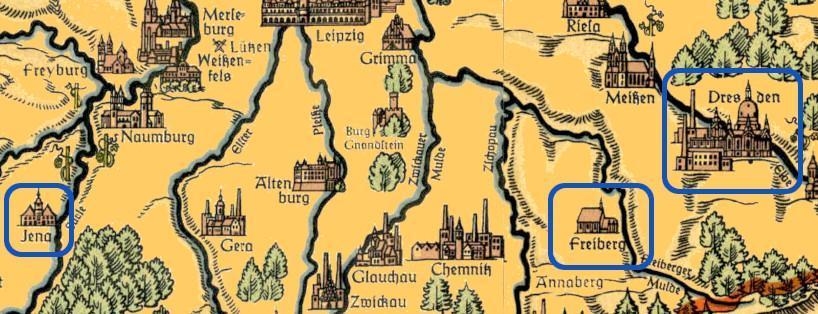
[1] Hardenberg had spent Christmas 1798 in Dresden with the Charpentier family and paid a brief visit (“several hours”) to Charlotte Ernst and presumably her husband shortly after the Christmas celebration (Novalis Schriften 4:970; map: Rudolf Koch and Fritz Kredel, Deutschland und angrenzende Gebiete [Leipzig 1937]; illustration: Toiletten Kalender für Frauenzimmer [Vienna 1796]; Inhaltsverzeichnis deutscher Almanache, Theodor Springmann Stiftung):

[2] In his letter to her on 20 January 1799 (letter 216), Hardenberg had remarked that his health was “tolerable.” Back.
[3] Hardenberg had concluded his letter of 20 January as follows: “Without love I would absolutely not be able to endure.” Caroline is correctly (and affectionately) insinuating a romantic love interest (Daniel Nikolaus Chodowiecki, Ich stand da, albern und betroffen genug [1794]; Herzog August Bibliothek; Museums./Signatur Chodowiecki Sammlung [6-444]):

[4] Here Caroline is alluding to Hardenberg’s extemporaneous excursus on Fichte, Hemsterhuis, Spinoza, et al. in his letter of 20 January. Back.
[5] Viz., the “mysterious pulse beats in many earlier writings, demonstrating a point of contact with the invisible world” (letter of 20 January) or Julie von Charpentier, to whom Caroline earlier referred as a Harmonika; see her letter to Hardenberg on 15 November 1798 (letter 208), with note 8. Back.
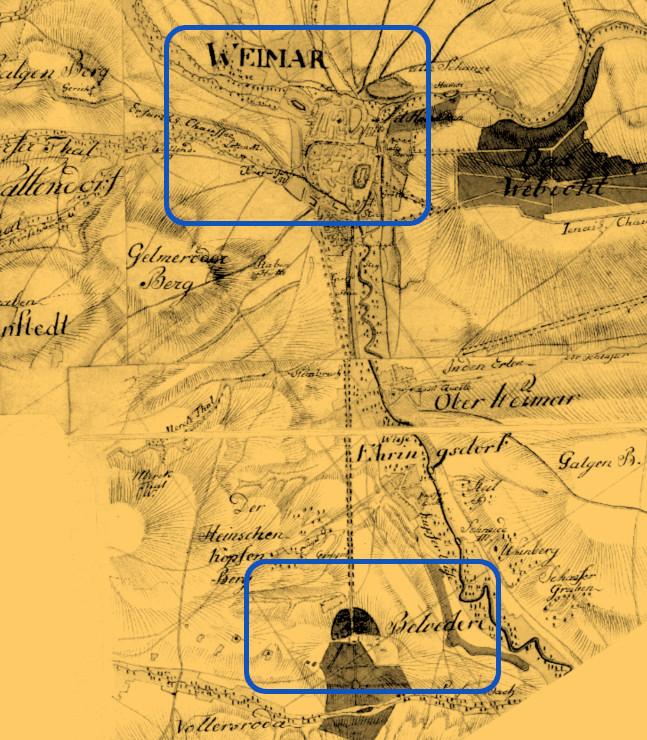
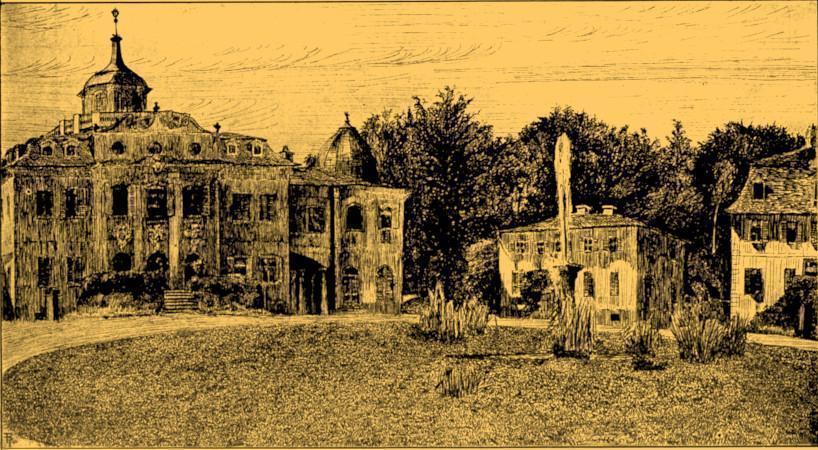
[6] Ritter was working on experiments with animal magnetism in the Weimar Belvedere Castle, the royal summer residence situated on a hill ca. 4 km south of Weimar; it was surrounded by a park and had various gardens and hot houses (map: A. W. Ludwig, Charte über den grosten Theil des Fürstenthums Weimar in 8 Sectionen nach einem Originale von Wibekind copiert durch A.W. Ludwig [1789]; Bibliothèque nationale de France, département Cartes et plans; illustration: Fritz Reichenbecher, in Wilhelm Bode, Damals in Weimar [Weimar 1912], 32):
Henrik Steffens, Was ich erlebte, 4:92, remarks that “Ritter’s primary contribution to the development of physics at that time consisted especially in having used frogs’ legs as electroscopes,” a line of experimentation he pursued “so broadly that it eventually almost became unbearable.”
See the illustration in Wilhelm Ostwald’s chapter on Galvani in Elektrochemie: Ihre Geschichte und Lehre (Leipzig 1890), 32:
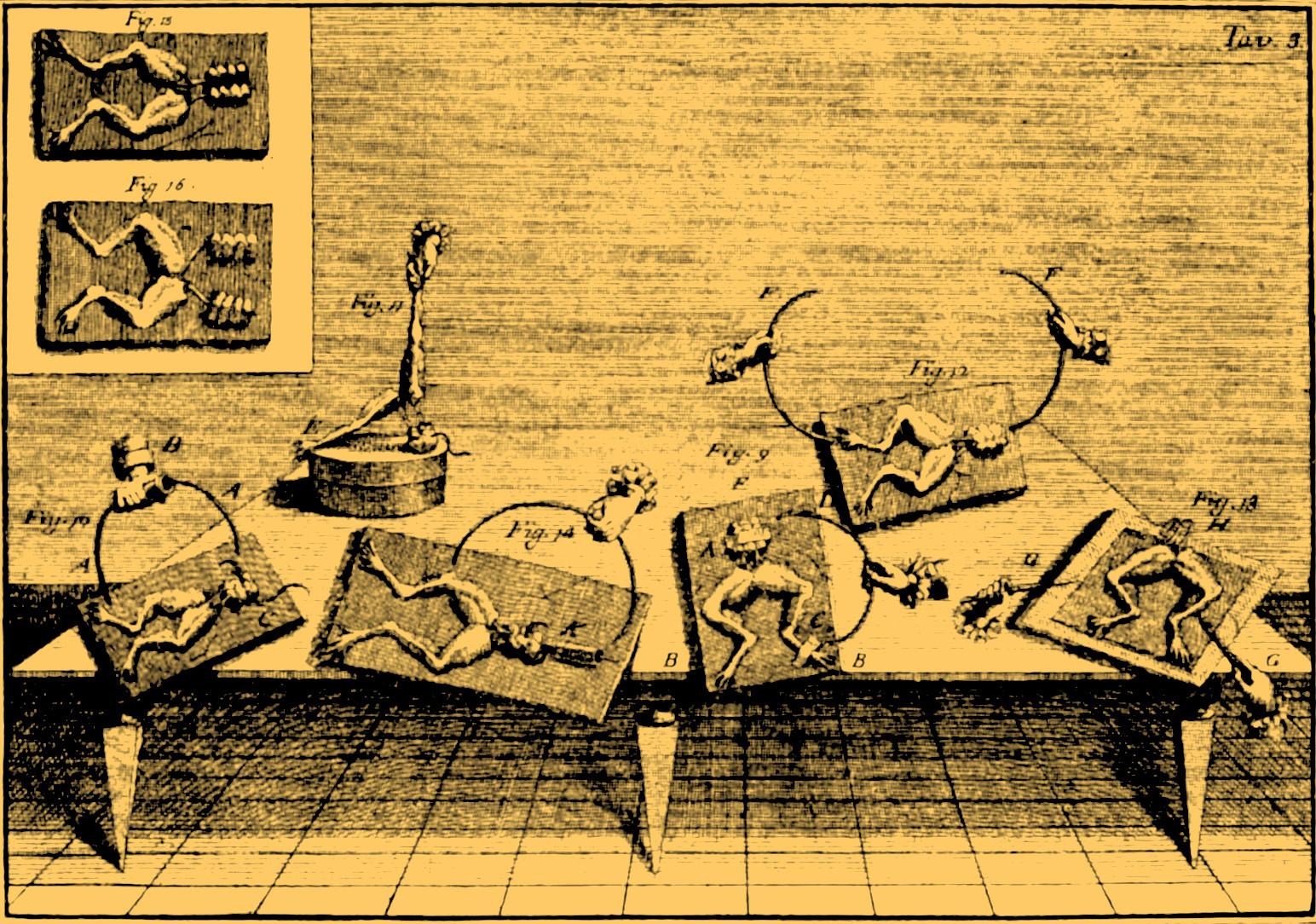
See similarly Aloysi Galvani, De viribus electricitatis in motu musculari commentarius) (Mutinae 1792), plates 2 and 3, with whose work Ritter was familiar:
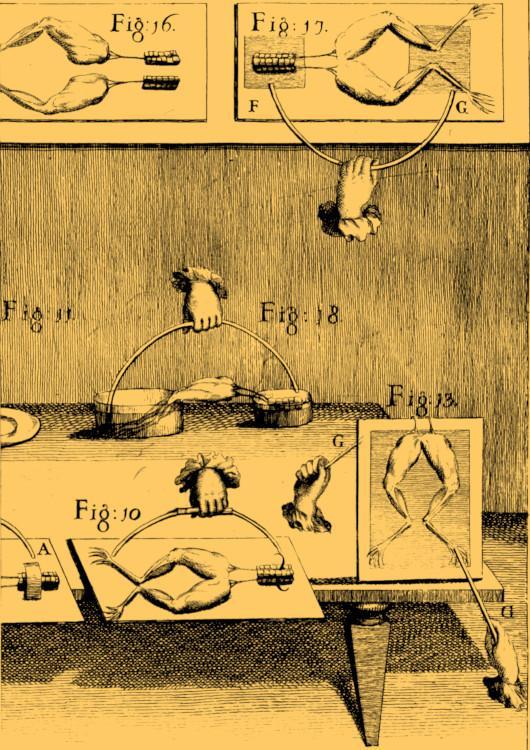
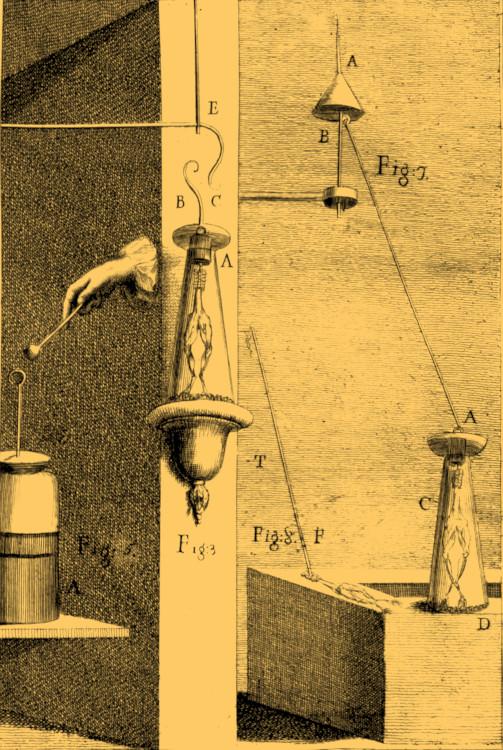
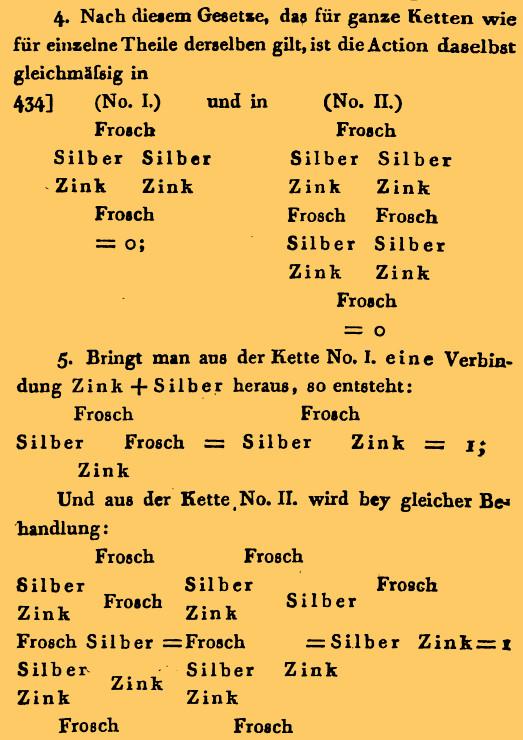
See also a random example of Ritter’s own deductions concerning the constellation of energy between frog, zinc, and silver as such applies to galvanic cells (Johann Wilhelm Ritter, Physisch-Chemische Abhandlungen in chronologischer Folge, vol. 1 [Leipzig 1806], 278):
Here other examples of laboratories set up to conduct such experiments, including on larger animals (Galvani in Elektrochemie: Ihre Geschichte und Lehre [Leipzig 1890], 32, 35):
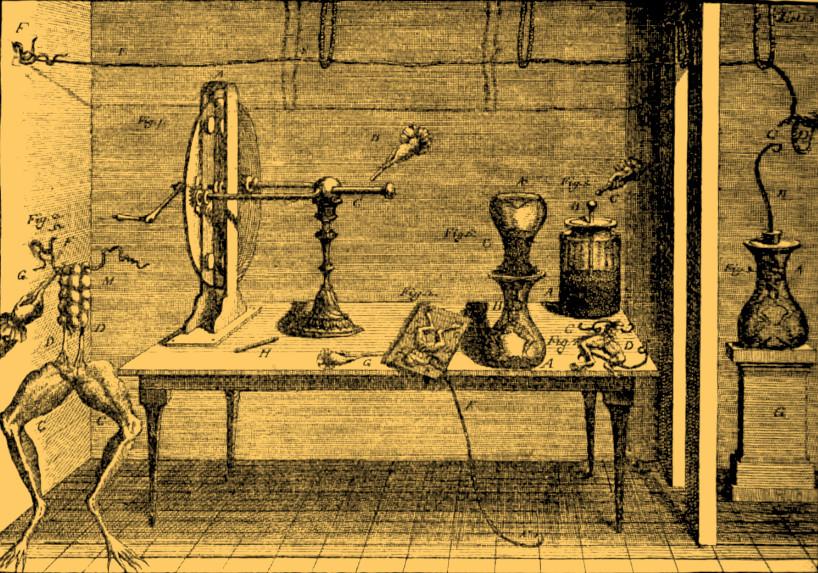
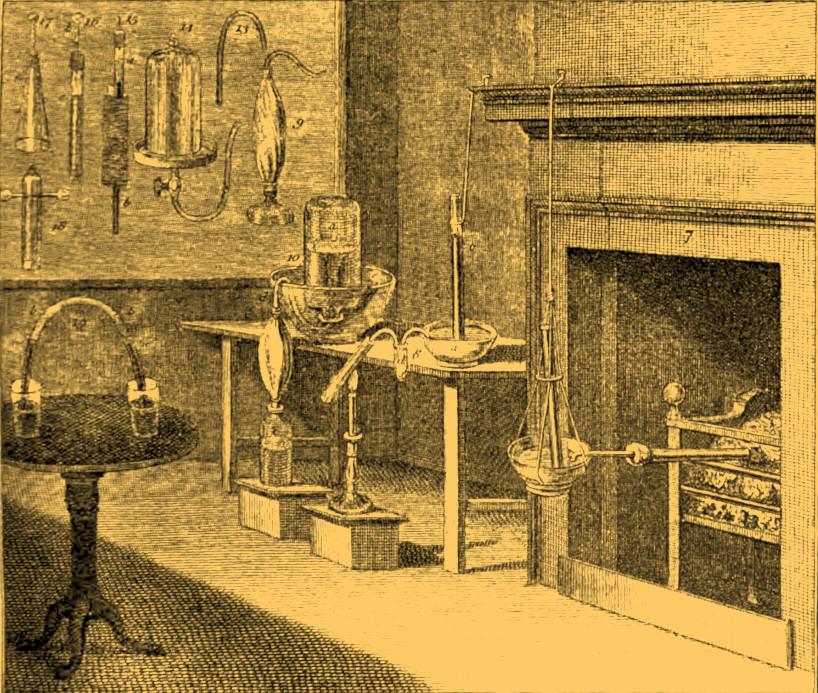
Here a laboratory for testing different kinds of air (Galvani in Elektrochemie: Ihre Geschichte und Lehre [Leipzig 1890], 11):
Click on the following image to open a gallery of illustrations of laboratories and experiments associated with Ritter’s interest and esp. applications — in later letters (letter 432d) with respect to overcoming death itself — of galvanism (illustrations from various editions of Aloysii Galvani [Luigi Galvani], De viribus electricitatis in motu musculari commentarius, cum J. Aldini dissertatione et notis. Acc. epistolae ad animalis electricitatis theoriam pertinentes [Apud Societatem Typographicam, 1792], largely reprinted in Jean Aldini, Essai théorique et expérimental sur le galvanisme: avec une série d’expériences faites en présence des commissaires de l’Institut National de France, et en divers amphitéatres anatomiques de Londres [Paris 1804]):

[7] Daniel Nikolaus Chodowiecki “Der Schriftsteller,” Illustrationen zu Erasmus’ Lob der Narrheit in sechs Abteilungen (1780) (Herzog Anton Ulrich-Museum; Museums./Signatur DChodowiecki WB 3.32)):

Schelling’s exact place of residence at this time is uncertain; see Friedrich Schlegel, Wilhelm Schlegel, and Caroline to Friedrich Immanuel Niethammer on 6 July 1798 (letter 202a), with note 7. Niethammer himself was from Swabia. Back.
[8] Schelling spends much of 1799 in a dispute with the editors of the Allgemeine Literatur-Zeitung, Christian Gottfried Schütz and Gottlieb Hufeland, concerning reviews of his work (Henrik Steffens also is involved). This extremely vitriolic dispute, documented in these letters and supplementary appendices, eventually resulted in a complete break between the two parties. Back.
[9] Steffens journeyed to Freiberg in May 1799. Back.
[10] See Erich Schmidt’s remarks on the occasion of this appearance of Henrik Steffens in these letters ((1913) 1:735–36; Schelling portrait: 1801, by Friedrich Tieck):
In his forthright autobiography, Was ich erlebte, Steffens wrote charmingly, warmly, openly, and with emotions of both love and hate about how Spinoza had shaken him from sleep, but how it was only Schelling who actively made him into a “philosopher in the truest sense of the word.” Schelling’s Ideen zu einer Philosophie der Natur (Leipzig 1797) “elastically elevated my entire existence; it was the decisive turning point of my life.”
The scales were tipped in favor of Schelling (who was moreover two years younger than Steffens) insofar as his genius provided a path from Fichte’s abstractions back to nature. And in Goethe, Steffens venerated the freshest, most immediate personality of the age. “Fichte and Goethe constituted the turning points of the entire perspective of the Schlegel brothers, whereas nature and Goethe constituted that of Schelling.”
He met the Schlegels and Schelling in Jena after a stay in the Thuringian Forest, where he read Fichte and Athenaeum. “In his manner of appearance,” Schelling “had something very definite, indeed defiant; broad cheeks, widely separated temples, a high forehead, an energetically taught face, a bit of an upturned nose; an intellectually commanding presence resided in his large, clear eyes.”

For his own part, Schelling was pleased to receive such unqualified devotion from a professional scientist. Steffens attended Schelling’s lectures. “A. W. Schlegel and his remarkable and highly intelligent wife along with her charming daughter were among my most pleasant social contacts” (Was ich erlebte 4:82). Although in one instance Caroline is quite shocked that Steffens has become indignant over an imagined slight by Goethe, she is delighted that this Norwegian can recite extensive passages from Faust from memory.
Schmidt is referring to the following passages from Was ich erlebte 4:94–97:
My precise familiarity with Goethe’s writings had raised somewhat of a stir in the Schlegel family. They were curious to hear sometime how Goethe would sound in the mouth of a northlander, so I was once asked to read aloud part of Faust in the version of the first fragment that had appeared at the time [“Faust. Ein Fragment,” in Goethe’s Schriften, vol. 7 (Leipzig 1790), 1–160]. Because a copy could not be readily located, I recited the first monologue by memory. I asked whether I should proceed further, and I genuinely could have recited most of the first part of the fragment without the printed text. Schlegel’s wife was delighted, and it was resolved that I should be introduced to the great poet as soon as possible. As it happened, Frommann anticipated my lady friend’s good will.
It is a peculiar feeling when one is introduced to someone for the first time who has exerted such an enormous and decisive influence on one’s life. Such a moment constitutes what amounts to a true epoch in a person’s life, and as I was on my way to Frommann’s, I felt as if a fateful event were before me. Goethe appeared.
The Frommann’s house is still extant. Map: Plan der Residenz- und Universitätsstadt Jena (1884); Thüringen, Städtische Museen Jena: Stadtmuseum und Kunstsammlung DE-Mb112/lido/obj/12070842; Städtische Museen Jena; ISIL:DE-MUS-873714. Photograph of the Frommann house in 1970, reproduced by permission: Stadtmuseum Jena. Illustration of leisure activity on the Fürstengraben, which the house fronted along the northern town walls, from Carl Schreiber and Alexander Färber, “Am Fürstengraben 1779,” in Jena von seinem Ursprunge bis zur neuesten Zeit, nach Adrian Beier, Wiedeburg, Spangenberg, Faselius, Zenker u. A. von Carl Schreiber u. Alexander Färber: Mit Kupfern, Karten, Lithographien u. Holzschnitten (Jena 1850), plate following p. 208. The house is located on the Fürstengraben just across from the former northern town walls. Caroline’s Jena residences included, initially, the garden house just outside the town gate, then Leutragasse 5 (on the map: center) and the Asverus house next door to the inn Zum [schwarzen] Bären (on the map: top right):


Steffens continues (illustrations: [1] Goethe in 1800 by Friedrich Bury; [2] Calendar für das Jahr 1796; Inhaltsverzeichnis deutscher Almanache, Theodor Springmann Stiftung; [3] Daniel Nikolaus Chodowiecki, Sitzende männliche Figur nach Chodowiecki; Österreichische Nationalbibliothek Signatur/Inv-Nr. LAV 215/7842 POR MAG; [4] Wiener Damenkalender zum Nutzen u. Vergnügen auf das Jahr 1801; Inhaltsverzeichnis deutscher Almanache, Theodor Springmann Stiftung):
Everyone who saw him at the time knows how his noble stature, his way of presenting himself, his powerful eyes, the genuinely refined element in his entire person, the calm accompanying his appearance, the full, rich world that visibly came to expression there — how all that impressed and surprised even those who were already anticipating that the grandeur of his writings would be expressed by his physical stature.

When I saw him the first time, I immediately had to turn away, so quickly did the tears well up involuntarily in my eyes. It was as if I were Egmont portraying Oranien, Tasso portraying Antonio [Egmont, in Goethe’s Schriften, vol. 5 (Leipzig 1788), 1–198; Torquato Tasso, in Goethe’s Schriften, vol. 6 (Leipzig 1790), 1–222]. A certain Herr von Stackelberg from Livonia was also present, whose beautiful and gracious wife pleased me greatly; he was introduced to Goethe at the same time as I myself.
My self-deception was only too natural, namely, that Goethe had to have an intimation of what he in fact had come to mean to me; but he spent the entire evening talking with Herr von Stackelberg. I was unable to draw his attention for even a single moment.
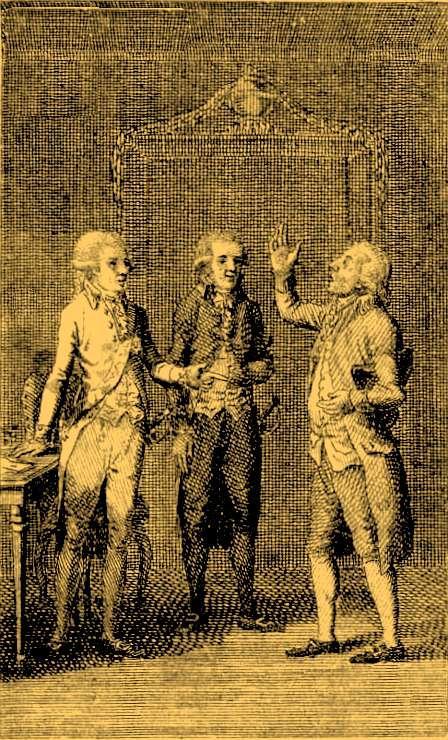
Goethe was in his best years. The distinguished calm with which he carried himself began to burden me, even to embitter me; I was silent, embarrassed, and felt slighted. I recalled the many stories circulating about his pride and his cold condescension, then went home in an unbearably unpleasant mood. Any closer acquaintance with him now seemed out of the question.
The northlander is by nature easily hurt at such occasions, and even into my later years I often had to struggle with a repugnant sensitivity that not infrequently made me quite unhappy. . . I was fortunately able to hide this sensitivity, and on the way home kept repeating Philine’s words to myself, “and if I am fond of you, what does it concern you?” [Wilhelm Meister, bk. 4, chap. 9] And yet what permeated my whole being was instead a feeling of depression, a dark shadow that spread broadly and gloomily over my entire past.

I had to talk about it, so the next day I hastened over to the Schlegels’. Madam Schlegel was utterly taken aback upon seeing me, so vividly was my bitterness oppressing me. She was put off that Frommann had anticipated her, and assured me that a second meeting with Goethe — one she herself promised to arrange — would quickly dispel this mood.
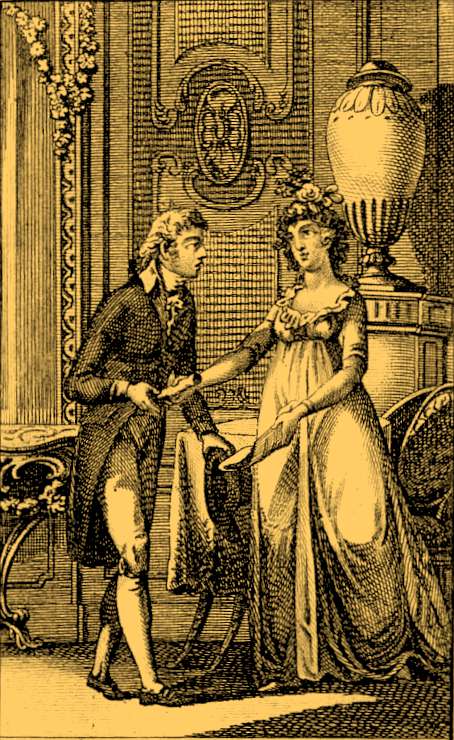
But now my Nordic stubbornness emerged. The higher I esteemed him, the more resolutely I had been devoted to him, the more impossible did it seem to allow myself to be introduced to him a second time. I resolutely declared that I now expected Goethe to seek me out; no persuading helped.
One evening I was cordially invited to the Schlegels; well-disposed as they were toward me, they wanted to surprise me. Goethe was there, though they had not told me in advance. I, however, learned of it, turned around, and did not appear in the company that evening. Several weeks passed, and I tried in every possible way to distract myself through my studies. Although I sometimes succeeded, the feeling tormented me constantly that an enormous bit of misfortune had befallen me. Back.
[11] The allusion is to the developments surrounding the charge of atheism leveled against Fichte; concerning the “appeal” mentioned here — Fichte’s Appelation an das Publikum über die durch ein Kurf. Sächs. Confiscationsrescript ihm beigemessenen atheistischen Aeusserungen. Eine Schrift, die man erst zu lessen bittet, ehe man sie confiscirt (Jena, Leipzig, Tübingen 1799) — and the general situation, see Wilhelm Schlegel’s letter to Hardenberg on 12 January 1799 (letter 215a) with note 12. Back.
[12] The reference is to the following section in Fichte’s Appelation (trans., J.G. Fichte and the Atheism Dispute (1798–1800), ed. Yolanda Estes and Curtis Bowman [Farnham, U.K., Burlington, VT 2010], 119–21, quod vide also for annotations):
Consequently, since we can neither come together nor come apart, given how the matter currently stands, they [Fichte’s opponents] will allow me to make a conciliatory proposal.
That in their opinion I am mistaken goes without saying, and for the present I intend to argue about it with them no further. But it will probably make a difference to them, as regards my guilt, whether my assertions have been tossed out impudently and rashly and, as it were, in order to defy them, or whether grounds can be offered for them and something plausible can be adduced in their favor.
Once they have finished reading this essay, then, I hope they will not wish to deny the latter. Furthermore, they will have to admit to me that this doctrine is not dangerous in its consequences. If they are correct, and if I am incorrect, then the worst consequence is that the adherents and practitioners of this doctrine become good-natured fanatics who deprive themselves of life’s pleasures.
But how does this injure them? On the contrary, if they are consistent in their mode of thought, then they must enjoy themselves and from their side must attempt to contribute everything possible to ridding themselves in this way of many contenders and competitors for their happiness. This very inconsistency of theirs, this very desire of theirs to make others just as smart and just as happy as they themselves are without the least advantage to them arising out of it, could make them doubtful as to whether their own conduct is not in fact grounded on a more exalted principle than they are willing to grant.
Finally, however, doubt is secretly stirred inside of them — I am sure of this and can know it — as to whether or not I might be right. And they may not want — I am sure of this — to risk their entire happiness, temporal and eternal, on being certain that I am wrong. Actually, if they scrutinize themselves properly, they will find that they have only been waiting for the proper time to consider the matter.
Thus they are now awaiting such an opportunity. If I asserted all by myself what I am asserting, then earlier they could have at most believed that I am a fanatic and that I am not in command of my reason. But do I stand so entirely alone? Which theologian, entirely free of any suspicion of partisanship, do I name as my authority? Would that you, venerable Father Spalding — whose The Vocation of Man sowed the first seed of higher speculation in my young soul, and all of whose writings, just like the one mentioned, so exquisitely characterize the striving for the supersensible and the everlasting — would that you could, and would wish to, speak up on my behalf!
And the senior chaplain Reinhard, who must have sat among the judges of my atheism and my attacks on religion in the ecclesiastical court of the Electorate of Saxony — I have none of his latest writings to hand, but in a learned newspaper I find an advertisement for his latest collection of sermons. What can he be saying in these sermons: “On the joyful philanthropic faith that everything must get better and better in this world,” “That one cannot be a true Christian without a certain degree of noble inspiration,” “Of the feeling of imperishability with which Christians are supposed to regard the decrepitude of everything worldly” — what can the clever and thorough man be saying in such sermons other than what I have said in that banned essay and in this one, and what everyone must say to takes the true, inner religion to heart?
And, among philosophers, you, noble Jacobi, whose hand I grasp more confidently, however differently we may think about mere theory, what matters here you said long ago — exactly as I think it — and with a vigor and warmth with which I can never say it. You have made it the soul of your philosophizing: “One becomes aware of God by means of a godly life.”
Therefore, since all of this is the case, here is my conciliatory proposal! Immediately and henceforth, it is preferable that we have nothing more to do with each other. Better that they apply themselves to those in whom they can still hope to find an opening for their doctrine, and I will do the same on my side. Let each party do whatever it pleases in order to bring others into agreement with itself. Only do no harm to anyone in the other party; only let our competition be honest, and let no on make use of forbidden weapons. Just as I would certainly not ban and confiscate their writings, certainly not prohibit and decry either attendance at the universities in which they have their seat or their lectures (even if I were capable of doing so), let them not do so on their side as well. Back.
[13] Although Caroline missed the premiere of the first full part of Schiller’s Wallenstein, namely, Die Piccolomini, on 30 January 1799, she, Wilhelm, and Auguste did attend the second performance, on 2 February. See esp. her letter to Luise Gotter in early 1799 (letter 215) with note 1, also Wilhelm’s letter to Goethe on 4 February 1799 (219a) and Auguste’s letter to Cäcilie Gotter on 18 February 1799 (letter 220). Back.
[14] Goethe was in Jena 7–28 February 1799 (Weimarer Ausgabe 3:2:232–36). Back.
[15] Concerning Wilhelm’s elegy, see his letter to Hardenberg on 12 January 1799 (letter 215a) with note 8, and Hardenberg’s response to Caroline on 20 January 1799 (letter 216), esp. note 4. — The first issue of Athenaeum in 1799 would appear in March. Back.
[16] This trip never materialized. Back.
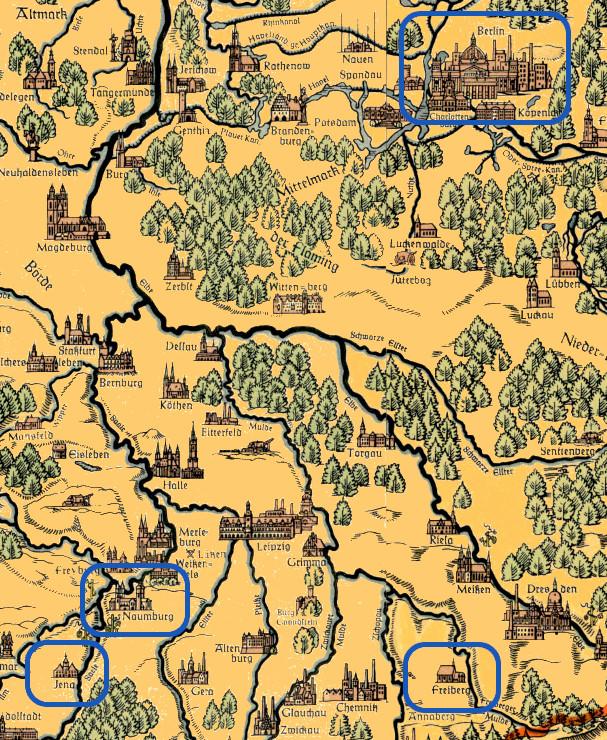
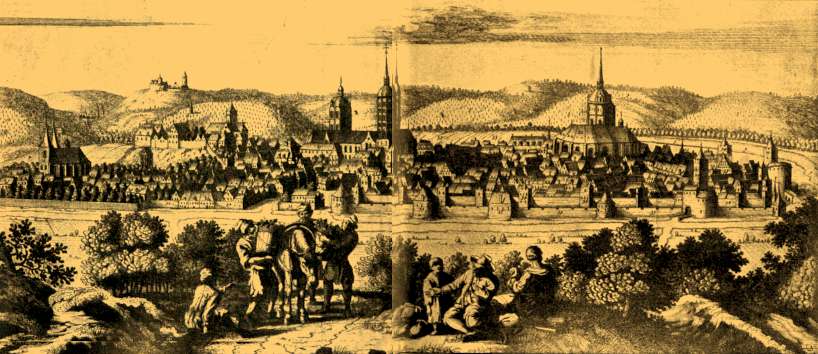
[17] Naumburg is located ca. 30 km northeast of Jena and ca. 110 km northwest of Freiberg; it is then ca. 180 km farther north to Berlin (Rudolf Koch and Fritz Kredel, Deutschland und angrenzende Gebiete [Leipzig 1937]; illustration from the mid-seventeenth century: Ernst Borkowsky, Die Geschichte der Stadt Naumburg an der Saale [Stuttgart 1897], foldout following p. 64:
[18] As You Like It; see Friedrich’s letter to Caroline on 12 February 1799 (letter 218) with note 4. Back.
Translation © 2013 Doug Stott