
• 216. Friedrich von Hardenberg to Caroline in Jena: Freiberg, 20 January 1799 [*]
Freiberg, 20 January 1799
|489| Since I last wrote you, I have been happy enough. Since Christmas Eve, when her terrible malady suddenly departed, Julie has again been healthy and cheerful as if by a miracle. [1] My own health is tolerable. I saw our good Madam Ernst — albeit for but a very short time, though I do think I will probably be seeing her again, and for a longer time.
I infinitely regret that my future place of residence will be so far from Dresden. Proximity to Madam Ernst would be |490| so valuable to me. I am saying a great deal about my heart when I say that she is a woman after my own heart. I am also sincerely happy about Friedrich’s fortunate alliance. [2] I, too, have just acquired an excellent sister-in-law, and I confess I, too, would be glad to enter into a civil alliance were such possible. Wilhelm’s dear letter of late was quite welcome to me. Surely he will pardon me if I answer it here to you — to you, who have genuinely become even more valuable and dear to me through your recent, sincere interest and assiduousness. [3]
For two months now everything has come to a halt with me that is part of a liberal being. I have not had three good ideas during this entire period. Just now I am living entirely in engineering insofar as my apprenticeship is coming to a close and professional life with its various demands is approaching ever closer. For now I am only collecting material for future plans and am thinking that perhaps this summer I might be able to complete some of what I have begun or outlined. Poesy with its living powers, with people, and such, increasingly pleases me. One must construct a poetic world around oneself and live within poesy. This context includes my mercantile plan, to which I subordinate my writing.
I admire Wilhelm for so vigorously pursuing his professorial activities. This, too, is part of the context of the beautiful liberal economy, the true element of the cultivated human being. I am very anxious to read his elegy. [4] It indisputably will be a wonderfully constructed reflection of the stuff of life drawn from the fragrance of the past. If he would but also dissolve a bit of future in it beforehand, the resulting crystals would be even more beautiful.
The reawakening of Athenäum is priceless to me. I will not risk making any predictions about Friedrich’s novel. [5] It will doubtless be something |491| completely new. I have read Tieck’s Phantasien. [6] As much wonderful material as there indeed is in it, there could have been less. The meaning and sense are often secured at the expense of the words themselves. I am beginning to love that which is sober but which genuinely progresses or moves things forward, whereas the Phantasien are indeed always sufficiently fantastical, and perhaps that is all they intend to be. Tieck’s Don Quixote is, of course, also already underway. [7]
Please write to me soon about Ritter and Schelling. Ritter is Ritter, and the rest of us are merely squires. [8] Even Baader is merely his poet. [9]
In the meantime, however, these gentlemen are probably not really seeing the best in nature as clearly as they could: Here Fichte will yet shame his friends, and Hemsterhuis intimated clearly enough this particular sacred path leading to physics. In Spinoza, too, this divine spark of the understanding of nature is alive. Plotinus was the first with genuine spirit, stimulated perhaps by Plato, to enter the sanctuary, and there is still no one who has subsequently penetrated so far into that sanctuary. A mysterious pulse beats in many earlier writings, demonstrating a point of contact with the invisible world — a vivification. Göthe is to become the liturgist of this physics — he completely understands what it means to serve in this temple, and Leibniz’s theodicy has always represented a magnificent attempt in this field. The physics of the future will become something similar — albeit in a more lofty style. If only one had access to a different expression in so-called physico-theology than astonished admiration!
But enough — please continue to be favorably disposed toward me at least a little, and abide in the magical atmosphere that surrounds you, amid a tempestuous storm, isolated like a family of spirits amid the stunted moss people, so that none of the more base needs and cares is able to tempt you and bring you down. [10] And please send this letter |492| on to Friedrich, [11] whom I was able to write only very briefly because I have lately spent a great deal of time beneath the earth, and above the earth am plagued by so many laborious studies. [12] I will be leaving here at Easter and am thinking I will be among you in April. My future life might possibly become quite attractive and productive.
Please write to me soon — if possible accompanied by Athenäum. Just now I am overwhelmed by too many responsibilities. After Easter I will be able to take a deep breath of new air, and springtime will thaw me out and warm me up anew. Without love I would absolutely not be able to endure. I will have many new and wonderful things to tell you in person. A thousand warm regards to Wilhelm and Auguste.
Notes
[*] Also in Novalis Briefwechsel mit Friedrich und August Wilhelm, Charlotte und Caroline Schlegel, ed. J. M. Raich (Mainz 1880), 99–103; Novalis Schriften 4:274–76. This letter is the response to Wilhelm Schlegel’s letter to Hardenberg on 12 January 1799 (letter 215a). Back.
[1] Hardenberg relates to Friedrich Schlegel on the same day, 20 January 1799 (Novalis Schriften 4:273): “Julie was tormented by terrible pain for six solid months without cease — one could not but fear the worst — and yet precisely during the most horrific period, the malady suddenly abated, and since Christmas Eve she has been healthy and cheerful.” Concerning Julie von Charpentier’s possible illness, which Caroline diagnosed as “facial pain,” see Caroline’s letter to Hardenberg on 15 November 1798 (letter 208). Back.
[2] Viz., with Dorothea Veit. Back.
[3] See Caroline’s letter to Hardenberg on 15 November 1798 (letter 208) mentioned above (not “1799” as in Novalis Schriften 4:848). Back.
[4] Wilhelm’s (according to Erich Schmidt) pompous programmatic poem “Die Kunst der Griechen. An Goethe. Elegie,” Athenaeum (1799) 181–92; Wilhelm mentions it in his letter to Hardenberg on 12 January 1799 (letter 215a). Concerning Schiller and Goethe’s reaction both to Wilhelm’s elegy and to this particular issue of Athenaeum, see the final exchange of letters between them in supplementary appendix 204.1.
Friedrich, providing a thorough analysis and relating Ludwig Tieck’s approval as well, was nonetheless irritated at what seems to have been Caroline’s criticism of it (Walzel, 407; KFSA 24:241):
It is the most antiquity-esque thing I have ever read in the Teutonic language. It is indeed a powerful product, and, as an aside, what I especially like is a certain ebb and flow among the masses of ideas or images, which I find quite elegiacal. Although I was initially unable quite to understand the ending, I now find it very beautiful indeed; and even in general, one first has to read rather deeply into the piece. So what does Caroline want? If only she can avoid falling — to the point of intolerance — into that particular rapturous enthusiasm for the “beautiful middle,” her old hobbyhorse. It is absolutely not too learned, for Dorothea and Henriette understood after only three readings . . .
Friedrich similarly wrote to Schleiermacher on 1 March 1799 (Aus Schleiermacher’s Leben 3:103; KGA V:3:27; KFSA 24:236) that “Wilhelm’s ‘Kunst der Griechen’ is . . . a powerful piece . . . Now those who do not want to believe that he has genius will doubtless open their eyes.” Back.
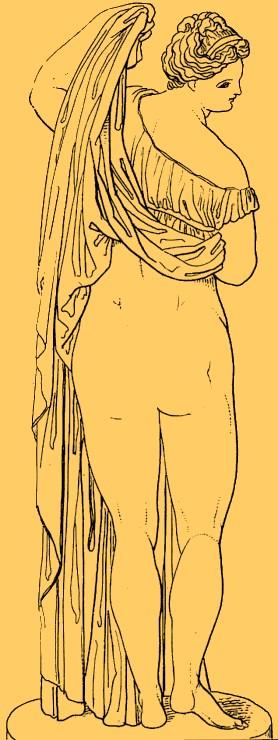
[5] Hardenberg wrote to Friedrich back on 27 December 1797 (Novalis Briefwechsel mit Friedrich und August Wilhelm, Charlotte und Caroline Schlegel, ed. J. M. Raich [Mainz 1880], 51; Novalis Schriften 4:243): “[Your novel] is a puzzle to me — You and a novel — non credo“; he then writes to Friedrich on 7 November 1798 (Novalis Briefwechsel 77; Novalis Schriften 4:264): “Your Lucinde is enticing me even beforehand, like Venus Callipyge [lit., Venus of the beautiful buttocks, a Roman statue, likely a copy of a Greek original], whose sister she will no doubt prove to be” (Carl Ottfried Müller and Carl Osterley, Denkmäler der alten Kunst, 3rd ed., ed. Friedrich Wieseler [Göttingen 1877], vol. 2:2, plate 276):
[6] Wilhelm Heinrich Wackenroder, Phantasien über die Kunst, für Freunde der Kunst, ed. Ludwig Tieck (Hamburg 1799) (frontispiece from the edition Vienna 1818):

[7] Miguel de Cervantes Saavedra, Don Quixote, 2 vols. 1605, 1615, trans. Ludwig Tieck as Leben und Thaten des scharfsinnigen Edlen Don Quixote von la Mancha, 4 vols. (Unger: Berlin 1799–1801); volume 1 (1799) reviewed by Wilhelm Schlegel in the Allgemeine Literatur-Zeitung (1799) 230 (Saturday, 20 July 1799) 177–83 (Sämmtliche Werke 11:408–26). Volume 1 also reviewed by Friedrich Schlegel in Athenaeum (1799) 324–27. Here several frontispieces from the edition Vienna 1817–18 (the first edition had no illustrations):


[8] A play on Ritter’s name, which in German means “knight.” — Hardenberg would not make Ritter’s personal acquaintance until the early autumn of 1799. Back.
[9] Both Ritter and Baader reappear later in Munich when Schelling and Caroline themselves are living there. Back.
[10] Hardenberg draws here on a variation of a character found not only in legends and fairy tales from the nearby Thuringian Forest, but also in other locales. The Moosmensch was once widely celebrated as the symbol of Christmas in the Vogtland and is still represented in art as an iteration of father Christmas in a moss outfit.
It was similarly associated elsewhere with other religious celebrations. Here an example from Baden. On the third Sunday in Lent, older boys in a village carried around a masked straw puppet whose two companions, armed with signature hazel switches, went from door to door reciting the following (Elard Hugo Meyer, Badisches Volksleben im neunzehnten Jahrhundert [Straßburg 1900], 91):
After fasting comes the summer,
When every farmer must to plow;
Morning, midday, evening, too,
Till fields are properly seeded through.

And who the highest farmer is?
Why, Jesus Christ, Lord and Savior 'tis!
Which also quite in order is,
Since all alike are servants his.

And even if 'tis but a tailor,
Still can he sit as head of table,
Eat and drink whatever he will,
Turnips, bacon, schnitzel, his fill.

And yet without the farmers, you see,
Many lord's money chest quite empty would be.
Hence if you will, then generous be,
And now our Miesma (Moosmann) come and see.

For if the Miesma you happen to miss,
Will you find no Easter bliss.
Meyer glosses:
That is: a Moosmann, a “wild man from the forest,” is carried around the village. School children in southern Tyrol before the time of Emperor Joseph II similarly played the “wild man game” on the Thursday before Fastnacht, during which a bearded Moosmann was accompanied into the village from a nearby cave. The wild man and wild woman were the main actors of Fastnacht in Nürnberg and Switzerland and in many other areas as well.
These legendary figures inhabit the pine forests in the Thuringian Forest, Fichtel Mountains, and Saxon Vogtland and bear a bewildering variety of dialect-based names:
Moosmann, Moosmensch, Moosmaa, Miesma, Muesmoa (Vogtland dialect); diminutive Moosmännel; plural Moosmänner, Moosleute, Moosmenschen (Hardenberg’s choice); also feminine Moosweib, Moosweibel, Moosweiblein
Traditionally poor themselves, they live on what they can find in the forests, are dressed in thick moss, and viewed largely as beneficent spirits of the forest who provide assistance to those who work and play in the forest, including children and women bearing heavy baskets. They must, however, hide from their adversary, the “wild hunter,” beneath roots in which three trinitarian crosses are carved. People who help them are rewarded with leaves that turn into gold when the persons arrive home.
During the winter, especially at Christmas, during the cold, long nights when the “wild hunter” is particularly active, the Moosmenschen seek shelter among people, where they are treated with food, warmth, shelter, and a dry seat at a window where, in gratitude, they hold a candle to ward off the “wild hunter.”
See Günter Reitzenstein, “Die Moosleute des Fichtelgebirges und des Vogtlandes,” Der Siebenstern: Vereinszeitschrift des Fichtelgebirgsvereins für Heimatpflege, Heimatkunde, Wandern und Naturschutz, vol. 77 [2008], no. 5, 312–14. Back.
[11] This letter, with its survey of philosophers, was obviously written more for Friedrich than for Caroline. Back.
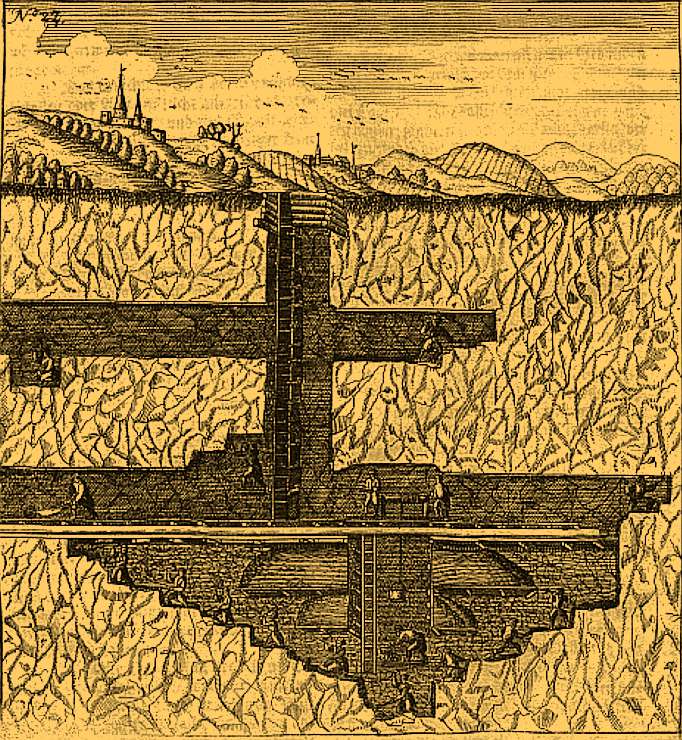
[12] “Beneath the earth”: Hardenberg, a mining administrator, means this description literally (mining arteries ca. 1700; Dresden, Sächsische Landesbibliothek – Staats- und Universitätsbibliothek Dresden (SLUB), Signatur/Inventar-Nr.: Hist.Sax.M.15;
Kupferstich No. 23):
Translation © 2013 Doug Stott