
• 217a. Friedrich Schlegel to Auguste Böhmer in Jena: Berlin, February 1799 [*]
[February 1799]
|640| Since I am sending so much to read today, including Don Quixote especially for you, [1] I will also take the liberty to address a few humble lines to Your Gracious Meritoriousness.
Make sure you read Don Quixote a lot and always with reverence. It is a wonderful book; also write and tell me whether you are able to understand it. —
Madam Reichardt, who has grown quite fond of both your mother and you, is here just now with little Riecke, her daughter, who also is always reading. [2] But she has rather delicious taste. At Tieck’s we recently gave her The Tempest by Shakespeare. [3] But she soon put it aside and told us which books would be for her, namely, ones that are either extremely terrifying or very funny.
Apart from Henriette and Madam Veit, Mademoiselle Levi also often asks about you and sends her regards. [3a]
What are your primary studies this winter? — I have recently been focusing on fairy tales and will certainly tell you some when you are here. Whenever your mother loses either her desire or courage to come, start pleading with her anew. [4]
To the many prologues to the great play, [5] Woltmann has now added yet another, a short one, available at the ticket office, of and for 2 Gr. Now I myself really want to write a prologue to his prologue. — You also could have written me a few words about the Piccolomini, since surely you have also seen it. [6]
Eternally yours,
Friedrich
|641| Is Griess still in Jena? Does he still not want to become hulled barley? [7] — Give my regards to Schelling.
Notes
[*] Source: Schmidt (1913), 1:640–41 (letter no. 26); Waitz (1871), 1:371; reprinted in KFSA 24:228–29. — Concerning the textual history of Friedrich Schlegel’s letters to Auguste Böhmer, see supplementary appendix 181d.1. Back.
[1] Ludwig Tieck’s hastily prepared translation; see Friedrich von Hardenberg’s letter to Caroline on 20 January 1799 (letter 216), note 7. Back.
[2] Illustration from Johann Friedrich Cotta, Taschenbuch für Damen auf das Jahr 1800 (Tübingen 1800):

See Johann Friedrich Reichardt to Wilhelm Schlegel from Giebichenstein on 16 November 1798 (Körner [1930], 1:81–82):
I cannot possibly allow Herr Dr. Scheel [?] to travel from here to Jena without telling you, my esteemed friend, how inexpressibly pained I was to have missed you and your dear, noble wife here [on their return to Jena from Dresden in September]. Hence do allow me to hope that I might be your most cordial host here next summer for an all the more lengthy and pleasant stay.
Many thanks for the beautiful poem you left behind for me and whose final part has already been set to music [presumably Wilhelm’s Lebensmelodien; see letter 209, note 9]. When you come, you will find it completely finished. I myself must sing something like this for you the first time. I am about to go to Berlin to compose and present another opera and will be staying there until May. Please allow me to receive your cordial words of love there.
Please extend our warmest regards to your noble, dear wife, to whom my own wife is devoted with all her heart. Of course, those regards extend to you yourself as well.
Yours,
Reichardt
[3] Ludwig Tieck’s adaptation of Shakespeare’s The Tempest as Der Sturm. Ein Schauspiel von Shakspear, für das Theater bearbeitet (Berlin, Leipzig 1796); here the frontispiece:

[3a] Rahel Levin had met Auguste the past summer in Dresden, not least when Auguste almost certainly accompanied Caroline, Wilhelm, and Schelling on their excursion to Saxon Switzerland. Back.
[4] The Schlegels’ anticipated Berlin visit during the spring of 1799 never materialized. The trip is discussed in upcoming letters. Back.
[5] Namely, to Schiller’s Wallenstein. Concerning the “several” prologues (or preludes and prologues) to Wallenstein, see Caroline’s letter to Friedrich on 14–15 October 1798 (letter 204) along with notes 1 and 18 there. Back.
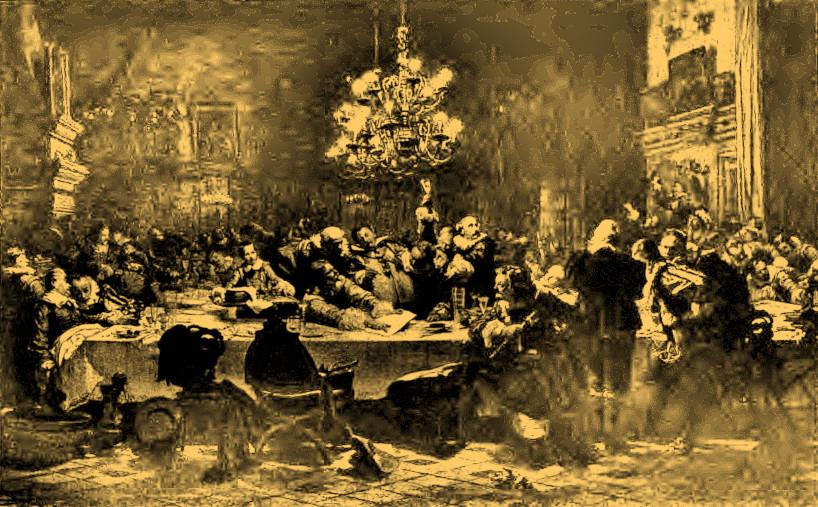
[6] Neither Caroline nor Auguste had attended the premiere of Die Piccolomini in the Weimar theater on 30 January 1799. They both did, however, attend the second performance of the play on 2 February 1799; it would not be offered again until 17 April, after which the second and final part (or third part of the trilogy), Wallensteins Tod, premiered on 20 April (Das Repertoire des Weimarischen Theaters, 31–32).
Here a scene from Die Piccolomini, “Banquet of Wallenstein’s Generals at Pilsen” (from The Piccolomini, The Death of Wallenstein, Wallenstein’s Camp, Friedrich Schiller’s Works, trans. Samuel Taylor Coleridge London 1903], plate following p. 128):
See Caroline’s letter to Luise Gotter in early 1799 (letter 215) with note 1 and her letter to Friedrich von Hardenberg on 4 February 1799 (letter 219), and, finally, Auguste’s letter to Cäcilie Gotter on 18 February 1799 (letter 220). Back.
[7] Wordplay on Gries’s name: Germ. Griess, “semolina, groats, grits.” Back.
Translation © 2013 Doug Stott