
202g. Friedrich Schlegel to Henriette Herz in Berlin: Dresden, 24 August 1798 [*]
. . . Madem Levi is currently here and indeed took an excursion out to the Uckewalder Grund with Wilhelm and Caroline. [1] I remained here at home to pack the picture and to work, [2] for I am now thinking of nothing but my departure and will genuinely be returning to you soon. [3] Please but remain as long as possible in the Tiergarten, where we enjoyed such wonderful and beautiful Saturdays last autumn.
I will be bringing all sorts of good things back for Athenaeum, among others a letter on philosophy to Madam Veit [4] — but not just to Madam Veit alone, but also to all women. Since the learned scribes in Berlin, as I hear, are intent on not understanding us, [5] we are both quite inclined to put our hopes in women. Do you believe this resolution can indeed be implemented? I myself now find my courage renewed and revived along with the most ardent love for our literary marriage. — —
My brother and sister-in-law send their kindest regards to you. Unfortunately, things are still rather murky concerning their possible trip to Berlin, since we still know nothing yet about Hamlet. The indecisiveness of the protagonist seems to have infected the piece itself and now even the performance. [6] . . .
Notes
[*] Sources: Euphorion: Zeitschrift für Literaturgeschichte 82 (1988) 357–65; Aus Schleiermacher’s Leben 3:93–94n*; KGA V/2:398; KFSA 24:168–69. Back.
[1] This reference seems to be the only documentation of a meeting between Caroline and Rahel Levin. The excursion took them to Saxon Switzerland, part of the beautiful Elbe Sandstone Mountains in what is today a national park just southeast of Dresden and which even at that time was a popular tourist attraction (Schelling and Auguste were also members of the party) (Karl Baedeker, Northern Germany as far as the Bavarian and Austrian Frontiers: Handbook for Travellers, 15th rev. ed. [Leipzig 1910], following p. 210; note Pillnitz at the upper left, just outside Dresden proper; illustration: A. Tromlitz, Romantische Wanderung durch die Sächsische Schweiz, Das malerische und romantische Deutschland: In zehn Sektionen 2, Die sächsische Schweiz [Leipzig n.d. (ca. 1840)], plate following p. 92):
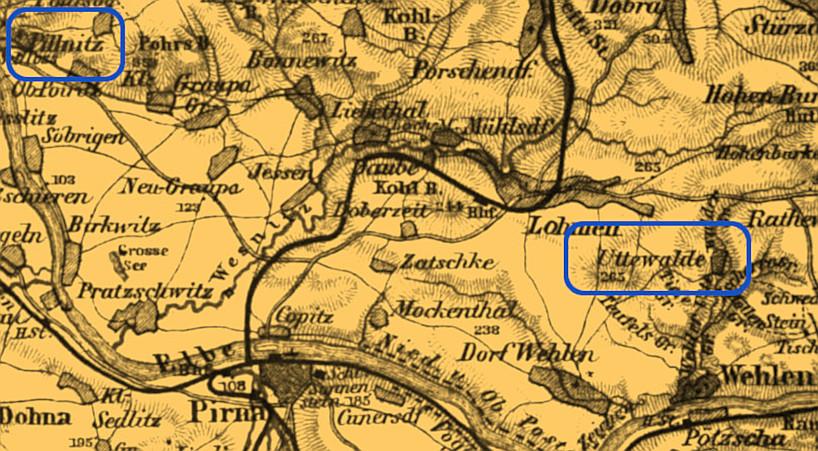
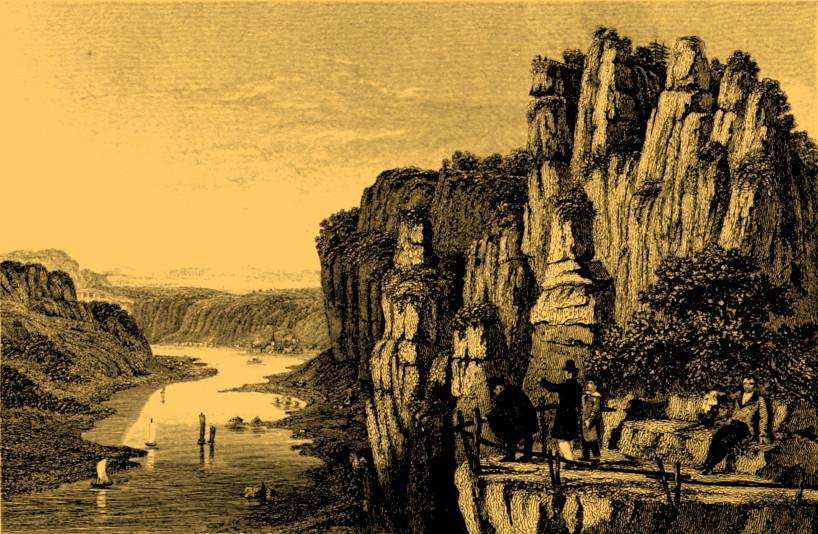
See also Schelling’s letter to his father on 20 September 1798 (letter 203b), note 2, with illustrations.
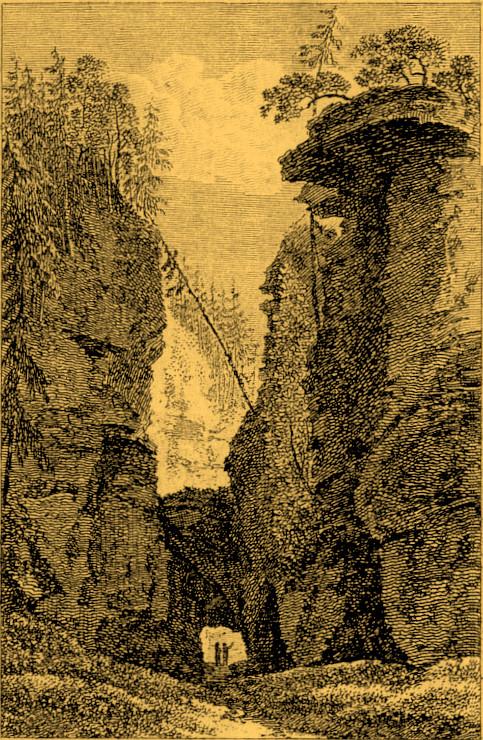
Concerning the Uttewalder Grund (Friedrich spells it Uckewalder): Legend alleges that the devil, frustrated at not being able to seduce a devout hermit in the area, tore off a huge boulder and cast it down to crush him, but an elf (or angel) intervened and instantly pushed the two sides of the gorge together so as to catch the boulder before it hit the hermit; and there it still lies caught today. See Karl Baedeker, Northern Germany: Handbook for Travellers, 6th ed. (Leipzig 1877), 234:
The Uttewalder Grund is one of the finest rocky gorges in Saxon Switzerland. The sides are so lofty and close together that some parts of the ravine are never reached by the sun’s rays. About 10 min. from the above-mentioned finger-post is a restaurant; the path passes the Teufelsküche (devil’s kitchen), a grotto resembling an open fire-place. At the narrowest part, called the Felsenthor [stone gate], 5 min. above the restaurant, the path is carried over the brook by means of a wooden scaffolding. At the upper end of the valley steps ascend to Uttewald. Those who visit the Uttewalder Grund from the above-mentioned finger-post usually proceed as far as the Felsenthor only.
Here the Felsenthor and a nearby rock formation in 1800, essentially as Caroline experienced it (both illustrations: Leipziger Taschenbuch für Freunde und Freundinnen des Schönen und Nützlichen [1800]; Inhaltsverzeichnis deutscher Almanache, Theodor Springmann Stiftung):

See also See also Bayard Taylor, Views A-Foot; Europe seen with Knapsack and Staff (New York 1875), 205:
After passing the night at the little village of Uttewalde, a short distance further, we set out early in the morning for the Bastei, a lofty precipice on the Elbe. The way led us directly through the Uttewalder Grund, the most remarkable of all these chasms. We went down by rocky steps into its depths, which in the early morning were very cold. Water dripped from the rocks, which, but a few feet apart, rose far above us, and a little rill made its way along the bottom, into which the sun has never shone. Heavy masses of rock, which had tumbled down from the sides, encumbered the way, and tall pine trees sprang from every cleft. In one place the defile is only four feet wide, and a large mass of rock, fallen from above, has lodged near the bottom, making a low arch, under which the traveller has to creep.
Here again ca. 1820 (watercolor by Johann Carl August Richter):

[2] A picture mentioned earlier that Friedrich was sending along to Berlin. Back.
[3] Friedrich arrived back in Berlin on 31 August 1798. Back.
[4] “Ueber die Philosophie. An Dorothea von F.,” Athenaeum (1799) 1–38; KFSA 8:41–62. Back.
[5] The first issue of Athenaeum was not received well by representatives of the Berlin late-Enlightenment. See esp. (in German) Heinz Härtle, “Athenaeum-Polemiken,” in Debatten und Kontroversen: Literarische Auseinandersetzungen in Deutschland am Ende des 18. Jahrhunderts, ed. Hans-Dietrich Dahnke and Bernd Leistner (Berlin, Weimar 1989), 2:246–357, esp. the section “Der ‘Aufklärungsberlinism’ und ein Jenaer Pamphletist,” 279–86. Back.
[6] Concerning the difficulties attending the performance of Wilhelm Schlegel’s translation of Hamlet in Berlin, see Ella Horn’s essay on the background to the premiere of Hamlet in Berlin. In any event, Caroline and Wilhelm did not return to Jena by way of Berlin (Post Karte Durch ganz Deutschland, ed. J. Walch [Augsburg 1795]):

Translation © 2012 Doug Stott