
143d. Friedrich Schlegel to Wilhelm Schlegel in Amsterdam: Dresden, 9 May 1794 [*]
Dresden, 9 May 1794
[Reception of money from Wilhelm.] I immediately sent 4 louis d’or to Göschen and will write to Caroline today, [1] and also send 3 louis d’or to my mother today. . . .
The hope of seeing you again soon fills my heart with joy. [2] Our wish has now been fulfilled, namely, our watchword: Your return to the fatherland. — Nothing is lacking except a home, and I am sure something can be found.
Caroline has written and asked me to reconnoiter here; I wish you two had also indicated for me how much I may tell Lottchen. [3] — If I am not to allow her to suspect that you two intend to live in the same place after your return, I can hardly really sound her out on the matter. — It is difficult to predict here beforehand — concerning Ernst’s behavior, since neither of them can be relied on with any certainty, for either good or ill. Ernst acts wholly according to his mood, and himself has no firm prejudices excepting perhaps that of Christianity. —
That said, I do believe to have seen that Charlotte is keen on propriety, and hence if things simply cannot be changed, she will comport herself externally quite well regardless of what she may really think. Furthermore, she has long had a preference and rather high opinion of you. — Political considerations are a matter of indifference to the Ernsts, nor do they have to take much notice of such in their choice of social contacts. —
Charlotte’s opinion contra Caroline is that of complete and utter female immorality; she thinks you have been beguiled and deceived and is resolutely convinced regarding the connection with Forster. [4] —
Charlotte simply does not have the adroitness to present someone in society, and certainly not in so delicate a case as this one, nor would her circle of acquaintances, to my mind, suit Caroline, nor, for that matter, sit particularly comfortably with you either. Hence as far as Caroline is concerned, it would have to and indeed probably would remain a case of proper but rather distant social contact. — Caroline would thus perhaps be completely isolated here. —
Becker might perhaps prove to be a useful contact for you, though probably also rather empty company. [5] You would find Körner interesting; he is without a doubt capable of acknowledging every talent he encounters, acknowledge in the fullest sense of the word. Within certain parameters, he is quite zealous and even delicate in helping artists whom he values, making their situation easier to the extent he can. And one can reliably count on him in all circumstances. His women, [6] however, hate Caroline because of the connection with Forster and Huber. —
Hence at least at the beginning Caroline would be isolated, and if she does not want to be wholly so, you two would have to form your own circle. — Although I do not believe political considerations will pose any difficulties, you probably should instead ask Göschen for advice in that regard. I can probably find out, but not so easily without mentioning Caroline by name. —
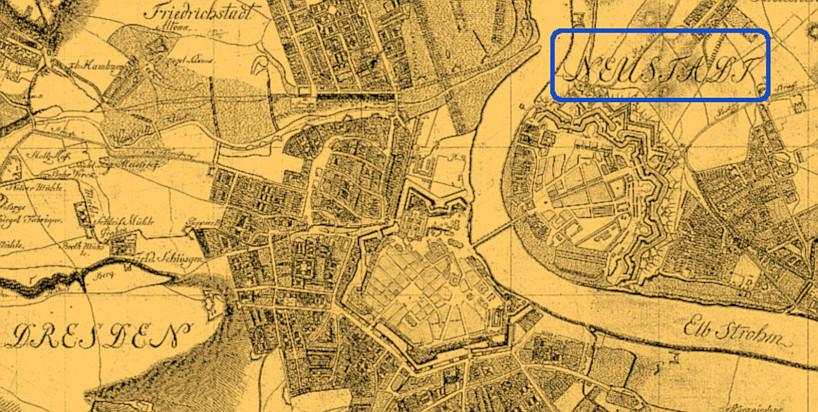
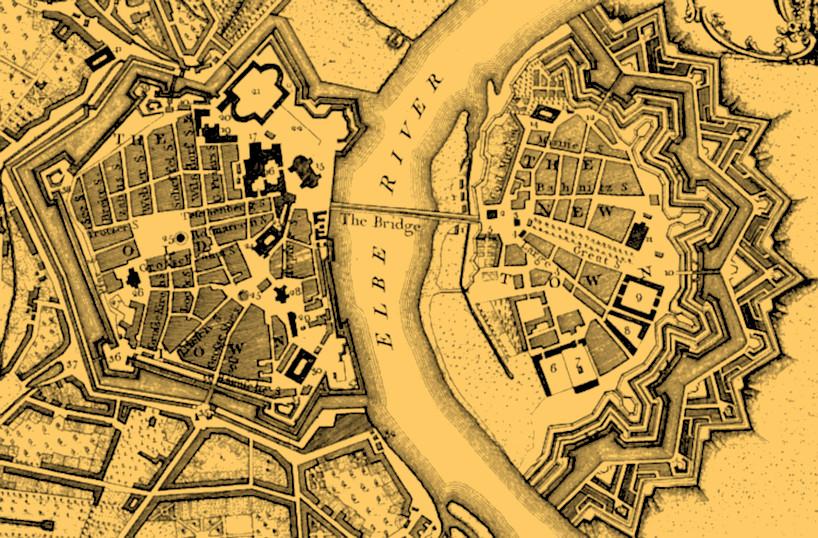
Lodging here is very inexpensive, especially in Neustadt; [7] as far as clothing is concerned, everyone is completely free, on the whole people go about dressed quite simply, and what constitutes such is at least much less expensive than in Hannover or Göttingen. — Food is inexpensive, but services and domestics are a bit more expensive. — You both could live in the country during the summer, and that, too, is extremely inexpensive. —
I must, however, draw your attention to one thing, namely, that Caroline has absolutely no acquaintances here; hence whenever she appears publicly among people who know Charlotte or you, it cannot be under any other auspices than that she is here for your sake. But perhaps this will not prove to be a crucial disadvantage. . . .
I cannot tell you how much I am looking forward to the time when you are free, and with Caroline; even should fate yet separate us two for a while. — I am extremely curious to hear about Dante; [8] I will ask Caroline, if you would allow it, to save for me all the materials she has concerning it as well as everything you may yet send until I am in Pillnitz, [9] and then to send it along to me, where I can then enjoy it with more leisure and, as is my intention, write about it. . . .
Notes
[*] Sources: Walzel, 178–82; KFSA 23:192–96. Back.
[1] See Friedrich’s letter to Georg Joachim Göschen on 3 May 1794 (letter 143c): the payment was for support for Caroline’s child, Wilhelm Julius Kranz (Böhmer), whom Caroline had left behind in foster care in Lucka. Back.
[2] Despite Friedrich’s elation, Wilhelm would not be returning to Germany from Holland until the summer of 1795. Back.
[3] Concerning how much Charlotte Ernst in Dresden knew about Caroline’s pregnancy, see Friedrich’s letter to Wilhelm in mid-May 1794 (letter 144a). Friedrich is likely also referring to Wilhelm and Caroline’s apparent plans to reside in the same locale. Back.
[4] Namely, that Forster was the father of Caroline’s child or at least that Caroline had had an affair with him in Mainz. Back.
[5] Both brothers would take advantage of the connection with the Dresden publisher Wilhelm Gottlieb Becker. Back.
[6] Körner’s wife Minna and his sister-in-law Dora Stock, the latter the former fiancée of Ludwig Ferdinand Huber. Back.
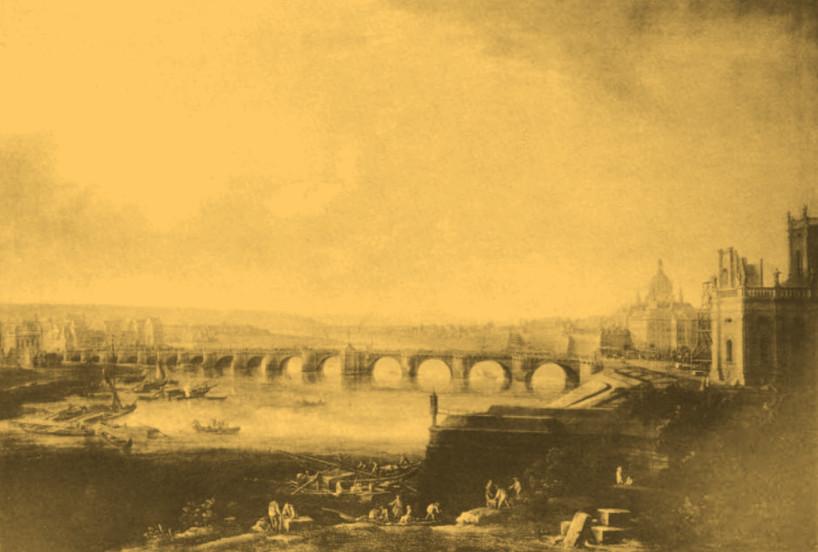
[7] Neustadt (New Town): the neighborhood in Dresden located to the east across the Elbe River from the Old Town; during the eighteenth century, the area was extended outside the town walls proper on that side of the Elbe (which became known as the Outer New Town); final illustration from 1748 (Friedrich Ludwig Aster, Sächs. Ing.-Korps, Meilenblätter von Sachsen, Berliner Exemplar [1780–1806], Blatt 262; second map: Jakob Gottlieb Isaak Boetticher, A Geographical, historical, and political Description of the Empire of Germany, Holland, the Netherlands, Switzerland, Prussia, Italy, Sicily, Corsica, and Sardinia, trans. from the German [London 1800], map preceding p. 177; final illustration: Johann Alexander Thiele, Prospect von der alt. und Neu Stadt Dresden, zu sammt der Brücken ad vivim pinx [1746]):
Dresden in 1746 with the bridge over the Elbe River:
[8] See Friedrich’s letter to Wilhelm on 17 April 1794 (letter 143b), note 2. Back.
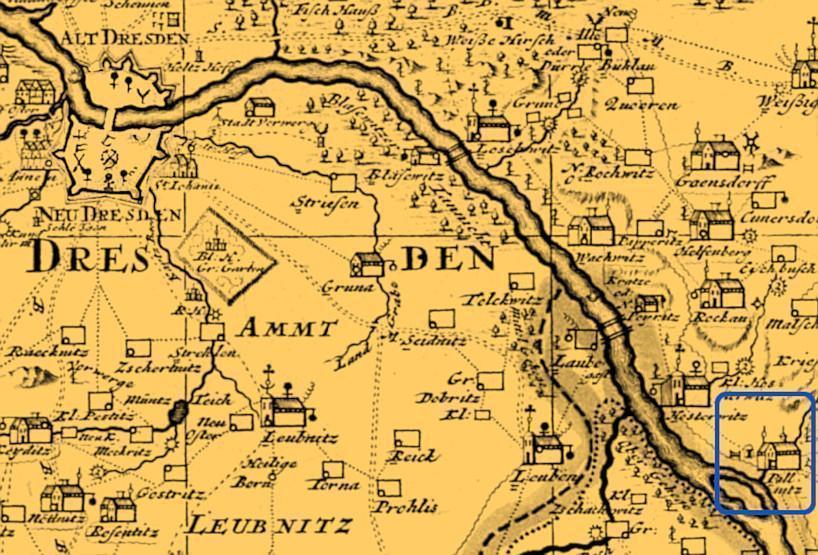
[9] Pillnitz, a former suburb ca. 15 km downstream (on the Elbe River) from the center of Dresden, where Charlotte Ernst and her husband seem to have owned a summer home (Adam Friedrich Zuerner, Accurate geographische delineation der dioeces und des Ammtes Dresden [Amsterdam 1700–99]):
Here Pillnitz ca. 1840 (A. Tromlitz, Romantische Wanderung durch die Sächsische Schweiz, Das malerische und romantische Deutschland: In zehn Sektionen 2, Die sächsische Schweiz [Leipzig n.d. (ca. 1840)], plate following p. 55; second illustration from Johann Sorschil, Leipzig, Meissen, Dresden und die sächsische Schweiz: Ein Wegweiser und Führer [Leipzig 1844], plate following p. 140):

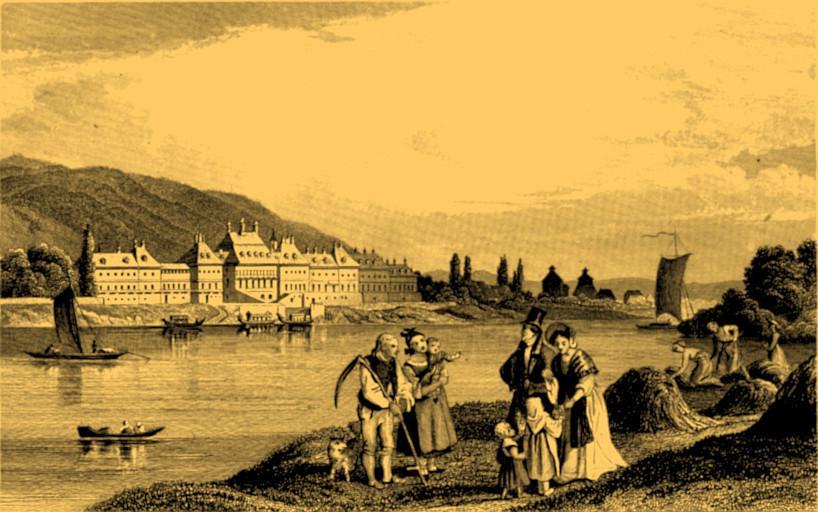
Pillnitz was also attractive as a locale for summer homes because of its scenery and landscape (“Ansicht der Ruinen und eines Teils des Gartens von Pillnitz,” “Die Keppmühle bei Pillnitz,” Taschenbuch zum geselligen Vergnügen 14 [1804]):

Translation © 2011 Doug Stott