
203b. Schelling to his Father in Schorndorf: Dresden, 20 September 1798 [*]
Dresden, 20 September 1798
Yes, you do indeed have every right to be angry! — it is truly irresponsible — over a month in Dresden and yet I have written not a single syllable home! [1] I could perhaps relate to you that more than once I have begun letters, and yet, wanting to write too much — did not finish them. But I have been unable to enjoy a single thing here without sharing it with you in spirit. It was to become quite a large travelogue indeed — but then the time just went by, and now all you are getting is this paltry letter!
But, then, why did I have to travel precisely to Dresden? — and at a time when even as it was I already had so much work to do? Well, I have seen everything of note in Dresden — the gallery, where the divine paintings of Raphael and Correggio are preserved, the antiquities collection, where the ancient world lives on in vibrant statues —
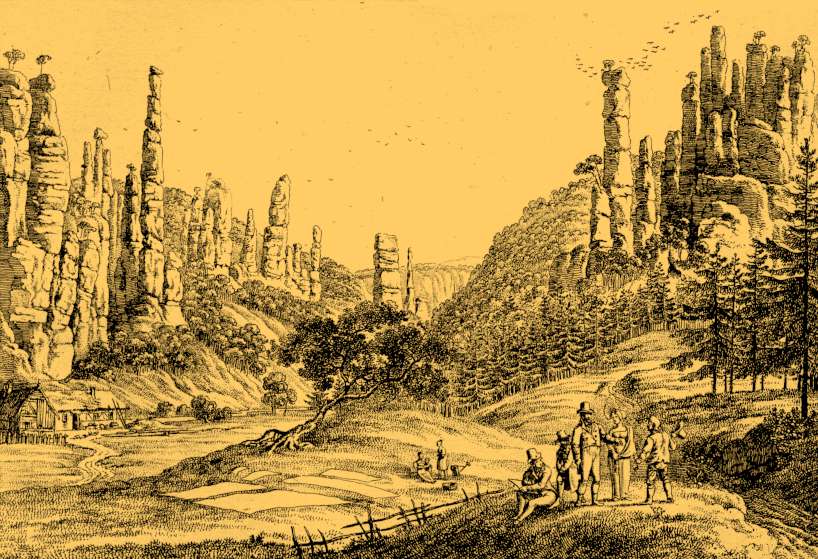
I have viewed the entire, vast, magnificent area around Dresden, all the countless, verdant valleys, followed the rock formations all the way to the Bohemian border [2] — have seen all these things and much more as well, and yet nonetheless have also been working such that I will be returning well-equipped to Jena. [3]
So there has admittedly been very little time to draft any travelogues. Let me tell you in a few words that I have been living here more happily than I have been accustomed to in a very long time. All the treasures of art and science collected together here — the extraordinarily manifold charms of nature, the splendid company of excellent and cheerful people [4] — all this has prevented me from being vexed for even a single moment, except, unfortunately! right now, since soon the time for departure will be here.
I will be leaving here for Jena on 1 October and will arrive there on the 3rd or 4th. I begin lecturing on the 29th on the philosophy of nature and will be distributing a draft in incremental sheets, being paid four louis d’or per printing sheet. I am hoping to find news from you awaiting me in Jena, for I have heard that Madam Paulus will be returning shortly. [5]
But how often has my imagination flown there to you! A year from today, God willing, I will be there with you and can then relate to you in person how I have hitherto fared. Why, when things go ill, should one recapitulate it all in writing? Is it not enough simply to have gotten through it all? And when things do go well, alas! there is so much to write that one never gets through it all! So, I will leave everything until we can have a conversation in person! — And what is a year, after all? — Just 365 days.
One question for you yet. I would very much like to have a glass of wine in Jena from time to time. Could you please arrange to have a cask of the best Remsthaler sent to me in Jena, and perhaps find an opportunity to do so? Just pay whatever it costs, I can reimburse you for it and will send you the money immediately. As soon as I get back to Jena, I will inquire whether any excise need be paid. If such be the case, it would be far too expensive for me. [6]
And now, my dearest parents, stay well; a thousand greetings to you all. I hope I will soon receive news of your well-being.
Your,
Fritz
Notes
[*] Sources: Plitt 1:240–41; Fuhrmans 2:160–62. Back.
[1] Schelling had arrived in Dresden on 18 August 1798, having traveled over from Leipzig (Post Karte Durch ganz Deutschland, ed. J. Walch [Augsburg 1795]):
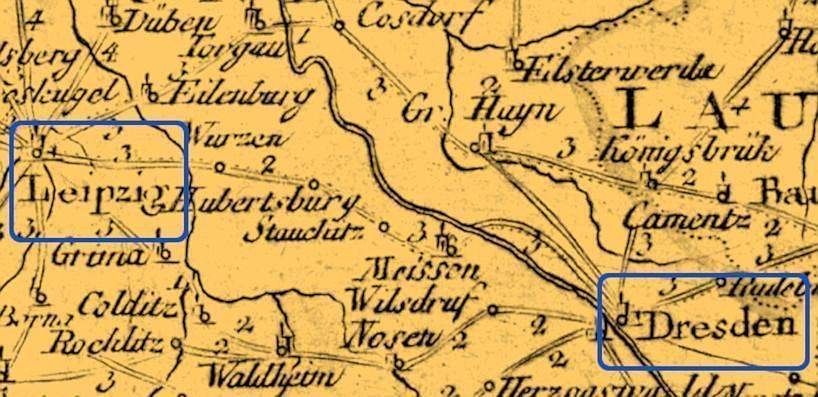
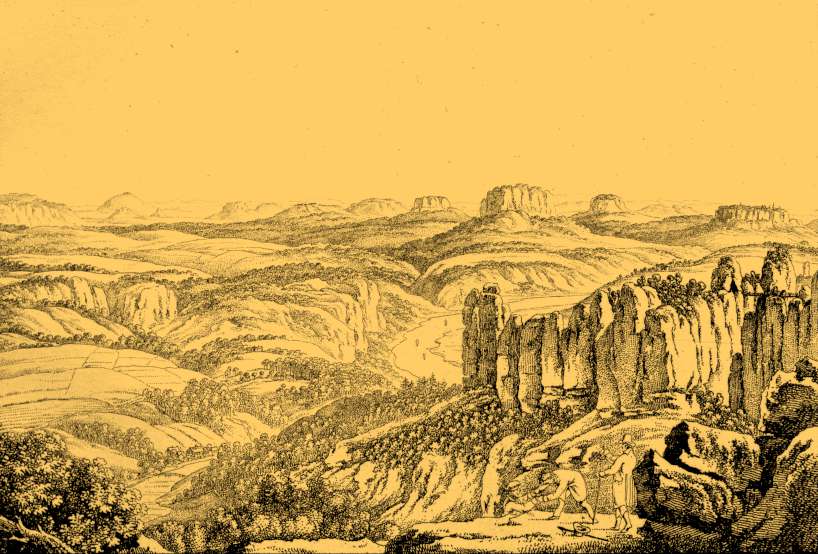
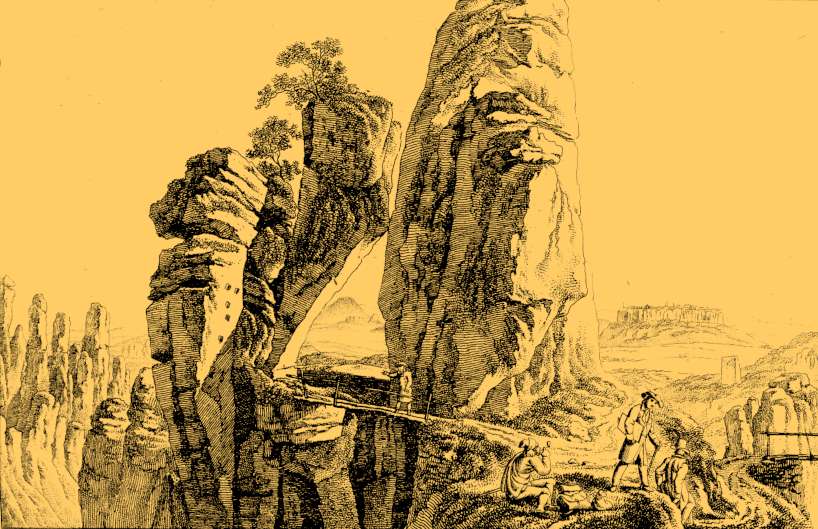
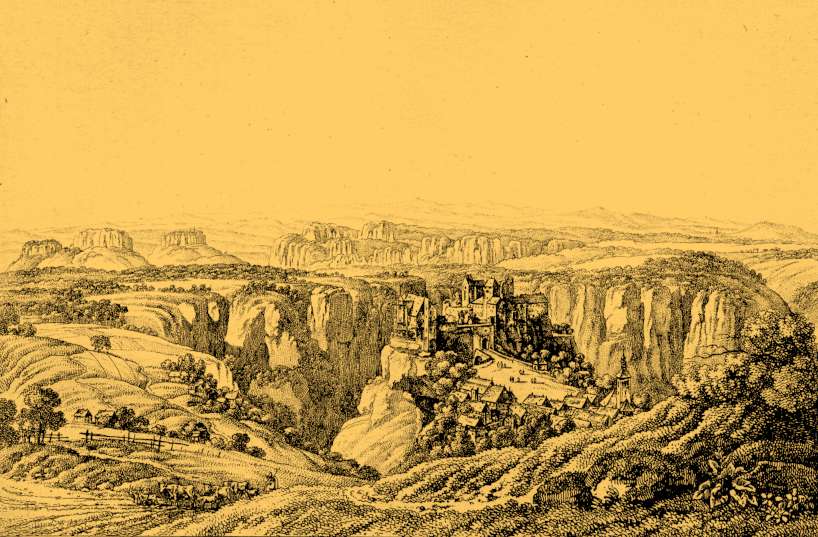
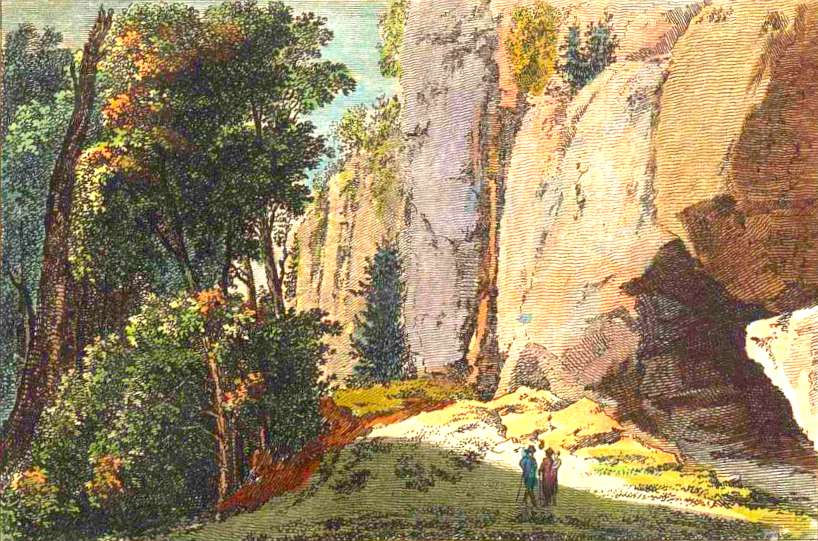
[2] Schelling, too, seems to have taken an excursion to Saxon Switzerland as did (or did he accompany?) Caroline, Wilhelm Schlegel, and Rahel Levin on 24 August 1798; according to Friedrich Schlegel’s letter to Henriette Herz on that day, the group seems also to have visited the rock formation Uttewalder Grund there (see letter 202g, note 1). Schelling may have made a similar excursion with Johann Diederich Gries (see Caroline’s letter to Friedrich Schlegel on 14 October 1798 [letter 204] with note 19).
Saxon Switzerland offers sometimes breathtaking mountainous vistas and peculiar rock formations (first 4 illustrations: Carl August Richter and Ludwig Richter, 70 mahlerische An- und Aussichten der Umgegend von Dresden in einem Kreise von sechs bis acht Meilen [Dresden ca. 1820]; color illustration: Leipziger Taschenbuch für Freunde und Freundinnen des Schönen und Nützlichen [1801]; Inhaltsverzeichnis deutscher Almanache, Theodor Springmann Stiftung):
[3] Schelling had been working on his Erster Entwurf eines Systems der Naturphilosophie: Zum Behuf seiner Vorlesungen (Jena 1799), which began appearing in increments during the winter semester 1798–99 in Jena (whence the subtitle: “as an aid to [those attending ] his lectures”). Back.
[4] The reference is to what has become known as the “meeting of the Romantics in Dresden,” which at various times during the the summer of 1798 (see chronology) included, besides Schelling himself also Wilhelm and Caroline Schlegel, Friedrich Schlegel, Friedrich von Hardenberg, Fichte, and Johann Diederich Gries (see also Rudolf Haym’s discussion of this episode in Caroline’s letter to Dorothea Marie Campe on 6 May 1798 [letter 200b], note 9).
On 28 August 1798, after Schelling had been in Dresden for ten days, he wrote to Friedrich Immanuel Niethammer back in Jena (Fuhrmans 1:167–68):
The Schlegels send their regards. Mde. Schlegel is especially eager for news about your wife and is anticipating news of her successful childbed in the letter that is supposed to arrive in 8–10 days.
As indicated in her own letter from Dresden on 20 September 1798 (letter 203a), Caroline, Wilhelm, and Auguste would be visiting the Tischbein family in Dessau on their way back to Jena (concerning which see supplementary appendix 181c.1). Adolf Julius Niethammer had been born on 21 August 1798 in the house at Leutragasse 5.
In his own turn, Schiller queried Christian Gottfried Körner about Schelling on 31 August 1798 (Correspondence of Schiller with Körner, trans. Leonard Simpson, 3 vols. [London 1849], 3:163):
Have you made the acquaintance of Schelling, who is now gone to Dresden? You have doubtless read his work, Über die Weltseele [Von der Weltseele, 1798]. He is a man of first-rate talents, whose acquaintance I look forward to with pleasure, he having been appointed Professor at this University.
Körner responded on 16 September 1798 (Schillers Briefwechsel mit Körner: Von 1784 bis zum Tode Schillers, 2 vols. 2nd ed. ed. Karl Goedeke [Leipzig 1878], 2:305):
I have only seen Schelling once, and not alone. He spends a great deal of time with the Schlegels, with whom I have little contact. Wilhelm Schlegel has lost a certain element of suppleness in comportment that formerly made it possible to enjoy his company, and yet does not possess sufficient intellect and spirit to compensate for the presumptuous, caustic quality attaching to his judgments. Back.
[5] From a trip to her home in Swabia. Back.
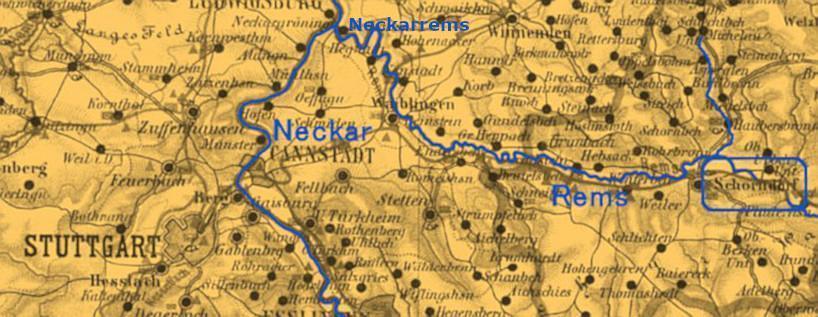
[6] The valley of the Rems River in Württemberg originates near Essingen (off the map below to the east) and moves ca. 80 km before flowing into the Neckar River at the appropriately named town of Neckarrems (today part of the town Remseck). Schorndorf, where Schelling’s parents were living, is indicated at the eastern edge of the map (see below).
The Rems Valley (Remsthal, Remstal) has long been known for its excellent wines and beautiful scenery. Its vineyards, possibly dating back to the Romans, produced one of the most popular wines for both home and tavern consumption, e.g., in Stuttgart, and at one time were allegedly often fertilized with human hair, which vintners secured from Stuttgart barbers (Gustav Jäger, Lehrbuch der allgemeinen Zoologie, vol. 3 [Leipzig 1885], 142).
Schelling’s parents were in an excellent position to secure the wine for him, since at the time they were living in Schorndorf, itself situated in the Rems Valley (Johann Sebastian Gerster, Julius Iwan Kettler, F. Rösler, Schauenburg’s neue Wand-karte von Baden, Württemberg und Hohenzollern [Lahr 1883]):
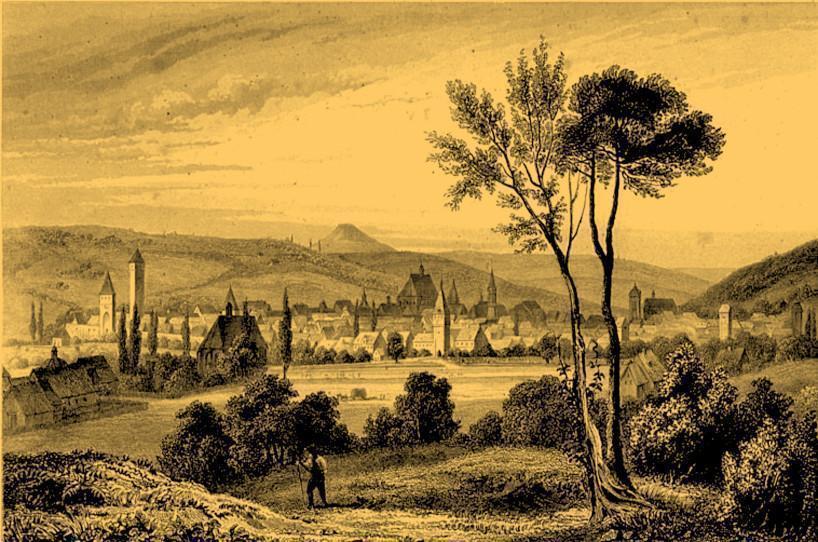
Here Schorndorf ca. 1850 (frontispiece to Beschreibung des Oberamts Schorndorf, Beschreibung des Königreichs Württemberg 29, ed. Königliches statistisch-topographisches Bureau [Stuttgart 1851]):
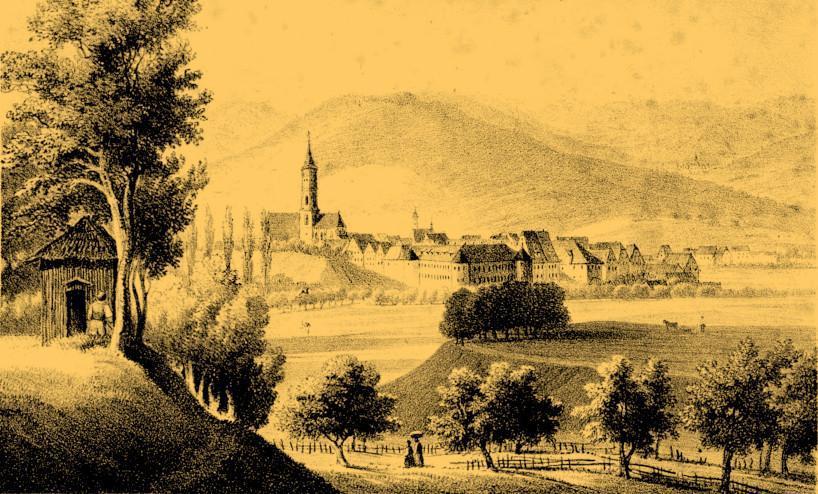
Here Schwäbisch Gmünd along the Rems River (J. Poppel after F. Mauch, Schwäbisch Gmünd [ca. 1850]):
Translation © 2012 Doug Stott