
• 261. Auguste Böhmer to Schelling in Schorndorf: Bamberg, Wednesday, 4/5 June 1800 [*]
[Bamberg] Wednesday, 4 [–5] June [1800]
|598| Well, yet again I am being put to work a bit, for Mother is glad to have me sit down and write you, since she herself would prefer to expend her energy telling you about her emotions at your departure rather than about practical matters. [1]
Thank you so much for the trick you gave me for amusing Mother; it works so splendidly. Whenever nothing seems to help regardless of how much I fool around trying |599| to entertain her, I simply tell her “how very much he loves you,” and she immediately gets all kittenish. [2] But the first time I told her, she also wanted to know how much you loved her, and all my wisdom was suddenly at a dead end; but I quickly got out of it by saying: more than anything; she was satisfied, and I hope you will be too.
We have really thought about you a lot, my dear Mull, and were afraid those French lads might do something to you, but by now you have probably already long arrived home. [3] Please write us a lot about everything there, and especially about your dear sister, and give her my warm regards; she should return with you!
Today we took a ride with Röschlaub and his cousin to a village with whose pastor they are acquainted; we could not stay long. But Röschlaub went on and found him, and the man, who is very hospitable and merry, immediately invited us to come to his house, then when we told him we could not accept the invitation, he sent us, by carriage, the most magnificent milk, completely fresh honey, and beer — well, in a word, it was quite heavenly! He fervently invited us to visit him often, and when you are here again you must come with us, it will certainly please you greatly; he has a very handsome parsonage. [3a]
Now, however, I must finally get to the wretched practical matter with which I have been charged, though I would prefer not to talk about it at all.
You will be truly pained when you hear it, namely, that the thing with the Wiedman [Wiedemann?] garden house has come to nothing. [4] The owners simply had no intention of letting it out. Marcus knows his people better and was quite right, neither he nor Röschlaub were able to do anything about it, and what the cousin said, she said purely for your sake, since she saw how much in a hurry you were and was afraid of your ill mood, since even at that time she could probably already see that nothing was going to come of it. Hence it is |600| to your own fearful amiability that you must attribute this false hope that you took along with you.
Since nothing will come of that now, we immediately began looking for something else. [5] . . .
Röschlaub and his cousin are utterly insufferable; [6] we cannot get rid of them the entire day, so Mother has decided to do with the cousin what Tieck did with Angebrentano. [7] So, now good night, dear Mullchen, more tomorrow.
5 June
Adieu. It is quite stupid that we still know nothing yet; I would like to strangle the cousin.
Your Uttelchen
Please notice the many “my dearest, dearest Augustes” in Wilhelm’s letter; [8] I recently wrote him such an impertinent, merry letter that my poor mother almost got cramps from laughing [Caroline: It was an artistic masterpiece of impertinence].
Since Mother is now again able to write, I herewith abdicate the office, commending myself thus to Your Grace, and, should you have further need of my services, I graciously commend myself herewith as
Your Excellency’s most humble servant,
Auguste
Notes
[*] We learn from Wilhelm Schlegel’s letter to Goethe on 6 June 1800 (letter 261a) that Schelling’s sudden and unanticipated departure from Bamberg to journey to his parents’ home in Schorndorf was prompted by the death of his younger brother, Gottlieb Schelling.
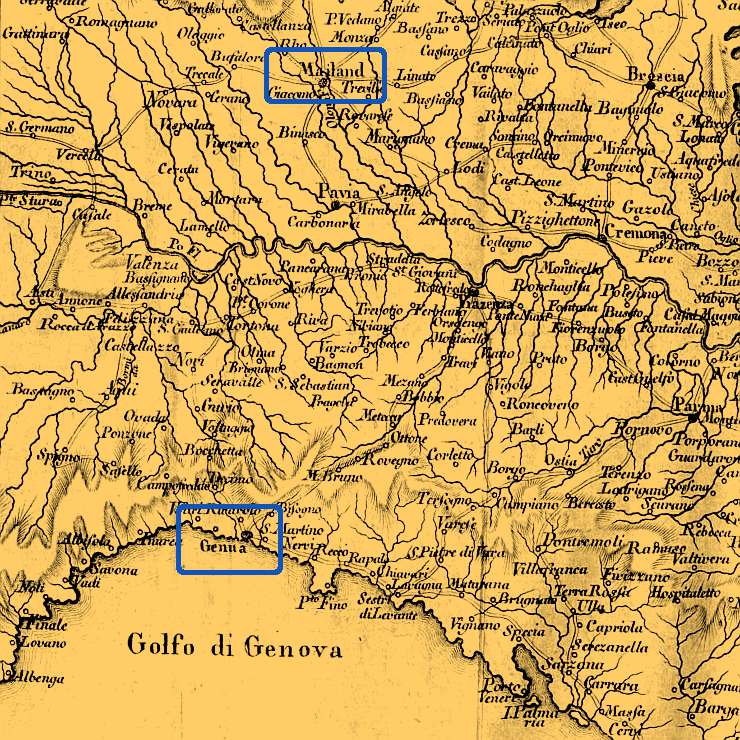
The latter had fallen at Genoa in one of the more gruesome battles in the Wars of the Second Coalition and in connection with Napoleon’s campaign into Italy in mid-May 1800 after the French had largely been driven out of Italy and Switzerland during the autumn of 1799. Genoa, besieged by the Austrians on land and by the Royal Navy from the sea, was being held by the French general Masséna as the main bastion along a 180-mile front; here Genoa with Milan to the north (“Charte von Ober Italian Zu den Feldzügen der Franzosen,” Militärischer Kalender auf das Jahr 1803; Inhaltsverzeichnis deutscher Almanache, Theodor Springmann Stiftung):
Napoleon, however, deciding on a different (and ultimately unsuccessful) tactic against the Austrians, did not immediately come to its assistance, instead urging Masséna to hold the town until June 4, the day Auguste is writing here and on which the French did indeed surrender the town after a civilian revolt, a typhus epidemic, and a famine. Back.
[1] Schelling seems to have left Bamberg on or around 1 June 1800, since here on 4 June Auguste is already assuming he has “long” been at his parents’ home in Schorndorf, which is about 150 km from Bamberg and thus would have required about a three-day journey (see Romantische Liebe und romantischer Tod, 92).
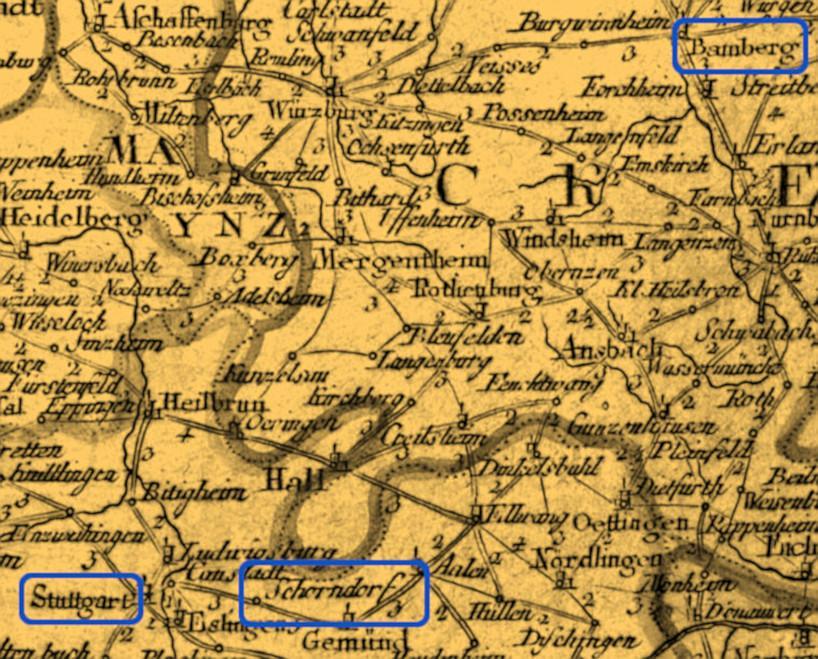
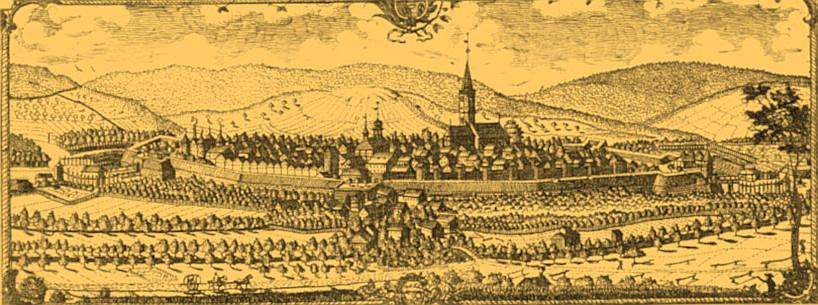
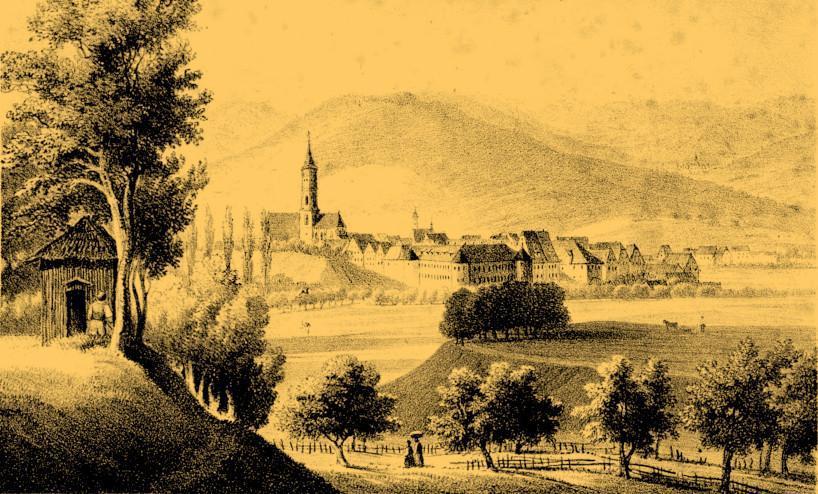
Schorndorf is otherwise situated ca. 26 km east of Stuttgart (Post Karte Durch ganz Deutschland, ed. J. Walch [Augsburg 1795]; illustrations: [1] Elias Nüsle, Die Wirtembergische Amts-Stadt Schorndorf, von Mitternacht anzusehen [1780–1781]; Herzog August Bibliothek, Museumsnr./Signatur Top 21d:2.4; [2] frontispiece to Beschreibung des Oberamts Schorndorf, Beschreibung des Königreichs Württemberg 29, ed. Königliches statistisch-topographisches Bureau [Stuttgart 1851]):
[2] A word play on Auguste’s nickname for Schelling, “Mull,” which in Swabian is a common pet name for cats. Back.
[3] In connection with the renewal of the French campaign against Austria and the Second Coalition in the spring of 1800, the French general Moreau, was concurrently (and successfully) directing the French campaign in Germany; he had crossed the Rhine in April and was on the way toward southern Germany.
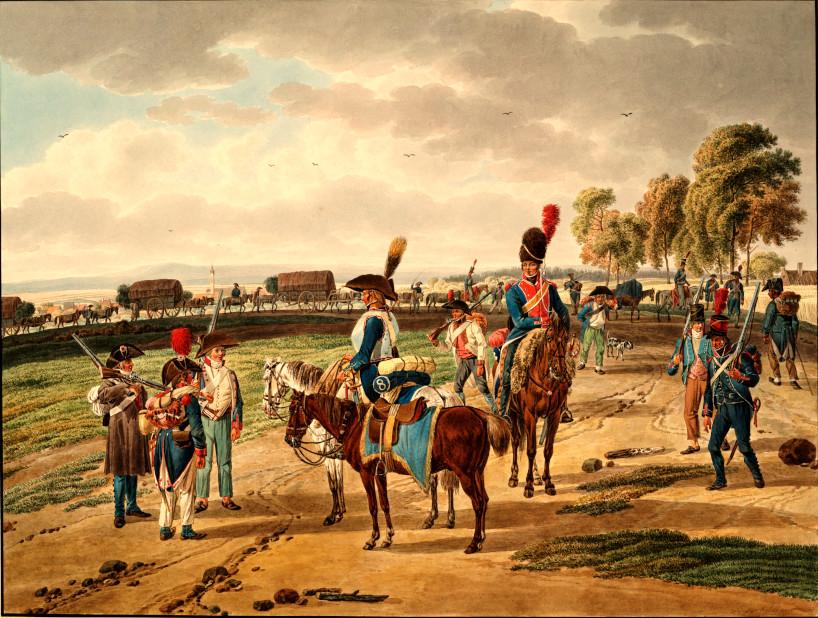
It is in connection with this campaign that Schelling is now encountering “French lads,” i.e., soldiers, since after crossing the Rhine, Moreau had indeed advanced into southern Germany along the Rhine and would eventually take Munich itself before advancing toward Vienna. Here an illustration of French cavalry and infantry on the march ca. 1800, by the artist Wilhelm von Kobell and the engravers Adam von Bartsch and Christian Gottfried Heinrich Geissler (© Anne S. K. Brown Military Collection, Brown University Library; by permission):
It is in connection with General Moreau’s Rhine crossing that Jean-Baptiste Dubois de Crancé, the father of Caroline’s second son, had just been killed in action on 25 April 1800 charging at the head of his troops; no materials document that Caroline had any knowledge of his death (representative illustrations from 1803: Taschenbuch für Geschichte und Unterhaltung auf das Jahr 1803; Inhaltsverzeichnis deutscher Almanache, Theodor Springmann Stiftung):

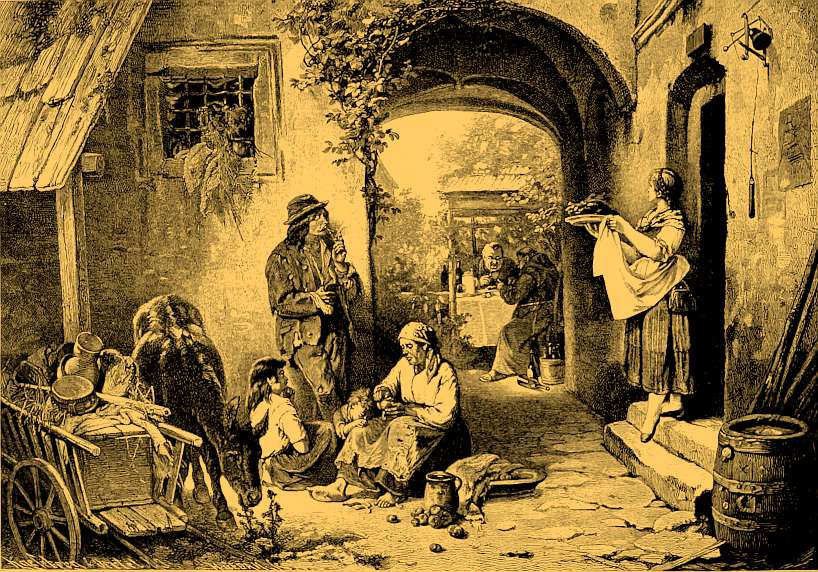
[3a] Auguste is presumably referring to a distinctly rural parsonage (Pfarrhof) near Bamberg of the type shown in the following illustration (A. van der Venne, “Im Pfarrhof,” Die Gartenlaube: Illustrirtes Familienblatt [1881] 26:425):
[4] The owners and location of this garden house — the latter of which Bamberg has always had many — are unknown. Back.
[5] Auguste recounts the story of this third (and final) unsuccessful attempt in her and Caroline’s letter to Schelling on 8/9 June 1800 (letter 262). Back.
[6] One might recall Dorothea Veit’s assertion in her letter to Schleiermacher on 15 May 1800 (letter 259s) that Caroline “has drawn her attention to Röschlaub and pointed out to her [Auguste] in a fairly crude fashion what a good match it would be for Auguste were he to marry her.” Back.
[7] Angebrentano, after angebrannt (“singed”), a jesting nickname for Clemens Brentano alluding to the latter’s slight craziness. Although the specific ploy Tieck used is uncertain, see Rudolf Köpke, Tieck: Erinnerungen, 1:354, concerning the nickname’s origin (illustration: Toiletten Kalender für Frauenzimmer 1792; Inhaltsverzeichnis deutscher Almanache, Theodor Springmann Stiftung):
He [Brentano] once told a story about a valuable edition of Shakespeare he had owned and then lost through a peculiar accident. One evening he was allegedly reading quite excitedly in one of the volumes, the others being lined up in front of him.
Fatigued by reading, his eyes closed and he fell asleep,
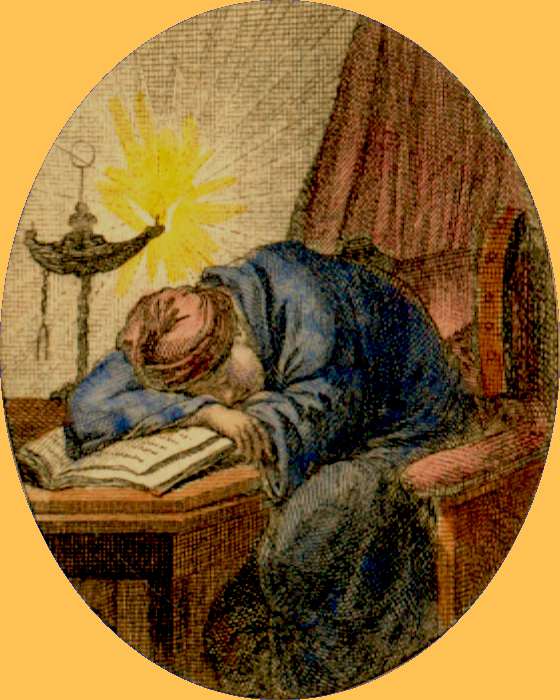
but was then suddenly awakened by a bright light — and he found himself in danger of getting severely burned. The books had caught fire, and his precious Shakespeare went up in flames. Tieck calmly listened to the story, then asked, “So that is why your name is Brentano?”
Friedrich Schlegel uses this nickname in a letter to Schleiermacher on June 1800 (letter 264e), and writes to Ludwig Tieck from Jena on 22 August 1800 (Briefe an Ludwig Tieck 3:315; KFSA 25:160):
The young Angebrentano was also here, presenting himself as the one who is now completely burned out [because of his recent break with Sophie Mereau; Brentano himself speaks about Sophie having “executed” him; see Dorothea’s letter to Wilhelm Schlegel on 25 August 1800, where she also uses the nickname]. He descended on us with such an infinite and insufferable measure of familiarity that both Madam Veit and, soon enough, I as well found him intolerable, indeed so much so that I began to treat him with a gentle dose of truth, whereupon he quickly removed himself. Back.
[8] I.e., the many times in Wilhelm’s letter to Auguste (not extant) that he addresses her as “my dearest, dearest Auguste,” apparently — given what both Auguste and Caroline go on to say — in affectionate exasperation or lighthearted chiding. Back.
Translation © 2014 Doug Stott