
• 138. Caroline to Louise Gotter in Gotha: Lucka, early 1794
[Lucka, early 1794]
[Beginning of letter missing.]
|316| Gotter also mentioned the possibility of accommodations in your neighborhood — which would be quite nice, even were it on Dead-End Street. [1] — Were I ultimately to remain in the area during summer as well, I would very much like to spend it in the Thuringian Forest. — After all, you there have Georgenthal, Schnepfenthal nearby. That would be exactly what I want, a small hut and friends like you nearby. [2]
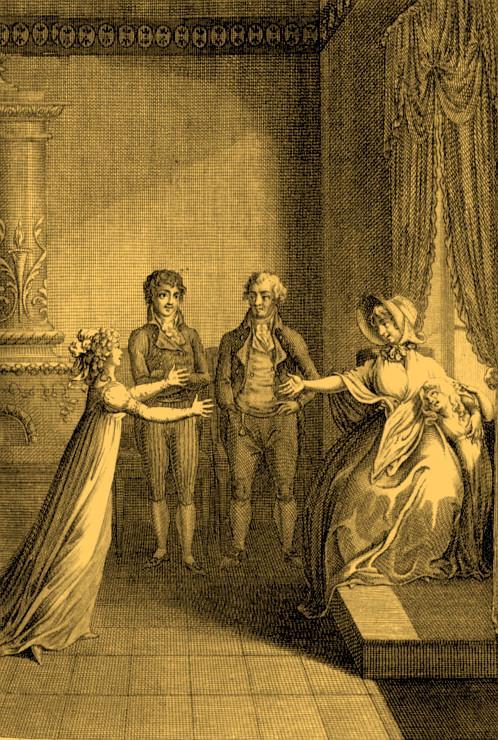
You will find great joy in being around Auguste — without this child, I confess I would not seek such solitude, but she is simply so full of life that at the end of the day, I do not realize I have not even left the room or seen another human face. This child of my soul — the early confidante of her mother’s sufferings — you must give her your blessing if ever you cared deeply for me. I embrace your daughters [3] — how inquisitively will the girls look at one another! —
Pass this letter along to our dear Mother Schläger, and together prepare an apartment for me. My heartfelt regards to Gotter, and more when we meet in person. — Tell Wilhelmine this as well.
|317| Amalie asked once about Forster — Gotter may go ahead and tell her that he wrote me from Paris and now belongs inviolably to his new fatherland — and thus has no plans to go to England. His resolve as a citizen [4] has not abandoned him. —
You can imagine, by the way, that Amalie’s house is among those into which I will not enter. I recently had the following dream — Amalie was against me, and treated me in a fearsomely nasty way, and you — yes, you, Luise! went over to her side, or so it seemed, and told me in an extremely serious tone that Amalie was a great woman. [5]
Farewell, my dear and precious friend, and trust only your own eyes, for though they be sick, you will still be able to consider me a good woman.
Notes
[1] See Adolf Moritz Schulze, Heimathskunde für die Bewohner des Herzogthums Gotha, vol. 1 (Gotha 1845), 63 (map: Grundriss der Stadt Gotha nach einer Ocular Messung vom Jahr 1796, fold-out map in Friedrich Albert Klebe Gotha und die umliegende Gegend [Gotha 1796], on which the east-west streets with connecting alleys are clearly visible):
The main market place [in Gotha; no. 5 on the town map below], itself basically positioned toward the north and south, divides the town interior into two large halves—the east and the west — of which the former is the larger and, as a result of earlier fires, also the more comely and symmetrical. The sixteen main streets crisscrossing the town basically from west to east are intersected by several side alleys, some of which are extremely narrow and two of which constitute dead-end streets.
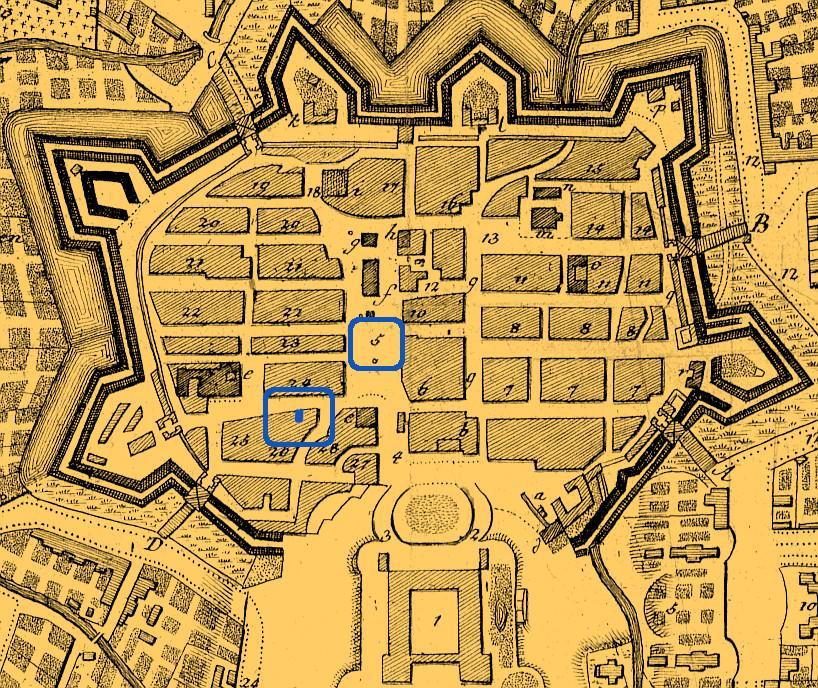
One of these dead-end streets, however, known as the Bratpfanne, “frying-pan” (Max Berbig, “Caroline v. Schelling und Therese Huber in ihren Beziehungen zu Gotha,” Mitteilungen des Vereins für Gothaische Geschichte und Altertumsforschung [Gotha 1924], 11–25, here 17), was an extremely narrow, dead-end alley with four residential buildings intersecting the Große Sundhäusergasse, the latter of which is today the Augustinerstrasse (at the time, the Gotters, Mother Schläger, and Minchen Bertuch lived (in order) in Große Sundhäusergasse 13, 15, and 21. This dead-end ally is noted both on the 1796 town map above and on the 1823 map below (Gotha und Umgebung [Gotha: Justus Perthes, 1823]):
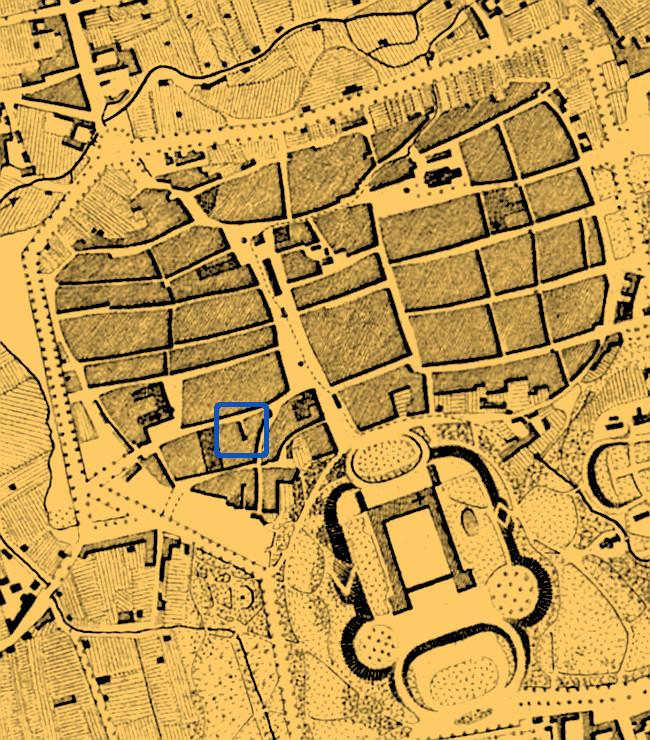
The “Frying Pan” was perhaps so named because of the heat in the summer, and it may be that Caroline is referring to these residences to emphasize that she would be willing to put up with something less than otherwise customary middle-class living conditions in Gotha. The 1913 postcard below bears the caption: “Gotha, 4 houses for 5 Marks. The four houses in the ‘Frying Pan’ were sold for this price, albeit with the proviso that they be demolished”:
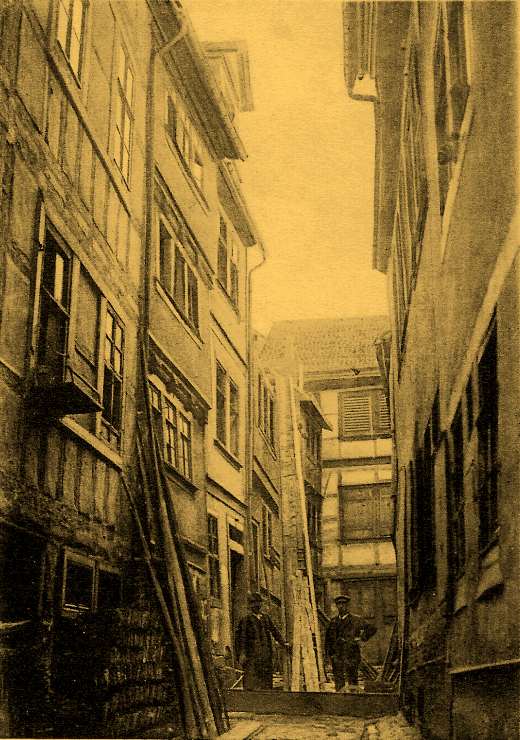
The caption on the reverse side reads:
A fourfold homeowner who has acquired four houses for 5 Marks is doubtless not an everyday phenomenon. These four houses are, to be sure, not particularly large, and the fortunate owner is, moreover, obligated to have them demolished. They are located in the “Frying Pan,” a small dead-end alley destined to disappear in its present form.
The resulting gap in the sequence of buildings on Augustinerstrasse was indeed later closed, and in 1922 Hjalmar Kutzleb, Der Zeitgenosse: mit den Augen eines alten Wandervogels gesehen (Leipzig 1922), 62, lamented rhetorically the disappearance from memory of even the former location of the “Frying Pan”: “Where in Gotha can one now find the Sock, the Frying Pan, the Lappenhög [Labbmhööch, a steep alleyway], the Swine’s Yard?” Back.
[2] Gartenkalender auf das Jahr 1782; Inhaltsverzeichnis deutscher Almanache, Theodor Springmann Stiftung:
The Thuringian forest (Thüringer Wald) is located broadly southwest of Gotha (Rudolf Koch and Fritz Kredel, Deutschland und angrenzende Gebiete [Leipzig 1937]; illustration: frontispiece to Karl Ernst Adolf von Hoff: Der Thüringer Wald besonders für Reisende geschildert 1,1 [Gotha 1807]):

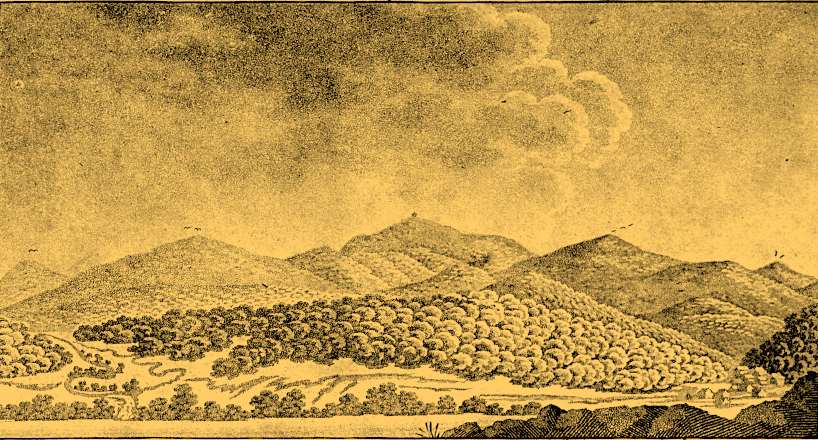
In general, even at the time the area was known for its picturesque scenery and remote villages and valleys, and it was doubtless during excursions during her time as a schoolgirl in Gotha that Caroline demonstrably became quite familiar indeed with parts of this forest even though she otherwise nowhere mentions these locales in extant letters (Ludwig Bechstein, Wanderungen durch Thüringen, Das malerische und romantische Deutschland 4 [Leipzig 1838], plate following p. 180):

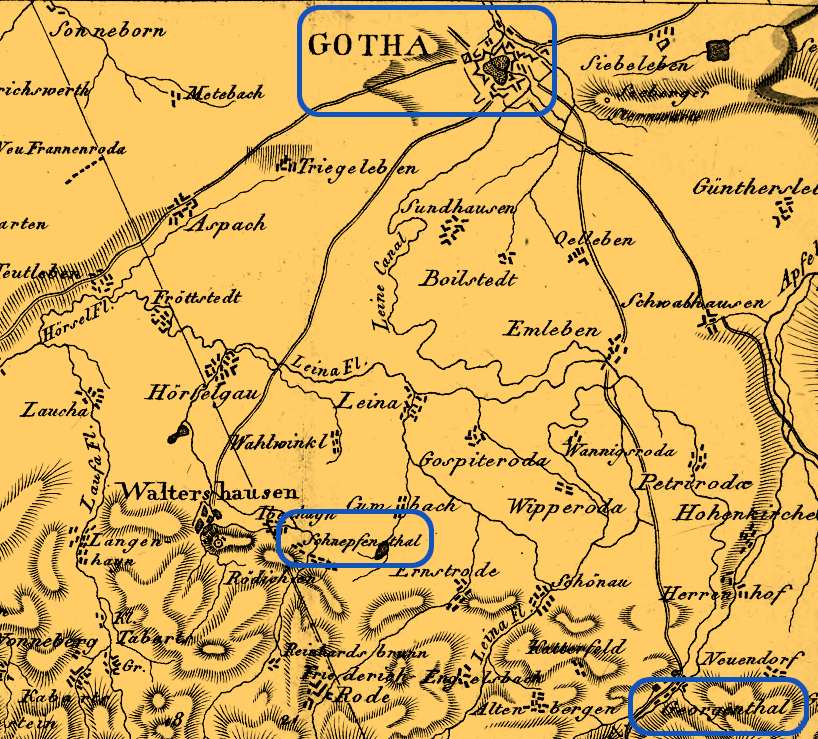
The inhabitants of Georgenthal, located ca. 15 km south-southwest of Gotha, generally worked in forestry-related industries and light manufacture (baskets, paper, glass) but little agriculture. That is, Caroline was indeed thinking of a considerably less urbanized setting, though the area was also known for its harsh climate. Even in 1845, Georgenthal had but six hundred residents, albeit in an allegedly charming setting (Adolf Moritz Schulze, Heimathskunde für die Bewohner des Herzogthums Gotha, 193–96).
Schnepfenthal is situated on the edge of the Thuringian forest and just outside Waltershausen, the latter ca. 10 km southwest of Gotha (map: Karl Ernst Adolf von Hoff: Der Thüringer Wald besonders für Reisende geschildert, vol. 1,1 [Gotha 1807]):
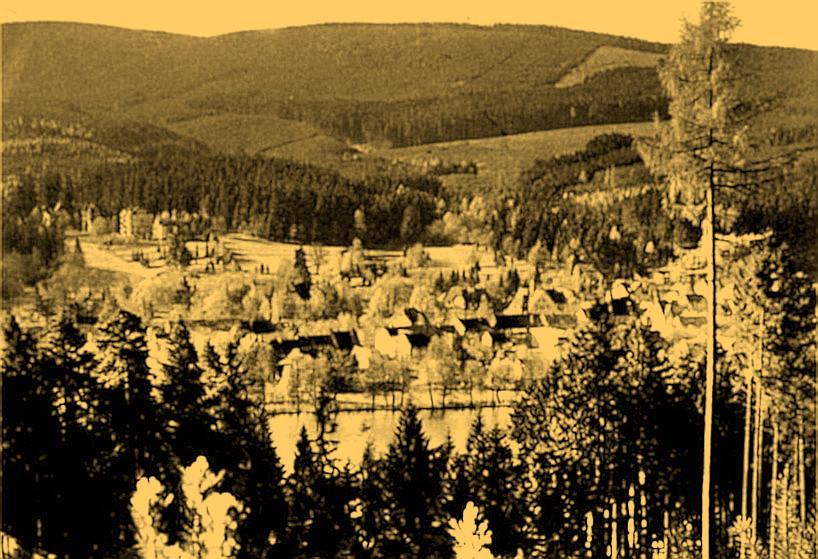
Here Georgenthal on an early twentieth-century postcard:
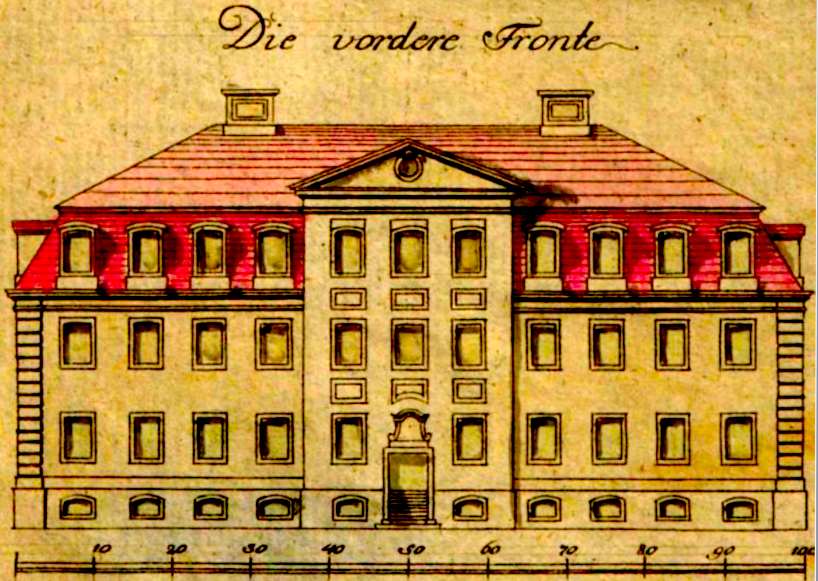
Caroline was not entirely without some familiarity with Schnepfenthal. Christian Gotthilf Salzmann (1744–1811) had in 1784 and supported by Duke Ernst II of Gotha founded a philanthropic boarding school in Schnepfenthal that still exists today. A view of the institute’s main building in 1784 is included in Christian Gotthilf Salzmann, Noch etwas über die Erziehung nebst Ankündigung einer Erziehungsanstalt (Leipzig 1784), unpaginated final illustration:
Here views of Schnepfenthal in 1794, the year after Caroline is writing (Johann Georg Wendel, Schnepfenthal-Rödichen [1794]; Sächsische Landesbibliothek – Staats- und Universitätsbibliothek Dresden, Deutsche Fotothek), and on a copper engraving from 1806 (Bildungsblätter oder Zeitung für die Jugend [1806], no. issue number, plate 53):
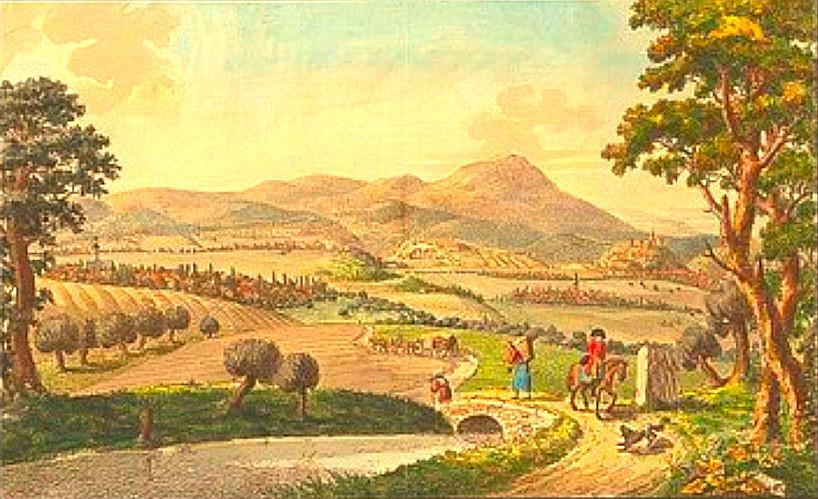
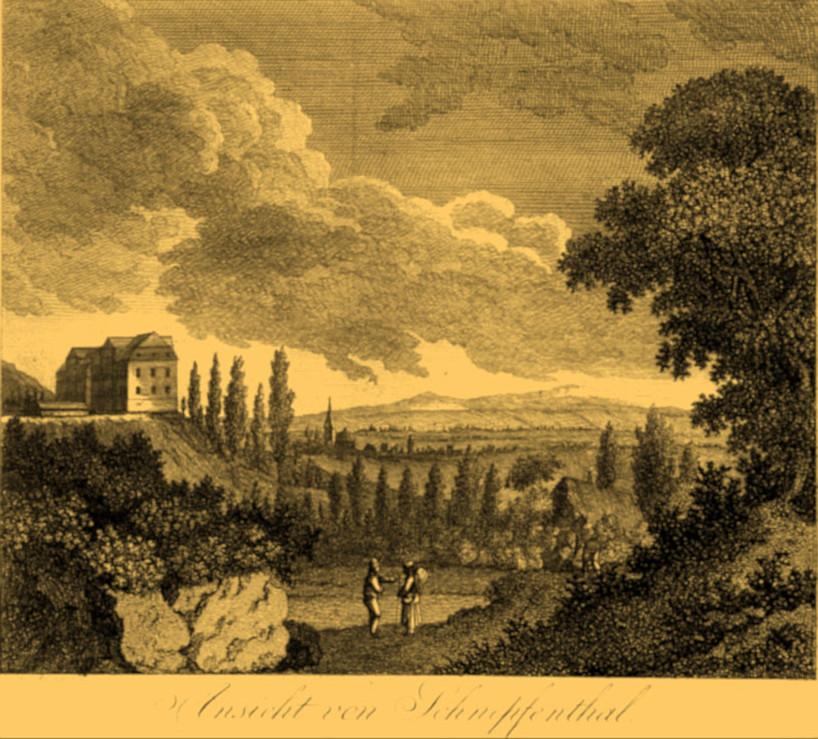
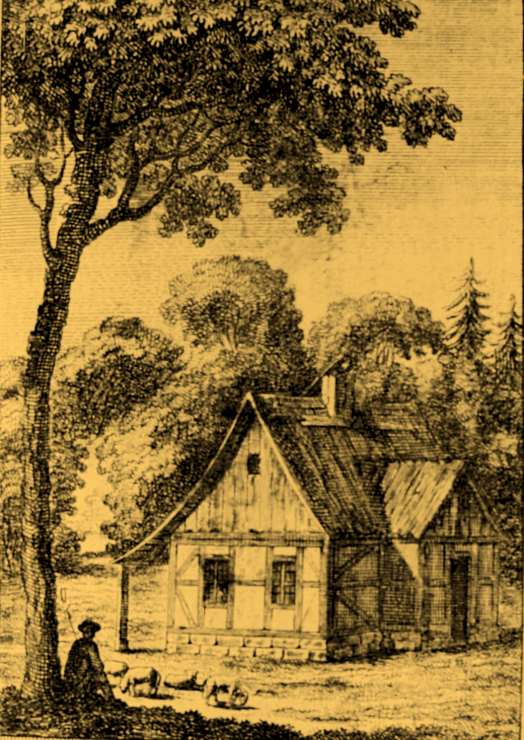
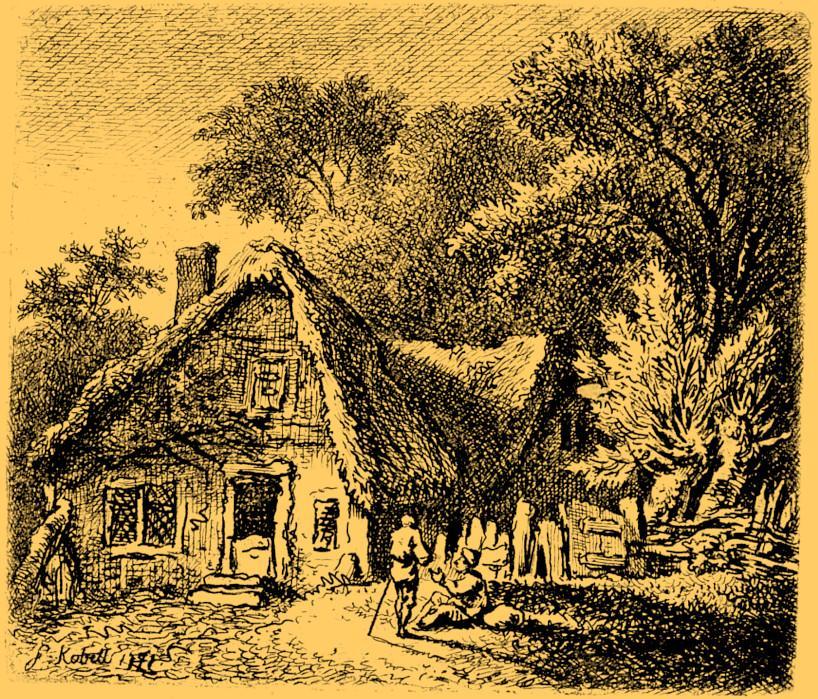
Given the seriousness of her essentially outlawed or proscribed status, it is difficult to determine how much Caroline was romanticizing the notion of living in the “Frying Pan” in Gotha or a “hut” in the Thuringian Forest (Ferdinand Kobell, Bauernhütte am Wald [1771]; Herzog Anton Ulrich-Museum; Museums./Signatur FKobell AB 3.7):
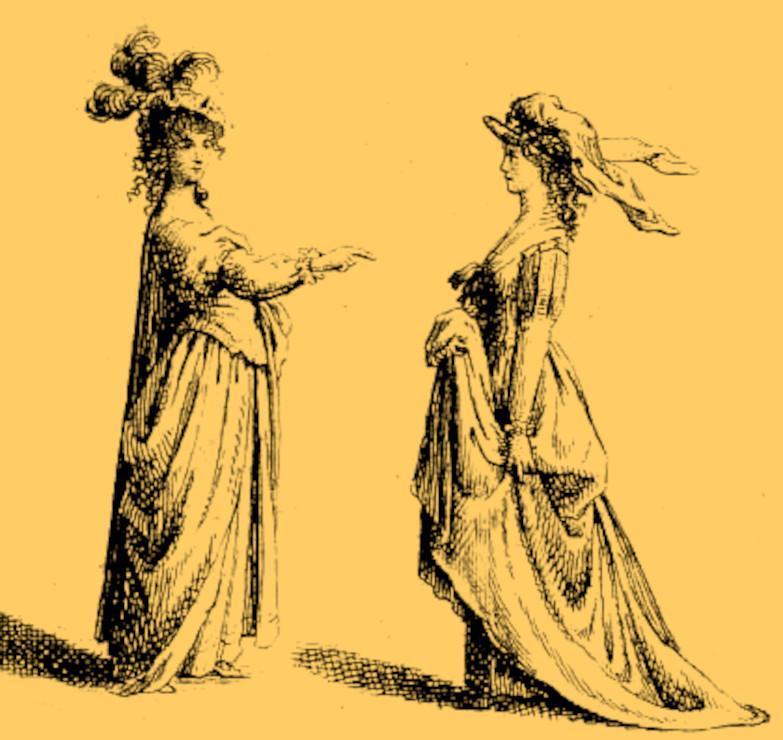
[3] Cäcilie, Julie, and Pauline (Aglaia Jahrbuch für Frauenzimmer auf 1803; Inhaltsverzeichnis deutscher Almanache, Theodor Springmann Stiftung):
[4] I.e., as a citoyen of France, the term commonly used during the Revolution even as a form of address. Back.
[5] Goettinger Taschen Kalender vom Jahr 1785; Inhaltsverzeichnis deutscher Almanache, Theodor Springmann Stiftung:
Translation © 2011 Doug Stott