
137d. Friedrich Schlegel to Wilhelm Schlegel in Amsterdam: Dresden, 21 January 1794 [*]
Dresden, 21 January [1794]
You must pardon me, my friend, for having sent you no word for so long. My recent situation simply made it impossible. If I remained at home for even a single hour, I could not be safe from visitors. A firm decision to depart; so much annoyance and humiliation; and then everything went awry; you could not help me; [Caroline] B[öhmer] did not receive money until later. Schweinitz tried in vain; all hopes for borrowing money failed. I often had absolutely no way out; only imagine my ill disposition and my impatience.
Although I did spend the last three days with Caroline, even had it not been my own choice, my distress alone would have forced me to leave town for those few days. — Caroline herself has perhaps already related to you my justification for having left her — if any is needed other than that it was necessary in order to save myself, and that she could now do without me.
She and the children are completely healthy — the departure cannot possibly be far off now, [1] and Göschen must and will doubtless now be so magnanimous as to take over my modest position. Should it take longer, however, then it would be good if you would write him.
Caroline’s sympathy and advice have been extremely useful to me, and can yet be even considerably more so. My trust in her is completely unconditional. She is no longer the singular, unfathomable one from whom one never ceases to learn something, but rather the kindest, best of persons, someone before whom I am ashamed of my own shortcomings. She has asked to see my letters to you, and I would like to ask you to send her all of them I wrote to you from Leipzig, or at least from August 1792 to Easter 1793, [2] but without being selective.
My dear Wilhelm, I want to try to keep your friendship pure, to remove anything that might disrupt it; but let us no longer speak of that disharmony, otherwise fear might prompt me to be less open. I myself must bear the ultimate responsibility and culpability for everything, and that without objection — not because my vice could not be healed, or because I was not open toward you, but because the only cause was that particular period of my life [3] that I can now view only as an inseparable whole. Although I do view it as having been natural and necessary, indeed even as relatively beneficial, for the formation of my entire life, still in and of itself it was quite bad and my guilt considerable. —
What might I reproach you for except that you did not rescue me at that time, when it would have been so easy? and that you now do so in a way that requires you to surrender part of what you have laboriously earned, on which your freedom, your connection with [Caroline] B[öhmer] — indeed your life’s happiness depends. And that is what will always unsettle me. — . . .
I will write you next time about my situation here; I have only been here a few days now. I am not yet free of financial worries. — After what happened before, arriving here wholly without money put me in an unpleasant relationship with Lottchen. I still must take my meals with her, which oppresses me. But as soon as I have even a few Thaler with which to buy bread, that will happen only rarely. —
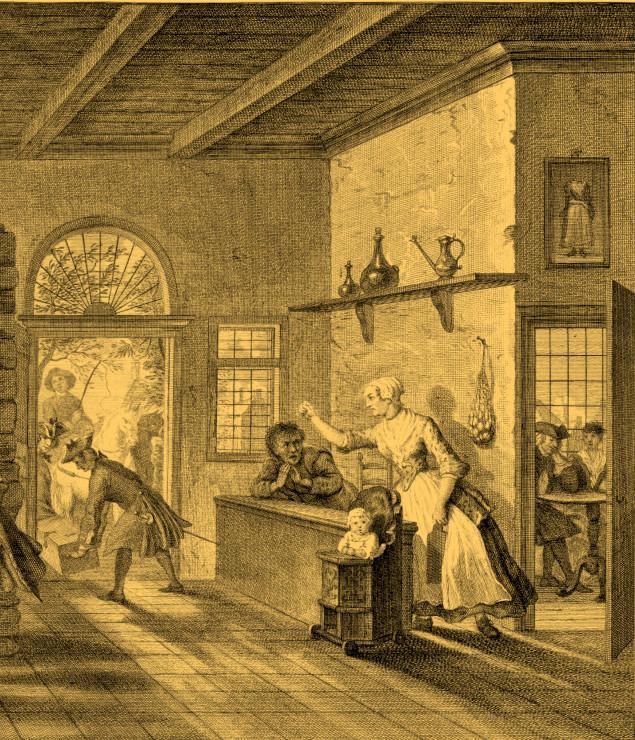
Furthermore, I had annoying problems with my landlady in Leipzig, a miserly, quarrelsome old witch. [4] I had to present a proper bill of exchange for what I still owed (over 30 Thaler); and also leave most of my personal things there. The bill is due in a couple of days, and it will presumably cause me enormous annoyance yet. [5]
It would also make me feel extremely bad could I not send at least something to my loyal manservant. If Caroline soon receives a lot of money, then everything will be fine. (How can you possibly think I would be ashamed to accept charity from her?) There is nothing to be done with Lotte; nor would your mediation help — and given her marital circumstances and the measure of her heart and understanding, that is also quite natural. You really do still have too good an opinion of her. Perhaps your sparing consideration of her is the reason I have not heard anything from you for so long, just like last Easter.
But that is superfluous; your friendship is really nothing more to her than one of her many toys, among which the best is still her husband, whom she increasingly resembles. She heard from Madam Körner that B. had been in Leipzig at your recommendation, and in what condition she was there, in which connection they mentioned Forster to her. [6] But do not believe that the conviction of your utter deception will prompt even a hearty bit of vexation in her. —
I did not enter into a discussion of any of it; for the rest I generally get along quite well with her, though our relationship will be truly bearable for me only when I no longer need to accept any favors from her. May heaven soon grant me some money! . . .
Notes
[*] Sources: Walzel, 159–62; KFSA 23:175–77. Back.
[1] Caroline and Auguste seem to have departed Leipzig for Gotha on or about 4 February 1794 (Post Karte Durch ganz Deutschland, ed. J. Walch [Augsburg 1795]):

Although Friedrich refers to the “children,” Caroline’s son, Wilhelm Julius, had remained behind in Lucka with foster parents. Back.
[2] The period during which Friedrich had an ill-fated love affair in Leipzig (Goettinger Taschen Calender vom Jahr 1789; Inhaltsverzeichnis deutscher Almanache, Theodor Springmann Stiftung):
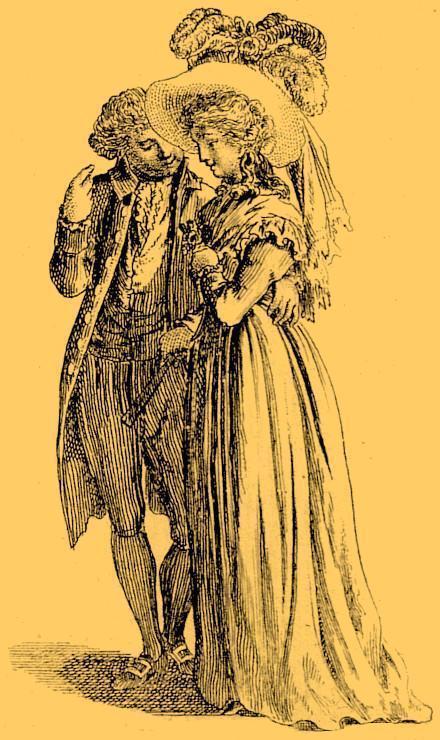
[3] The ill-fated love affair. Back.
[4] Cornelis Troost and Pieter Tanjé, [The angry landlady of Puiterveen] (ca. 1726–61); Herzog Anton Ulrich-Museum; Museums./Signatur PTanjé AB 3.23:
[5] Charlotte Ernst later redeemed the bill, and Wilhelm settled it. Back.
[6] I.e., as the probable father of her child. Back.
Translation © 2011 Doug Stott