
185c. Wilhelm Schlegel to Goethe in Switzerland: Jena, 24 September 1797 [*]
Jena, 24 September 1797
Although I have already often resolved to write you, it always seemed that what I might have to say was not of sufficient import to journey to you so far away, [1] a reservation which, however, your own free and easy conversation from the very first moment of our acquaintance had already helped me get past. You can well believe that I infinitely miss your company and that nothing can replace it for me even were I less isolated now and not so entirely dependent on my beloved lady friend for everything that is of value to my mind and heart. [2] . . .
. . . We have had various quite interesting visits from strangers here; you are perhaps already aware that Rittmeister von Funk was here, and Herr von Hardenberg from Weissenfels spent a day with us on several occasions. [3] Although you have probably seen him around here often, I know not whether you have had occasion yet to speak with him at greater length.
We find him to be an extremely interesting man, and the somewhat rapturously enthusiastic turn in his disposition brought on by the death of his beloved young lady friend, Fräulein von Kühn, has made him even more charming insofar as that disposition is countered by his extraordinarily cultivated mind, or, as it were, is balanced by it. His melancholy has plunged him into a doubly intensive engagement with the most abstract sciences, whereby his internal disquiet is betrayed by the sheer quantity and novelty of his rather strange views. —
He will shortly be leaving this area to go to Dresden and thence to Freyberg. [4] We have rather pleasant news from my brother in Berlin. It seems he has quite been drawn into society, [5] though he does insist he is staying very diligent and is not forgetting the Greeks, though it is unlikely anything in that regard will be ready by Michaelmas, more likely, I think, at Easter. [6] —
The second volume of my Shakespeare is well underway at the printer’s and should be ready very soon now. The prose in the second piece — in which most of the piece is written — gave me enormous trouble, almost as much as the verse passages; at the very least, the older translation had to undergo an equally severe transformation. [7] . . .
Kindest regards from my wife, who has not really been well recently and is still taking medication; I do, however, hope she will get better before the winter. . . .
Notes
[*] Source: Körner-Wieneke, 59–64. Back.
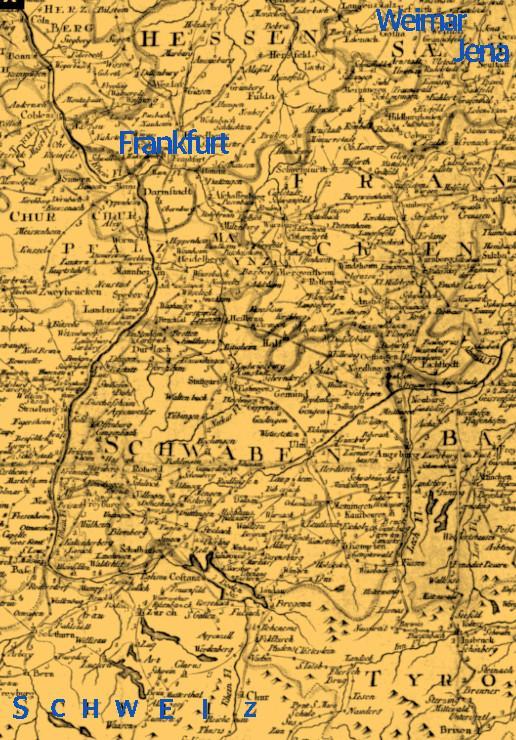
[1] Goethe was en route and in Switzerland between 30 July and 20 November 1797 (Weimarer Ausgabe 3:2:76–194; he visited his mother for the last time in Frankfurt between 4 and 25 August 1797). Wilhelm had visited him in Weimar on 22 July before his departure, but Goethe would not receive this letter until he himself was back in Weimar (Post Karte Durch ganz Deutschland, ed. J. Walch [Augsburg 1795]):
[2] The “beloved lady friend,” of course, is Caroline. Back.
[3] Friedrich von Hardenberg seems to have visited Jena at least twice during the summer of 1797: between 10 and 22 August and between 24 August and 5 September 1797 (Novalis Schriften 4:825; see also Friedrich Schlegel’s letter to Auguste in late September 1797 [letter 185b], note 2). Back.
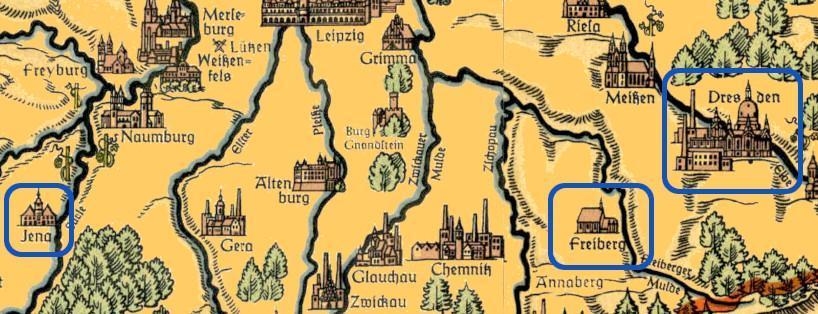
[4] Sophie von Kühn, Hardenberg’s fiancée, had died on 19 March 1797 of consumption (tuberculosis). See in this regard Friedrich Schlegel’s letter to him on 5 May 1797 (letter 181f), note 3. Not surprisingly, Hardenberg did not go to Freiberg (ca. 125 km east of Jena, 30 km southwest of Dresden) until 1 December 1797 to study mining and mineralogy at the recently founded (1765) academy there (1st map: Post Karte Durch ganz Deutschland, ed. J. Walch [Augsburg 1795]; 2nd map: Rudolf Koch and Fritz Kredel, Deutschland und angrenzende Gebiete [Leipzig 1937]):

During October and November 1797, he was engaged in intensive studies of Franz Hemsterhuis after similar studies during the summer in the works of Fichte, Kant, and Schelling, all of which contributed to his incipient new understanding of the death of Sophie von Kühn and its expression in his “Hymnen an die Nacht,” which were published in Athenaeum (1800) 188–204.
He writes to Friedrich Schlegel on 5 September 1797 (Friedrich Schlegel und Novalis. Biographie einer Romantikerfreundschaft in ihren Briefen. Auf Grund neuer Briefe Schlegels, ed. Max Preitz [Darmstadt 1957], 103–4; Novalis Schriften 4:235; KFSA 24:13; illustrations: [1] the Fichte house in 1984; today it houses the Museum of Romanticism; photo by translator; [2, 3] both illustrations: Inhaltsverzeichnis deutscher Almanache, Theodor Springmann Stiftung: Toiletten Kalender für Frauenzimmer [Vienna 1796] and Zeitvertreibs Kalender in vermischten Unterhaltungen für Gesellschaften [Vienna 1801]):
For a while I was quite inactive, quite sick — and for a while quite active — quite healthy. This latter period continues yet. I am in the waves and breakers — a powerful current is now casting me up on firm ground. My mind and spirit are now more fertile, perhaps even happier than ever. . . . I visited your brother twice [see dates above] — I was also at Fichte’s —
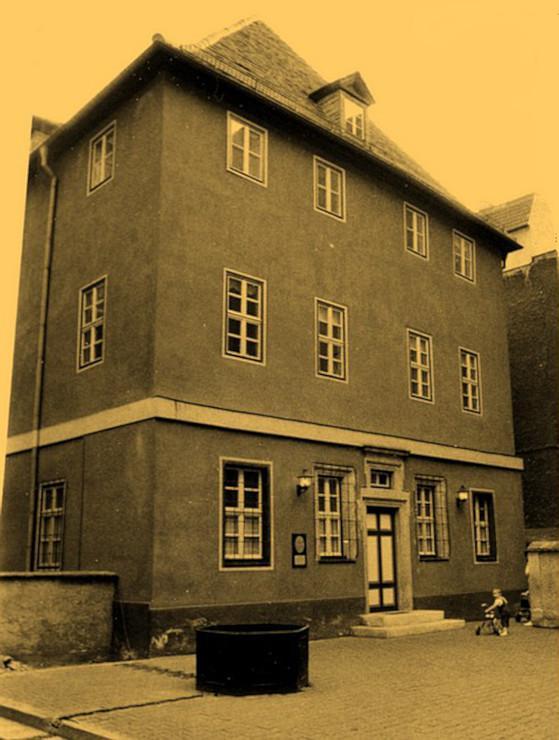
Your family members [Wilhelm and Caroline] multiplied my happy hours not inconsiderably. I felt completely at home with them [at Leutragasse 5]. A person cannot be more comfortable and content — Few people can be living as animated a life as those two. We immediately fell deep into conversation — They allowed me to speak so freely — and I knew that I could speak. Your brother recognizes that with which I am most ardently concerned.


[5] Friedrich was at the time frequenting the Berlin literary salons; he and Dorothea Veit had met at the salon of Henriette Herz the previous month (Taschenbuch für das Jahr 1810: Der Liebe und Freundschaft gewidmet [Frankfurt]; Inhaltsverzeichnis deutscher Almanache, Theodor Springmann Stiftung):

[6] That is, in time for the Leipzig book fair. The first volume of Friedrich’s Geschichte der Poesie der Griechen und Römer (Jugendschriften 1:231–362) was indeed not typeset until Easter 1798. Back.
[7] Shakspeare’s Dramatische Werke übersetzt von August Wilhelm Schlegel, vol. 2. Julius Cäsar, Was ihr wollt (Berlin 1797). The second piece is Twelfth-Night; or, What You Will. The volume seems to have been intended to appear in time for the Michaelmas book fair, which in 1797 began on 1 October. Back.
Translation © 2012 Doug Stott