
• 186. Caroline to Wilhelm Schlegel: Jena, 1797? [*]
[1797?] [1]
[The beginning and 2 pages are missing.]
|426| . . . thought? I’ve spent some time considering the whole matter. It absolutely must be short — at most one printer’s sheet. The piece is full of life, full of meaning, and yet also so simple — there are no riddles in it to solve.
The character of the monk has depth without mystery. [2] No saint, a venerable, gentle-thoughted old man, a mind capable of noble observation, almost sublime from his confidential intercourse with lifeless nature, and extremely attractive, piquant (if you will allow) from his equally accurate knowledge of the human heart, which is tinged with a merry, yea a witty humor. He has a quick head for adapting himself to the moment and using it; bold in proposals and resolutions, he feels their importance with a philanthropic seriousness. Of his order he has nothing about him but a little art of dissembling and physical timidity — he is free from any thirst for power and exposes himself unhesitatingly to dangers in order to work good, [2a] is candid and in control of himself amid inescapable danger.
Strange as it is to say, there is nothing more attractive or engaging than this monk, and the first scene in which he appears should serve to make palpable to us an element of the venerable power inhering within his nature, one that will strengthen that impression through admiration. He does what his young friends require of him, but he seems to yield not to their impetuosity, but to the almost sacred perception, experience, of what passion is. He addresses his demand to Juliet as to a heroine, exhorts her to constancy in love as to a lofty virtue, and seems |427| to foreknow that he will not be deceived in her — in whom passion has already been complemented by the pure, conscientious — the devout faithfulness of the spouse. —
Juliet’s whole being is love, and yet it would be impossible to regard her as nothing further than an ardent maiden who awakens for the first time and happens to fall upon the nearest object, regardless of what it is. It really does seem that their benevolent guardian spirit has brought these two together — they meet in a glance, and every following word is precisely like that glance. One believes along with them that no deception can possibly take place here. Even Romeo’s flightiness leaves no doubt — it is as if his initial devotion were merely a vision of the future, a dream of his imagination whose purpose was to prepare him. And even though we see nothing of these two except their passion, that passion manifests itself such that it suggests the presence of a noble disposition of the soul. [3]
Be not angry with her that she is so easily won — she knows of no other innocence than without dissimulation to follow the powerful draw. In Romeo there is nothing that can scare back her tenderness, or injure the delicate requisitions of a soul truly penetrated with love. She speaks openly to him and to herself; she speaks not under the control of her senses — but only utters, what the most modest being may think. One may forgive the hot Italian her rather vivid imagination.
From the very moment she becomes his spouse, her life is tied to his; she has the most profound aversion to anything that would make her turn away, and similarly fears the danger of being desecrated or torn from him. When she is forced to dissimulate, she does so with steadfastness and thus without pangs of conscience, since she could no longer have much respect for her parents after such an encounter.
I consider her monologue to be one of Sh[akespeare’s] flawless master strokes. |428| [4] First the shuddering to feel herself alone, almost already as in the grave — her taking courage — her reflection, her so natural suspicion, and how she with a soul elevated above all that is mean discards it — greater than that hero who not without ostentation swallowed the medicine — —
[Conclusion is missing.]
Notes
[*] (This editorial note also applies to letter 187.) These remarks in letters 186 and 187 constitute preliminary notes for Wilhelm’s essay “Ueber Shakespeares Romeo und Julia,” which appeared originally in Schiller’s periodical Die Horen (1797) 10, no. 6, 18–48, then was reprinted first in Wilhelm’s Charakteristiken und Kritiken, 2 vols. (Königsberg 1801), 1:282–317, then in Kritische Schriften 1:387–416, and finally in Sämmtliche Werke 7:71–99 (the latter being slightly edited but still incorporating entire passages verbatim from Caroline’s letters 186 and 187).
A translation of Wilhelm’s essay into English by Julius Charles Hare, based on the version published in Charakteristiken und Kritiken, appeared as “A. W. Schlegel on Shakspeare’s Romeo and Juliet; with Remarks upon the Character of German Criticism,” in what is today the rare first and only issue of Ollier’s Literary Miscellany in Prose and Verse by several hands. To be continued occasionally, no. I (London 1820), 1–39.
In the preface to his Kritische Schriften 1:xvii–xviii, Wilhelm acknowledges Caroline’s contribution to the essay.
Those works marked by an asterisk in the table of contents are not entirely my own, coming instead in part from the hand of an intelligent woman who possessed all the talents to shine as an author but whose ambition was not pointed in that direction.
In both letters (186 and 187), parallel (par.) passages reappearing more or less verbatim in Wilhelm’s essay are noted as such with cross references (1) between this translation of Caroline’s letters and Hare’s translation of Wilhelm’s essay, and (2) between Erich Schmidt’s edition (1913) and Wilhelm’s Sämmtliche Werke.
Ludwig Tieck, who was himself writing on Shakespeare at the time, wrote to Wilhelm Schlegel from Berlin on 23 December 1797 (Lohner 24–25; concerning Tieck’s reference to his “letters,” “Briefe über W. Shakspear,” see also Friedrich Schlegel’s letter to Caroline in mid-February 1798 [letter 195b]):
Your letters have been an extraordinary delight for me, and indeed have given me considerable courage to write something good myself, and to do so with care, something I have hitherto rarely done. I am studying your [translation of] Shakespeare quite closely and wish I could also study the next part thus. The review will then surely be ready immediately after publication.
I am seeing with increasing clarity what you have to overcome in your translation, and how successfully you overcome every resistance; the Germans will only now really come to understand this poet and perhaps shed the old, tough skin that has hitherto made them utterly insensible to all genuine beauty. Of course, Lafontaine and other writers of fashion are still diligently working against precisely that. —
I was infinitely pleased with your essay on Romeo [and Juliet]. You have anticipated virtually all my “letters” with respect to this piece [“Briefe über W. Shakspear,” in Poetisches Journal, ed. Ludwig Tieck (Jena 1800) 1 no. 1, 18–80; 1, no. 2, 459–72; reprinted in Tieck’s Kritische Schriften, 2 vols. (Leipzig 1848), 1:133–84.]; I find the discussion enormously helpful, and I was delighted to see how our ideas coincided. I do, however, view Juliet as a bit more sensual, which is why in my judgment it is so extraordinarily beautiful to see how differently, how far less maidenly her entire demeanor is after the night; the first monologue of the monk contains the course of the entire piece, and his reflection on the flowers the apology for his behavior, which is why I have always found him to be so significant in so many respects. . . .
I wish I could show you my “letters” on Shakspeare beforehand; in fact, it would be splendid in general if at some time or other we were to see each other frequently, and I for my part have already quietly considered how I might bring that about. My own “letters” will slip into a rather wild poetical tone, though perhaps poesy can sometimes be explained through poesy itself. I at least intend to try, and to portray everything I myself have always felt while reading Shakspeare. He is the greatest and most varied poet I know, and the most poetic as well, a kind of arch-poet, I would call him, who depends on absolutely nothing outside himself — which, unfortunately, is often the case with Goethe.
See also Hermann Conrad on Caroline and the translation of Shakespeare.
Here three contemporary renderings (early 1790s) of scenes from the play: [1] William Miller, Romeo and Juliet, Act I, Scene V (1792); Herzog Anton Ulrich-Museum; Museums./Signatur ShakespeareGallery AB 2.57:
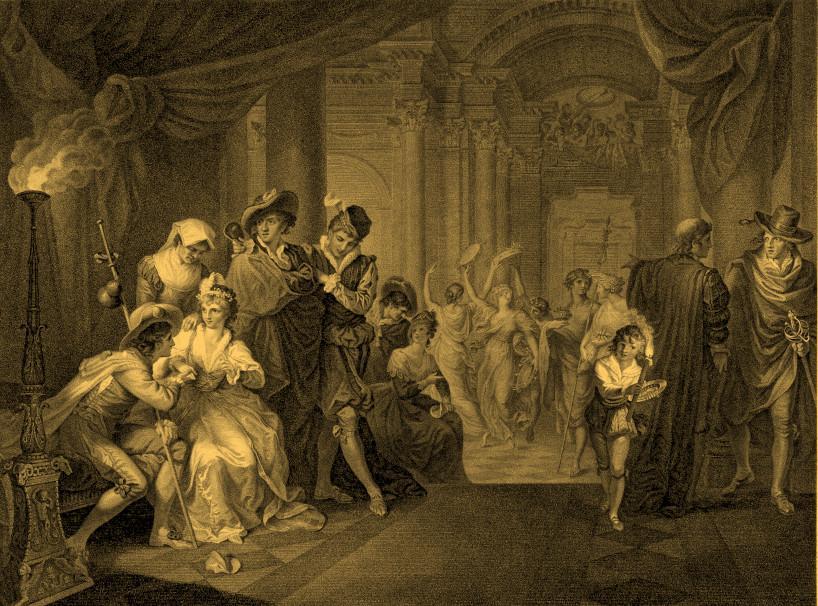
(2) Johann Gottlieb Facius, Romeo ans Juliet, Act IV, Scene V (1791); Herzog Anton Ulrich-Museum; Museums./Signatur ShakespeareGallery AB 2.58:
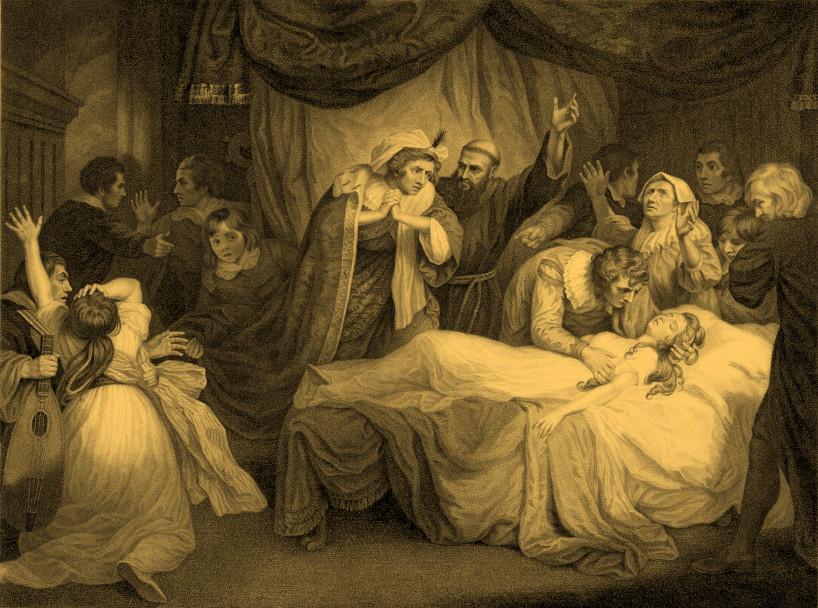
(3) John Peter Simon, Romeo and Juliet, Act V, Scene III (1792); Herzog Anton Ulrich-Museum; Museums./Signatur ShakespeareGallery AB 2.59:

[1] Concerning the dating of both letters (186, 187), Waitz (1871), 1:202n2, points out that the date “Tuesday the 19th” (in the continuation in letter 187, [1913], 432) fits only September or December in 1797, though we have no knowledge that Wilhelm was away during this time, e.g., with his brother Friedrich (Caroline’s reference to a second individual is uncertain); because a date of July 1796 is equally improbable, one must, Waitz concludes, perhaps go back to January or March 1796, when “the 19th” was a Tuesday, in which case “Madam Hufeland” in letter 187 would not be referring to the professor’s wife in Jena. That said, however, the number “19” itself might be incorrect. Back.
[2] The passage beginning with “No saint” corresponds to the passage beginning with the same words at the end of page 27 in “A. W. Schlegel on Shakspeare’s Romeo and Juliet” (similarly [1913], 1:426, par. Sämmtliche Werke 7:85). Back.
[2a] “Work good” (Germ. um Gutes zu stiften), a perhaps infelicitous rendering (to be understood in the sense “to do/effect some good”), reflects the translation (as do several passages in this and letter 187) of Julius Charles Hare, better enabling readers to locate which passages Wilhelm incorporated from these letters into that essay on Romeo and Juliet. Back.
[3] The passage beginning with “Be not angry with her” corresponds to the passage beginning with the same words on page 22 in “A. W. Schlegel on Shakspeare’s Romeo and Juliet” (similarly [1913], 1:427, par. Sämmtliche Werke 7:79). Back.
[4] The passage beginning with “First the shuddering” corresponds to the passage beginning with the same words on page 27 in “A. W. Schlegel on Shakspeare’s Romeo and Juliet” (similarly [1913], 1:428 top, par. Sämmtliche Werke 7:84). Back.
Translation © 2012 Doug Stott