
236c. Wilhelm Schlegel to Johann Diederich Gries in Göttingen: Jena, 10 May 1799 [*]
Jena, 10 May 1799
It was not until almost this evening that your brother brought us your letters, and yet tomorrow morning he will already be leaving again; since I had other letters that needed to be written today as well, I fear this time you will have to make do with this one.
I received your missive as well as the book — also the poetic compositions of the Göttingen meatmonger. [1] Please give my regards to Fiorillo when you see him, and thank him for the gift; I will be writing him soon. [2]
We are always glad to get your letters even though they do strike a plaintive enough tone [3] — all the more do we hope to see you here again soon among us. I foresaw that you would find the Göttingen world lagging far behind — let us hope that our own Jena will not end up the same way as a result of Fichte’s dismissal! [4]
Actually absolutely nothing more has transpired in his affair except the two student petitions, the second of which Steffens put up; [5] although it was seemingly submissive enough, it was actually quite cheeky, and no doubt quite vexed the gentlemen in charge. It really ought to be published, since it does contain the correct perspective, and presents the primary articles of Fichte’s self-justification; [6] and it ought to be published in a newspaper that has a wide circulation. Steps have indeed been taken in that direction. But now one must simply wait and see.
Fichte must yet postpone publication of his official explanation, and yet in the meantime cannot prevent parts of it from being made public. [7] He is still here, and his stay now seems to be being drawn out. Of course, he is admittedly in no hurry now. [8] The events of the war (which are driving us for our own part half to despair) are doubtless making him quite unsure about where to go. [9]
Jakobi’s letter is really quite heartfelt and eloquent. [10] The philosophical elements in it are quite at the correct level, and no one has yet spoken such powerful and beautiful words about Fichte. On the other hand, I cannot at all get on with his religion — for me, it is simple superstition — indeed, the entire letter has finally convinced me that religion is not possible without superstition, and philosophers would thus be better advised to dispense entirely with theological terminology, and to cease entirely from speaking about the venerable Lord in question.
Jakobi declares Fichte to be an atheist — and I do believe he is quite right in that assertion, for Fichte just happens to be wholly and completely a philosopher, and theism is a philosophical impossibility. I wish Fichte had not found it necessary to defend his theology in any way, though given the imminent possibility of being burned at the stake he really did not have much choice; that is, I wish he had withdrawn entirely into the sphere of morality. —
Jakobi then also disapproves of the publication of the essays, of Fichte’s as well, with a turn of phrase that obviously tends toward the postulation of esoteric and exoteric versions of the truth and toward not allowing the common man to catch any glimpse dessous des cartes [11] — an aristocratic principle I find positively insufferable. For these reasons, I cannot really approve of making the letter public, though from the philosophical perspective it would be interesting enough.
Enclosed please find your manuscripts, which I have been looking for an opportunity to return. It does not seem necessary to me to change anything else essential in “Der Wanderer” [12] — the execution is beautiful and careful — whatever may be missing in the way of definiteness within the course of the whole, or of more explicit evocation of the significance of various individual imagery, is already contained in the initial concept, from which one is ill-advised to stray too far.
You will soon enough have the opportunity for leisure and intellectual pleasures again when you can execute your various poetic plans. — Might you not submit this poem for inclusion in the Erholungen? Becker would no doubt be glad to accept it. He does pay a honorarium, albeit not commensurate with what such poems are worth — but one can rarely expect such these days in any case — in the meantime, one puts up with it. He pays 8 to 10 rth. per printer’s sheet in his extremely small format. [13] He is also seeking contributions for his Taschenbuch, albeit before the end of May. [14]
I would be curious to read Wallensteins Tod; we were not entirely satisfied with the impression it made as an actual theater production. [15] The murder was carried out so quietly that one could hardly imagine that it actually happened. [16] (In the second performance, they wrapped the corpse in a rug and carried it across the stage — something they did not do the first time.) [17]
Even in the larger sense, the grand scenes were too isolated — toward the end things seemed hardly to move; not as if the action itself went more slowly, but at the very least it did not in any way accelerate its rhythm, something that is, however, quite necessary. The discourses should be shorter, the maxims eliminated, etc. We found the scene between Thekla and the Swede to be the most moving. [18]
Lucinde is not finished, [19] but a volume of Shakespeare [20] and Don Quixote are. [21] Goethe is working on a grand epic poem and is here in Jena again. [22] Madam Unzelmann did not come, notwithstanding she did give us reason from Vienna to hope for such. [23]
Yesterday Stakelberg [?] [24] gave a grand, well-attended diné on the Driesnitz, which was very nice indeed — as it were, the first spring excursion. All sorts of people gathered together there, the Hufelands, Pauluses, Loders, Fichtes, Frommanns, and — Kotzebues! I have now both seen and spoken with this wooden idol, who appears inestimably common, lame, and philistine.
If no one knows about anything in Göttingen, then the murder of the French emissaries doubtless similarly caused no stir there; [25] here it is the topic of conversation, and is something that has violently shaken us — that is, those who are well meaning! — and filled us with indignation, rage, and a desire for revenge.
But those are nothing but impotent words. If you have a copy of Hamlet at hand, look on p. 302, where you will find our real opinion on the matter toward the bottom in the discourse of Laertes. [26] We do in the meantime hope that it will end up furthering the good cause.
Schelling is now taking his meals with us. [27] Steffens must be in Berlin now, I am eager to hear about his acquaintance with Friedrich Schlegel and Schleiermacher. [28] Hardenberg has not been here. [29]
My canto by Ariosto will be finished soon — I did not work on it for a long while. [30]
Stay well — I must close for today. My wife sends her warmest regards — she would like to have written today herself but is not feeling entirely well. [31] Adieu!
Yours,
A. W. S.
In the dictis of the elderly Heyne I do quite recognize his linen-weaver style. [32]
Notes
[*] Source: Körner, (1930), 1:90–93.
Johann Diederich Gries, with whom Caroline and Auguste had traveled to Dresden back in May of 1798, now becomes an increasingly familiar figure in the Jena circle and its correspondence and a considerable admirer of Caroline.
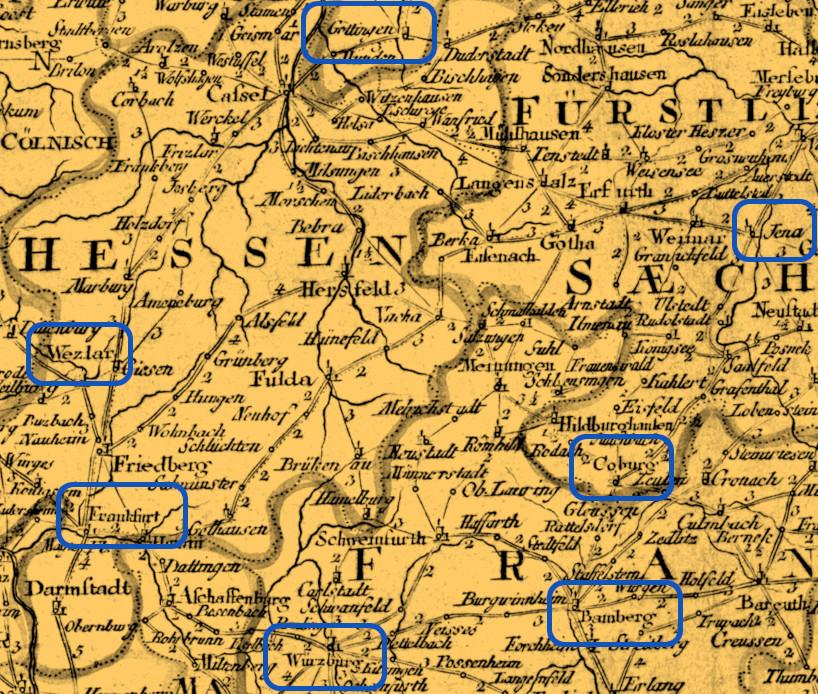
Background and trajectory: Gries had, however, been in Göttingen since 15 April 1799 finishing his law studies, which he had neglected as a student in Jena. He returned to Jena on 3 September 1799 for a visit before resuming his studies back in Göttingen (Rudolf Koch and Fritz Kredel, Deutschland und angrenzende Gebiete [Leipzig 1937]):

He returned to Jena again on 25 March 1800, where he hoped especially to visit Caroline, who in the meantime, however, had become ill with nervous fever. Gottlieb Hufeland convinced Gries to proceed immediately with finishing his degree in Jena and arranged for the second examination to be circumvented and for his dissertation to be submitted after the degree had been bestowed.
He passed the examination — albeit with some comical twists — and returned to Göttingen on 28 April 1800, Auguste’s fifteenth birthday, to finish his written dissertation. He left Göttingen for good on 22 July 1800.
On his journey southward, he learned that his friend Friedrich August Eschen had perished in Switzerland. While in Wetzlar, Gries similarly learned that Auguste had died in Bocklet. He left Frankfurt on 17 September 1800, traveled to Würzburg and on to Bamberg, where he found Schelling and — to his surprise — Wilhelm, as well as Caroline, with all of whom he seems to have spent his evenings in Bamberg.
He attests that Caroline initially vehemently expressed her grief at Auguste’s death and then fell into an “incomprehensible indifference” (Aus dem Leben J. D. Gries 47). He left Bamberg with all three on 1 October 1800, travelling with the Schlegels as far as Coburg, then with Schelling on to Jena, where the two arrived on 3 October 1800 (Post Karte Durch ganz Deutschland, ed. J. Walch [Augsburg 1795]):
[1] A tongue-in-cheek allusion to an earlier letter and its accompanying poems. Gries’s letters to Wilhelm, however, have not been preserved; the letter to which Wilhelm is here responding was accompanied by a gift of — quite literally — Göttingen sausages. See the supplementary appendix on Gries’s poems to Caroline and Wilhelm; concerning Gries’s earlier acquaintance with Caroline, see also Caroline’s letter to Wilhelm on 14–15 October 1798 (letter 204) with note 19. Back.
[2] Concerning the contact between Gries and Wilhelm during the former’s stay in Göttingen, see Aus dem Leben J. D. Gries 43–44:
During his stay in Göttingen, Gries remained constantly in contact with the Schlegels and Tieck, whom Gries repeatedly obliged by fetching for them from the library there everything they needed for their own study and work with the Romance languages.
August Wilhelm Schlegel, trying to excuse the burdens they placed on him, asked that he “consider that we need these books for our practical studies, and that you, by helping us acquire them, are performing a service to us, to poesy, and to the fatherland.” In his own turn, Gries was quite gratified in having August Wilhelm Schlegel take over the proofreading of his Tasso [see below] and could concentrate with less distraction on preparing for his trip.
Schlegel wrote him shortly beforehand: “I just took care of the final proofing of your Tasso, which I did with the greatest of pleasure; I do apologize that a couple of typographical errors nonetheless crept in despite my attentiveness. But such is unavoidable. The book will doubtless acquit itself very nicely indeed.”
Wilhelm is referring to the errata addressed in the customary fashion preceding canto 1 in vol. 1 (Germ. statt, “instead of”; German lies [abbrev. l.], “[one should] read”):
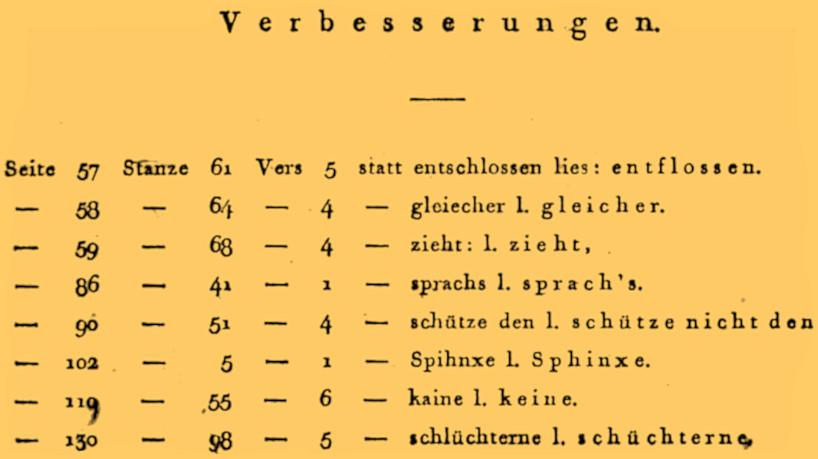
Gries’s translation of Torquato Tasso, Befreites Jerusalem, 4 vols. (Jena: Frommann,1800–1803) established him as a translator equal to Wilhelm himself. Back.
[3] Gries was invariably, chronically, and touchingly homesick for Jena whenever he left. Here the marketplace in Jena essentially as Gries and Caroline experienced it (Rathaus at left; Gustav Heinrich Schneider, Die Burschenschaft Germania zu Jena [Jena 1897], 87):

[4] Concerning Fichte’s atheism dispute and dismissal on 29 March 1799, see supplementary appendix 215a.1; also Friedrich’s letter to Caroline in late April 1799 (letter 236). Concerning what Friedrich anticipated might be the result of this dismissal, see his letter to Wilhelm in April 1799, cited in Dorothea Veit’s letter to Caroline on 20 April 1799 (letter 234), note 2.
Concerning the general disposition of Göttingen as a university town at the time, see Moritz Schlegel’s letter to Wilhelm from Göttingen back on 1 April 1797 (letter 181b). Back.
[5] Concerning these petitions, see Steffens’s own account in supplementary appendix 215a.1. See the editorial note to supplementary appendix 215a.1 for translation sources for these and the documents mentioned subsequently here. Back.
[6] J. G. Fichtes des phil. Doktors und ordentlichen Professors zu Jena Appellation an das Publikum über die durch ein kurf. sächs. Konfiskationsreskript ihm beigemessenen atheistischen Äusserungen (Jena, Leipzig, Tübingen 1799). Back.
[7] Der Herausgeber des philosophischen Journals gerichtliche Verantwortungsschriften gegen die Anklage des Atheismus, ed. J. G. Fichte (Jena 1799). Back.
[8] Fichte remained in Jena until the end of June, then traveled to Berlin, where he arrived in 3 July 1799 (Rudolf Koch and Fritz Kredel, Deutschland und angrenzende Gebiete [Leipzig 1937]):

[9] The War of the Second Coalition; see Friedrich’s letter to Caroline in late April 1799 (letter 236), note 7. Back.
[10] Friedrich Heinrich Jacobi’s letter to Fichte in Jena from Eutin on 3 March 1799, sent privately and then published during the autumn of 1799 in Hamburg after being circulated in manuscript form. Eutin is located in Holstein just north of Lübeck and northeast of Hamburg (Post Karte Durch ganz Deutschland, ed. J. Walch [Augsburg 1795]):

Caroline secured a copy for Gries; see her letter to him on 9 June 1799 (letter 240) with her sensitive assessment of the letter. The letter was translated into English by Diana I. Behler as “Open Letter to Fichte,” in Philosophy of German Idealism, ed. Ernst Behler (New York 1987), 119–41; also Friedrich Heinrich Jacobi, The Main Philosophical Writings and the Novel Allwill, trans. George di Giovanni (Montréal, Buffalo 1994), 497–536. Back.
[11] Fr., “beneath the cards,” here: “behind the scenes.” Back.
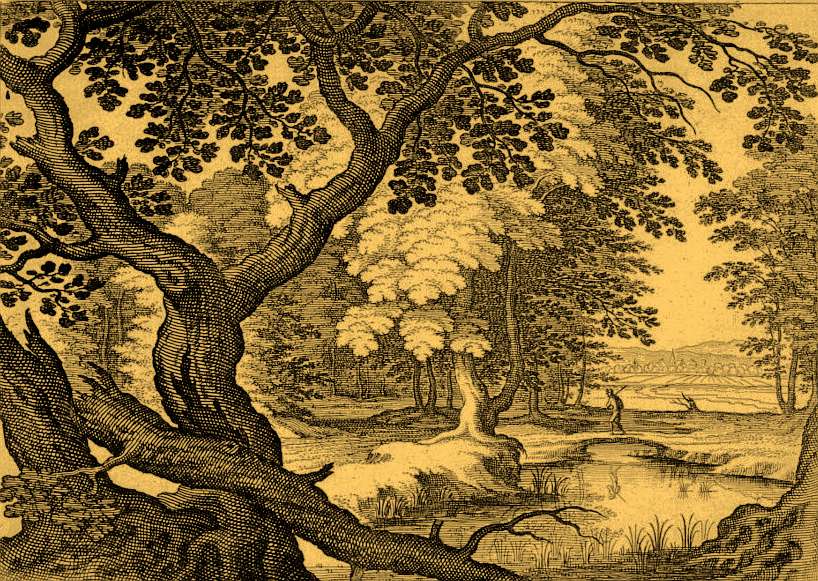
[12] Gries’s lengthy poem “Der Wandrer,” published later in his Gedichte und Poetische Übersetzungen, vol. 1 (Stuttgart 1829), 40–61, whose initial stanza begins (representative illustration: Matthäus Merian, Waldweiher mit gebrochenem Baumstamm [1622]; Herzog Anton Ulrich-Museum; Museums./Signatur MMerian AB 3.286):
Midday approaches; quickly from cloudless heights
Do piercing rays of sun plunge straight downward.
With quiet entreaty does the wanderer gaze,
Somewhere, anywhere to espy an arbor, a spring,
His discomfort to address,
When from the distant valley, in shimmering light,
A thick grove on gentle slope does emerge.
He beholds it with delight, and hastens his weary tread.
[13] Although Körner, (1930), 2:37, maintains that none of the four issues of Wilhelm Gottlieb Becker’s Erholungen (1799) contains anything by Gries, with six “Sonette nach Petrarch. Von Gries” appearing then in Erholungen 2 (1800) 171–77, Birgit Gottschalk, “Romantische Lebensläufe,” Romantik-Handbuch, ed. Helmut Schanze, 2nd ed. (Stuttgart 2003), 670, suggests that Gries did indeed publish in the Erholungen “1799 and 1800,” though she does not adduce specific titles. Back.
[14] Becker’s Taschenbuch zum geselligen Vergnügen (1791–1833); Birgit Gottschalk, “Romantische Lebensläufe,” 670, similarly suggests that Gries published material in this Taschenbuch for the years “1799f., 1802, 1806f.,” albeit again without adducing titles. Back.
[15] See Caroline’s letter to Luise Gotter on 24 April 1799 (letter 235) for her assessment of the performance of Schiller’s play Wallenstein’s Tod (the final part of the Wallenstein trilogy) in Weimar on 20 April 1799. Back.
[16] Wallenstein’s murder occurs in act 5, scene 7, but offstage; hence the death of the Wallenstein’s groom is seen, but not that of Wallenstein himself (The Death of Wallenstein, in Schiller’s Works, vol. 2, trans. J. G. Fischer [Philadelphia 1883]; illustration on 249):
Act 5, scene 7
Gordon (throwing himself between him and them [the assassins]. No, monster!
First over my dead body thou shalt tread.
I will not live to see the accursed deed!Butler (forcing him out of the way). Weak-hearted dotard!
[Trumpets are heard in the distance.]
Devereux and Macdonald. Hark! The Swedish trumpets!
The Swedes before the ramparts! Let us hasten!Gordon (rushes out). O, God of mercy!
Butler (calling after him). Governor, to your post!
Groom (hurries in). Who dares make larum here? Hush! The Duke sleeps.
Devereux (with loud harsh voice). Friend, it is time now to make larum.
Groom. Help! Murder!
Butler. Down with him!
Groom (run through the body by Devereux, falls at the entrance of the gallery). Jesus Maria!
Butler. Burst the doors open.
[They rush over the body into the gallery — two doors are heard to crash one after the other. — Voices, deadened by the distance — clash of arms — then all at once a profound silence.]
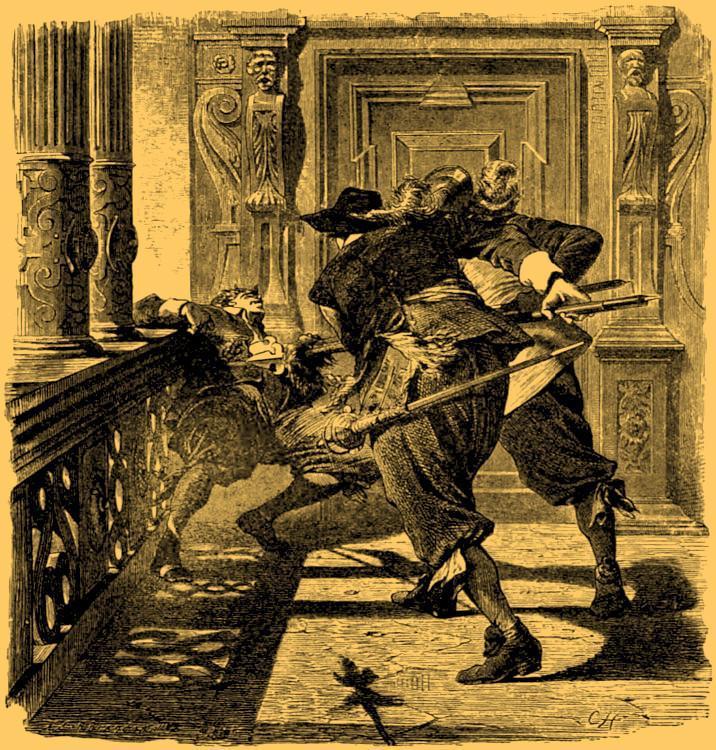
Here Daniel Nikolaus Chodowiecki’s portrayal of Wallenstein’s death (Wallensteins Tod [1799]; Herzog Anton Ulrich-Museum; Museums./Signatur DChodowiecki AB 3.1025):
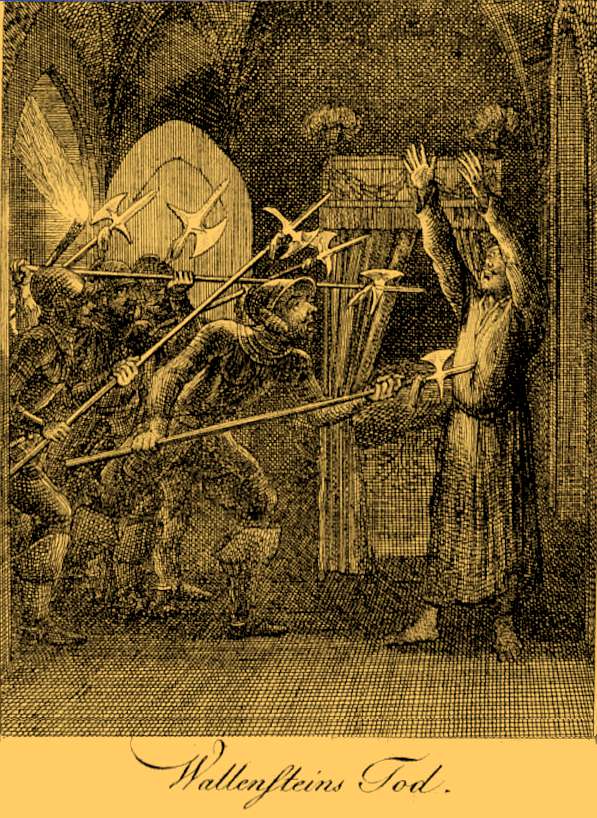
[17] In act 5, scene 11 (trans. The Death of Wallenstein [Philadelphia 1883]), “Wallenstein’s dead body is carried over the back part of the stage, wrapped in a piece of crimson tapestry.” Back.
[18] In act 4, scene 10, Thekla — Max Piccolomini’s love interest — receives the Swedish captain who has brought news of Max Piccolomini’s death in battle; Caroline Jagemann performed the role of Thekla in the premiere. For the text of this scene, see supplementary appendix 236c.1. Back.
[19] The first and only volume of Friedrich’s novel appeared in May 1799. Back.
[20] The fourth volume of Wilhelm and Caroline’s edition of Shakespeare, containing The Merchant of Venice and As You Like It, appeared at the Easter book fair 1799. Back.
[21] The reference is to Wilhelm’s review of Ludwig Tieck’s recent translation; see Wilhelm’s letter to Friedrich Justin Bertuch on 12 April 1799 (letter 230b) with note 1. Back.
[22] Goethe was trying to compose an “Achilleid” during the spring of 1799; he may have mentioned as much to Wilhelm during his stay in Jena between 21 March and 1 April, or between 1 and 27 May 1799; he met with Wilhelm on 28 and 29 March 1799 in Jena (Weimarer Ausgabe 3:2:238–40, 244–51; illustration: title vignette to Christian Friedrich Sintenis, Flemmings Geschichte: Ein Denkmal des Glaubens an Gott und Unsterblichkeit, vol. 1 [Leipzig 1789]):

[23] See Friedrich’s letter to Caroline in February 1799 (letter 224) with note 7 and its cross reference to letter 222a. Friederike Unzelmann did not appear in Weimar until the autumn of 1801, when her performances were attended by Caroline, Wilhelm, Luise Wiedemann, Luise Gotter, and the latter’s daughters, Julie, Cäcilie, and Pauline. Concerning the sequence of events that brought about the Weimar performances, see esp. Wilhelm Schlegel’s letter to Goethe on 14 August 1801 (letter 327c). Back.
[24] Josef Körner was unable to decipher the name of the host of the dinner on the Driesnitz outside Jena, perhaps “Stakelberg.” The reference is presumably the same Count von Stackelberg or Stachelberg whom Henrik Steffens mentions in connection with his own initial meeting with Goethe (Was ich erlebte 2:95–96) and who is similarly attested in Goethe’s diaries as being present in Jena during February 1799 with his wife (Weimarer Ausgabe 15/1 [index–S]). See Caroline’s letter to Friedrich von Hardenberg on 4 February 1799 (letter 219), note 10. Back.
[25] The reference is to the murder of French emissaries following the dissolution of the second Rastatt Congress ca. 75 km east of Stuttgart ([1] Map of the Empire of Germany including all the states comprehended under that name with the Kingdom of Prussia, &c. [London 1782]; [2] and [3] Revolutions-Almanach von 1800; Inhaltsverzeichnis deutscher Almanache, Theodor Springmann Stiftung):
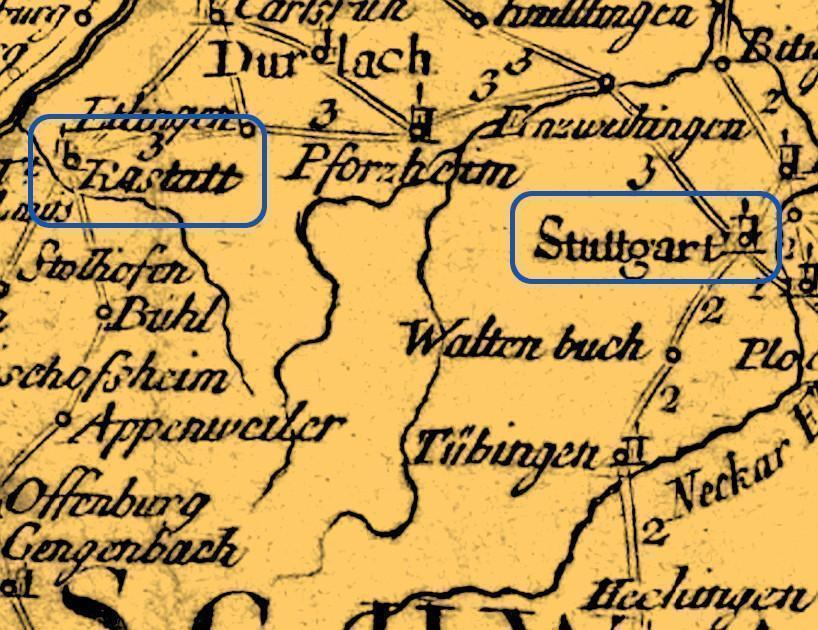
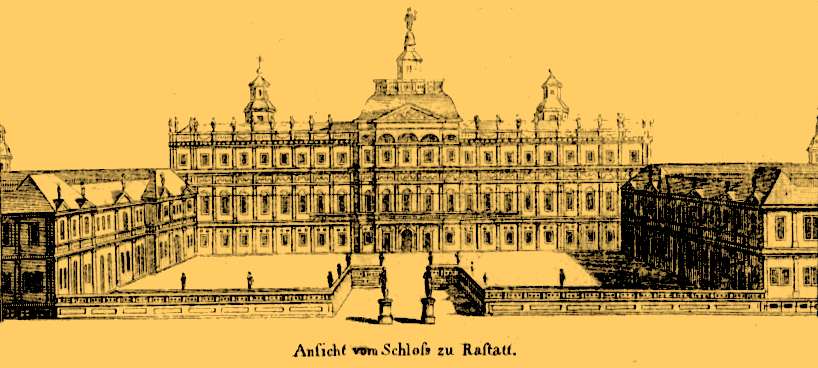
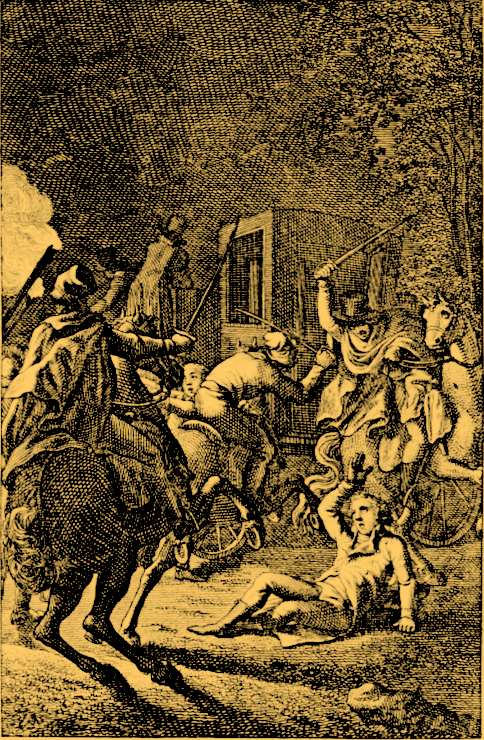
See Encyclopedia Brittannica (1911) s.v. Rastatt:
The second congress [of Rastatt, the first having opened in November 1713 for the purpose of ending the War of Spanish Succession], which was opened in December 1797, was intended to rearrange the map of Germany by providing compensation for those princes whose lands on the left bank of the Rhine had been seized by France. It had no result, however, as it was ended by the outbreak of the European war, but it had a sequel of some interest. As the three French representatives were leaving the town in April 1799 they were waylaid, and two of them were assassinated by some Hungarian soldiers (anonymous, Assassinat des plénipotentiaires français à Rastadt):
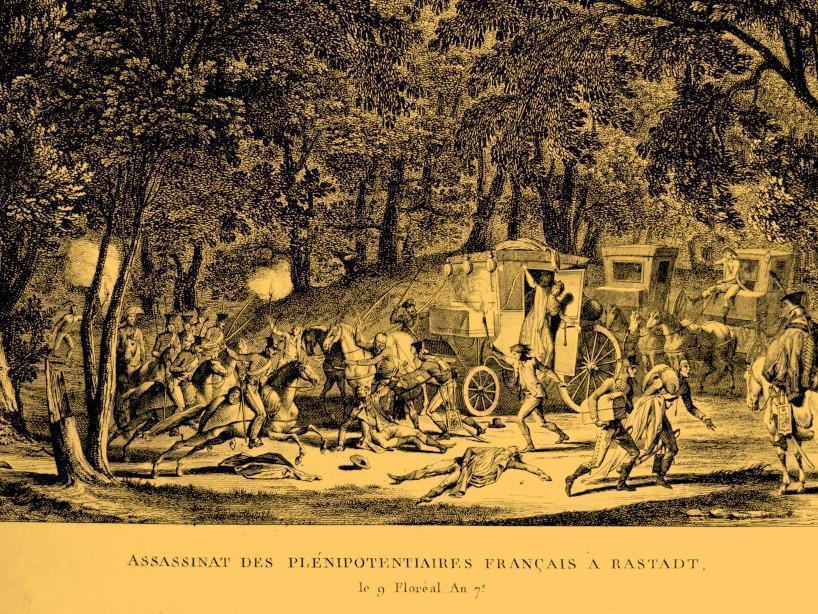
The origin of this outrage remains shrouded in mystery, but the balance of evidence seems to show that the Austrian authorities had commanded their men to seize the papers of the French plenipotentiaries in order to avoid damaging disclosures about Austria’s designs on Bavaria, and that the soldiers had exceeded their instructions. On the other hand, some authorities think that the deed was the work of French emigrants, or of the party in France in favour of war.
Here one of the illustrations included in the report Gemeinschaftliche Erklärung mehrerer ansehnlichen Gesandtschaften zu Rastadt über die Ermordung der französischen Gesandten und die übrigen dabey vorkommenden Umstände. Nebst einen Kupfer und Beilagen (n.p. 1799), folded frontispiece:
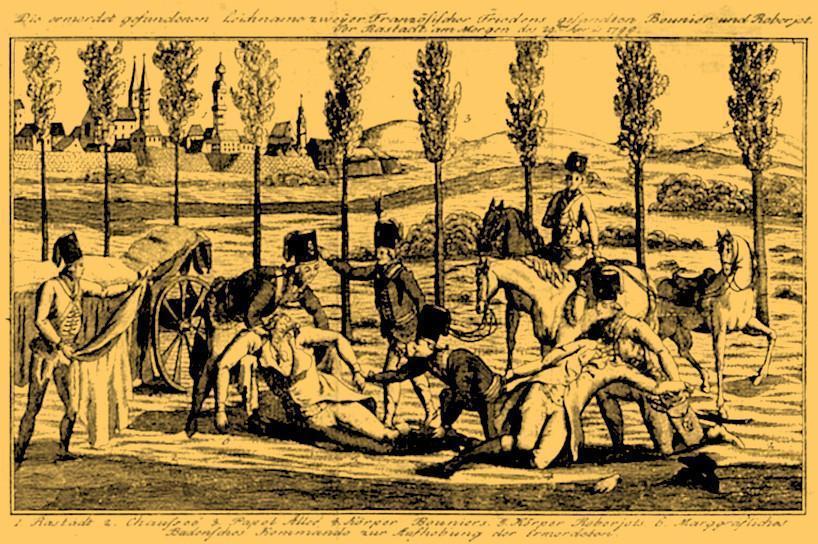
The sequence of events seems to have been approximately the following:
Four French diplomats — Bonnier d’Arco, Jean Débry, Claude Roberjot, and Heinrich Karl Rosenstiel — were charged with using diplomatic immunity at the congress to gather intelligence on troop movements and other information. On 10 March 1799, Archduke Charles ordered all French diplomats to leave Germany. On 17 April 1799 Austrian officers were ordered to seal off Rastatt, check all French couriers and diplomats, and seize their papers. Although most diplomats left Rastatt after the last meeting on 22 April, the French did not, notwithstanding their security was no longer guaranteed. Rastatt was indeed sealed off on 28 April and the French ordered to leave within twenty-four hours, which they did that evening.
Bonnier and Roberjot, however, were murdered shortly after leaving Rastatt under mysterious circumstances, whereas Debry and Rosenstiel were able to flee to the quarters of the Prussian emissary. Although an investigation was conducted beginning on 1 May at the behest of Archduke Charles, lasting six months, the results of that investigation seem to have disappeared. Several soldiers were arrested but then released even though they admitted to having participated in the events. Although further charges were filed, nothing came of them. The murders effectively ended the peace negotiations between Austria and France.
These events are mentioned again in Caroline’s letter to Luise Gotter on 6 June1799 and Johann Diederich Gries on 9 June 1799 (letters 239, 240). Back.
[26] Hamlet, act 4, scene 5 (Wilhelm is here referring to the pagination in volume 3 of his edition of Shakespeare); Laertes confronts the king, thinking he was responsible for the death of his father, Polonius, and not yet knowing it was in fact Hamlet (text Shakespeare, Complete Works, ed. W. J. Craig [London 1966]):
King. Tell me, Laertes,
Why thou art thus incens’d. Let him go, Gertude.
Speak man.
Laertes. Where is my father?
King. Dead.
Queen. But not by him.
King. Let him demand his fill.
Laertes. How came he dead? I’ll not be juggled with.
To hell, allegiance! vows, to the blackest devil!
Conscience and grace, to the profoundest pit!
I dare damnation. To this point I stand,
That both the worlds I give to negligence,
Let come what comes; only I’ll be reveng’d
Most thoroughly for my father. Back.
[27] See Caroline’s letter to Luise Gotter of June 1799 (letter 239) concerning those now taking their meals in their house at Leutragasse 5. Back.
[28] Concerning Steffens’ stay in Berlin, see Friedrich’s letter to Caroline and Wilhelm Schlegel from Berlin in May 1799 (letter 237). Back.
[29] Friedrich von Hardenberg arrived in Jena on 17 July 1799 and stayed two weeks. Back.
[30] The eleventh canto of Orlando furioso published in Athenaeum (1799) 247–84 (Sämmtliche Werke 4:93–130); Wilhelm sent a copy to Goethe in mid-May along with two copies of the fourth volume of his edition of Shakespeare, one for Karl August and one for Christian Gottlob Voigt (Körner-Wieneke 86).
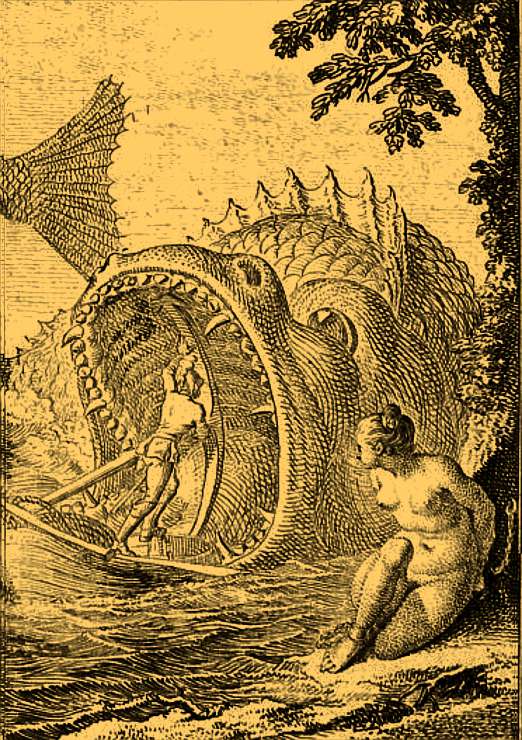
Sample translation of stanzas 33 and 37–39 from canto 11 (Athenaeum [1799] 260, 261–62) from Ariosto’s Orlando Furioso, trans. W. S. Rose, vol. 1 (London 1872), 183, 184; illustration by Daniel Nikolaus Chodowiecki, Rolands Kampf mit dem Seeungeheuer (1772); Herzog Anton Ulrich-Museum; Museums./Signatur DChodowiecki AB 3.64; for the Almanac genealogique pour l´année 1772 à Berlin:
Approaching to the naked rock as near
As vigorous hand might serve to cast a stone,
He knew not if he heard, or did not hear
A cry, so faint and feeble was the moan.
When, turning to the left, the cavalier,
His level sight along the water thrown,
Naked as born, bound to a stump, espied
A dame, whose feet were wetted by the tide.

. . .

As soon as him the monster has descried,
And skiff at little interval, his throat
The fish, to swallow him, expands so wide,
That horse and horseman through his jaws might float.
Here Roland with the anchor, and beside
(Unless I am mistaken) with the boat
Plunged, and engulphed the parted teeth betwixt,
His anchor in the tongue and palate fixt;

So that the monster could no longer drop
Or raise his horrid jaws, which this extends.
"Tis thus who digs the mine is wont to prop
The ground, and where he works the roof suspends,
Lest sudden ruin whelm him from atop,
While he incautiously his task intends.
Roland (so far apart was either hook)
But by a leap could reach the highest crook.

The prop so placed, Orlando now secure
That the fell beast his mouth no more can close,
Unsheathes his sword, and, in that cave obscure,
Deals here and there, now thrusts, now trenchant blows.
As well, as citadel, whose walls immure
The assailants, can defend her from her foes,
The monster, harassed by the war within,
Defends himself against the Paladin.
[31] Caroline would write a long letter to Gries on 9 June 1799 (letter 240). Back.
[32] Latin, “in the words, remarks.” Unclear allusion; while in Göttingen, Gries did attend Heyne’s lectures on archaeology for a time. Back.
Translation © 2013 Doug Stott