
230b. Wilhelm Schlegel to Friedrich Justin Bertuch in Weimar: Jena, 12 April 1799 [*]
Jena, 12 April [17]99
Might I take the liberty, my esteemed Herr Legationsrath, of burdening you with a request? Although for a quite specific purpose I would very much like to renew and expand my acquaintance with Spanish literature, I have access to almost none of the requisite books here. I would be extraordinarily obliged to you could you help me with some books from your excellent library. For now I would like to reread the works of Cervantes, especially Persiles, the Novelas exemplares, Galatea, and also Don Quixote. [1] If you happen to possess these volumes and might be willing to loan them to me for a time, I would treat them with extreme care.
Please be so kind as to pass on my kindest regards to Madam Bertuch and Mademoiselle Charlotte, to whom I also respectfully remain
your devoted
A. W. Schlegel
Notes
[*] Source: Körner (1930) 88. Back.
[1] In order: Persiles y Sigismunda (1617); Novelas ejemplares (1613); La Galatea (1585); Don Quixote, 2 vols. (1605, 1615). see Friedrich Schlegel’s remarks (with illustrations) concerning Cervantes in the “Notizen” in Athenaeum (1799) 324–27.
Wilhelm needed these books as background material for his review of M. de Cervantes Saavedra, Leben und Thaten des scharfsinnigen Edlen Don Quixote von la Mancha, vol. 1, translated by Ludwig Tieck (Berlin: Unger 1799) (eventually 4 vols. [1799–1801]) in the Allgemeine Literatur-Zeitung (1799) 230 (Saturday, 20 July 1799) 177–83 (Sämmtliche Werke 11:408–26).
Concerning Wilhelm’s use of these materials in his coming anthology Blumensträusse italiänischer, spanischer und portugiesischer Poesie (Berlin 1804) and his later Berlin lectures, see also Caroline’s letter to Wilhelm on 17 May 1802 (letter 358), note 4.
Significantly, this was the last review Wilhelm published in the Allgemeine Literatur-Zeitung, his vitriolic break with which is documented here in letters and other materials on into late 1799; that is, nothing else by Wilhelm appeared in the journal after late July 1799. This break resulted in the elimination of a not insignificant source of Wilhelm’s income (later attempts to found another literary periodical — also documented here — were unsuccessful) and, along with Schelling’s contemporaneous and even more vitriolic break with the Allgemeine Literatur-Zeitung (also documented), contributed to the dissolution of the Romantic circle in Jena.
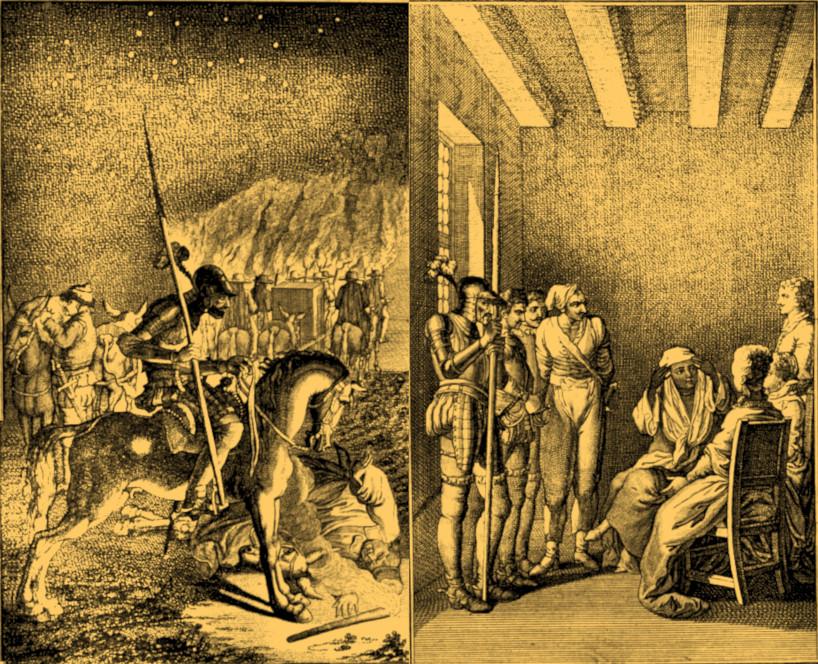
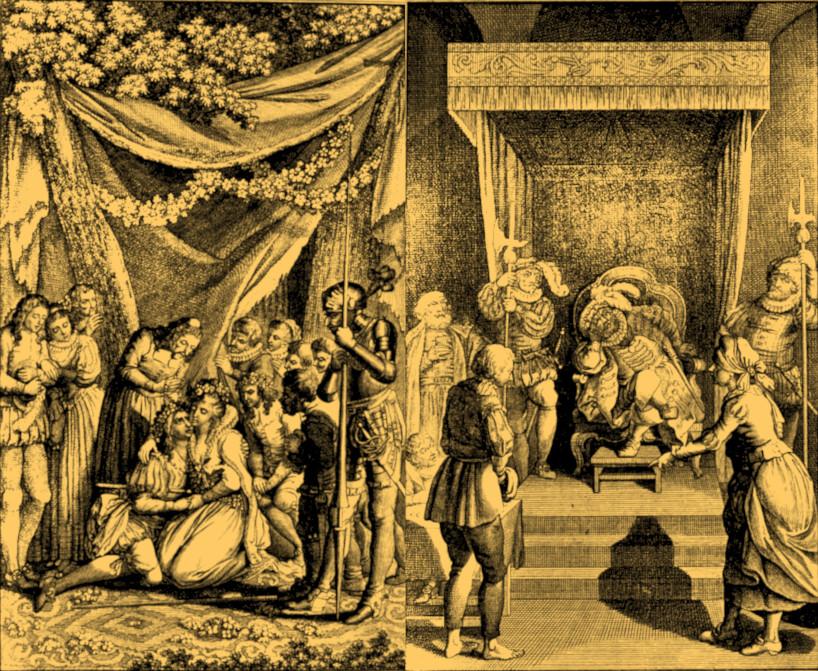
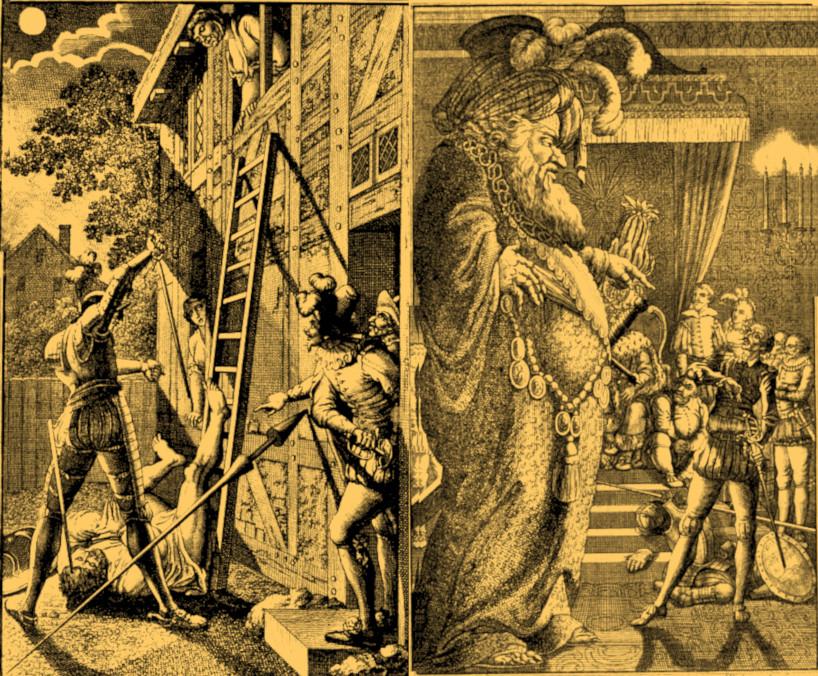
In any event, Bertuch responded the next day, on 13 April 1799 (Körner [1930], 89), saying that “my small Spanish library is always entirely at your disposal.” Bertuch himself had translated Don Quixote as Leben und Thaten des weisen Junkers Don Quixote von Mancha. Neue Ausgabe, aus der Urschrifft des Cervantes, nebst der Fortsetzung des Avellaneda, 6 vols. (Weimar, Leipzig 1775–77) Here the six frontispieces to the edition Vienna 1798:
Translation © 2013 Doug Stott