
• 224b (was 229). Friedrich Schlegel to Caroline in Jena: Berlin, early March 1799 [*]
[Berlin, early March 1799]
Quell n o b i l alma
Che giammai curó rime ne versi. [1]
|524| Only do not imagine that my obedience is anything other than obedience, romantic obedience. — I ask absolutely nothing about people because I am writing the book out of religion, just like every other one; and if they make things too crazy for me this time, then I will also immediately write my bible, and then, I can assure you, there will be no more talk of Lucinde.
If Wilhelm is intent on evaluating Lucinde as a novel or as a non-novel, one condition I probably ought to impose is that he has read Cervantes, and not just Don Quixote alone, which belongs more to the sphere for which I, for good reasons, have chosen the name novella; but rather also the novelas, and even more so Persiles, and most of all Galatea. [2] (Lucinde is not to be more witty than the latter — the whole exhibits a witty form and construction. For the kind of concrete wit Wilhelm seems to be expecting, let me direct him to the novellas. Here that would militate against my |525| whole intention and ruin the tone as much as would strewing various lieder about in it. The passage about wit against which Wilhelm is so opposed is the same passage Tieck praises most highly in the entire book.) [3]
I would similarly be disinclined to discuss novels with a woman who, as I am notoriously aware, loathes all English novels or, as I would prefer, has read none of them in the first place. — I am not postulating Cervantes as I would with regard to every other man, since I do believe that all of you, each and every one, has one novel inside you that is a bit more genuine than those four genuine ones and encompasses them all.
Ever since the gospel of your arrival has been proclaimed, Iffland has been applying himself quite properly to the fine arts. He is scanning in the Piccolomini, [4] sends his regards to me from the most distant ends of the earth, is once again performing Hamlet “ideally” (i.e., in thought) [5] — in a word: is becoming quite elegant.
My Herr Brother is seven times nine times correct with regard to the critical writings. We laughed heartily at Humbold and Schiller. [6]
We would like to come as far as Potsdam to meet you; [7] you would then be able enjoy it as an advance appetizer in 1, 2 days. Perhaps Schleiermacher will still be there. [8] — I would probably also bring Mademoiselle Levi along. [9] She is extremely gloomy and is full of reproach because you are coming so late. She came up with the idea that she might arrange to take board with you for a time beginning with your arrival. This idea speaks highly for her, and since then I have had more respect for her. I simply fear she would excessively impair Fichte. [10]
Your charming child should always write to me when she is a bit crazy. I intend to do the same whenever I am reasonable; today is not such a day. Next Tuesday I intend to be such.
Henriette is now of age and can speak for herself. [11]
I am extremely glad Wilhelm was able to take care of himself with respect to the money. |526| I must reproach myself with regard to the 5 louis d’ors, namely, that partly because of my illness and partly because of simple neglect you are receiving them so late. I hope you will receive them with this very letter or a few days later.
Mademoiselle Levi just told me that one can have three rooms and one chamber for 3 louis d’ors for one month in the house where Marianne lived, i.e., right in the middle of town and only a few steps from the theater. — She herself can, by the way, probably find the polite disguise in which to present such a suggestion to Madam Unger, since it genuinely would be inconvenient for the Ungers if she were to be staying in the garden apartment and you in her house in town.
Unfortunately the 5 louis d’ors will not be coming until the next postal day. The rascal Fröhlich has no money just now. I only took very little for Lucinde. [12]
Notes
[*] Was letter 229 but now redated from “March 1799” to “early March 1799” according to KFSA 24:239. Back.
[1] The superscription, incorrectly cited, comes from the eighth sestina in Petrarch’s Rime (Francesco Petrarca, Rime, ed. A. Marsand and G. Leopardi [Firenze 1886], 205):
Ma pria fia 'l verno la stagion de' fiori
Ch' amor fiorisca in quella nobil alma,
Che no curò giammai rime nè versi.
Translation from Francesco Petrarch, Canzoniere, trans. J. G. Nichols (New York 2002) 203:
But sooner shall the winter teem with flowers
than such love flourish in that noble soul
who never had a thought for rhyme or verse.
[2] See the prologue to Lucinde (Friedrich Schlegel’s Lucinde and the Fragments, trans. Peter Firchow [Minneapolis 1971], 42):
Petrarch smiles with emotion as he surveys and introduces the collection of his immortal romances. Subtle Boccaccio speaks politely and flatteringly to the ladies at the beginning and at the close of his opulent book. And even sublime Cervantes — still amiable and full of delicate wit, though old and wracked by pain — clothes the colorful spectacle of his vibrant works in the costly tapestry of a preface that is in itself already a beautiful romantic painting.
In the “Notizen” in Athenaeum (1799) 324–27, Friedrich discusses Cervantes as a romantic writer in connection with remarks on Ludwig Tieck’s translation of Don Quixote as Leben und Thaten des scharfsinnigen Edlen Don Quixote von la Mancha, 4 vols. (Unger: Berlin 1799–1801). There (327) he refers to the “charming and imaginative Galatea,” and in the “Gespräch über die Poesie,” Athenaeum (1800), here 80, to “Galatea, a wondrously grand composition of eternal music[,] imagination, and love, the most delicate and charming of all novels.”
Cervantes’s pastoral novel La Galatea was published in 1585, his adventure tale Persiles y Sigismunda posthumously in 1617. His collection of short stories, Novelas ejemplares, was published in 1613; Friedrich remarks in Athenaeum (1799), 326, that these stories are in no way to be considered inferior to any of Cervantes’s other works.
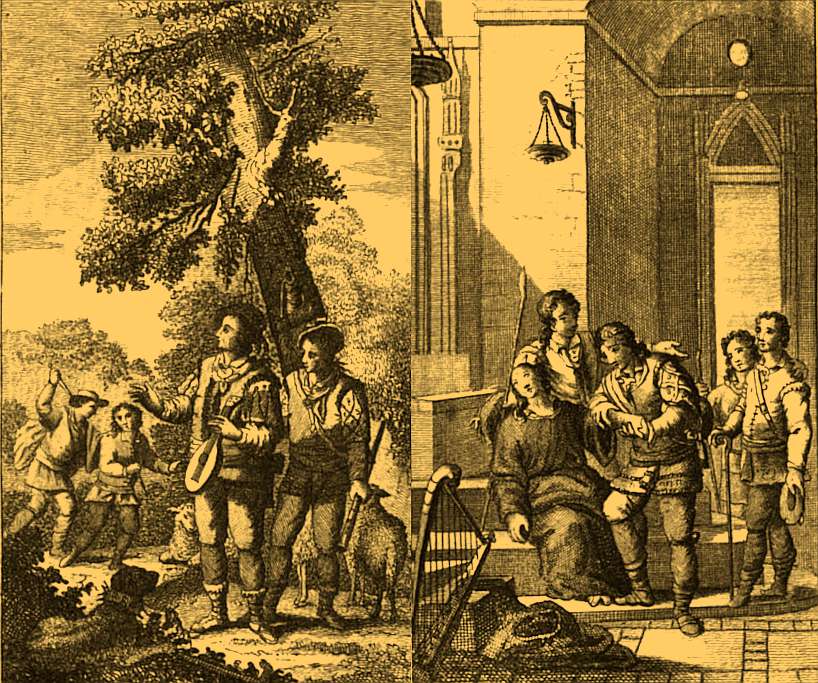
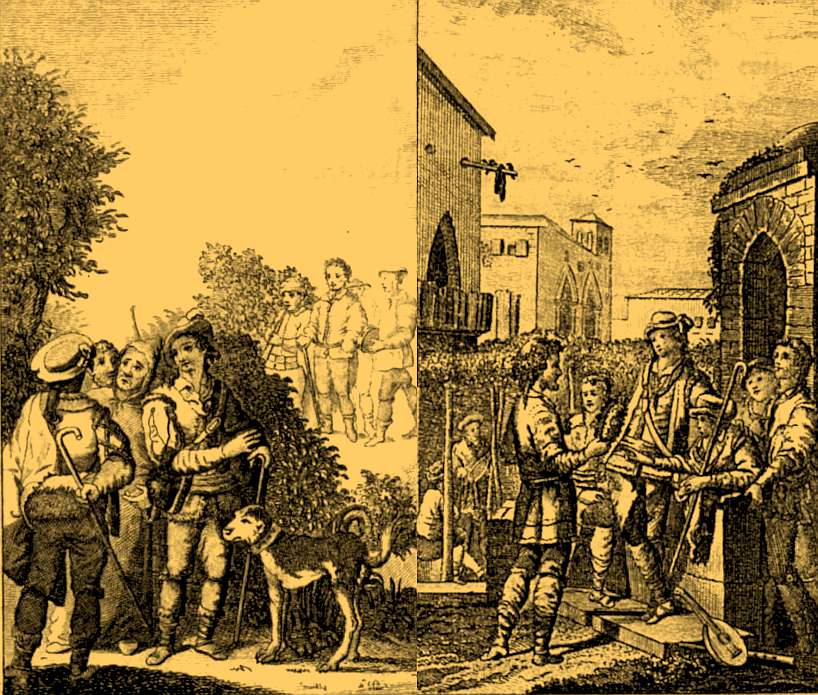
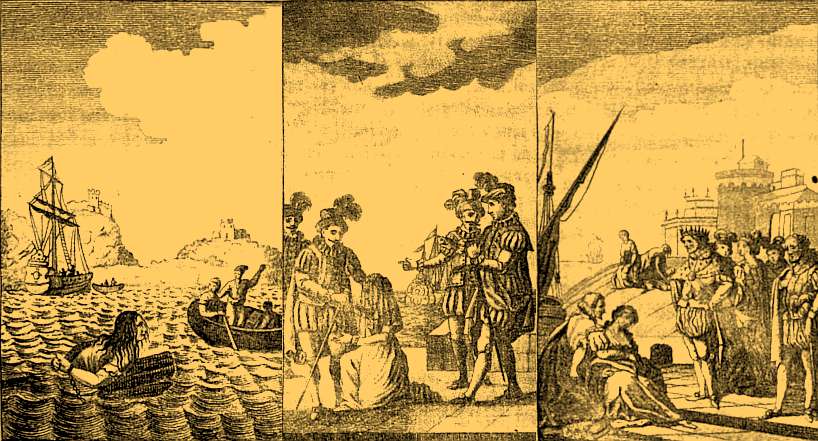
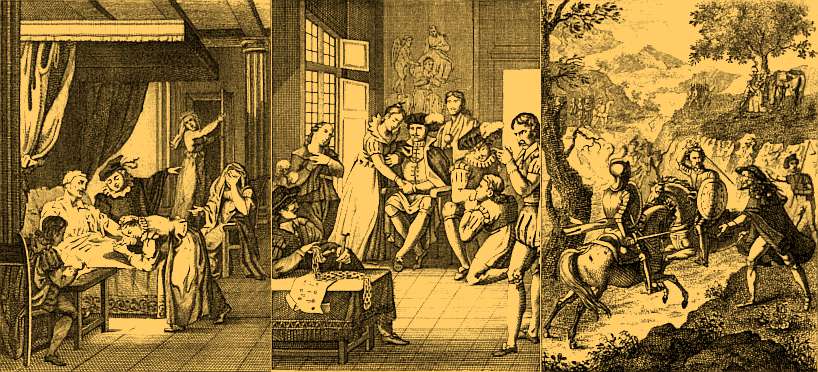
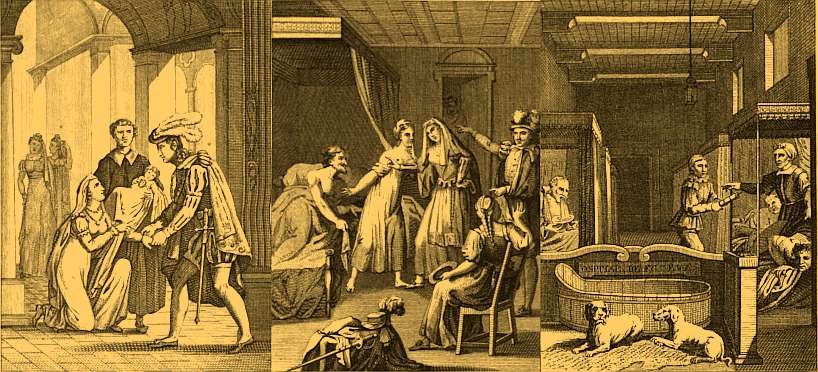
Here, from contemporary editions, are selected illustrations of “the colorful spectacle of his [Cervantes’s] vibrant works,” works which arguably inhabit a world quite different from Friedrich’s own and that in Lucinde.
4 illustrations from La Galatea, vols. 1 and 2 (Madrid 1805):
3 illustrations from Historia de los trabajos de Persiles y Sigismunda, vol. 1 (n.p. 1805):
6 illustrations from Novelas exemplares, vol. 2, new ed. (Madrid 1816):
[3] Wit is personified in Lucinde in the “Allegorie von der Frechheit,” translated as “Allegory of Impudence” in Friedrich Schlegel’s Lucinde and the Fragments, trans. Peter Firchow (Minneapolis 1971), 53–58, and is otherwise an important concept in Friedrich’s thinking, e.g., also in his “Gespräch über die Poesie,” in both issues of Athenaeum (1800) 58–128; 169–87 (see Dialogue on Poetry and Literary Aphorisms, trans. Ernst Behler and Roman Struc [University Park, Pa. 1968]). Back.
[4] Schiller’s play Die Piccolomini, the first part (after the prologue) of the trilogy of Wallenstein, had just premiered in Berlin on 18 February 1799. Wallensteins Tod would be performed on 17 May 1799, Wallensteins Lager not until 28 November 1803. Concerning the Berlin performance of the Piccolomini, see Wilhelm Schlegel’s letter to Goethe on 4 February 1799 (letter 219a), note 3.
Concerning the Piccolomini otherwise, see Caroline’s letter to Luise Gotter in early 1799 (letter 215) and esp. the second half of Auguste’s letter to Cäcilie Gotter on 18 February 1799 (letter 220). Back.
[5] Caroline and Wilhelm were planning a trip to Berlin in anticipation of the premiere of Hamlet in their translation; they did not make the journey. See Ella Horn’s essay on the background to the premiere of Hamlet in Berlin. Back.
[6] Uncertain allusion; the reference may be to a specific published edition of Kritische Schriften. Back.
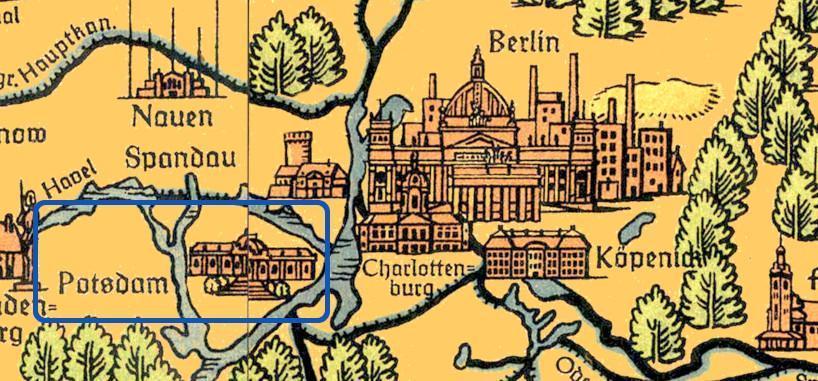
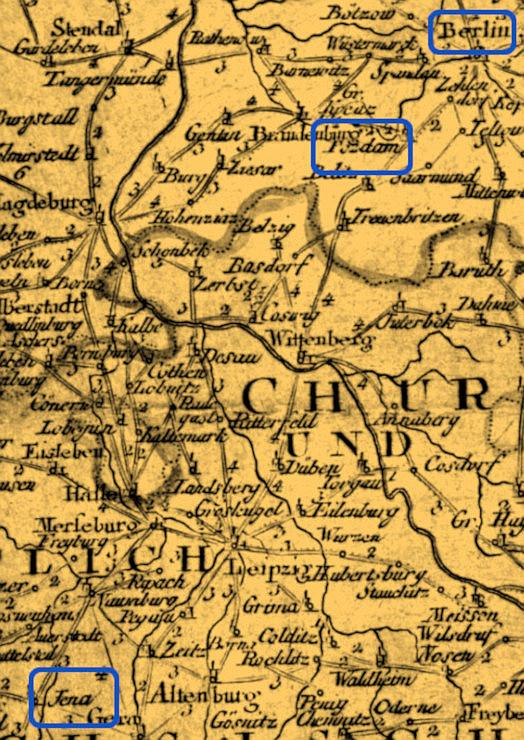
[7] That is, when Caroline and Wilhelm journey to Berlin; Potsdam is located ca. 25 km southwest of Berlin (Rudolf Koch and Fritz Kredel, Deutschland und angrenzende Gebiete [Leipzig 1937]; Post Karte Durch ganz Deutschland, ed. J. Walch [Augsburg 1795]; illustration: F. Meyer and Andreas Ludwig Krüger, Troisieme vue de la Ville de Potsdam [1772]; Herzog Anton Ulrich-Museum; Museums./Signatur ALKrüger AB 1.35):

[8] Schleiermacher was in Potsdam on business and tentatively planning to stay until Easter, which in 1799 fell on 24 March; see Friedrich’s letter to Caroline on 19 February 1799 (letter 221). Back.
[9] Concerning the journey and plans, see Friedrich to Schleiermacher on 1 March 1799 (not 1 January as in (1913), 1:738; see KFSA 24:441n6): “In that case [Potsdam], perhaps I would then bring Mademoiselle Levi along as well.” Back.
[10] Uncertain allusion; Fichte did not arrive in Berlin until early July, staying then until December and moving to Berlin permanently with his family in early 1800. Back.
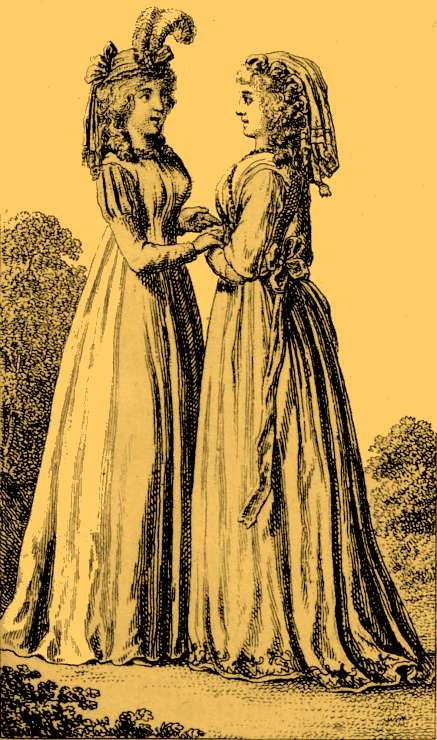
[11] Henriette Mendelssohn was twenty-three years old at the time Friedrich is here writing. Although regrettably no portraits of her seem to exist, her appearance presumably resembled the women in the following illustration from 1797 (Göttinger Taschen Calender Für das Iahr 1797; Inhaltsverzeichnis deutscher Almanache, Theodor Springmann Stiftung):
[12] Cf., however, KFSA 25:693, Beilage III, no. 1:
To date I have received on account from the bookseller Herr Heinrich Fröhlich the honorarium for Lucinde of 5 Ldrs, viz. five Friedrichsd’or. Berlin, 14 February 1799.
Friedrich Schlegel
Frölich equated Louisd’or and Friedrichsd’or; see the supplementary appendix on currencies. Back.
Translation © 2013 Doug Stott