
224a. Henriette Mendelssohn to Wilhelm Schlegel in Jena: Berlin, 2 March 1799 [*]
Berlin, 2 March 1799
Although you are amiable and kind enough to defend me against my own reproaches, I can nonetheless never forgive myself for having let several months pass without writing you. [1]
And by “you” I understand specifically your charming wife, whom I have not yet even thanked for her dear letter full of beautiful truths and affable cordiality, a letter I read ever anew with pleasure. [2] For although I do owe considerable gratitude to you yourself, my good friend, I do not at all owe you a letter. If in the meantime you can think of nothing that can excuse me with her for, first, writing this letter now and, second, for addressing it to you, then perhaps you might adduce my infinite timidity, which more than any other original sin tends to mislead me into all sorts of gaffes.
Please let me know quite specifically when you intend to be in Berlin. [3] Madam Veit believes it will yet be in March, in which case I would still have the great pleasure of seeing you here. I will not be departing for Leipzig until 7 April, which, however, seems much too good for me; [4] I kept thinking instead that we might depart — you from Jena — and I from here — at the same time, and then I would not even be able to visit you in Jena for a few days; what a witty bit of malicious chance that would be, albeit of the sort to which I am already accustomed. [5] —
Tell me something about your plans to come, and whether I can do anything to avoid missing you here.
What you presume about my journey to Vienna is not really a matter of certainty even for me myself; I am not anticipating anything pleasant there, and cannot think of any sort of happiness that might await me in my new vocation. In the meantime, however, your wife quite correctly assessed the reason that nonetheless prompted me to make this choice. It is a step that will enable me to test my own powers and will extract me from my accustomed dependence. I had to commence with something or other in order to expand the horizon of my future, or at least change the prospects. —
I am not, by the way, committed to anything, and if things go too badly, I will sing our song about the theater director. [6]
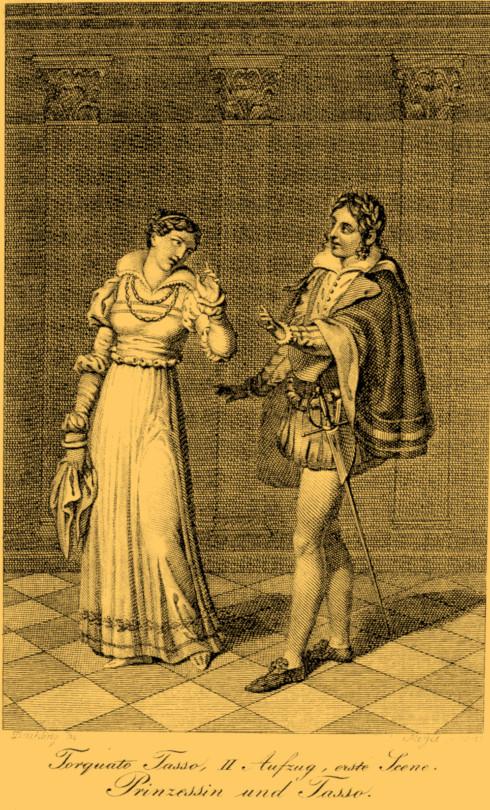
Ah, yes, Lucinde! Quite in confidence, let me tell you that our young scholar quite duped me. You should have seen how in preparation he read every possible English novel, all Fastler, [7] and, if I am not mistaken, even Clarissa and Pamela. [8] Did I now not have every right to expect a quite moral, chaste, and delicate little Lucinde? Hence after I began reading in all calmness, I had the same experience as the princess in Tasso:
It doth allure us still to listen to it:
We listen, and we think we understand,
We understand, and yet we censure not,
So with thy song, thou winnest us at last. [9]
What you said about being “spoiled,” of course, I related to Madam Veit, but she will know how to defend herself quite well indeed. [10] —
This evening Friedrich will read aloud your elegy to Madam Veit and me. She has already heard and read and studied it and prepared me for it quite solemnly. [11]
Well, that is all certainly in order. You compose a divine elegy for Goethe and I am just now occupied with a work for you, about which your brother says that in return you really ought to compose at least one elegy for me as well. He admittedly said it, however, before reading it.
— I am prepared quite to admire and love you this evening. —
I was unable to deliver your greetings to Mariane Meyer. She has cast off the common garb and traveled to Königsbrück as Princess Reus. [12] I will take care of your request to Mademoiselle Levi today. And now, take care, all of you, and let me earnestly entreat you to think of me often. A thousand regards to Auguste as well.
Henriette M.
I just received news from Vienna that I will have a convenient opportunity to travel there in 14 days. Now I am really confused.
Notes
[*] Source: Karl von Holtei, Dreihundert Briefe, 1:2:169–71. Back.
[1] The last extant letter from Henriette to Wilhelm seems to have been that of 18 December 1798 (letter 212c). Back.
[2] Unfortunately, Caroline’s letter to Henriette seems to have been lost (Königl. Großbrit. Genealogischer Kalender auf das 1786 Jahr; Inhaltsverzeichnis deutscher Almanache, Theodor Springmann Stiftung):

[3] The Schlegels were planning a trip to Berlin during the spring of 1799 anticipating the premiere of Hamlet in the Berlin theater in Wilhelm and Caroline’s translation; the trip did not happen. See Ella Horn’s essay on the background to the premiere of Hamlet in Berlin. Back.
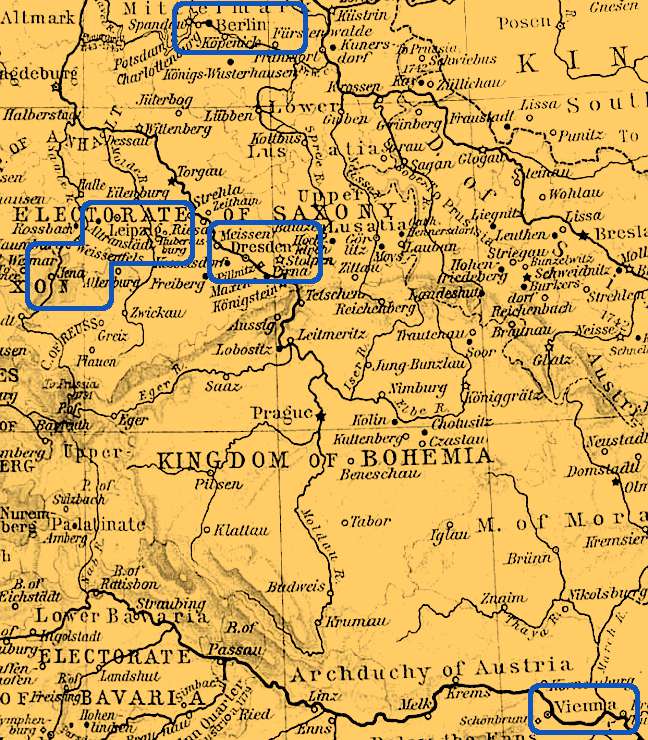
[4] Henriette would be traveling to Vienna by way of Leipzig and, possibly, Jena (W. R. Shepherd, Historical Map of Central Europe about 1786 [1926]):
Concerning her decision to try out her independence with a position as a governess in Vienna, see Friedrich’s letter to Caroline and Wilhelm Schlegel on 15 December 1798 (letter 212). Also earlier Caroline’s letter to Friedrich 14–15 October 1798 (letter 204) with note 30; and Friedrich’s letter to Caroline in mid-December 1798 (letter 211). Back.
[5] Henriette seems to have visited the Schlegels in Jena on but a single day, namely, 16 April 1799. Back.
[6] Uncertain allusion. Back.
[7] Uncertain reference; possibly an incorrect transcription by Karl von Holtei. Back.
[8] Samuel Richardson, Clarissa. Or the History of a Young Lady, 8 vols. (London 1748–49), and Pamela: or, Virtue rewarded: In a series of familiar letters from a beautiful young damsel, to her parents. Now first published in order to cultivate the principles of virtue and religion in the minds of the youth of both sexes (London 1741 [1740]).
That Friedrich read these novels in preparation for Lucinde comes as no surprise. See in this context the following brief remarks on Richardson’s three novels by Archibald T. Strong, A Short History of English Literature (Oxford 1921), 239–40:
His first novel, Pamela, or Virtue Rewarded, did not appear till 1740, when he was over fifty. His friends, the publishers Messrs. Rivington and Osborne, had desired him to write “a book of familiar letters on the useful concerns in common life,” and this he did with an aim at once moral and anti-romantic. He wished to turn young people away from “the pomp and parade of romance writing” into courses which “might promote the cause of religion and virtue.”
In this mood he bethought him of a story he had heard many years before of virtue tempted and persecuted, yet resisting and, in the end, winning the decent triumph of marriage. From these beginnings sprang Pamela, the tale of a girl left dependent on the libertine son of her dead mistress.
She continues to stay beneath his roof while he makes repeated but unsuccessful attempts upon her virtue, treating her with every circumstance of insolence and perfidy. Yet in the end the reader is expected to be greatly edified by finding that the heart of “Mr. B.” has been softened by her resistance, and that he offers her marriage, which she accepts with trembling gratitude. It is not too much to say with Sir Walter Raleigh, that in Pamela “the prudential doctrine appears in its earliest and most disgusting form.”
Yet the novel had an astonishing vogue throughout the country, for reasons by no means difficult to appreciate. The extraordinary subtlety and care which went to the description of Pamela and her sufferings, have still their hold on Richardson’s readers; and for all the novel’s length and ethical fustiness, it is impossible not to feel interested in its heroine and villain, in good Mrs. Jervis and odious Mrs. Jewkes, and in the well-meaning “college novice,” Mr. Williams. Far less interesting are the two volumes subsequently added by Richardson, which show Pamela married and still triumphant over temptation.
A far greater novel is Clarissa, or the History of a Young Lady (1747—48). Richardson’s moral earnestness, instead of being cheapened into prudentialism, is here heightened into tragedy. The book’s prime purpose is still ethical, and it aims at showing “the distresses that may attend the misconduct both of parents and children in relation to marriage.”
Lovelace entices Clarissa from her home, and pursues her with his love through the book’s first six lengthy volumes. In the end he has his will and overcomes her, though not her virtue. She languishes and dies, and he falls in a duel by the hand of her kinsman, Colonel Morden.
Such is the plot of this great novel, which was not only read by all England in its day, but had subsequently a profound effect upon European thought and feeling. Throughout its eight volumes the action is scanty, and apart from the central catastrophe, trivial. The same minuteness is shown in describing Lovelace’s tactics and Clarissa’s emotions of despair, religious faith and hope, and stifled love for her tormentor.
Yet, despite its length, Clarissa remains as readable to-day as when it moved [Thomas Babington] Macaulay to tears. Its appeal is due first and foremost to Richardson’s masterly touch on the feminine heart and soul, and to his poignant sense of the tragedy implicit in such a seduction as Clarissa’s. Lovelace, too, with his refinement, his great gifts, and his artistic reservations in villainy, remains, when criticism has done its worst upon him, a vastly interesting figure. The novel’s obvious defects are more than redeemed by the presence of a great idea, on the whole greatly carried out.
Still longer than Clarissa, but far less great, is Sir Charles Grandison (1753–54). Here the drawbacks of Richardson’s method, which is ultimately the sentimental, become very apparent. Sir Charles is the perfect man, and he knows it, and several women know it too, and worship him adoringly. In [George] Meredith’s hands he would have been matter for comedy, and might have been profitably put to the test which wrought such havoc on Sir Willoughby Patterne [in Meredith’s novel The Egoist (1879)]. Or he might have figured in tragedy, in which case his perfections, like Clarissa’s, would have become interesting.
Attended as they are by his own self-complacency and the admiration of all and sundry, they are little less than odious; and when he confers himself magnanimously on the grateful Harriet Byron, we wish to be shown him suing to Clara Middleton, or even to Laetitia Dale [characters in The Egoist]. Yet, repulsive as the hero is, he is drawn with much psychological power, as are also Clementina, Sir Hargrave Pollexfen, and the minors of the tale.
Click on the following image to open a gallery of Daniel Nikolaus Chodowiecki’s illustrations to the German and French translations by Ludwig Theobul Kosegarten, Clarissa. Neuverdeutscht und Ihro Majestät der Königin von Grosbrittanien zugeeignet, 8 vols. (Leipzig 1790–93) and M. Le Tourneur, Clarisse Harlowe, 14 vols. (Geneva, Paris 1785–87), a novel that functions almost as a locus classicus for the various “crises faced by pretty girls” when Caroline, her sisters, and her friends were young women:
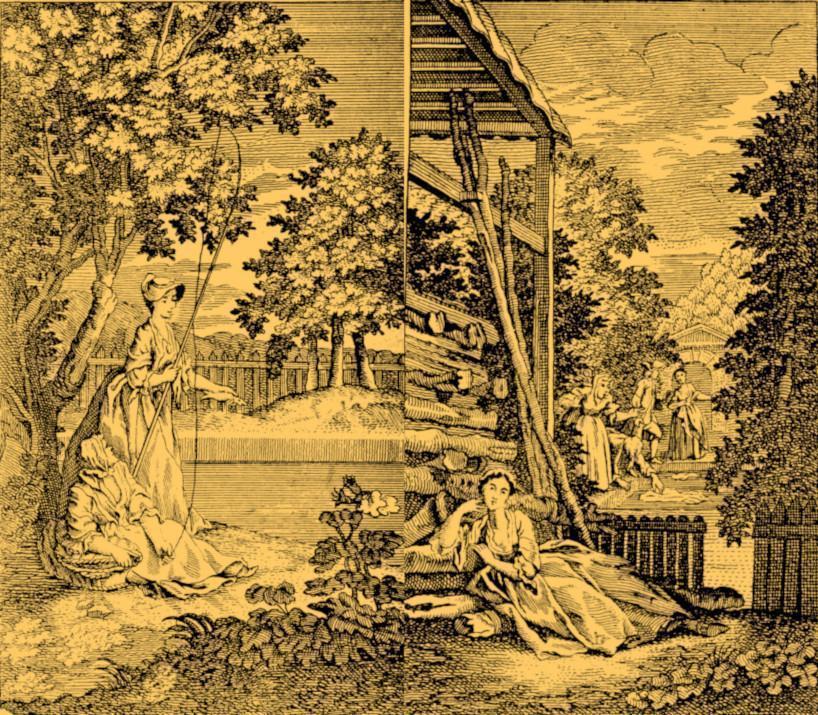
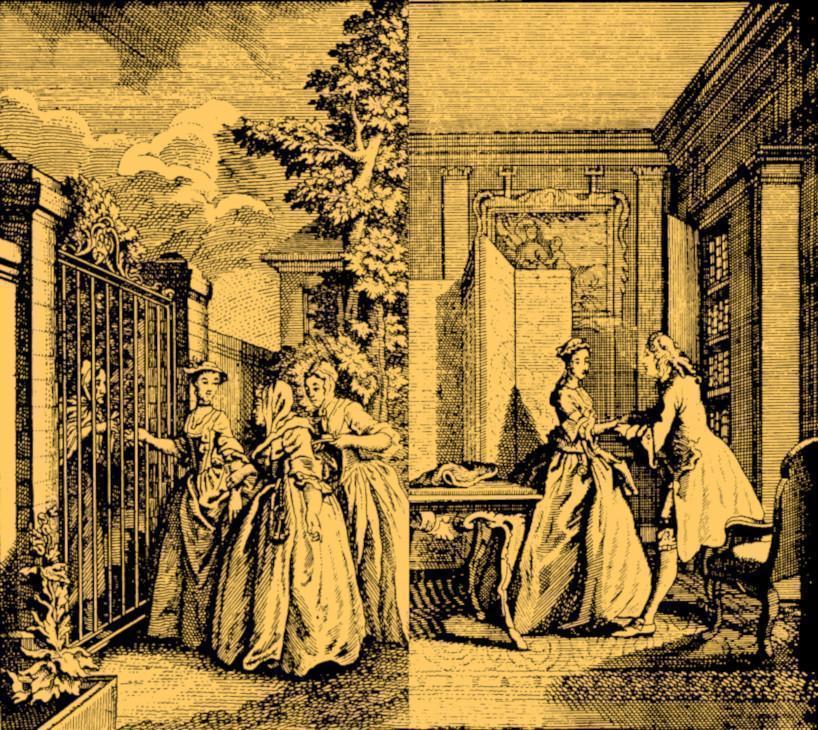
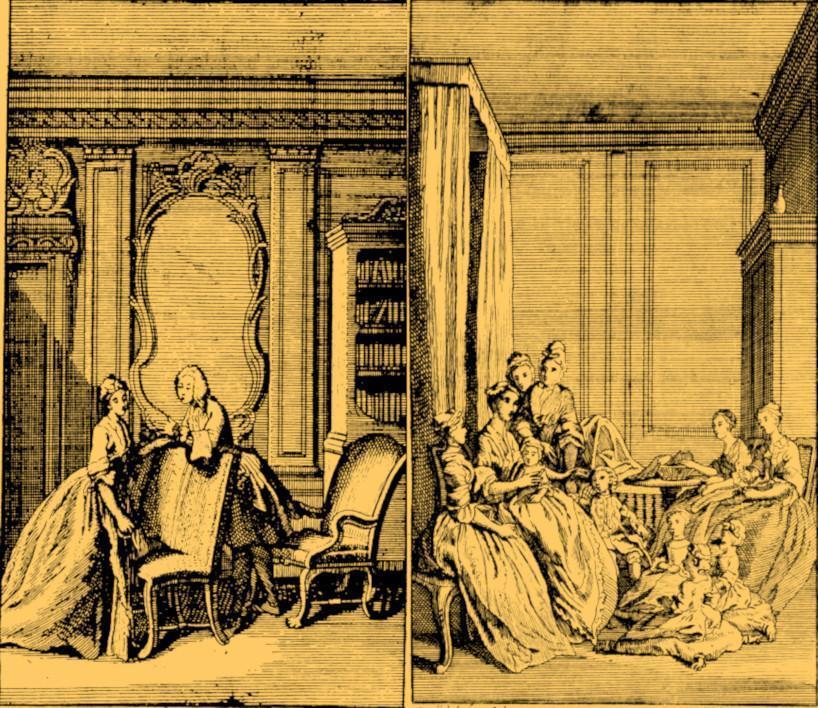
Here sample interior illustrations to the German translation of Pamela (Samuel Richardson, Pamela oder die belohnte Tugend, 4 vols. [Leipzig, Liegnitz 1772], plates following 1:226, 1:308, 1:396; 4:30, 4:246; 4:568):
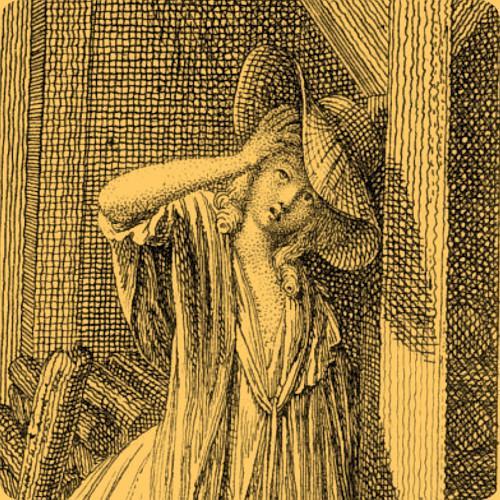
[9] Goethe, Torquato Tasso, in Goethe’s Schriften, vol. 6 (Leipzig 1790), 1–222, here act 2, scene 1. Translation from Torquato Tasso, trans. George Barrie, Goethe’s Works, vol. 3 (Philadelphia 1885), 120; here an illustration of the princess’s remarks (Daehling de. and Meyer sc. Ber., “Torquato Tasso, II. Aufzug, erste Scene / Prinzessin und Tasso,” Urania. Taschenbuch für Damen auf das Jahr 1815; copy: Stadtgeschichtliches Museum, Inv.Nr. Stoh 1200; GOS-Nr. mt007619):
[10] See Friedrich’s letter to Caroline in March 1799 (letter 225) and his remarks on Wilhelm’s insinuation that Lucinde was “merely a spoiled child of Dorothea alone.” Back.
[11] Wilhelm’s “Die Kunst der Griechen. An Goethe. Elegie,” which opens the second issue Athenaeum (1799) 181–92; see Caroline’s letter to Friedrich von Hardenberg on 4 February 1799 (letter 219), note 15 and the cross references (esp. to letter 216). Back.
[12] See Marianne Meyer’s biogram and also Friedrich Schlegel’s letter to Caroline on 19 February 1799 (letter 221). She was not allowed to continue to bear the title Princess von Reuss. Back.
Translation © 2013 Doug Stott