
• 224. Friedrich Schlegel to Caroline in Jena: Berlin, February 1799 [*]
[Berlin, February 1799]
|511| Well, here there is much to read! — I am sending you “Fidelity and Playfulness” [1] with even more remorse and pain than with the previous material. For Dorothea, Henriette, and Tieck find that it is neither my best work nor their favorite. — And yet I have already made many and numerous changes in it. — The next will be the “Apprenticeship for Manhood,” completely narrative, rather long and actually the novel itself. It is almost finished. [2]
That much about me. And now again my plea for Wilhelm’s elegy and your assessment! [3]
The business with the 3 rh., that is bad; [4] if the villain has a note, I probably will have to pay. I will perhaps send the money with the rest of the honorarium from Fröhlich. – The old lady did write you, and I will soon learn what is going on. [5] — That your coming should depend on such a toad! — I really could do nothing other than what I actually did. —
|512| We have now rented a good logis into which Dorothea will be moving in three or four weeks but to which we will probably have to commit for a year. — It is nice and certainly spacious enough, and if the old lady behaves badly, all of you should still come. You and Auguste would then stay with Madam Veit, Wilhelm with us so that space does not get too tight. Although you would admittedly be a bit farther from the theater, not so far that you could not get there and back easily on foot. Please do consider that seriously, and also how happy it would make us, and how you would then not have to put on cordial faces for bad people. This is only in case of an emergency! [5a]
The date of Henriette’s departure from here has not yet been set exactly, perhaps around 7 April. [6] I really would like to know soon when you are coming.
Madam Unzelmann thinks she will be back here on 30 April. [7] Iffland is again talking strongly about Hamlet. [8]
I have still not seen the Die Piccolomini, since on the evening of the second performance I was at Madam Unzelmann’s with Mademoiselle Levi, which really was more interesting to me; [9] but I have certainly heard more than enough about it. — The first time, the performance lasted till 10:30 p.m., which was too long, particularly since people were annoyed that they really did not get a proper ending for their money. So Iffland deleted parts of it, and at the 2nd performance the theater notice said it would be finished at nine o’clock.
Madam Unzelmann told me that Wilhelm had much more amiable eyes than I, and then she said something which, if literally true, speaks extremely well for her. For her benefit performance she definitely wanted to have Shakespeare’s Romeo in Wilhelm’s translation, and she spoke with great passion about the role. [10] |513| But Iffland is a weak individual and simply did not want to.
And now something for Wilhelm. . . . [11]
Now that I read this letter over again, it seems so dry to me. Let me entreat you, however, to make do with it for today.
Notes
[*] Also in KFSA 24:232–33. Back.
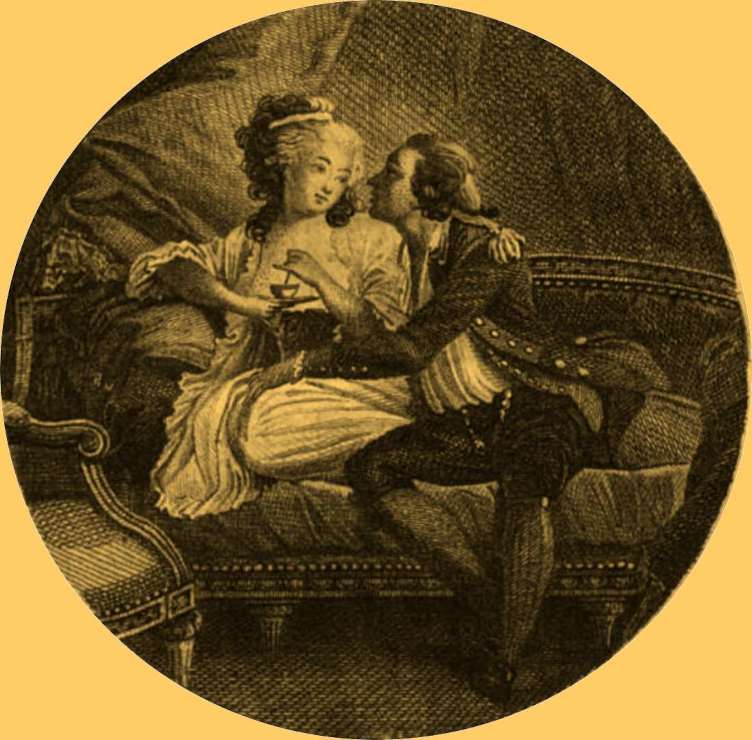
[1] An erotic dialogue toward the beginning of the novel Lucinde, completed on 15 February 1799; see Friedrich Schlegel’s Lucinde and the Fragments, trans. Peter Firchow (Minneapolis 1971), 68–76 (frontispiece to Restif de La Bretonne, Liebschaften der Freuden-Mädchen im Palais-Royal, vol. 1 [Strassburg 1791]):
[2] The chapter “Apprenticeship for Manhood” follows “Fidelity and Playfulness,” Friedrich Schlegel’s Lucinde and the Fragments, 77–105. Back.
[3] Concerning Wilhelm’s elegy, “Die Kunst der Griechen,” see Caroline’s letter to Hardenberg on 4 February 1799 (letter 219), note 15 and the cross references (esp. to letter 216). Back.
[4] Uncertain allusion that obviously involves Friedrich’s chronic debts. Back.
[5] Presumably Friederike Unger. At issue is the Schlegels’ lodgings during their anticipated journey to Berlin for the premiere of Hamlet in Wilhelm’s and Caroline’s translation. Back.
[5a] Concerning the location of Dorothea’s current apartment in Berlin, see Friedrich’s letter to Friedrich von Hardenberg on 17 December 1798 (letter 212b), note 2. Back.
[6] Henriette Mendelssohn had for some time been planning to stay with the Schlegels in Jena on her way to Vienna; concerning her decision to try out her independence, see Friedrich’s letter to Caroline and Wilhelm Schlegel on 15 December 1798 (letter 212). Also earlier Caroline’s letter to Friedrich 14–15 October 1798 (letter 204) with note 30. As it was, she seems to have spent only 16 April 1799 in Jena with the Schlegels. See also her letter to Wilhelm on 18 December 1798 (letter 212c). Back.
[7] Friederike Unzelmann would be giving six guest performances at the Royal Theater in Vienna in April 1799, including the role of Gurli in August von Kotzebue’s Die Indianer in England (Leipzig 1790) and that of Josefine in Kotzebue’s Armuth und Edelsinn. Ein Lustspiel in drey Aufzügen (Leipzig 1795) (Chronik des k. k. Hof-Burgtheaters zu dessen Säcular-Feier im Februar 1876, ed. Eduard Wlassack [Vienna 1876], 92–93) (illustrations depicting [1] the characters of Louise and Hinrich Plum, frontispiece to Armut und Edelsinn, in Schauspiele von August von Kotzebue, vol. 4 [Leipzig 1797]; and [2] the final scene in Armuth und Edelsinn, in Theater von Kotzebue, vol. 6 [Prague 1817]):
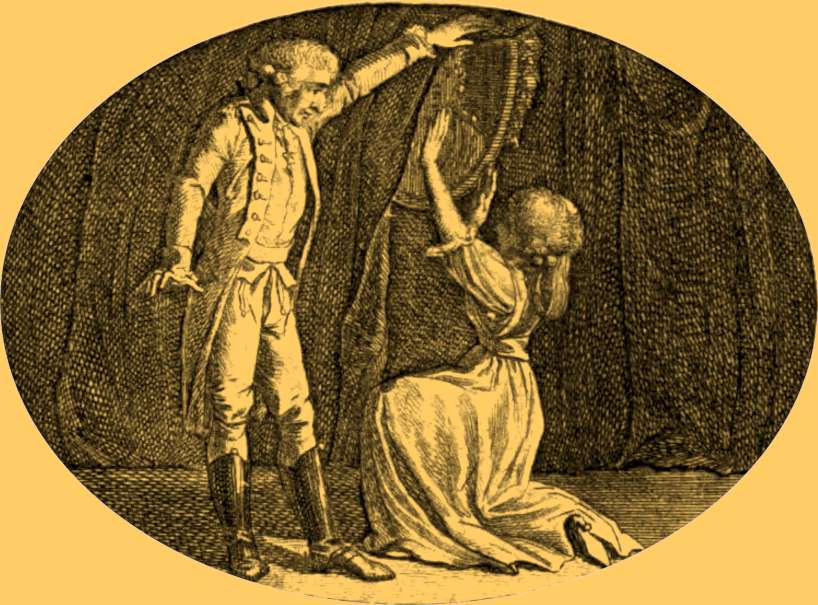

To open a gallery of Daniel Nikolaus Chodowiecki’s illustrations to Kotzebue’s popular Die Indianer in England, references to which occur elsewhere as well in this correspondence, click on the image below:

Although Friederike Unzelmann had anticipated guest performances in Weimar on her return trip to Berlin, they never materialized; see Caroline’s letter to Luise Gotter on 25 February 1799 (letter 222a), note 15. Back.
[8] Concerning the problems associated with the premiere of Hamlet in Berlin, see Ella Horn’s essay on the background to the premiere of Hamlet in Berlin. Back.
[9] Concerning the nature of Friedrich’s relationship with Rahel Levin, see esp. his letters to her in December 1801 and January 1802.
Schiller’s Die Piccolomini (part of the Wallenstein trilogy) premiered in Berlin on 18 February 1799, Wallensteins Tod on 17 May 1799, Wallensteins Lager not until 28 November 1803. Concerning the Berlin performance of the Piccolomini, see Wilhelm Schlegel’s letter to Goethe on 4 February 1799 (letter 219a), note 3.
Concerning the Piccolomini otherwise, see Caroline’s letter to Luise Gotter in early 1799 (letter 215) and esp. the second half of Auguste’s letter to Cäcilie Gotter on 18 February 1799 (letter 220). Back.
[10] The translation of Romeo and Juliet had appeared in 1797 in volume 1 of Wilhelm and Caroline’s edition of Shakespeare.
In her letter to Wilhelm on ca. 20 August 1801 (letter 327e), Sophie Bernhardi writes from Berlin to Wilhelm in Jena that “I think of you and how I now no longer see your eyes, which so often shined toward me like friendly stars.” See esp. note 4 there concerning Wilhelm’s expressive eyes.
Concerning the rather different relationship between Friedrich and Friederike Unzelmann, see the anecdote from 1801 in the supplementary appendix on Friederike Unzelmann. Back.
[11] The rest of this letter continues to Wilhelm (Walzel, 405), though Walzel associates it with the wrong letter to Caroline, namely, the one on 19 February 1799. Schmidt, [1913], 1:727, associates it with the correct letter, as does KFSA 24:233 (see notes 24:436). Back.
Translation © 2013 Doug Stott